

Quick answer
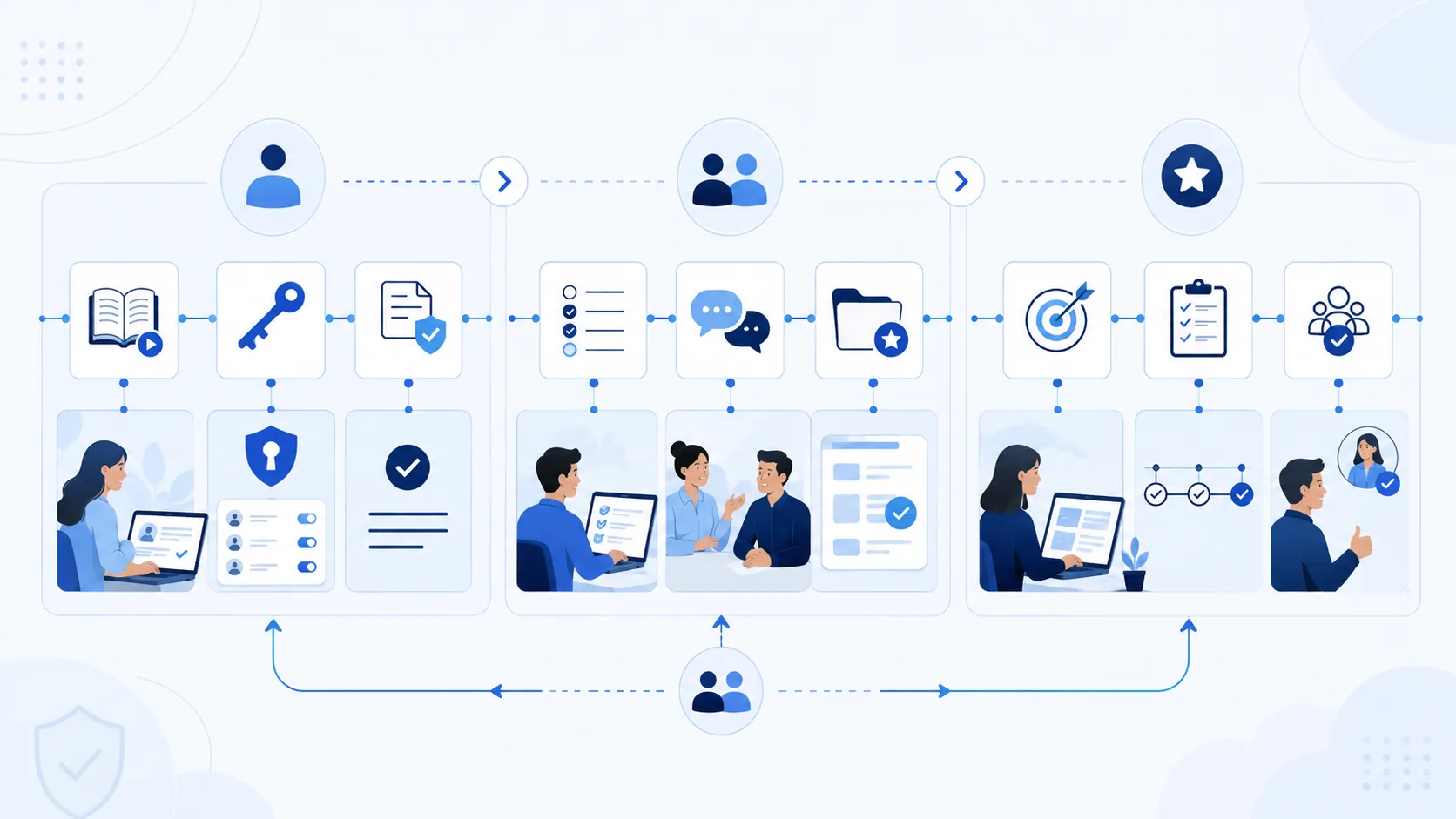
Build the first 90 days around three review boundaries, not three vague impressions. By day 30, confirm role outcomes, accessible orientation, least-privilege access, and one safe evidence checkpoint. By day 60, complete a bounded contribution, accountable handoff, two-way correction review, and role-relevant learning demonstration. By day 90, trial defined ownership, review evidence against the role map, agree a sustainable operating cadence, and hand unresolved work into the next quarter. Every item needs an owner, evidence, support, authority, review date, and exception path.
Define the plan contract before day one
Scope and role version
Record start date, employment and location context, role version, essential duties, manager, buddy or trainer, systems, work setting, schedule, and what this plan does not decide.
Outcome and evidence schema
For every outcome define the job reason, expected artifact or behavior, source of evidence, acceptance owner, quality and control criteria, dependencies, contrary evidence, and status.
Support, time, and access
Name required training, paid time treatment, accessible format, accommodation route, equipment, data, least-privilege access, reviewer availability, fallback, and manager commitment.
Review and decision rights
Define checkpoints, employee comment and correction, evidence states, who can change scope, grant access, accept work, adjudicate conflicts, apply employment rules, and stop unsafe work.
Days 1–30: orient, enable, and verify safe access
The first boundary verifies that the organization has made the work understandable and accessible. It does not demand full output before systems, policy context, relationships, and support exist.
Role and outcome map
Manager and employee review essential duties, first-quarter priorities, dependencies, decision rights, and evidence for “done.”
- Acceptance evidence
- Signed role map; named owners; questions and conflicts logged.
- Guardrail
- Do not infer capability from speed, social fluency, after-hours availability, or similarity to the team.
Accessible orientation and policy access
Provide required policies, conduct rules, safety material, benefits routes, privacy notices, accommodation process, and accessible formats with time for questions.
- Acceptance evidence
- Delivery and access confirmed; questions routed; acknowledgements distinguish receipt from comprehension.
- Guardrail
- A click or signature does not prove understanding, consent to unrelated processing, or successful training.
Least-privilege tools and safe practice
Provision only role-needed accounts, data, environments, and approvals; train in a sandbox or reversible path before production access.
- Acceptance evidence
- Access owner, approval, scope, expiry, test evidence, and exception route recorded.
- Guardrail
- Do not grant broad access because it is convenient or withhold an effective accommodation because a default tool is easier.
First evidence checkpoint
Use a small representative task to inspect instruction clarity, access, dependencies, support needs, and safety—not to label the employee.
- Acceptance evidence
- Task context, employee questions, observed output, blockers, feedback, correction, and next support recorded.
- Guardrail
- Do not turn one early task, attendance pattern, accent, disability, or manager impression into a performance forecast.
Days 31–60: contribute with evidence and correction
The second boundary shifts from guided practice to bounded real work. Scope and controls remain explicit, and the review examines the work system as well as the employee.
Guided contribution with boundaries
Assign a real but bounded deliverable with customer, quality, security, approval, and escalation expectations stated in advance.
- Acceptance evidence
- Accepted brief; checkpoints; cited work evidence; review comments; approved release or safe rollback.
- Guardrail
- Do not measure contribution only by visible activity, message volume, office presence, or unreviewed AI output.
Stakeholder and handoff map
Practice one accountable handoff across the roles the employee actually depends on, including acceptance and exception ownership.
- Acceptance evidence
- Sender, receiver, required context, acceptance evidence, unresolved risk, due point, and escalation owner visible.
- Guardrail
- Do not assume the newest employee must repair unclear ownership or absorb work that lacks authority and resources.
Feedback, correction, and manager obligation
Hold a two-way review: compare expected and observed evidence, correct inaccurate records, identify manager or system blockers, and agree support.
- Acceptance evidence
- Evidence citation, employee response, correction, owner, due point, and follow-up test retained.
- Guardrail
- Feedback is not a personality verdict; do not hide missing training, inaccessible systems, or conflicting instructions as employee weakness.
Role-relevant learning demonstration
Ask the employee to explain, perform, document, or teach back one priority workflow under realistic conditions and approved support.
- Acceptance evidence
- Relevant artifact, control use, questions, verification, uncertainty, and recovery evidence captured.
- Guardrail
- Do not treat course completion, quiz score, confidence, or memorized policy language as sufficient job performance evidence.
Days 61–90: test accountable ownership and hand off
The third boundary tests a defined outcome under realistic authority and support, then closes the onboarding plan into a normal operating cadence. Day 90 is not an automatic pass, fail, or proof of productivity.
Accountable ownership trial
Delegate one defined outcome with explicit authority, dependencies, review gates, fallback, and human owner for irreversible decisions.
- Acceptance evidence
- Plan, decisions, evidence, approvals, exceptions, handoffs, accepted output, and retrospective linked.
- Guardrail
- “Ownership” does not mean unsupported autonomy, unlimited hours, hidden risk, or bypassing controls to appear fast.
Outcome review against the role map
Review evidence for agreed outcomes and controls, alongside changing priorities, manager commitments, accommodation effectiveness, and blocked dependencies.
- Acceptance evidence
- Criterion-level state, cited evidence, contrary evidence, employee comment, and adjudicated next action recorded.
- Guardrail
- Do not reverse-engineer standards after seeing results or compare people who received different scope, support, time, or access.
Sustainable operating agreement
Agree recurring one-to-ones, decision and escalation routes, work and communication norms, development support, access review, backup, and correction channels.
- Acceptance evidence
- Cadence, owners, response expectations, accessible channels, records, and review date confirmed.
- Guardrail
- Do not equate sustainability with constant availability, surveillance, synchronous presence, or suppressing disagreement.
Plan closeout and next-quarter handoff
Close completed items, carry forward unresolved risks with owners, remove unnecessary access, document support still owed, and create the next-quarter outcome plan.
- Acceptance evidence
- Accepted items, open issues, access changes, lessons, commitments, notices, and next review preserved.
- Guardrail
- Day 90 is a review boundary, not proof of fit, productivity, retention, compliance, or completion of every learning need.
Worked example: a missed checkpoint is not automatically an employee failure
This hypothetical example is not a real employee or performance result. A new operations analyst misses the day-60 dashboard delivery. A shallow review records “slow ramp and weak ownership.” The evidence shows that production access arrived twelve working days late, the metric definition changed twice, and the named reviewer was unavailable. The employee completed the sandbox version, documented both definition conflicts, and requested the required approval.
Incorrect conclusion
The plan treats calendar variance as personal underperformance and removes the missing organizational inputs. It also changes the standard after the fact.
Evidence-based correction
Status: blocked dependency, not accepted or failed. Preserve the original due point, access request and grant dates, definition versions, sandbox artifact, approval request, and reviewer absence. The manager owns access and metric resolution; both parties agree a new evidence checkpoint after inputs are ready. Any employment action follows the authorized process, not the AI label.
How OpenMax can coordinate the 90-day plan
OpenMax can coordinate approved role-plan versions, preboarding dependencies, accessible materials, least-privilege requests, training schedules, milestone evidence, manager and employee check-ins, blocked-dependency alerts, feedback and correction records, review assignments, access recertification, exception routing, and next-quarter handoff. Humans retain employment classification, pay, job design, legal scope, accommodation decisions, sensitive data, access authority, performance standards, dispute resolution, and employment decisions.
Sources, legal boundaries, and limitations
Qualified local counsel and HR, wage-and-hour, benefits, accessibility, privacy, security, labor, and performance owners must adapt this template. Required job-related training may be compensable depending on facts and law; accommodations are individualized; access should be necessary for assigned tasks; and protected traits or proxies must not influence opportunities, support, or evaluation. Do not treat plan completion, a manager click, AI summary, activity metric, or day-90 status as proof of understanding, fit, productivity, compliance, retention, or fairness.
- U.S. OPM — Onboarding toolkit
- U.S. OPM — End-to-End Hiring Initiative onboarding material
- U.S. Department of Labor — Training and hours worked example
- U.S. EEOC — Disability accommodations tips
- NIST SP 800-171 Rev. 3 — Least privilege
Frequently asked questions
Must every role use the same milestones?
No. Keep the governance fields consistent, but derive outcomes, evidence, support, access, timing, and acceptance from the actual role and lawful process.
Does day 90 prove successful onboarding?
No. It is a review boundary. Examine evidence, missing inputs, changing priorities, accommodations, employee comment, manager obligations, and downstream outcomes over time.
Should mandatory onboarding training happen after hours?
Do not assume it is unpaid. Applicable wage-and-hour rules depend on facts and jurisdiction; qualified local owners should classify, schedule, and record time correctly.
What if access or manager support is late?
Record a blocked dependency, preserve dates and evidence, assign the organizational owner, adjust only through the approved process, and do not relabel the delay as employee failure.
What can OpenMax automate?
It can coordinate plan versions, dependencies, access requests, materials, checkpoints, evidence, corrections, reviews, and handoffs while people retain legal, accommodation, performance, access, and employment authority.