

Quick answer
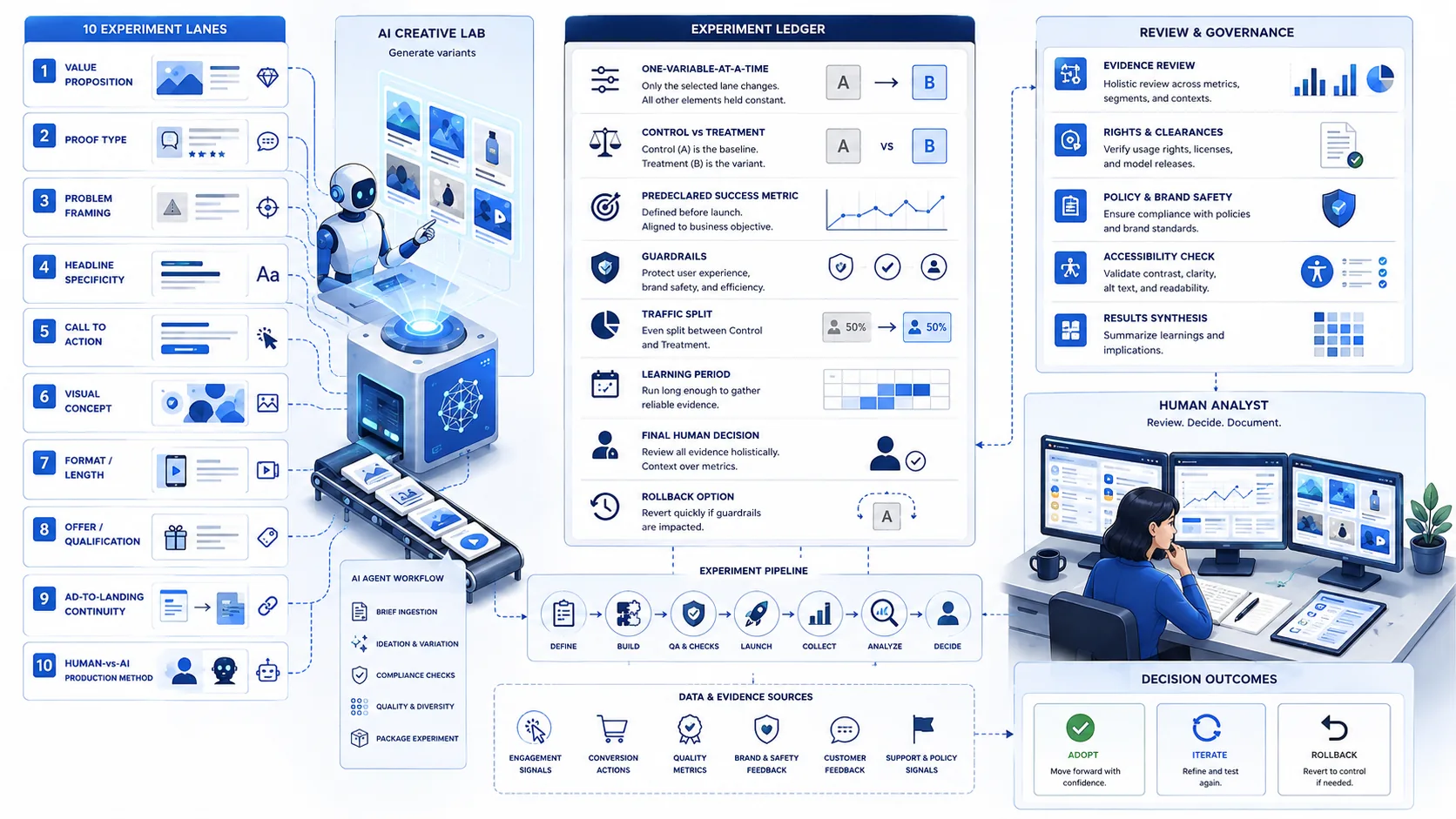
Run ten separate experiments: value proposition, proof type, problem framing, headline specificity, CTA, visual concept, format/length, offer qualification, ad-to-landing continuity, and human-versus-AI production method. For each, predeclare the audience, placement, control, single treatment variable, qualified primary outcome, guardrails, allocation, minimum exposure and conversion maturity, exclusions, owner, decision rule, and rollback.
AI can generate bounded variants, inspect differences, and organize results. It cannot rescue a confounded design, invent substantiation, grant asset rights, declare legal compliance, infer causality from a dashboard, or automatically apply a “winner” outside approved authority.
What makes an ad creative experiment interpretable
An experiment compares a defined control and treatment under an allocation mechanism while holding other causes stable enough to support a decision. The unit may be an ad, asset, campaign arm, audience exposure, or production task; declare it before launch.
One test can answer one primary question
If headline, image, offer, landing page, bid, audience, and schedule all change, the result describes a bundle—not which creative choice mattered. Platform experiments can split eligibility or traffic, but exposure and spend may still differ through auctions, rank, budgets, learning, review status, and delivery. Record those conditions rather than claiming a perfect laboratory.
Responsive ads add another complication: assets may appear in combinations and order can vary. Each asset must work alone and together, and interpretation must respect the reporting grain. An asset label or early lead is not equivalent to a causal estimate for every future audience.
The prelaunch experiment contract
Freeze the contract before seeing results; otherwise success metrics, windows, and explanations can drift toward whichever variant happens to look favorable.
| Field | Required record | Stop condition |
|---|---|---|
| Question | Audience, placement, hypothesis, mechanism, control, one treatment variable. | Treatment changes multiple business propositions. |
| Evidence | Research, product facts, claims, rights, policy, accessibility, previews. | Either arm is untruthful, unlicensed, inaccessible, or disallowed. |
| Allocation | Unit, split method, eligibility, dates, budget, bid, learning and exclusions. | Arms overlap improperly or base changes confound the test. |
| Measurement | One primary qualified outcome, denominators, attribution, lag, guardrails. | Tracking breaks or the primary outcome changes after launch. |
| Decision | Minimum exposure/maturity, uncertainty rule, owner, adopt/iterate/stop logic. | Early peeking triggers an unplanned winner declaration. |
| Recovery | Change IDs, monitoring, complaint/safety boundaries, pause and rollback. | Material harm, policy failure, or guardrail breach. |
10 AI ad creative experiments to run
Run these as separate hypotheses. Each card contains the hypothesis, evidence packet, and acceptance boundary needed before an AI-generated treatment reaches paid delivery.
Value proposition
For [defined audience and placement], leading with [specific product value] rather than [control value] will improve [predeclared qualified outcome] because [evidence-backed audience problem]. Change only the value proposition; hold offer, format, visual, CTA, landing page, targeting, bid, and schedule constant where the platform permits.
Proof type
Replacing generic assurance with one approved proof form—demonstration, documented process, sourced statistic, named testimonial, certification, or transparent limitation—will improve trust for the same claim. Test one proof type and keep the underlying promise unchanged.
Problem framing
Framing the verified user problem as [task or cost of delay] rather than [fear, blame, or vague pain] will improve qualified response without exploiting vulnerability. Keep product, proof, CTA, visual, and offer constant.
Headline specificity
A headline naming [audience/task/product boundary] will outperform a broad headline by improving comprehension rather than merely attracting curiosity. Change only headline wording and account for responsive combinations or placement truncation.
Call to action
Replacing [control CTA] with [treatment CTA] will better match the next real step for the same offer and audience. Test action clarity—not deceptive urgency—and preserve destination and eligibility.
Visual concept
A [product demonstration/process diagram/contextual outcome] visual will communicate the same approved message better than [control visual]. Keep copy, offer, CTA, destination, targeting, and format stable.
Format and length
For the same message and asset concept, [short/static/single-card] versus [long/video/carousel] will improve task completion in [placement]. Do not change the value proposition, proof, CTA, or offer while changing format.
Offer and qualification
Making eligibility, price, trial terms, availability, or commitment explicit will reduce unqualified response while improving [qualified outcome]. The experiment tests qualification wording for the same real offer—not two different commercial propositions.
Ad-to-landing continuity
A destination that directly fulfills the tested ad promise will improve qualified completion compared with a generic page. Keep ad, audience, offer, bid, and schedule stable; change only the final URL or bounded page module.
Human-versus-AI production method
An AI-assisted workflow with a fixed brief, sources, constraints, and human review will change [production quality/time/rework metric] compared with the existing human workflow without changing media delivery or the audience-facing proposition. This tests process, not whether AI copy “wins” an auction.
Worked example: the “winning image” that changed three variables
A hypothetical team compares a product screenshot against an AI-generated lifestyle image. The treatment also uses a “free” headline, a different CTA, and a new landing page. Its dashboard shows more clicks during the first two days, so an automation proposes replacing the control everywhere.
Why no creative winner exists yet
The test changed visual, offer language, CTA, and destination. Review timing is immature, auction exposure may differ, and click volume does not establish qualified value. The synthetic scene also depicts a product state that is not available, and its paid-media rights and alt text are unresolved. The correct decision is HOLD, not scale.
How to rebuild the experiment
Both arms use the same sourced claim, headline, CTA, offer, final URL, audience, placement, bid, budget, and dates; only the rights-cleared visual concept differs. The contract defines the exposure unit, qualified primary conversion, downstream quality and complaint guardrails, conversion-lag date, preview checks, minimum analysis rule, owner, and rollback.
How to record the result
Store assignments, delivery, denominators, outcome definitions, uncertainty output, policy/rights/accessibility status, unexpected differences, reviewer interpretation, and decision. If evidence is inconclusive, record that result and iterate; do not turn “undecided” into a universal winning-image claim.
How to keep an experiment program credible
Use an experiment registry
Assign an ID and retain hypothesis, assets, owners, dates, eligibility, policy state, metrics, guardrails, changes, results, interpretation, and reuse limits. Search past tests before repeating one.
Control concurrent changes
Freeze or log base-campaign edits, landing releases, tracking changes, budgets, bids, seasonality, outages, promotions, and audience shifts. If a confound is material, pause or classify the result as non-interpretable.
Measure learning quality
Track pre-registered versus post-hoc decisions, inconclusive-result rate, policy/rights/accessibility defects, time to maturity, guardrail breaches, successful rollbacks, repeated tests, and whether learnings reproduce in their stated scope.
Limit generalization
A result belongs to its audience, placement, market, period, offer, creative system, measurement, and delivery conditions. Revalidate before transferring it to another language, channel, product, or customer stage.
How OpenMax can coordinate creative experimentation
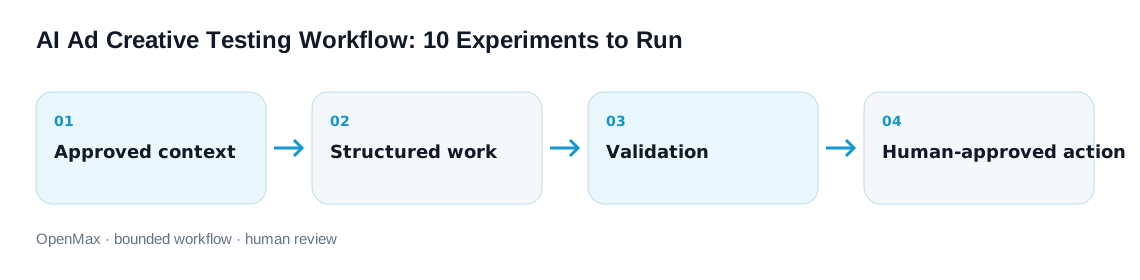
Connect briefs, variant production, evidence, and approvals
OpenMax can assign hypothesis preparation, claim-grounded drafting, asset checks, experiment tagging, monitoring summaries, and result documentation to specialized AI employees and people. Shared context and logs keep variants tied to the same experiment card; permissions can withhold campaign launch and spend changes until approval. OpenMax cannot repair a confounded test or guarantee statistical or commercial significance.
Limits and mandatory human boundaries
Creative experiments can reduce uncertainty within a defined scope; they do not prove universal causality or make prohibited, untruthful, inaccessible, or unlicensed content safe.
- Do not optimize solely to clicks, CTR, view rate, or an asset label when the business goal requires qualified outcomes, value, retention, safety, or margin.
- Do not change multiple propositions while describing the result as a single-variable creative effect.
- Do not generate testimonials, certifications, product UI, prices, scarcity, before/after results, or people without verifiable facts, rights, consent, and required disclosure.
- Do not infer protected or sensitive traits, exploit vulnerability, or use a creative result to justify disallowed targeting.
- Do not stop early, extend selectively, switch metrics, exclude inconvenient data, or generalize beyond the registered scope without labeling the analysis exploratory.
- Keep campaign application, bids, budgets, targeting, account credentials, and rollback separately permissioned and human-approved.
Frequently asked questions
Can we test ten creative variables at once?
Not if the goal is to learn which variable caused a difference. Run separate experiments or use a justified multivariate design with adequate expertise, exposure, analysis, and interpretation.
Does a 50/50 split guarantee equal impressions or spend?
No. Google notes that a split can control eligibility while auctions, rank, bidding, and budgets produce unequal exposure. Record delivered denominators and conditions.
Should the highest CTR creative win?
Only when CTR was the justified predeclared primary outcome and guardrails pass. Most business tests should include qualified conversion, value, downstream quality, or another outcome closer to the goal.
Can AI-generated visuals enter a test immediately?
No. Verify depicted facts, rights, releases, provenance, brand, policy, accessibility, crops, and every placement. AI generation does not grant a license or make an impossible product state truthful.
What if the result is inconclusive?
Record undecided, inspect power, delivery, maturity, implementation, and confounds, then stop or redesign. Do not move thresholds or select a secondary metric simply to produce a winner.
Where does OpenMax fit?
OpenMax can coordinate briefs, variants, evidence, reviewers, permissions, experiment records, analysis packets, monitoring, and rollback. Advertisers remain responsible for platforms, designs, policies, measurement, budgets, and decisions.
Sources, editorial method, and limitations
OpenMax editors reviewed primary Google Ads documentation for experiment design, custom experiments, ad variations, responsive combinations, asset reporting, and misleading claims. We synthesized an original ten-experiment library with prelaunch contracts, one-variable boundaries, qualified outcomes, rights/policy/accessibility gates, human decisions, and rollback. Sources were checked September 3, 2026. No experiment result or platform endorsement is claimed.
- Google Ads — Test with confidence — hypothesis, one variable, metrics, and records.
- Google Ads — Custom experiments — control/trial setup, allocation, delivery, and limitations.
- Google Ads — Ad variations — headline, description, promotion, and URL variation setup.
- Google Ads — Responsive search ads — asset combinations, ordering, and reporting context.
- Google Ads — Ad-level asset report — asset reporting grain and metrics.
- Google Ads policy — False, misleading, or unrealistic claims — truthful identity, costs, and outcome claims.