

Quick answer
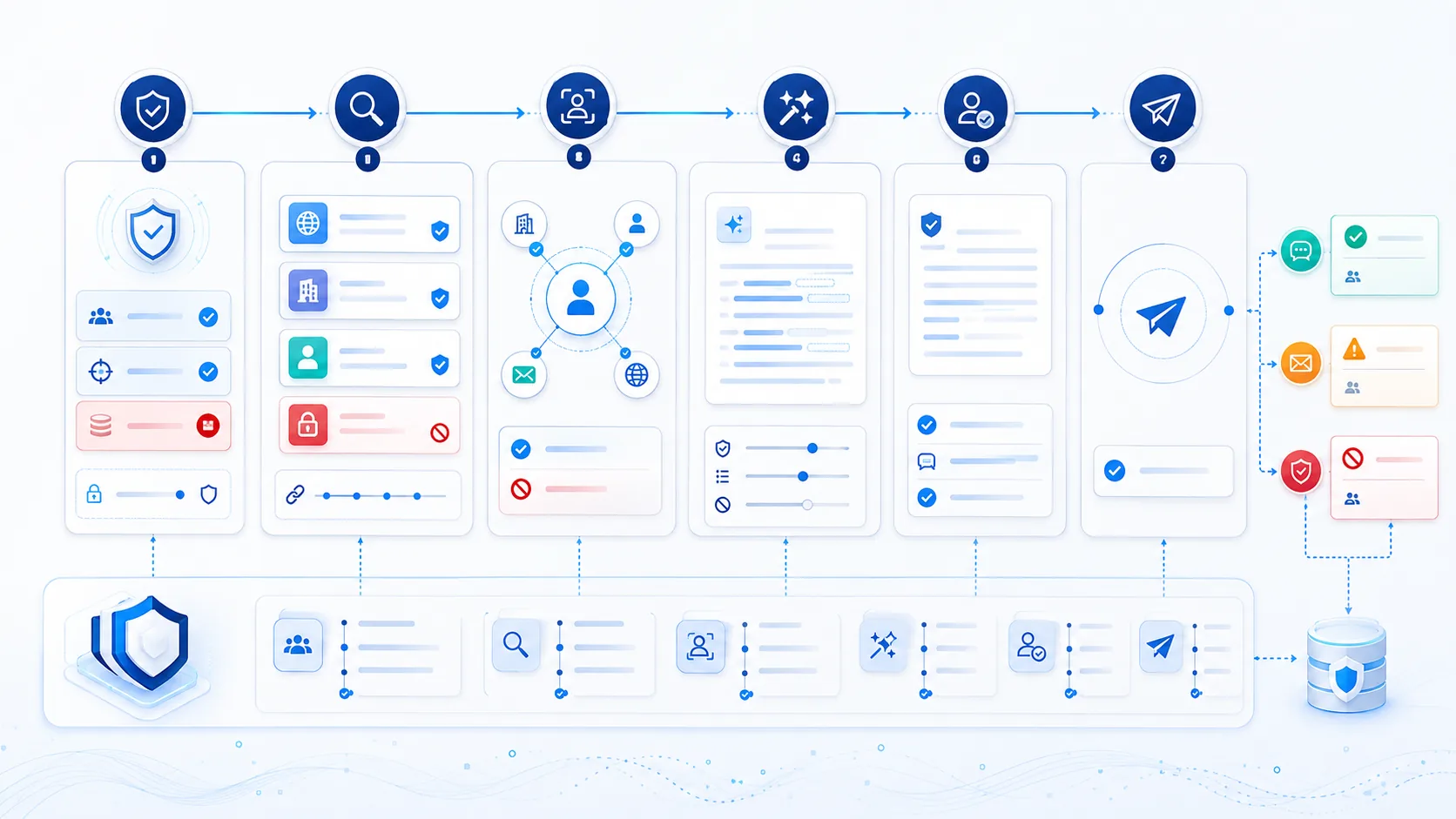
Build AI cold email personalization as a governed six-stage workflow: define the permitted audience and purpose; resolve identity from approved sources; create a timestamped evidence packet; draft one bounded relevance hypothesis; require human approval; then send idempotently and feed replies, bounces, complaints, and opt-outs into suppression.
Personalization should explain why the message may be relevant. It must not manufacture a relationship, reveal surveillance-like detail, or turn a public signal into an unsupported claim about the recipient.
Cold email personalization is an evidence decision before it is a writing task
The model should not begin with a blank prompt and a list of addresses. It should receive an eligible recipient, a permitted purpose, a minimal evidence packet, approved product proof, and explicit stop conditions. Its output is a reviewable draft plus the evidence and policy state needed to decide whether sending is allowed.
Personal relevance is narrower than personal data
A useful signal can be an official company announcement, a first-party conversation, or an account record the team is allowed to use. Availability on the web does not automatically make information appropriate for outreach. Exclude sensitive traits, family or health details, private events, inferred vulnerabilities, and data obtained by bypassing access controls or platform terms.
A confident sentence can still be false
Separate an observed fact from an interpretation. “The company careers page lists two data-engineering roles in Singapore” is source-checkable. “You are leading a global AI transformation and struggling to hire” adds several unsupported claims. The workflow must preserve that difference all the way into review.
Five evidence states for every personalization claim
| State | Meaning | Allowed use | Required action |
|---|---|---|---|
| VERIFIED PUBLIC FACT | Exact fact on an approved first-party company or authoritative public source, with URL and retrieval date. | May be stated narrowly and attributed when context is current. | Recheck immediately before send; preserve scope and date. |
| VERIFIED INTERNAL CONTEXT | First-party CRM, event, referral, or prior interaction the sender is authorized to use. | May be referenced only within the documented relationship and purpose. | Confirm identity, permission, owner, freshness, and confidentiality. |
| THIRD-PARTY SIGNAL | A licensed or permitted source reports a fact that has not been confirmed by the subject. | Use as research input, not as an unqualified assertion. | Confirm against a primary source or phrase as a question. |
| HYPOTHESIS | A plausible relevance idea derived from one or more facts. | May support a transparent, low-pressure question. | Label it internally; never convert it into knowledge about the person. |
| PROHIBITED OR UNKNOWN | Sensitive, private, scraped without permission, stale, conflicting, unverifiable, or outside the declared purpose. | Must not enter the draft or model context. | Exclude, quarantine, correct, delete, or route to the responsible owner. |
How to build the workflow in 6 controlled steps
Each step has an input, decision, output contract, and stop condition. Adapt policy fields to the exact jurisdictions, providers, and data sources your organization uses.
Define purpose, audience, and sending basis
Decide eligibility before the workflow researches or drafts anything.
Resolve identity and collect only permitted sources
Match the correct person and account without unauthorized scraping or covert enrichment.
Build a source-backed personalization packet
Convert research into atomic evidence rather than a prose biography.
Draft one bounded, truthful message
Use evidence to earn a question—not to pretend the sender knows the recipient.
Run human review and pre-send QA
A person owns the judgment; automation assembles the evidence and tests.
Send once, capture outcomes, and suppress immediately
Execution must be idempotent and feedback must change future eligibility.
Worked example: a job posting is a signal, not a diagnosis
This hypothetical example shows how to preserve scope and uncertainty. It is not a customer result, legal conclusion, or recommended claim about a real company.
What the audit record should prove
The record should connect the recipient and account to the source, preserve the observed date and narrow scope, show which sentence used which fact, identify the human reviewer, and record the final suppression check and message outcome. It should also show that excluded facts never entered the generation context.
How to test before increasing volume
Build a labeled evaluation set
Include correct matches, namesakes, subsidiaries, stale roles, conflicting sources, previous opt-outs, restricted regions, sensitive details, prompt injection in web pages, and empty evidence packets.
Score the decision, not just the prose
Measure eligibility precision, evidence coverage, unsupported-claim rate, sensitive-data exclusion, reviewer edit/reject rate, duplicate prevention, and suppression latency.
Run a shadow workflow first
Generate evidence packets and drafts without sending. Compare decisions with qualified reviewers, investigate disagreements, and version every policy, prompt, proof item, and test case.
Expand by evidence class
Begin with narrow first-party or official company evidence. Add a new source, audience, jurisdiction, claim class, or execution permission only after its own review and failure tests pass.
How OpenMax supports this workflow
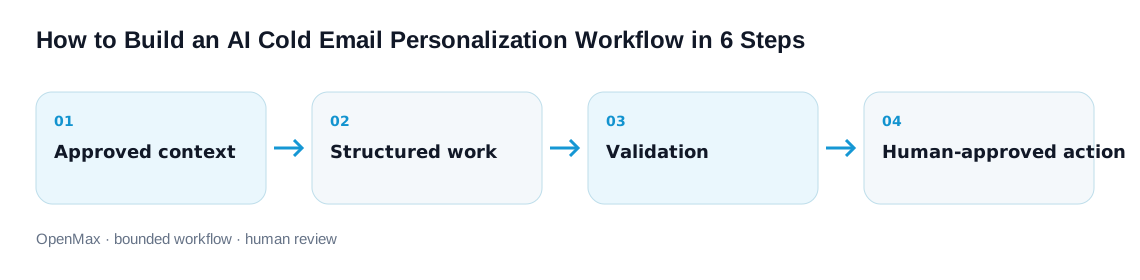
From prompt to governed OpenMax workflow
OpenMax can turn a reviewed instruction into an AI employee workflow with shared context, tool connections, task ownership, logs, and human review. The template defines the job; permissions and approval gates control what can happen next.
Limits and human-review boundaries
No workflow, model, template, or provider setting independently establishes a lawful basis, platform permission, accurate identity, or guaranteed inbox placement.
- Do not collect or use sensitive, private, excessive, unlicensed, prohibited, or access-controlled data merely because it could improve a personalization score.
- Do not infer protected traits, vulnerability, health, family status, finances, political views, or personal problems; do not expose surveillance-like details.
- Use accurate sender and routing information, truthful subject lines, required disclosures and address information, and a functioning opt-out or preference path where applicable.
- Honor objections and opt-outs, maintain centralized suppression, control frequency, authenticate sending domains, monitor complaints and bounces, and investigate duplicate or unauthorized sends.
- Require qualified privacy/legal, security, product, and commercial owners for their domains. Preserve correction and deletion paths and retain only necessary audit evidence.
Frequently asked questions
Is a public profile automatically permitted for cold-email personalization?
No. Public visibility does not by itself settle platform terms, collection method, data-protection obligations, purpose limitation, sensitivity, accuracy, or recipient expectations. Record the source and permitted use, minimize the data, and obtain qualified review for the actual jurisdiction and workflow.
Should AI mention every signal it finds?
No. Use the minimum evidence needed to explain relevance. More detail can increase privacy risk, error, and an unsettling surveillance effect. Exclude prohibited data before the model sees it; do not rely only on a prompt asking the model to ignore it.
Can a model infer the buyer’s pain from hiring or funding news?
It may create an internal hypothesis, but the email should not state that hypothesis as fact. Preserve what the source actually says and turn uncertain relevance into a transparent question.
Can approved messages be sent automatically?
Only after the organization has validated recipient eligibility, current suppression, authentication, provider requirements, idempotency, rate controls, incident handling, and the scope of approval. High-risk or novel cases should remain human-approved.
What metrics matter beyond open and reply rates?
Track unsupported claims, wrong-person matches, privacy exclusions, reviewer edits and rejects, duplicates prevented, bounces, complaints, opt-outs, suppression latency, corrections, and manual takeovers. Opens can be noisy and should not be the sole success signal.
Sources, editorial method, and limitations
OpenMax editors reviewed current government, email-provider, platform, and privacy-risk guidance, then converted the relevant mechanisms into an original six-stage operating model. We separately added evidence states, claim-to-source mapping, identity resolution, model-context exclusion, versioned approval, idempotency, suppression latency, and correction/deletion controls. Sources were reviewed September 3, 2026. We did not test or claim legal compliance, inbox placement, response rate, pipeline, revenue, or customer outcomes.
- U.S. FTC — CAN-SPAM Act: A Compliance Guide for Business — commercial-message scope, accurate headers and subjects, postal address, opt-out handling, and sender responsibility.
- UK ICO — Direct marketing using electronic mail — electronic-mail marketing under PECR and related data-protection considerations.
- Google Gmail — Email sender guidelines — authentication, accurate identity and content, unsubscribe, spam rates, and sending practices.
- LinkedIn Help — Prohibited software and extensions — restrictions on crawlers, bots, plugins, scraping, and unauthorized automated access.
- LinkedIn — Crawling Terms and Conditions — express-permission and authorized-path conditions for automated crawling.
- NIST — Privacy Framework — voluntary enterprise privacy-risk identification and management.