

Quick answer
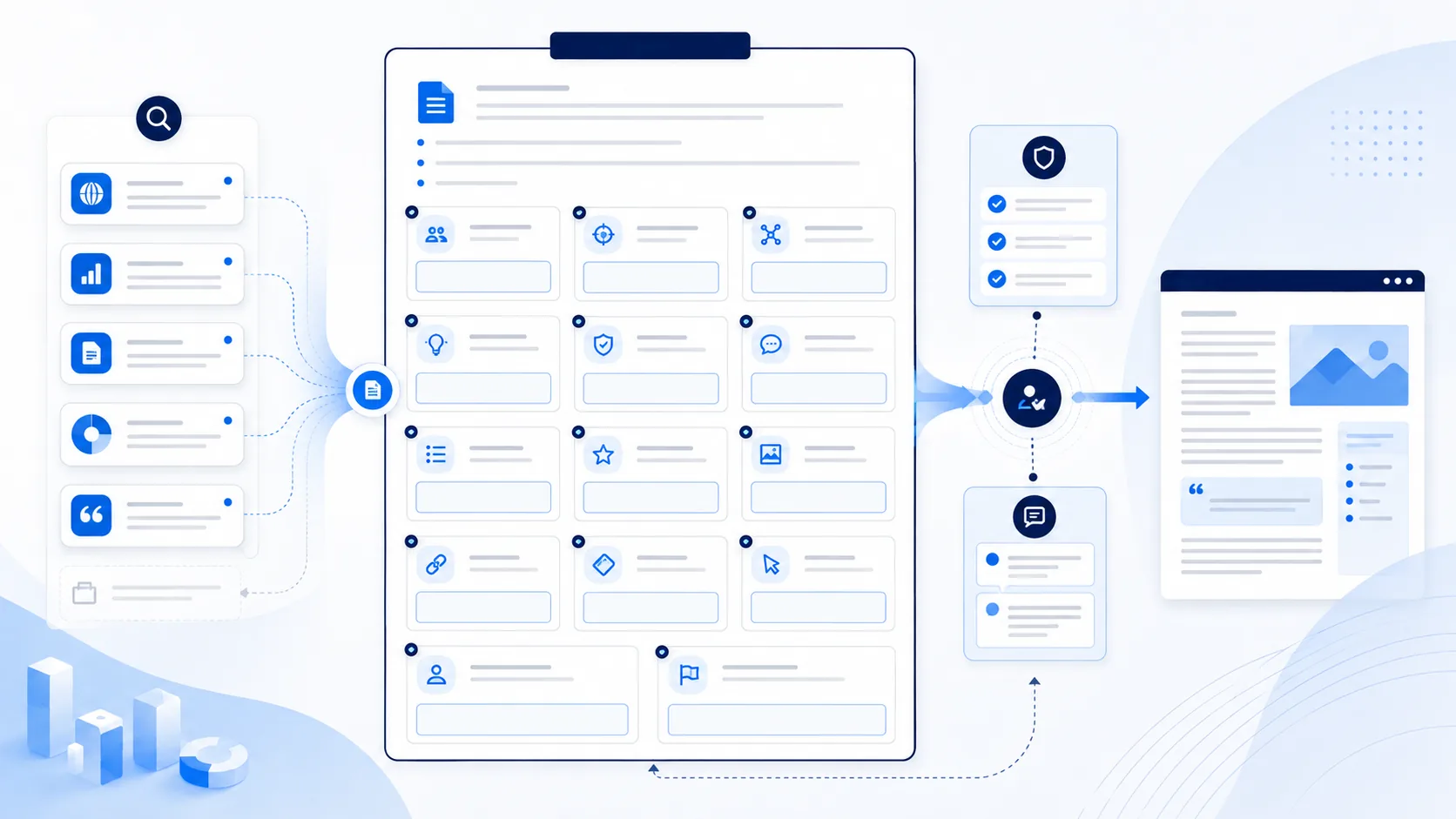
An AI content brief writers can actually use needs 14 fields: business goal and page role; audience and task; search intent evidence; topic and entity boundaries; angle and original value; answer and takeaways; claims and source plan; H1/H2/H3 architecture; examples and practical assets; product relevance and proof; internal links and journey; URL/title/meta/canonical/schema; visual/accessibility/localization plan; and ownership, acceptance, measurement, and refresh.
Do not ask AI to “write 2,000 words for this keyword.” Give it bounded evidence, explicit unknowns, prohibited claims, audience success criteria, and a human review route. Word count can estimate scope, but it is never the definition of completeness or quality.
A content brief is a decision contract, not a keyword worksheet
The brief aligns search opportunity with a real audience task, the site’s purpose, available expertise, defensible evidence, product truth, editorial craft, and a measurable next step. It should reduce avoidable ambiguity while leaving the writer room to exercise judgment and add insight.
Separate evidence from instructions and assumptions
“Current search results include templates and how-to guides” is an observation with date and market. “The reader wants a downloadable spreadsheet” is a hypothesis unless research supports it. “Include a practical worksheet” is an editorial instruction. Labeling these separately stops plausible AI inference from becoming an invented audience fact.
Brief for usefulness before search appearance
Search intent and metadata matter, but the page must satisfy someone who arrives directly. Define what the reader should understand, decide, or complete; what original evidence or asset the page contributes; and where the honest limits sit. Search optimization then helps people discover that useful page.
Five instruction states inside the brief
| State | Meaning | Writer action | Reviewer test |
|---|---|---|---|
| REQUIRED | A deliverable, boundary, source, disclosure, or acceptance condition that must be present. | Implement exactly or raise a documented exception. | Verify observable completion, not intent. |
| VERIFIED EVIDENCE | A current, attributable fact suitable for this claim and market. | Use within source scope; cite or link where readers need support. | Check provenance, recency, context, and implied meaning. |
| ASSUMPTION TO TEST | A plausible audience, intent, query, product, or structural hypothesis. | Validate through research or phrase as a question/limitation. | Reject any assumption presented as established fact. |
| OPTIONAL / WRITER CHOICE | A direction where expert judgment and originality are expected. | Choose the best form and explain material departures. | Evaluate usefulness and coherence, not template conformity. |
| PROHIBITED / HOLD | Unsupported, unsafe, confidential, irrelevant, stale, or unapproved material. | Exclude and route to the named owner if resolution is needed. | Check prompts, drafts, visuals, metadata, schema, and final output. |
14 fields writers actually need
Each field includes the instruction, evidence expected before drafting, and an observable acceptance test. Copy the blocks into a brief, then replace assumptions with verified project information.
Business goal and page role
State why this page should exist for the business and reader, its place in the site, funnel or support journey, the primary conversion or assistance role, and what it must not do. Choose one primary job rather than combining awareness, evaluation, purchase, support, and recruitment.
Audience, situation, and task
Define the intended reader by role only where relevant, prior knowledge, situation, constraint, risk, and the specific decision or task they need to complete. Include excluded audiences and accessibility/language needs. Avoid demographic stereotypes or fictional pain.
Search intent and query evidence
Document the primary query family, likely intent, sub-intents, modifiers, language/market/device/date, current result formats, query ambiguity, and the evidence that a new or updated page can satisfy the task. Do not equate one keyword with one stable intent.
Topic, entity, and boundary map
Name the central topic and entities, essential definitions, attributes and relationships, adjacent concepts to cover, terms that need disambiguation, and subjects explicitly out of scope. Record preferred product and industry terminology.
Angle and original value
Define the editorial promise beyond “cover the keyword”: original framework, test, dataset, comparison, workflow, calculator, template, visual, expert interpretation, or synthesis. State what the reader gains here that current results do not provide.
Answer, takeaways, and completion definition
Draft the one-paragraph answer, three to seven key takeaways, the decision rule or method, and what the reader should be able to do after reading. Include uncertainty and cases where there is no universal answer.
Claims, evidence, and source plan
Create a claim ledger with proposed statement, claim type, required evidence strength, source URL/record, owner, publication date, reviewed date, applicable scope, exact excerpt/data, citation placement, and expiry. Add prohibited claims and missing evidence.
H1, H2, and H3 information architecture
Specify one clear H1, answer-first placement, ordered H2 sections, and H3 subsections that divide real concepts or steps. Map each heading to reader question, evidence, asset, and intended depth; include FAQ only when questions are genuine.
Examples, templates, tools, and practical assets
Plan the concrete proof of usefulness: worked example, before/after with honest evidence, decision table, checklist, copyable template, calculator, code, diagram, downloadable file, or test procedure. Define input, output, assumptions and failure conditions.
Product relevance, proof, and commercial boundary
Explain when OpenMax is relevant to the reader’s task, which verified capability supports which step, prerequisites and limitations, appropriate internal link/CTA, and situations where the product is not the right fit. Keep education useful without purchase.
Internal links and reader journey
List inbound context, required contextual links, next-step pages, anchor purpose, canonical relationship, and orphan-page prevention. Each link should help readers define, compare, implement, validate, or act—not merely circulate authority.
URL, title, description, canonical, and schema
Propose a stable descriptive slug, concise page-specific title, honest meta description, canonical, robots intent, hreflang set, Open Graph/Twitter fields, dates, authorship, breadcrumbs, and schema type/properties that match visible content.
Visual, accessibility, and localization plan
Define the hero’s explanatory job, additional diagrams/tables/media, original or licensed source, dimensions, responsive behavior, filename, caption, alt purpose, long description where needed, contrast, keyboard behavior, and locale adaptation.
Ownership, acceptance, measurement, and refresh
Name writer, editor, subject expert, product/brand/legal/security reviewers, publisher, due dates, required gates, correction contact, version, freshness triggers, analytics specification, and a definition of done tied to the audience task.
Worked example: a high-volume keyword that produces the wrong page
This hypothetical example demonstrates brief correction. It is not Search Console data, keyword volume, ranking evidence, or an OpenMax performance result.
What the audit record should prove
Store the brief version, research date/market, observed result set, query and audience hypotheses, claim ledger, source captures, decisions and exclusions, assigned owners, draft/output versions, review comments, approvals, final URL/hash, measurement specification, and refresh triggers.
How to operationalize the brief
Research before generation
Inventory existing pages, define the reader task, observe current search and internal evidence, map entities and claims, identify original material, and name gaps. Keep dated evidence separate from assumptions.
Approve the decision frame
Align business owner, editor, subject expert, and product/brand/risk reviewers on angle, boundaries, sources, structure, practical asset, product role, prohibited claims, and definition of done.
Draft with traceable packets
Give AI only the approved brief and bounded source extracts. Preserve claim IDs and unknowns; let the writer make optional choices; route exceptions instead of silently filling gaps.
Verify, publish, learn, and refresh
Run content, fact, source, product, accessibility, technical SEO, responsive, link, and structured-data QA. Measure the intended user action and update when queries, sources, products, laws, or user needs change.
How OpenMax can operationalize the brief
Turn 14 fields into assigned, reviewable work
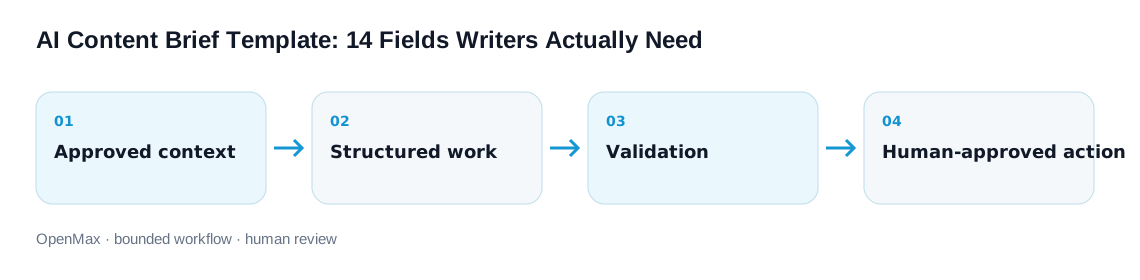
OpenMax can route research, drafting, source verification, product review, localization, and publication checks to different AI employees or people while preserving the same brief and evidence links. Permissions can keep agents from changing source material or publishing directly. A content brief still needs editorial judgment; OpenMax coordinates the work but does not establish factual truth or search performance.
Limits and human-review boundaries
A content brief constrains and coordinates work; it cannot prove demand, expertise, truth, or quality by itself.
- Do not fabricate search volume, customer intent, experience, expert consensus, quotes, product behavior, statistics, or expected ranking.
- Do not instruct writers to copy competitor headings, hit arbitrary repetition counts, add unrelated entities, or pad to a word target.
- High-stakes legal, financial, health, safety, security, privacy, product, performance, comparative, and customer claims require suitable evidence and qualified review.
- Structured data, metadata, dates, authorship, visuals, examples, and translations must match visible, current, permitted content; they are not decoration for search engines.
- A human editor owns the audience promise, original value, final wording, source fitness, publication decision, correction, and refresh.
Frequently asked questions
Does every brief need all 14 fields?
Use all 14 as a decision checklist, but depth should match risk and complexity. “Not applicable” needs a reason; unknown facts should remain assumptions or holds rather than invented answers.
What word count should the brief specify?
Estimate only enough depth to satisfy the task and evidence. Google does not publish a preferred word count. Structure, completeness, originality, usability, and source quality matter more than hitting a number.
Should writers follow the outline exactly?
Required logic, evidence, boundaries, and acceptance criteria should hold. Mark optional sections clearly so the writer can improve sequence, examples, headings, and voice when research supports a better route.
Can AI perform the research and write from the same prompt?
That hides provenance and encourages gap filling. Separate retrieval, evidence classification, brief approval, drafting, and verification; keep source extracts and claim IDs available to reviewers.
How is a brief measured after publication?
Start with the reader task: completion, qualified next step, reduced support need, worksheet use, or successful navigation. Add discovery and quality measures, citation validity, corrections, accessibility defects, and content freshness—not rankings alone.
Sources, editorial method, and limitations
OpenMax editors reviewed current primary guidance for people-first content, title links, snippets, structured data, image discovery, and AI-assisted content. We converted those principles into an original 14-field production contract with evidence states, source plans, writer discretion, claim controls, visual/accessibility requirements, measurable acceptance, and refresh ownership. Sources were reviewed September 3, 2026. No ranking, traffic, conversion, revenue, or productivity result is claimed.
- Google Search Central — Creating helpful, reliable, people-first content — audience usefulness, original value, completeness, authorship, how, why, and self-assessment.
- Google Search Central — Influencing title links — descriptive, concise, page-specific title text and automated title-link selection.
- Google Search Central — Control snippets — page-content and meta-description inputs to automatically generated result snippets.
- Google Search Central — Article structured data — article properties and content/markup consistency.
- Google Search Central — Image SEO best practices — relevant images, standard image elements, filenames, surrounding text, alt text, quality, and performance.
- Google Search Central — Generative AI content guidance — AI can assist research and structure; scaled content without user value may violate spam policy.