

Quick answer
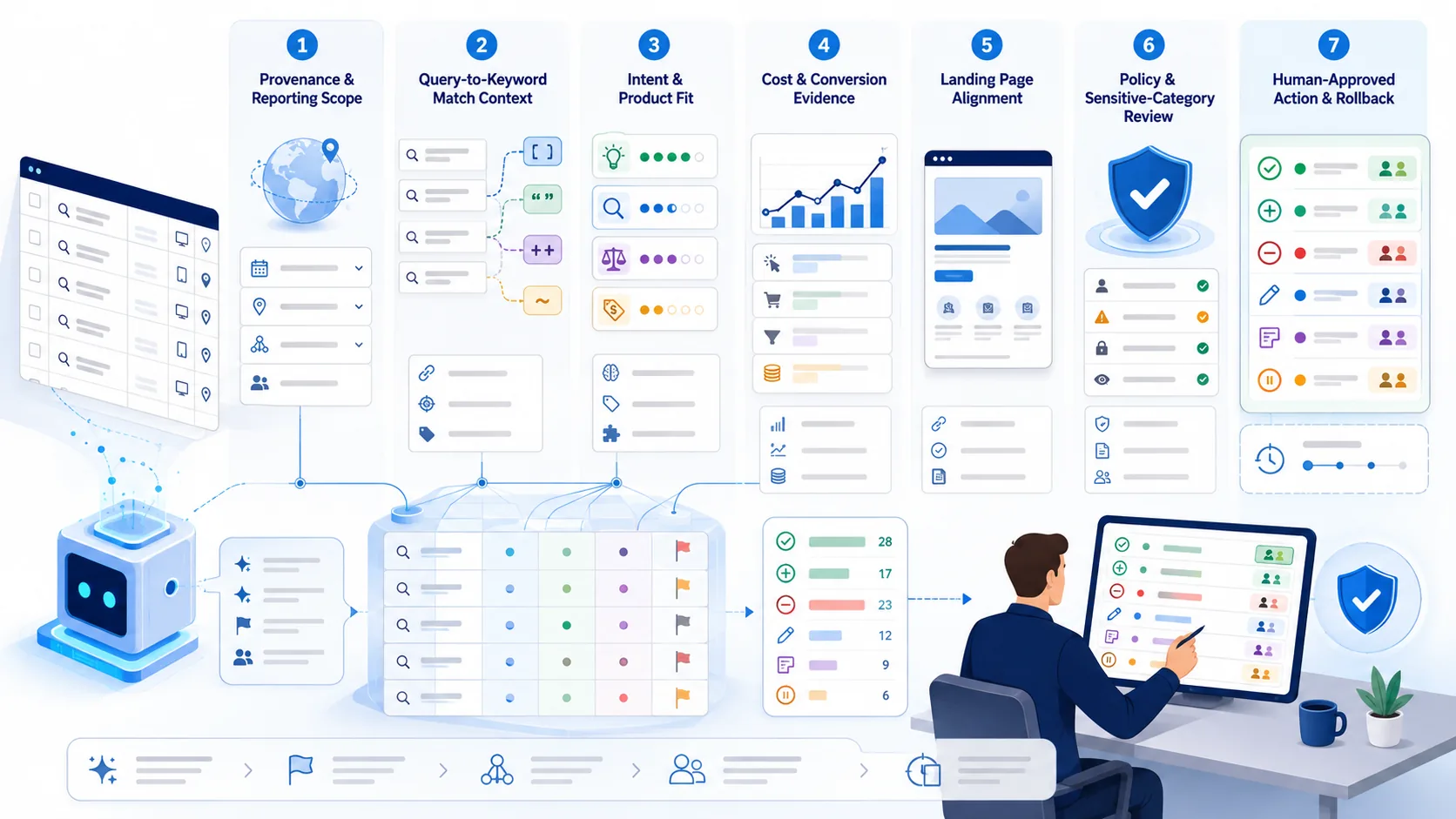
Analyze PPC search terms with seven checks: preserve report scope and row provenance; inspect query-to-keyword matching context; classify intent and product fit with uncertainty; evaluate cost and conversion evidence after lag and attribution checks; verify ad-to-landing-page continuity; screen policy, privacy, brand, and sensitive-category risk; then approve one narrow, reversible action with monitoring and rollback.
The search terms report is decision evidence, not a complete transcript of every search or a command queue. Keep raw rows, aggregated Insights, positive match types, and negative match types distinct. AI may recommend; a responsible owner approves account changes.
Search term, keyword, category, and person are not the same thing
A search term is the reported phrase associated with an ad impression or interaction under platform reporting rules. A keyword is an advertiser setting used in eligibility and matching. An Insights category is an aggregation. None is a verified statement about the identity, circumstances, or full intent of a person.
Analyze decisions at the correct grain
Keep the grain visible: account, campaign, ad group, keyword, search term, date, network, market, device, conversion action, and attribution setting. A row that looks poor at one grain may reflect a mixed ad group, bad creative, delayed conversions, a broken page, or unsuitable measurement rather than an irrelevant query. Conversely, a converting term can still be misaligned with policy, margin, qualification, or customer outcome.
Google explains that matching can consider meaning and additional signals, that Search terms Insights aggregates categories including terms not exposed in the row-level report, and that negative match behavior differs from positive matching. These mechanisms make provenance and scope part of the analysis—not administrative metadata.
Seven allowable dispositions after analysis
Do not reduce analysis to “add negative” versus “do nothing.” The observed problem may belong to keyword coverage, ad promise, destination, structure, policy, measurement, or insufficient evidence.
| Disposition | Use when | Do not use when |
|---|---|---|
| KEEP / OBSERVE | Fit is plausible and data is immature, sparse, or affected by lag. | High-impact policy or destination failure is unresolved. |
| ADD POSITIVE | A useful term has repeatable fit and needs intentional coverage. | One conversion or broad topic similarity is the only evidence. |
| ADD NEGATIVE | Intent is demonstrably out of scope and match/scope conflicts are tested. | It may block valuable variants or another campaign’s job. |
| CHANGE AD | Targeting is valid but promise, qualification, or language is unclear. | The landing page or offer cannot fulfill the corrected promise. |
| CHANGE PAGE | The query/ad fit but destination fails the task or conversion path. | Policy or product availability makes the traffic invalid. |
| SEGMENT | Distinct intent needs separate creative, page, budget, or ownership. | Volume and operational capacity cannot support separation. |
| HOLD / INVESTIGATE | Tracking, policy, privacy, rights, data quality, or intent is uncertain. | A documented urgent safety containment rule already applies. |
7 checks for AI-assisted PPC search term analysis
Each check is a decision contract with required evidence and acceptance criteria. Configure fields, thresholds, conversion definitions, policies, and approvers for the account before use.
Preserve reporting scope and row provenance
Freeze the account, customer ID, campaign and ad-group IDs, campaign type, network, country, language, device, reporting timezone, date range, attribution settings, conversion actions, currency, export time, filters, and source report/API version. Retain the original search term separately from any normalized text.
Inspect query-to-keyword and matching context
Compare the person’s reported search term with the bidding keyword, keyword match type, close-variant or broader meaning, ad group theme, negatives already applied, campaign settings, landing page, and other signals that can influence eligibility. A lexical mismatch is not automatically irrelevant, and a similar phrase is not automatically useful.
Classify intent and product fit with uncertainty
Assign the term a primary task—learn, compare, buy, navigate, support, job seeking, research, or another organization-specific category—and evaluate product, customer, geography, language, lifecycle, price, and qualification fit. Let AI propose labels and neighbors, but provide an evidence excerpt and allow MULTIPLE or UNKNOWN.
Evaluate cost and conversion evidence in context
Calculate metrics only from validated fields and adequate denominators. Compare cost, clicks, conversion actions, conversion value, profit or qualified outcome where supplied, while accounting for conversion lag, attribution model, primary versus secondary actions, modeled versus observed reporting, seasonality, budget changes, and small samples.
Verify ad promise and landing-page continuity
Review the term as a user task, then inspect the served ad message and final landing page on relevant device, market, and language. Confirm that product, offer, price, eligibility, geography, CTA, availability, claims, forms, consent, navigation, speed, and accessibility fulfill the expectation instead of merely repeating the phrase.
Screen policy, privacy, brand, and sensitive-category risk
Flag queries involving sensitive interests, protected or regulated opportunities, minors, health, finance, housing, employment, politics, adult content, trademarks, competitors, safety, abuse, personal data, or other policy categories. Evaluate the advertised product, creative, landing page, audience method, and market—not the term in isolation.
Approve an action, scope, experiment, and rollback
Choose one evidence-backed disposition: KEEP/OBSERVE, ADD POSITIVE KEYWORD, ADD NEGATIVE, CHANGE AD, CHANGE LANDING PAGE, SEGMENT CAMPAIGN, or HOLD/INVESTIGATE. Specify level, match type, impacted entities, hypothesis, owner, approval, deployment window, conflict tests, monitoring period, and rollback trigger.
Worked example: “jobs” looks obvious until scope is checked
A hypothetical Search campaign for customer-service automation reports the term “AI customer support jobs remote,” matched within an ad group intended for business software. An AI reviewer proposes adding jobs as an account-level broad negative because the term appears informational and outside buyer intent.
Why the first recommendation is unsafe
The term is likely wrong for this ad group, but the action has the wrong scope. The account may contain a recruiting campaign; account-level exclusion could block its intended traffic. Negative matching differs from positive matching and does not simply cover every close variant. Recent rows may not have mature conversions, and a job-seeking query could expose policy or privacy concerns if converted into an audience inference.
The evidence-backed decision
The analyst verifies the raw term, campaign and ad group, triggering keyword/match context, existing negative lists, other campaign ownership, ad and page, reporting period, conversion actions and lag. The reviewer classifies the business-software fit as out of scope for this ad group, checks neighboring terms such as “AI customer support careers,” and proposes a campaign-level negative phrase or an exact set—using the platform’s actual syntax—only after conflict simulation.
Approval and monitoring record
The ticket binds the negative text and type, campaign ID, pre-change export, affected-query sample, approver, deployment time, recruiting-campaign exception, guardrail for lost qualified traffic, conversion-maturity date, and rollback. No invented spend or conversion result is used. If valid software queries decline or a conflict appears, the owner restores the prior state and revises scope.
How to validate an AI search-term review system
Create a labeled decision set
Sample across campaigns, match types, languages, products, brand/non-brand, high/low volume, converting/non-converting, policy-sensitive, ambiguous, and aggregated or missing data. Have qualified reviewers label both intent and correct action.
Test action errors separately
Measure intent-label disagreement, false negatives that block valuable demand, missed exclusions, wrong level or match type, bad destination diagnoses, unsupported profitability claims, sensitive inference, and unauthorized changes.
Use counterfactual and holdout evidence carefully
Where feasible, stage changes, use experiments or bounded rollout, preserve control conditions, and wait for conversion maturity. Do not attribute every before/after movement to one edit when bids, budgets, auctions, seasonality, pages, or measurement also changed.
Audit permissions and rollback
Confirm a reviewer can reject or narrow a recommendation, shared lists cannot be changed accidentally, budget and bid tools remain separately permissioned, logs identify actor and version, and the prior state can be restored from the approved export.
How OpenMax can support search-term operations
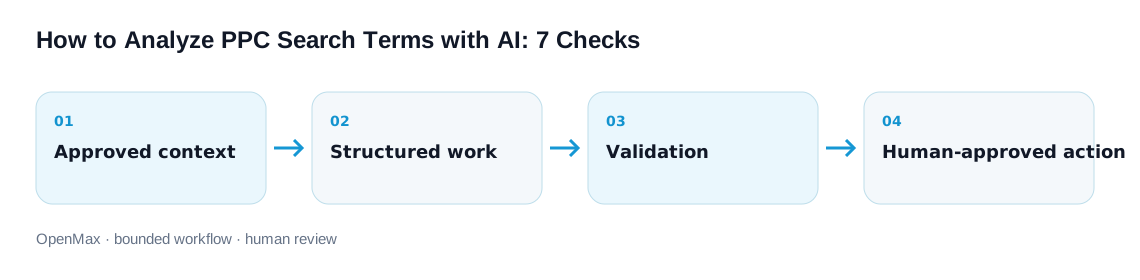
Coordinate exports, classification, review queues, and approved actions
OpenMax can coordinate agents that validate exports, label search terms, prepare negative and expansion candidates, check destination continuity, and route high-cost or uncertain rows to a PPC owner. Permissions and approval gates can keep the workflow read-only until a reviewed change set is accepted. OpenMax does not replace the advertising platform’s attribution, guarantee campaign outcomes, or authorize spend on its own.
Limits and human decision boundaries
Search-term analysis is incomplete, delayed, attribution-dependent, and sensitive to account structure. It cannot establish a person’s identity or guarantee the effect of a campaign change.
- Do not reconstruct hidden queries, identify users, or infer sensitive traits from search phrases, landing-page behavior, or AI categories.
- Do not mix Search terms rows with aggregated Insights without recording the different grain, window, privacy treatment, and metrics.
- Do not label a term wasteful or profitable before validating currency, conversion definitions, tracking changes, attribution, lag, modeled data, sample size, qualification, and margin.
- Do not apply account-level negatives, shared-list edits, bids, budgets, audience changes, or campaign pauses without separate authority, conflict checks, and rollback.
- Do not use Quality Score as a business KPI or auction input; use its components diagnostically with ad, page, intent, and outcome evidence.
- Recheck current Google Ads documentation and organization policy because interfaces, reports, matching, privacy thresholds, and advertising restrictions change.
Frequently asked questions
Does the search terms report show every query?
Treat it as reported data under platform thresholds and rules, not a complete transcript. Google describes the report in terms of searches reported at sufficient volume, while Insights can aggregate categories that include terms not exposed at row level. Do not invent missing rows.
Should every non-converting term become a negative?
No. Check sample size, conversion action, lag, attribution, tracking, product fit, other campaign roles, ad promise, landing page, negative scope, and expected value. HOLD may be the correct action.
Can AI choose negative match type automatically?
It can propose and simulate, but negative broad, phrase, and exact behavior differs from positive matching and has edge cases. A qualified owner should approve exact text, match type, level, conflicts, and rollback.
Are Search terms Insights the same as the row-level report?
No. Insights groups terms into categories and can include terms not individually exposed for privacy reasons. Preserve source, grain, date window, and available metrics when combining evidence.
Is Quality Score the target KPI?
No. Google describes it as a diagnostic tool, not a KPI and not an auction input. Use its components to investigate relevance and landing experience alongside business outcomes.
Where does OpenMax fit?
OpenMax can coordinate exports, classifications, evidence, approvals, tool permissions, change records, monitoring, and rollback. The advertiser remains responsible for account configuration, policy, measurement, bids, budgets, and decisions.
Sources, editorial method, and limitations
OpenMax editors reviewed primary Google Ads guidance on search-term reporting, keyword matching, negative keywords, aggregated Insights, conversion lag and attribution, landing-page diagnostics, and personalized-ad restrictions. We then synthesized an original seven-check workflow with row provenance, uncertainty, action dispositions, conflict tests, human approval, monitoring, and rollback. Sources were checked September 3, 2026. No account performance test, bid recommendation, legal result, or ROI claim is made.
- Google Ads — Search terms report definition — reported search terms and keyword refinement.
- Google Ads — Keyword matching — positive match types, meaning, and account signals.
- Google Ads — Negative keywords — negative match behavior, scope, and limitations.
- Google Ads — Insights page — search-term categories, aggregation, eligibility, and metrics.
- Google Ads — Conversion lag reporting — delay effects on recent conversion metrics.
- Google Ads — Quality Score — diagnostic components and explicit non-KPI boundary.
- Google Ads policy — Restricted targeting — sensitive-interest and opportunity-category constraints.