

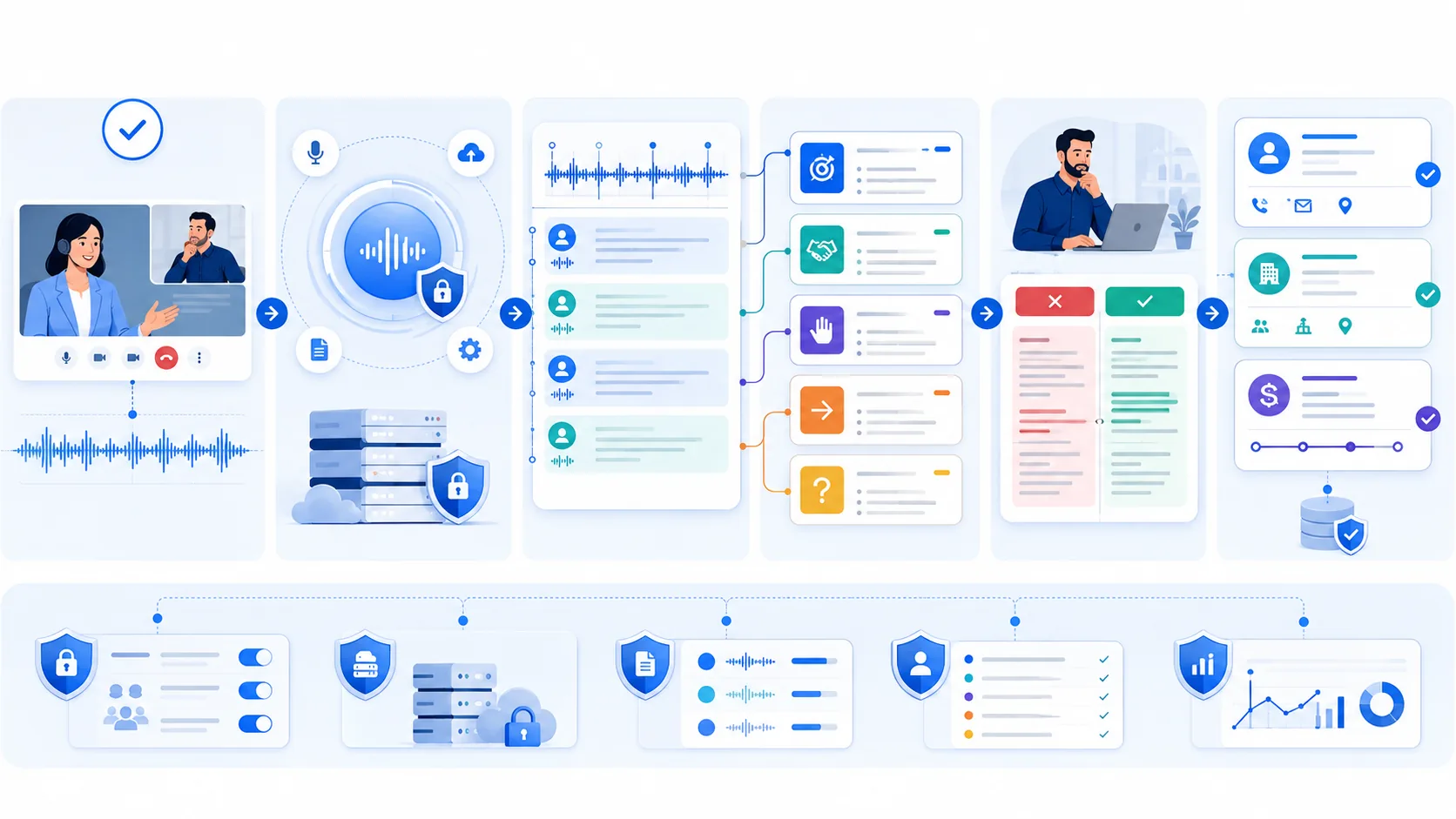
Quick answer
Start with the business decision, restrict the agent to consented recording or transcript, meeting metadata, CRM schema, opportunity rules, and approved summarization criteria, require a structured CRM update proposal with quote references, field confidence, missing information, and seller approval, and name the person who approves consequential actions.
This guide is for: revenue, operations, marketing, support, and enablement teams that need repeatable work with visible ownership.
A call summary is a proposed evidence packet, not CRM truth
Automation should preserve what was said, who may have said it, when it occurred, and how confidently it maps to an allowed CRM field. It should not turn a tentative discussion into an approved budget, a vague date into a committed close date, or a participant into a verified decision-maker.
Separate four records
Keep the immutable call/media record, versioned transcript, structured extraction, and CRM write receipt separate. A corrected transcript can create a new extraction version without silently rewriting the original evidence or erasing who approved an earlier change.
Use field-level authority
Safe activity notes may be auto-created after validation, while forecast category, amount, close date, stage, contact role, legal terms, and commitments require a named seller or manager. The destination schema—not a free-form prompt—defines what the workflow may propose or write.
The five-stage evidence contract
| Stage | Required artifact | Reject or hold when |
|---|---|---|
| Authority and intake | Call ID, source, participants, consent/notice state, purpose, retention class, media checksum | Authority, identity, source integrity, or permitted purpose is unclear |
| Transcription | Transcript version, language, speaker labels/states, timestamps, model/config, quality flags | Audio is missing/corrupt, speaker assignment is unsafe, or critical spans are unintelligible |
| Extraction | Schema-valid facts, quote-span references, uncertainty, conflicts, unknowns, proposed destinations | A material field lacks evidence or violates the allowed schema |
| Review | Before/after diff, linked evidence, reviewer identity/authority, decision, expiry | The target changed, approval expired, or reviewer lacks authority |
| Write and audit | Idempotency key, target IDs, result/version, association, error/rollback, trace | The target is ambiguous, stale, duplicated, unauthorized, or partially updated |
5 steps to automate sales call summaries into CRM
Implement each step as a separate, versioned contract. Keep raw evidence immutable and grant write authority field by field.
Capture a consented, verifiable call record
Establish recording authority, purpose, source integrity, participants, retention, and the exact CRM relationship before any model processes audio.
Create a versioned transcript with speaker evidence
Transcribe the bounded recording while preserving timestamps, language, speaker uncertainty, audio gaps, and processing provenance.
Extract evidence-linked facts and proposed actions
Convert the transcript into a strict schema that distinguishes statements, interpretations, proposals, commitments, conflicts, and unknowns.
Validate the CRM diff and obtain seller approval
Show a field-level before/after proposal with transcript evidence, record identity, policy result, and reviewer authority.
Write idempotently, verify state, and monitor corrections
Apply only the approved diff to verified CRM records, associate the call correctly, and prove the resulting state.
Worked example: a budget discussion is not budget approval
This hypothetical example illustrates evidence handling; it is not a customer call or a claim about transcription accuracy.
Reviewer decision and write result
The seller confirms the activity summary, changes the task date after checking the calendar, and rejects all consequential deal-field updates. The workflow binds approval to that diff, writes the activity and task once, verifies their associations, and stores both rejected proposals and the final CRM receipt.
Evaluation set before enabling CRM writes
Build a permission matrix
List recording purposes, regions, participant states, storage classes, reviewers, and field-level write authority.
Label hard audio and semantic cases
Include crosstalk, accents, names, numbers, negation, vague dates, proposed versus accepted actions, conflict, and silence.
Score extraction by field
Measure supported facts, unsupported additions, missed commitments, wrong speaker/time evidence, schema errors, and abstention quality.
Exercise CRM failure paths
Test ambiguous associations, stale records, duplicate events, concurrent edits, partial writes, permission failures, retries, rollback, and deletion.
How OpenMax supports this workflow
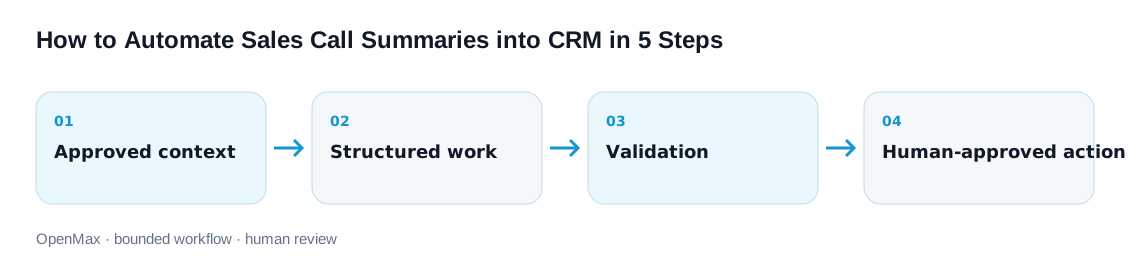
From prompt to governed OpenMax workflow
OpenMax can turn a reviewed instruction into an AI employee workflow with shared context, tool connections, task ownership, logs, and human review. The template defines the job; permissions and approval gates control what can happen next.
Limits and human-review boundaries
Audio, transcripts, summaries, and CRM fields can contain personal, confidential, regulated, or inaccurate information. A model output is not independent evidence.
- Do not record, retain, transcribe, or repurpose a call without verified authority and an applicable notice/consent process.
- Do not equate diarization labels with verified identities or convert uncertain speech into names, amounts, dates, approvals, or commitments.
- Do not auto-change stage, amount, close date, forecast, contact role, legal/security terms, or customer commitments without authorized field-level review.
- Do not attach a call by name alone, expose media links/tokens to the model, or let retries create duplicate activities and tasks.
- Define access, retention, legal hold, correction, deletion, incident, vendor, cross-border, and rollback procedures with qualified owners.
Frequently asked questions
What makes a good automate sales call summaries to CRM workflow?
A clear outcome, approved sources, explicit boundaries, a structured output, and a named review or escalation point.
Can the AI take action automatically?
Only if the action is explicitly permitted, technically constrained, logged, reversible where possible, and appropriate for the workflow risk.
How should teams test these entries?
Use a small labeled set containing normal, missing, conflicting, stale, and adversarial inputs. Record failures and revise the workflow, not just the wording.
Where does OpenMax fit?
OpenMax coordinates AI employees, shared context, connected tools, workflow ownership, and human review for repeated business work.
Are the examples guaranteed to improve results?
No. They are structured starting points. Results depend on models, source quality, tools, policy, evaluation, and reviewer judgment.
Sources, editorial method, and limitations
OpenMax editors reviewed current first-party documentation for recorded-file transcription, structured outputs, CRM call activities, record associations, upsert/external identifiers, and privacy risk management. We translated those mechanisms into five vendor-neutral evidence contracts and independently added consent, field authority, immutable provenance, review expiry, idempotency, read-back, correction, and deletion controls. Sources were reviewed September 3, 2026. No transcription accuracy, time saving, CRM compatibility, or customer outcome is claimed.
- OpenAI API — File transcription — recorded audio transcription, supported files, and specialized options for speakers/timestamps.
- OpenAI API — Structured model outputs — constraining model output to a supplied schema.
- HubSpot Developers — Calls activity — call records, properties, and CRM associations.
- HubSpot Developers — Associations overview — relationships among contacts, companies, deals, and activities.
- Salesforce Developers — Upsert using an external ID — create-or-update operations keyed by external identifiers.
- NIST — Privacy Framework — organizational privacy risk identification and management.