Thirty evidence-led workflows for audience research, messaging, content, campaigns, ads, email, events, launches, localization, QA, and measurement—with claim control, consent, attribution limits, and human approval.
OpenMax Product and Content Team32 min read
Reviewed for audience evidence, claim substantiation, consent, disclosure, campaign measurement, and accountable publication
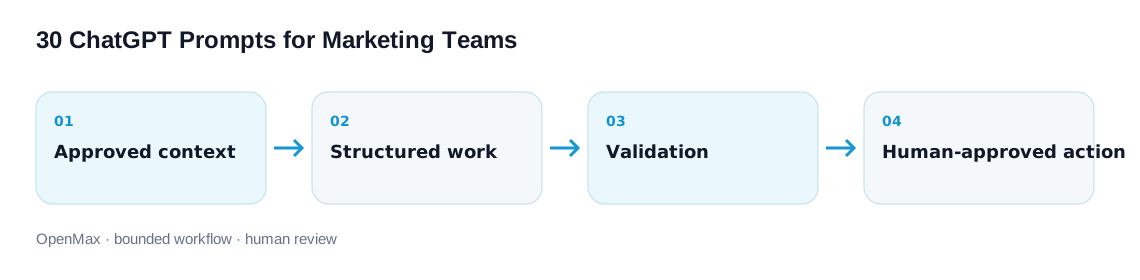
A governed marketing workflow links audience evidence and approved claims to channel-native work, measurable links, review, and learning.
Editorial and commercial disclosure OpenMax publishes this educational guide and provides a human-agent collaboration platform. These prompts are original starting points—not OpenAI, Google, FTC, or ICO endorsement, legal advice, marketing-performance benchmarks, or customer results. Rules vary by market, audience, channel, data, and offer. Corrections: contact@openmax.com.
Quick answer
Start with the business decision, restrict the agent to approved positioning, audience research, product facts, campaign brief, brand rules, source links, and performance data, require a channel-ready draft with claim sources, audience, CTA, variants, and review checklist, and name the person who approves consequential actions.
This guide is for: revenue, operations, marketing, support, and enablement teams that need repeatable work with visible ownership.
What marketing prompts must control
Marketing work moves from audience evidence to claims, assets, distribution, measurement, and learning. A useful prompt keeps those stages connected while showing what is verified, what is hypothetical, what permission applies, and who approves publication or spend.
Generative output is not market evidence
A model can organize research and propose options; it cannot prove audience demand, product differentiation, claim truth, consent, or campaign impact. Require named sources and validation for each transition.
One metric never tells the full story
Impressions, clicks, sessions, leads, qualified pipeline, and revenue use different denominators and attribution scopes. Preserve definitions, UTMs, time windows, missing data, and alternative explanations.
Seven gates from audience evidence to learning
Marketing evidence and approval chain
Gate
Required evidence
Common failure
Owner
Audience
Research source, segment boundary, variation, unknowns
Sample, data quality, counterevidence, decision rule
Correlation becomes causation
Campaign owner
Control principle: AI may draft and organize evidence, but audience targeting, claims, spend, publishing, sending, and performance conclusions remain with authorized people and systems.
30
30 ChatGPT prompts for marketing entries
Use each entry as a starting point. Replace bracketed context, attach approved evidence, and assign a reviewer before execution.
01
Audience problem brief
Define the operating problem from evidence without turning a segment into a stereotype.
Build an audience problem brief for [market, offer, and decision] using [approved interviews, support themes, win/loss notes, product usage, and market sources]. Separate observed behavior, direct quotation, organization-level context, hypothesis, and unknown. Include affected workflow, trigger, current workaround, cost/risk without invented numbers, desired outcome, alternatives, disconfirming evidence, and five neutral validation questions. Do not infer protected traits, personality, budget, authority, urgency, or intent from title, name, location, or page activity. Return evidence citations and dates, segment boundaries, excluded claims, research gaps, and the product-marketing owner who must approve the brief.
02
Persona evidence table
Create a job-context research aid, not a fictional biography.
Using [approved audience research], create a persona evidence table for [role and workflow]. Columns: proposed attribute, exact evidence, source/date, confidence state, variation within the segment, decision relevance, and validation question. Cover responsibilities, inputs, handoffs, constraints, success measures, information needs, and buying-process involvement only where supported. Keep organization-level facts separate from person-level facts. Exclude invented names, demographics, personality, salary, private motivations, protected characteristics, and unsupported “pain points.” Mark Missing or Conflicting rather than filling gaps. Return usable message implications, prohibited targeting assumptions, and a review queue for [research owner].
03
Message hierarchy
Turn approved evidence into one prioritized narrative with claim control.
Create a message hierarchy for [audience, use case, and funnel stage] from [positioning, product documentation, claim registry, proof inventory, and objections]. Produce one category/context statement, one value proposition, three supporting messages, proof required for each, limitations, and a next action. Tag every sentence as Approved claim, Evidence-led draft, Hypothesis, or Prohibited. Explain why each supporting point earns its position and where it should not be used. Do not invent differentiation, urgency, customer outcomes, integrations, security status, or market leadership. Return the hierarchy, claim-to-source ledger, unresolved choices, channel constraints, and named approver; do not publish or overwrite the source messaging.
04
Value proposition options
Generate genuinely different value propositions while keeping claims within evidence.
Draft [number] value-proposition options for [audience and job] using [approved positioning, product facts, alternatives, proof, and constraints]. Each option must choose a distinct emphasis—time-to-value, coordination, risk visibility, ownership, or workflow quality—rather than swapping adjectives. Include audience, job, outcome, mechanism, reason to believe, limitation, and disqualifying condition. Map factual claims to sources and label hypotheses. Avoid “best,” “only,” guaranteed savings, unmeasured percentages, competitor disparagement, and feature promises not in current documentation. Score options against supplied criteria without inventing research results. Return options, evidence gaps, testable questions, and the human decision required.
05
Campaign concept
Connect one audience tension to one verifiable campaign idea and measurable behavior.
Develop a campaign concept for [objective, audience, offer, market, period, and channels] using the approved message hierarchy and evidence. Define the audience tension, single campaign promise, creative device, content sequence, CTA, landing experience, exclusions, channel adaptations, and measurement events. Separate a communications objective from a business outcome; name the assumptions between them. Include claim/disclosure needs, consent and frequency constraints, brand-safety risks, accessibility, localization, dependencies, and stop conditions. Do not fabricate trends, customer stories, scarcity, reach, conversion lift, or budget. Return a one-page concept, claim ledger, experiment hypothesis, UTM naming plan, approval gates, and alternatives rejected with reasons.
06
Creative brief
Give creators enough strategic constraint without dictating unsupported execution.
Write a creative brief for [asset, audience, channel, objective, and deadline]. Include one communication task, audience evidence, insight status, message hierarchy, approved proof, mandatory elements, prohibited claims, tone, format/specifications, accessibility, rights/usage, localization, CTA, destination, UTM fields, review owners, and acceptance criteria. Distinguish fixed requirements from creative freedom. Reference the exact product and claim versions. Do not invent customer quotes, endorsements, performance numbers, market facts, visual rights, or platform specifications. Add edge cases for cropped formats, muted video, dark mode, translation expansion, and expired offers. Return the brief, missing inputs, decision log, and preflight checklist.
07
Landing page outline
Design an evidence-led conversion path around one visitor decision.
Outline a landing page for [campaign, audience, offer, and traffic source]. Begin with the visitor question and one verifiable answer. Sequence hero, problem context, mechanism, product workflow, proof, limitations, objections, FAQ, CTA, privacy/consent, and related resources. For every section state purpose, required evidence, proposed H2/H3, visual role, CTA relationship, and owner. Preserve message match with the source ad/email and disclose material conditions near the claim. Do not invent testimonials, logos, security badges, results, prices, or urgency. Include mobile reading order, accessibility, page-speed constraints, analytics events, and post-conversion expectations. Return wire-content, claim gaps, SEO metadata draft, and approval map—not HTML or publication.
08
Hero copy
Write a specific above-the-fold promise that can survive claim review.
Create [number] hero-copy routes for [page, audience, and job] using [approved message hierarchy and proof]. Each route includes eyebrow if useful, one H1, a two-sentence subhead, primary/secondary CTA, and a proof/limitation line. Keep H1 readable and describe the user outcome plus credible mechanism, not vague transformation. Explain the difference among routes and cite the facts behind product assertions. Do not use “revolutionary,” “effortless,” “guaranteed,” invented adoption metrics, hidden conditions, or unsupported competitor comparisons. Check message match against [source campaign]. Return character counts, mobile line-break risk, claim status, evidence needed, and a recommended test hypothesis for human approval.
09
Feature-benefit translation
Convert product capabilities into conditional user value without overstating causality.
For each item in [current product documentation], create a feature-to-benefit record: exact capability, eligible user/workflow, task changed, mechanism, likely benefit stated conditionally, evidence, prerequisites, limitations, failure mode, and proof needed. Preserve product terminology and version/date. Separate capability (“can connect approved tools”) from outcome (“may reduce manual handoffs when configured”) and from untested marketing hypothesis. Do not invent availability, integrations, compliance, time savings, adoption, or universal benefit. Flag features that do not yet support the target message. Return a table, approved draft wording, unsafe wording to avoid, questions for product/solutions teams, and expiry/review date.
10
Proof-point inventory
Audit what marketing can substantiate before drafting claims.
Build a proof inventory from [product records, approved research, customer permissions, case studies, security/legal documents, and analytics]. For each proof point capture exact statement, source owner, source URL/file, collection date, methodology/sample, geography/product scope, permission, disclosure, expiry, reproducibility, and claim it can support. Mark Verified, Qualified, Stale, Conflicting, Missing permission, or Not for marketing. Keep anecdotes, model outputs, internal metrics, and representative customer outcomes distinct. Do not turn correlation into causation or a single result into typical performance. Return usable proofs, prohibited uses, renewal tasks, missing evidence priorities, and approvers.
11
Case study interview guide
Elicit a verifiable customer story without leading the interviewee.
Create an interview guide for [customer, workflow, and approved story scope]. Ask neutral questions covering prior process, trigger, evaluation, implementation, people/roles, data/tools, constraints, setbacks, observed change, measurement method, alternatives, limitations, current state, and advice. For every outcome ask baseline, period, numerator/denominator, exclusions, attribution limits, and who can verify it. Include permission checks for name, logo, quotation, metrics, screenshots, and confidential details. Do not suggest answers, promise publication, pressure for praise, or ask for unrelated sensitive information. Return interview flow, probes, fact-check checklist, redaction plan, and customer/legal approval stages.
12
Case study outline
Structure an approved customer narrative with evidence and representative-limit disclosures.
Outline a case study from [transcript, approved facts, metric workbook, permissions, and product records]. Separate customer statements, independently verified facts, OpenMax contribution, other contributing factors, and unknowns. Include context, prior workflow, decision criteria, implementation, human/agent responsibilities, measurable outcomes with methodology, complications, lessons, current state, and who the approach fits or does not fit. Map every quote, logo, screenshot, metric, and product claim to permission and source. Do not invent a smooth journey, causal attribution, typical-result implication, or anonymous quote identity. Return section outline, evidence ledger, disclosure needs, fact-check questions, and customer/legal approvals.
13
SEO content brief
Define search intent, information gain, and evidence before assigning a page.
Create an SEO brief for [primary query, market, locale, and funnel stage] using [SERP observations, Search Console if supplied, existing inventory, product truth, and primary sources]. Identify dominant and secondary intents, user decisions, competing page types, content gaps, information gain, entities/questions, one H1, H2/H3 structure, answer block, examples/tables/visuals, internal links, authoritative sources, metadata, schema candidate, and conversion path. Separate observed search evidence from inference; do not invent volume, ranking difficulty, traffic forecast, or competitor performance. Check cannibalization and localization needs. Return brief, evidence/source dates, claims requiring review, originality plan, and measurable post-publish checks.
14
Blog outline
Build a reader-first argument rather than expanding keywords into filler.
Create a blog outline for [topic, audience, search intent, and decision]. State the direct answer, reader starting knowledge, practical promise, original contribution, and exclusions. Design one H1 and a logical H2/H3 chain where each section answers a distinct question and earns the next. Specify examples, decision tables, visuals, source needs, counterexamples, limitations, internal links, CTA, and FAQ only where useful. Map important claims to current primary sources and identify where OpenMax product context is relevant versus commercial overreach. Do not pad for word count, duplicate headings, fabricate expertise, or copy competitor structures. Return annotated outline, estimated depth by section, evidence gaps, and editor acceptance criteria.
15
Executive article draft
Draft a decision-oriented point of view with evidence, tradeoffs, and accountable recommendations.
Write an executive article for [leader audience, topic, and decision] from [approved thesis, operating evidence, primary sources, and product context]. Lead with the decision and stakes, then explain current conditions, evidence, alternatives, tradeoffs, failure modes, and a practical operating model. Distinguish organizational observation, external fact, interpretation, and recommendation. Use concrete examples without inventing customer experience or metrics. Include counterarguments, conditions where the thesis fails, implementation owners, and questions leaders should ask. Avoid trend theater, certainty, generic futurism, and disguised product pitch. Return draft, claim/source notes, fact-check flags, commercial disclosure, and executive-review questions.
16
Newsletter draft
Create one useful editorial send with transparent purpose and measurable links.
Draft a newsletter for [subscribed audience, edition goal, locale, and send context] using [approved stories, links, claims, and email policy]. Include subject/preheader, concise opening, one lead insight, supporting items with source dates, one primary CTA, optional secondary links, preference/unsubscribe language, and sender identity. Explain why each item matters to this audience; preserve material conditions and paid/partner disclosures. Do not invent urgency, personalize from sensitive behavior, hide promotional intent, use misleading reply/forward cues, or claim unverified popularity. Return copy, link/UTM table, accessibility/plain-text notes, consent/frequency checks, test hypothesis, and sender/editor approval fields.
17
Email nurture sequence
Design a permissioned learning journey with clear exits, not pressure automation.
Create a [number]-message nurture sequence for [confirmed information need, lifecycle state, locale, and permitted channel]. For each message define objective, evidence-based topic, approved asset, subject/preheader, body outline, CTA, delay, UTM values, personalization source, frequency rule, suppression check, success event, and exit condition. Keep service messages separate from marketing. Do not infer interests from unrelated browsing, manufacture scarcity, increase frequency after low engagement, or keep sending after objection, conversion, or invalid address. Include branches for missing consent, existing customer, sales acceptance, no engagement, and request for human contact. Return journey table, claims, dependencies, QA checks, and marketing-operations approval.
18
Subject line variants
Test honest framing without creating false urgency or hiding the sender.
Generate [number] subject-line and preheader pairs for [approved email, audience, and objective]. Use genuinely different hypotheses—specific benefit, question, content type, workflow, or sender context—rather than punctuation changes. Preserve the body’s actual offer and material conditions. For each pair provide character count, likely truncation, hypothesis, evidence/claim risk, and matching opening line. Do not imply a prior conversation, reply, invoice, security alert, deadline, exclusivity, personal knowledge, or result that is not true. Avoid sensitive personalization and spam-like formatting. Return candidates, excluded unsafe options with reasons, segment/holdout plan, success metric, and human approval; do not schedule or send.
19
Paid search ad draft
Match a verified query intent to an accurate offer and landing experience.
Draft paid-search components for [campaign, query themes, audience, geography, and landing page] using [approved claims, platform limits, policy, and negative-keyword rules]. Group by intent, then provide headline/description assets, path, CTA, required disclosure, and landing-page evidence. Label dynamic elements and check combinations for contradictory or unsupported messages. Do not insert trademarks without permission, imply official affiliation, use unverifiable superlatives, promise outcomes, or target prohibited/sensitive categories. Include negative themes, geo/language conditions, UTM naming, conversion event, and budget/bid fields as placeholders only. Return claim map, policy risks, combination QA, and advertiser approval; do not launch.
20
Social ad draft
Adapt one approved promise to a feed context with disclosure, accessibility, and comment risk.
Create social-ad variants for [platform, audience, objective, format, and locale] from [approved concept, proof, offer terms, and platform specification]. For each provide primary text, headline, CTA, visual direction, alt text, disclosure placement, safe-zone/crop notes, and landing-message match. Identify audience assumptions, comment/moderation risks, and what the creative cannot imply. Do not fabricate endorsements, engagement, scarcity, before/after outcomes, UI screenshots, or platform affiliation. Avoid sensitive-attribute targeting language. Return variations tied to distinct hypotheses, UTM content values, review checklist, community-response plan, and legal/brand/media approval fields.
21
LinkedIn post
Turn a real operating insight into a useful professional post without manufactured authority.
Draft a LinkedIn post for [named authorized author/company, audience, insight, and CTA] using [source evidence and approved voice]. Open with a concrete observation, explain the operating problem, give a practical framework or example, acknowledge limitation/counterpoint, and end with a relevant question or resource. Distinguish the author’s actual experience from editorial synthesis; do not invent first-person use, customer conversations, job title, opinions, metrics, endorsements, or “everyone is talking about” claims. Include source links and disclose commercial or partner relationships when material. Return draft, claim/evidence notes, image/alt-text idea, link/UTM, moderation considerations, and author approval.
22
Short video script
Write for sight, sound, captions, and proof—not just a compressed blog post.
Create a [duration]-second script for [platform, audience, message, and CTA]. Provide timecoded scenes, spoken words, on-screen concept without relying on text, captions, visual evidence, transition, audio notes, and end frame. Hook with a true problem or question, demonstrate one mechanism, state a limitation, and align the CTA with the landing page. Mark every product/outcome claim and required disclosure. Do not invent interface behavior, customer results, trending status, countdowns, or endorsements; avoid flashing, inaccessible contrast, copyrighted assets, and captions that change meaning. Return script, shot list, rights needs, localization expansion risk, claim checklist, and human production approval.
23
Webinar abstract
Set accurate learning expectations and qualify speakers without overselling the event.
Draft a webinar abstract for [topic, audience, format, speakers, date, and offer] from [approved agenda, speaker bios, sources, and event terms]. Include who it is for/not for, the operating problem, three specific learning outcomes, evidence/examples used, prerequisites, format, accessibility, recording availability, data-use notice, and CTA. Verify speaker title and experience; distinguish education from product demonstration. Do not promise certification, personalized advice, guaranteed outcomes, live participation, recording, or expert credentials unless confirmed. Return title options, abstract, agenda, speaker proof, registration fields, disclosures, follow-up permissions, and event-owner approval.
24
Event invitation
Invite eligible contacts with complete logistics and a truthful reason to attend.
Write an invitation for [event, audience, locale, channel, and relationship] using [approved details, eligibility, capacity, terms, and consent state]. State sender, purpose, date/time/time zone, location/access method, agenda value, speaker status, cost, capacity/waitlist, accessibility, recording/data use, and cancellation expectations. Personalize only from permitted relationship data. Do not imply an existing relationship, limited seats, exclusivity, free access, or confirmed speaker when untrue; do not mix operational updates with marketing consent. Return subject/preheader, invitation, calendar description, reminders, UTM links, suppression/frequency checks, and event/legal approval fields.
25
Product launch checklist
Coordinate launch truth, readiness, distribution, and rollback before promotion.
Build a launch checklist for [product/release, market, date, and channels] from [release status, product docs, claim registry, support readiness, legal/security reviews, and measurement plan]. Organize by decision gates: audience/positioning, product availability, documentation, pricing/terms, proof, creative/accessibility, localization, sales/support enablement, tracking, approvals, publish sequence, monitoring, and rollback. Each item needs owner, evidence link, deadline, dependency, status, and stop condition. Do not treat code merged, beta access, or a target date as general availability. Flag incompatible claims and outdated assets. Return go/no-go evidence, unresolved blockers, channel URLs/UTMs, incident contacts, and rollback communications—not an automatic launch.
26
Sales enablement summary
Translate campaign truth into seller-ready context without turning marketing hypotheses into facts.
Create a sales enablement summary for [campaign, offer, audience, and sales stage] from [approved positioning, assets, product facts, proof, objections, pricing/terms, and routing rules]. Include campaign purpose, eligible accounts, buyer questions to validate, message hierarchy, product mechanism, proof with limitations, disqualifiers, common objections with evidence-led answers, discovery questions, content map, CTA, lead-source context, and feedback route. Clearly label marketing hypotheses and prohibited claims. Do not give sellers fabricated personalization, competitor claims, urgency, or permission to contact suppressed leads. Return one-page brief, claim ledger, handoff fields, training checks, expiry date, and sales/product/legal approvals.
27
Content repurposing map
Create channel-native derivatives while preserving source meaning, rights, and attribution.
Map [approved source asset] into [target channels and formats]. First extract source thesis, evidence, quotes, visuals, limitations, CTA, permissions, and expiry. For each derivative specify audience/context, new angle, format, required adaptation, evidence retained, disclosure, internal/canonical link, UTM content value, owner, and acceptance criteria. Avoid chopping the same wording into every channel; add no claim that the source cannot support. Do not reuse customer quotes, images, charts, music, or partner marks beyond licensed scope. Flag derivatives that would misrepresent nuance or require new research. Return priority map, dependency/rights checklist, production sequence, and approval trail.
28
Localization brief
Adapt meaning, evidence, policy, and conversion context—not words alone.
Prepare a localization brief for [source campaign, target locale, audience, and channel] using [approved source, glossary, brand guide, product availability, pricing/terms, legal/privacy requirements, and local research]. Identify text requiring translation, transcreation, preservation, replacement, or removal. Cover search intent, terminology, formality, date/time/units/currency, examples, imagery, accessibility, CTA, landing path, consent, disclosures, customer support, text expansion, and QA. Never infer local norms without evidence or silently change claims and conditions. Return locale-specific risks, back-translation requirements for consequential text, local source needs, screenshot/device cases, and native reviewer plus legal/product approvals.
29
Campaign QA checklist
Test the complete customer path before launch, including combinations and failure states.
Create a campaign QA plan for [channels, assets, audiences, locales, and launch window]. Cover approved copy/claims, disclosures, spelling, links/redirects, UTMs, destination message match, forms, consent, confirmation, CRM routing, suppression, frequency, responsive layouts, image/caption/alt text, tracking events, cross-browser/device, personalization fallbacks, offer eligibility/expiry, permissions, and rollback. Include normal, missing, conflicting, expired, duplicate, blocked-cookie, invalid-form, and wrong-locale cases. For each record expected result, evidence, owner, severity, and release blocker. Do not fix silently or mark untested as passed. Return pass/fail/not-run totals, defect log, go/no-go recommendation, and accountable approver.
30
Performance learning memo
Explain what the campaign evidence supports without hiding uncertainty or overclaiming attribution.
Write a learning memo for [campaign, date range, decision, and comparison] using [frozen metric definitions, spend/delivery, traffic-source data, events, CRM outcomes, experiments, and data-quality notes]. State objective, cohort, channel, attribution scope, time zone, exclusions, consent/modeling effects, missing UTMs, sample sizes, and definition changes. Separate delivery, attention, on-site behavior, qualified outcomes, and business results; distinguish correlation, attributed credit, and randomized evidence. Analyze creative/audience/landing/process explanations plus counterevidence. Do not claim causation from last-click or platform totals, merge incompatible denominators, or hide direct/(not set). Return findings, confidence, limitations, failed hypotheses, follow-up tests, and owners.
Worked example: campaign traffic that cannot all be credited to one event
This hypothetical mirrors common analytics ambiguity; it is not an OpenMax customer result.
Inputs Event links use one campaign UTM, but some QR codes lack source/medium, partners reuse untagged URLs, and attendees later search the brand on Google.
Observed data GA4 reports tagged campaign sessions, referral traffic, organic search, direct, and “not set.” These are acquisition observations, not proof of who attended or what caused a later conversion.
Safe analysis Report directly tagged sessions separately, explain other plausible paths, reconcile registrations with privacy-safe identifiers only when permitted, and avoid adding direct/organic traffic to the campaign total.
Next improvement Standardize case-sensitive UTM fields, give each partner/creative a distinct content value, test redirects/QRs, preserve raw landing URLs, and define the attribution question before launch.
Acceptance test
The memo passes only when every reported number retains its scope, denominator, time range, source fields, exclusions, and uncertainty; “unknown” traffic is not reassigned for a better story.
How to implement and test it
Choose one business outcome
Do not combine research, judgment, writing, approval, and execution in one vague request. Name the decision this output supports.
Connect only approved context
Provide the minimum records needed, preserve source links and dates, and exclude data the workflow is not authorized to use.
Test with ordinary and edge cases
Check correct inputs, missing data, conflicts, prompt injection, stale records, and requests that should trigger escalation.
Review before expanding autonomy
Start read-only. Compare quality and exceptions, then grant narrowly scoped actions only when controls are proven.
How OpenMax supports this workflow
From prompt to governed OpenMax workflow
OpenMax can turn a reviewed instruction into an AI employee workflow with shared context, tool connections, task ownership, logs, and human review. The template defines the job; permissions and approval gates control what can happen next.
These examples are editorial templates, not independent performance tests or legal, privacy, employment, or security advice.
Do not use the workflow for publishing content, inventing customer proof, making legal or performance claims, or using personal data without consent without an authorized reviewer and enforceable controls.
Verify facts against the cited source system; model confidence is not evidence.
Minimize personal and confidential data, retain source dates, and follow applicable consent and retention rules.
Measure exception rate, correction rate, completion quality, and harmful side effects before scaling.
Frequently asked questions
What makes a good ChatGPT prompts for marketing workflow?
A clear outcome, approved sources, explicit boundaries, a structured output, and a named review or escalation point.
Can the AI take action automatically?
Only if the action is explicitly permitted, technically constrained, logged, reversible where possible, and appropriate for the workflow risk.
How should teams test these entries?
Use a small labeled set containing normal, missing, conflicting, stale, and adversarial inputs. Record failures and revise the workflow, not just the wording.
Where does OpenMax fit?
OpenMax coordinates AI employees, shared context, connected tools, workflow ownership, and human review for repeated business work.
Are the examples guaranteed to improve results?
No. They are structured starting points. Results depend on models, source quality, tools, policy, evaluation, and reviewer judgment.
Sources, method, and limitations
OpenMax editors reviewed primary guidance on prompting, advertising substantiation, endorsements/disclosures, campaign tagging, and direct-marketing privacy, then rewrote all 30 entries as distinct governed workflows. Sources were reviewed September 3, 2026. No rank, traffic, conversion, pipeline, revenue, or productivity outcome is claimed.
Scope note FTC and ICO guidance is jurisdiction-specific; Google documentation describes Analytics behavior, not causal proof. Qualified organizational owners must determine claim substantiation, disclosure, privacy, platform policy, and measurement design.