

Quick answer
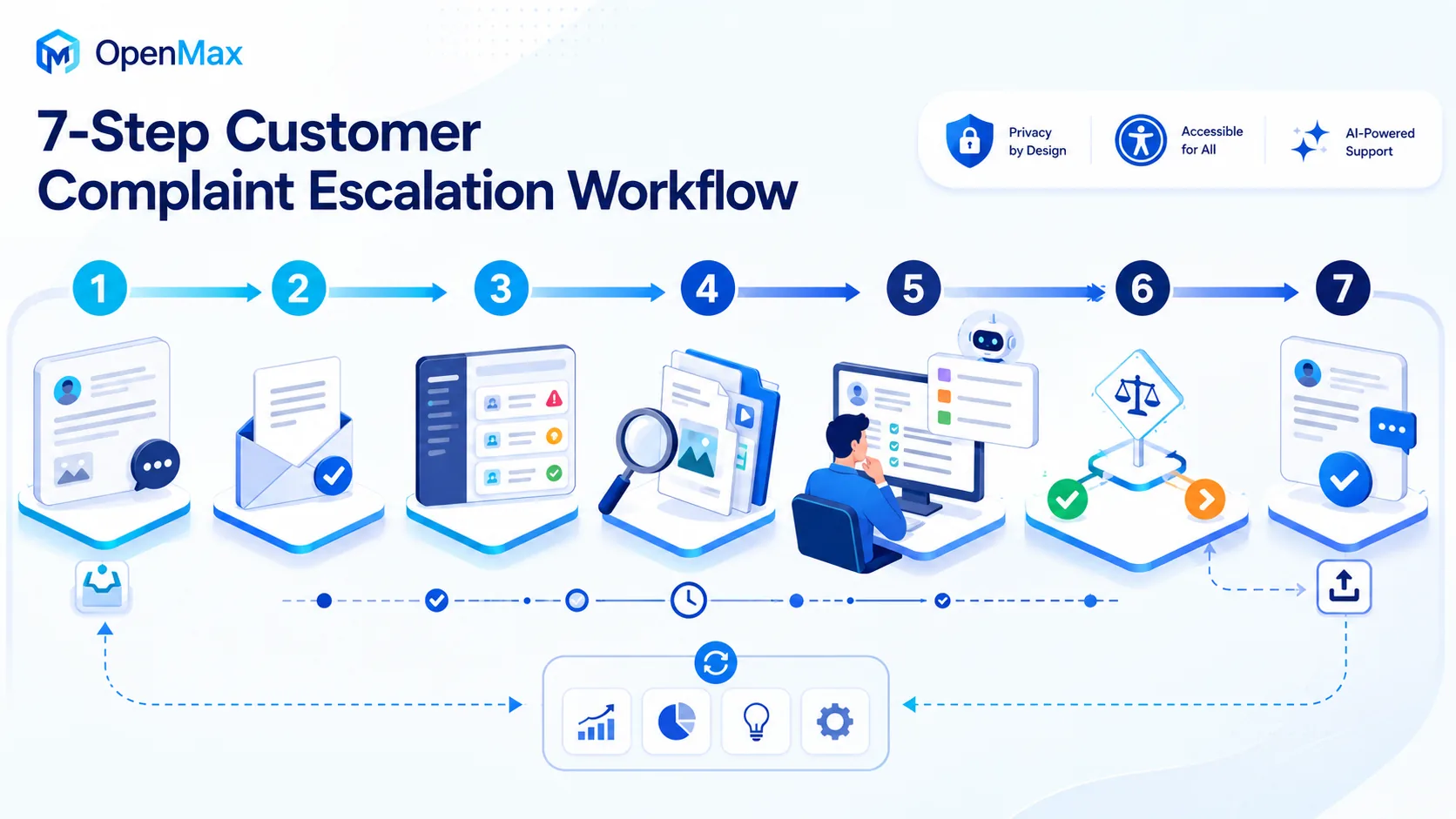
Use one controlled case from first dissatisfaction to verified closure. Preserve the customer’s words, acknowledge accessibly, triage evidence and conflicts, investigate both supporting and contrary explanations, authorize a proportionate remedy, communicate every finding and review route, then verify completion or escalate. Automation may classify, assemble, remind, and monitor; humans retain consequential decisions.
What a customer complaint escalation process must protect
A useful workflow protects access, fairness, evidence integrity, independence, timeliness, confidentiality, remedy authority, and learning at the same time. The customer’s desired outcome is an input—not proof that the underlying allegation is true and not permission to ignore it. A fast refund can restore service while a separate investigation examines a systemic fault.
Complaint
An expression of dissatisfaction for which a response is expected or should reasonably be provided. Local definitions may be broader.
Escalation
A controlled transfer of decision authority, expertise, independence, urgency, or review level—not merely forwarding a ticket.
Resolution
The organization’s documented response and action state. It does not necessarily mean the complainant agrees or waives review rights.
Workflow rules and decision states
Publish locally validated acknowledgement, update, response, review, and external-route objectives. Do not present the example states below as universal legal deadlines or contractual SLAs.
| State | Required evidence | Human decision |
|---|---|---|
| RECEIVED | Original expression, provenance, case ID | Recognize scope and protect access |
| TRIAGED | Impact, urgency, risk triggers, conflict check | Assign priority, owner, and independent route |
| INVESTIGATING | Issue list, provenance, supporting and contrary evidence | Accept findings or request more evidence |
| REMEDY REVIEW | Finding-to-remedy map, authority, calculation, reversibility | Approve, change, deny with reasons, or escalate |
| CLOSED / ESCALATED | Delivery, implementation, review window, residual owner | Verify closure, reopen, or transfer review authority |
7-step customer complaint escalation workflow
Execute these as evidence gates, not a script that advances because a timer expired. Straightforward complaints may pass several gates in one contact; complex complaints still require an explicit record of each decision.
Recognize, capture, and preserve the complaint
Operating instruction
Treat an expression of dissatisfaction as a complaint when a response is expected, even if the customer never uses the word “complaint.” Create one case ID, preserve the customer’s own words and attachments, record channel and received time, link related contacts without silently merging people, and separate the requested outcome from the facts already verified.
Evidence to retain
Original message and attachments; channel and timestamps; customer/account identifiers with confidence; product or service; requested outcome; accessibility or representative needs; duplicate links; retention and access classification.
Acceptance and escalation gate
The record preserves the customer’s meaning, limits unnecessary personal data, shows provenance for every attachment, and has a named intake owner. A suspected safety, security, fraud, privacy, discrimination, or legal issue is routed immediately while ordinary fact-finding continues.
Acknowledge receipt and make the process usable
Operating instruction
Confirm what was received, the case ID, current owner, next update point, secure channel, and what information is still needed. Use the customer’s preferred accessible format and language where supported. Do not promise a remedy or resolution date before authority, evidence, and applicable rules are known.
Evidence to retain
Acknowledgement copy and sent time; delivery status; channel preference; accessible-format or language request; identity/representative verification state; next-update target; safe contact restrictions; unanswered questions.
Acceptance and escalation gate
The customer can identify the case, knows what will happen next, and can correct the captured issue. Failed delivery, vulnerable-customer needs, inaccessible communication, disputed identity, or third-party representation creates a tracked exception rather than silent closure.
Assess impact, urgency, route, and independence
Operating instruction
Triage the complaint using evidenced harm, continuing exposure, deadline, affected scope, available workaround, regulatory or contractual triggers, and required expertise. Distinguish service recovery from investigation. A complaint about the assigned handler, manager, automated decision, discrimination, retaliation, or misconduct needs an independent route.
Evidence to retain
Impact and urgency evidence; continuing-harm flag; deadline source; workaround quality; safety/security/privacy/accessibility/legal indicators; responsible service; conflict-of-interest check; provisional priority; rule version and review time.
Acceptance and escalation gate
A documented route and accountable owner are assigned, specialist overrides are applied, and the complainant is not forced back to the person or system being challenged. Priority remains provisional and must change when material facts change.
Investigate impartially and test competing explanations
Operating instruction
Write the allegations or issues as separate answerable questions. Collect both supporting and contrary evidence, preserve originals, interview relevant people without exposing unnecessary complaint details, verify system records and policy versions, and give the affected customer a fair opportunity to clarify. Do not let an AI summary replace the source record.
Evidence to retain
Issue list; evidence register with provenance and access; policy/contract version; system logs; interview notes; contrary evidence; missing-evidence list; fact-versus-inference labels; investigator independence; decision deadline and update log.
Acceptance and escalation gate
Every issue has a supported, unsupported, or unresolved finding; material conflicts and gaps remain visible; access is limited; and the investigator can explain how each conclusion follows from evidence. New risk triggers cause re-triage before the investigation continues.
Decide remedy, correction, and authority
Operating instruction
Match the finding to an authorized remedy: explanation, correction, replacement, refund or credit, service restoration, accessibility adjustment, apology, policy change, monitoring, or no remedy with reasons. Separate immediate containment from final redress and systemic corrective action. Verify calculation, approval threshold, legal or contractual constraints, and consistency with comparable cases.
Evidence to retain
Finding-to-remedy map; customer request; remedy options considered; amount or action calculation; authority and approver; precedent/comparable-case check; tax/accounting or legal review when relevant; implementation owner; acceptance and reversal tests.
Acceptance and escalation gate
The remedy addresses the substantiated issue, the decision-maker has authority, calculations and dependencies are checked, and any denied request receives a specific reason. High-impact, irreversible, regulated, or precedent-setting action receives independent human approval.
Communicate the outcome, evidence basis, and review route
Operating instruction
Respond to every issue in plain language: what was understood, what evidence was considered, what was found, what action will occur, who owns it, and when the next milestone is due. Explain unresolved points and limitations. Provide an accessible internal-review or external-dispute route when applicable without presenting the organization’s interpretation as final legal advice.
Evidence to retain
Approved response; issue-by-issue findings; evidence references safe to disclose; remedy and implementation date; owner; review/escalation route and deadline; accessible format; delivery proof; privacy redactions; communication-quality check.
Acceptance and escalation gate
The response is complete, accurate, timely under the organization’s validated rules, understandable, safely delivered, and gives a real review path. It avoids blame, retaliation, unverifiable certainty, confidentiality leakage, and language that treats acceptance as a condition of remedy.
Close or escalate, verify completion, and learn systemically
Operating instruction
Close only after promised actions are implemented or explicitly tracked elsewhere, delivery is confirmed, review windows are recorded, and unresolved risk has an owner. Escalate when the customer disputes material findings, remedy authority is exceeded, deadlines are missed, independence is compromised, or external review is required. Aggregate de-identified patterns with meaningful denominators rather than treating complaint volume alone as quality.
Evidence to retain
Action completion evidence; delivery and response state; review-window status; external-route information; residual-risk owner; reopen conditions; root-cause candidate; corrective action; control owner; denominator; trend method; retention/disposal event.
Acceptance and escalation gate
Closure reason and evidence are recorded, outstanding work cannot disappear, reopening remains possible, and systemic themes reach accountable product or service owners. Trend reporting protects identities and distinguishes increased harm from increased access or reporting awareness.
Worked case: a refund request reveals a systemic billing complaint
A customer writes, “You charged us twice—refund it today.” Intake initially labels this a duplicate-charge refund. The acknowledgement confirms the case and avoids promising a same-day outcome. Triage finds one disputed invoice and an available temporary credit, so the individual case begins as moderate impact with an urgent billing deadline.
- Preserve and clarify. The agent retains the original invoice, payment reference, customer wording, and requested remedy; “twice” remains an allegation until reconciled.
- Test the narrow explanation. Ledger and gateway records show two captures tied to one order. A credit can contain the customer impact, but it does not explain the cause.
- Look for counterevidence and scope. A query finds 14 similar capture pairs after a recent payment-rule change. The case is re-triaged from individual recovery to a possible systemic incident; affected-customer count is still provisional.
- Separate remedies and authority. An authorized human approves the customer credit; payments engineering owns containment and reconciliation; finance verifies amounts; legal/privacy review whether notices or additional action are required.
- Communicate without false certainty. The response confirms the verified duplicate, remedy, owner, and next update, explains that wider scope is under review, and provides a review route. It does not claim every flagged pair is an error.
How to operate and test the workflow
Ownership and timers
Use one accountable case owner, specialist owners for restricted decisions, business-calendar rules, pause reasons, next-update timers, overdue escalation, and a manager-visible queue. A timer creates review work; it must not auto-approve a remedy or close a case.
Quality sampling
Sample by route, priority, outcome, reviewer, channel, language, vulnerability, product, and reopen status. Check issue completeness, provenance, independence, calculation, communication, delivery, review rights, completion, and correction—not satisfaction score alone.
Failure and recovery tests
Test duplicate messages, missing attachments, wrong identity, bounced acknowledgement, inaccessible format, absent owner, conflicted investigator, missed deadline, unauthorized refund, disclosure leak, failed remedy, disputed closure, reopen, and external referral.
Minimum auditable record
case_id · received_at · source · customer_words · issue_list · requested_outcome · identity_state · representative_authority · accessibility_need · evidence_register · priority · override · owner · conflict_check · next_update_at · finding_by_issue · remedy · authority · approval · response_version · delivery_state · review_route · completion_evidence · reopen_state · root_cause · corrective_action · retention_event
How OpenMax can coordinate complaint escalation
OpenMax can connect intake channels, propose complaint recognition and issue splits, collect permitted evidence, apply versioned routing rules, calculate update timers, draft issue-by-issue responses, request approvals, monitor implementation, and preserve the decision trail. Configure least-privilege access and separate customer-visible text from restricted investigation material.
Mandatory human escalation and safety boundaries
- Do not expose complaint details beyond need-to-know access, especially health, identity, payment, employment, minor, or investigation data.
- Do not infer consent, representative authority, protected characteristics, vulnerability, fault, intent, or legal conclusions from tone or incomplete records.
- Never route a complaint solely to the person, manager, model, or function being challenged when independence is required.
- Require qualified review for safety, security, privacy, fraud, discrimination, accessibility, retaliation, misconduct, regulated products, litigation, or external-dispute rights.
- Do not let automation deny, settle, disclose, destroy evidence, waive rights, or close a consequential complaint without authorized human approval.
- Validate sector and jurisdiction rules, contractual commitments, record retention, accessibility, language access, review deadlines, and external referral information.
Frequently asked questions
What counts as a customer complaint?
An expression of dissatisfaction for which a response is expected or should reasonably be provided. Use the applicable organizational and legal definition; do not require a customer to use a special word.
Does acknowledgement admit fault?
No. It confirms receipt and process. Findings and responsibility follow evidence review and authorized decision-making.
When should a complaint be escalated?
Escalate for material or continuing harm, specialist triggers, missed objectives, inadequate authority, disputed findings, compromised independence, failed remedies, or required internal/external review.
Can a complaint close if the customer disagrees?
An organization may record its response as complete under validated rules, but disagreement, review rights, reopen conditions, and unresolved actions must remain visible. Closure is not consent.
How should complaint trends be measured?
Use de-identified themes, severity, substantiation, exposure, channel, product, reopen, remedy, and meaningful denominators. Rising volume may indicate more harm—or better access and awareness—so investigate before concluding.
What can OpenMax automate?
It can coordinate capture, issue proposals, evidence requests, routing, timers, drafts, approvals, implementation checks, and audit trails. Humans retain findings, remedies, disclosures, rights, and consequential closure.
Sources, editorial method, and limitations
OpenMax editors reviewed ISO 10002:2018, the Commonwealth Ombudsman Better Practice Complaint Handling Guide, the CFPB company complaint-response process, and WCAG 2.2. We synthesized an original seven-step general-business workflow, evidence contracts, controls, and billing case. Sources were rechecked September 3, 2026. This is operational guidance, not legal advice, a universal SLA, or proof of live outcomes.
- ISO — ISO 10002:2018
- Commonwealth Ombudsman — Better Practice Complaint Handling Guide
- CFPB — Company role in the complaint process
- W3C — WCAG 2.2