

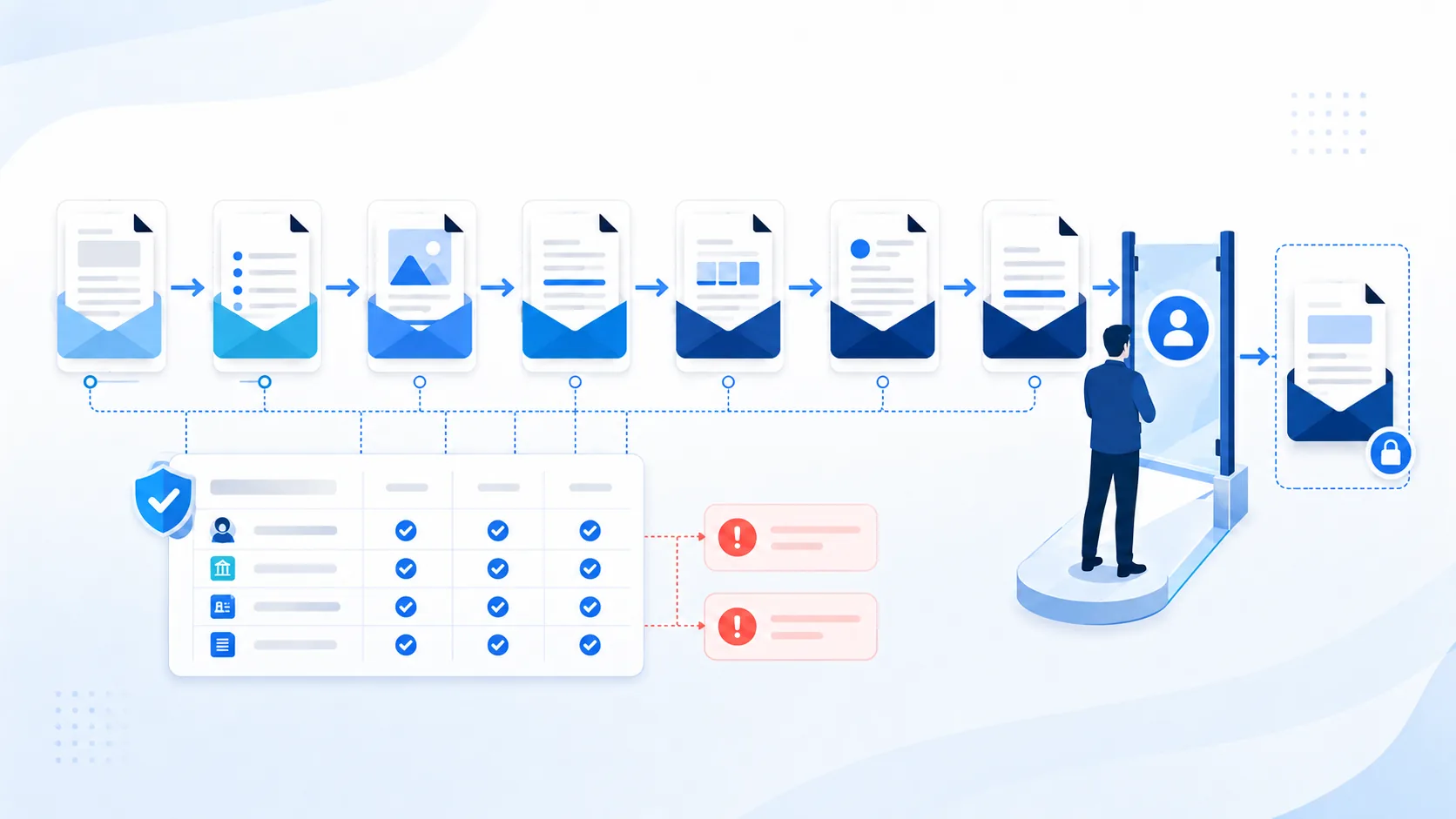
Quick answer: select the renewal stage before drafting the message
Freeze the account, tenant, governing agreement and version, renewal and notice milestones, recipient roles, communication purpose, approved value evidence, open issues, current proposal, and one desired next step. Choose only the template that matches the account's present stage. Then require the account owner—and finance, legal, security, support, or privacy reviewers when the content calls for them—to approve facts, recipients, commitments, and sending.
The minimum renewal-message contract
Every draft needs an account ID, agreement ID and version, evidence cutoff, message class, intended recipient and purpose, present stage, approved source IDs, unresolved conditions, requested response, owner, deadline, follow-up limit, and disposition. Missing fields must remain visible. Fluent prose is not permission to infer a price, legal deadline, purchasing authority, customer value, or consent.
What an AI drafting workflow may do
A bounded workflow may retrieve permitted records, identify conflicts, organize facts into a chosen structure, calculate explicitly approved arithmetic, propose a subject and body, flag missing evidence, and route the draft for review. It should not interpret renewal clauses, decide whether a message is transactional or commercial, create a discount, approve a proposal, hide a service issue, infer agreement from silence, or send under a person's identity without explicit authority.
Download the working materials
Use the editable customer renewal evidence worksheet to define the account, agreement, stage, sources, review path, and stop rules. Then inspect the complete RR085 fictional renewal packet. It prints 28 source records, seven filled email candidates, and seven review records in full; no rows are compressed as “similar.”
Classify the message before applying a template
Renewal communication can combine relationship management, contractual notice, service information, negotiation, and promotion. The words “customer renewal” do not settle which rules apply. Classification should be an explicit human-owned field because it affects recipients, approved wording, unsubscribe controls, retention, and legal review.
Contractual notice is not a casual reminder
If the message is intended to satisfy a notice requirement, the governing agreement and counsel-approved process control the sender, destination, timing, method, and wording. A template email is not evidence that notice was valid. Keep the authoritative agreement and notice record outside the prose, and do not convert a calendar calculation into a legal conclusion.
Relationship communication is not automatically transactional
An account manager may reasonably ask for a planning meeting or correction to a stakeholder map. That does not make every attached offer, upsell, or promotional claim part of a transactional message. In the United States, the FTC describes narrow categories for transactional or relationship content and explains that mixed-content primary purpose matters. Other jurisdictions differ. Route classification to qualified reviewers instead of letting a model decide from tone.
Sender requirements still matter
Google's current Gmail guidance requires senders to personal Gmail accounts to meet authentication and infrastructure requirements; senders above Google's stated daily threshold have additional SPF, DKIM, DMARC alignment, and one-click unsubscribe requirements for marketing and subscribed messages. It also says headers, display names, subjects, and content should be accurate rather than misleading. Those controls do not make a particular renewal email lawful or wanted, but they belong in the operational preflight.
Build one renewal record before writing prose
The evidence brief should be small enough to review and complete enough to stop invention. Do not give a model an unrestricted CRM export, entire mailbox, contract repository, or support archive. Retrieve only records permitted for this account and purpose, keep stable identifiers, and preserve the original source outside the draft.
Account and agreement identity
Record the legal customer entity, service tenant, account ID, agreement or order-form ID, version, effective date, stated renewal mechanism, governing-language reference, currency, product scope, notice destination, and system of record. A parent company name is not enough if the agreement belongs to a subsidiary. A CRM close date is not necessarily a contract milestone.
Recipient role and purpose
For each To and Cc recipient, record the verified address, organization, relationship, reason for inclusion, appropriate information scope, communication preference, and known authority. A title such as VP or Director does not prove signature, procurement, billing, legal-notice, or security authority. Previous participation also does not guarantee the role remains current.
Value evidence with definitions
Store the measure, numerator, denominator, time period, timezone, source, data owner, exclusions, baseline, customer confirmation state, and attribution limit. “Seventy-one active users” needs a definition of active, an eligible population, and a period. Activity can support a planning question; it cannot automatically prove adoption quality, business value, causality, ROI, or renewal intent.
Open issues and commitments
List support cases, product gaps, security reviews, privacy questions, credits, invoices, implementation dependencies, and any customer-requested condition. Preserve the current owner, verified status, last update, next evidence, and approved wording. Do not bury a material issue beneath a positive value recap or promise a resolution beyond the responsible owner's plan.
Proposal and commercial authority
Record proposal ID, version, issue date, expiry, term, product scope, quantity, currency, list or proposed price, tax basis, credits, discounts, dependencies, and the person authorized to approve each. The email should link the authoritative proposal rather than creating a second set of terms in prose. Any mismatch is a stop, not an invitation to improvise.
Use the templates as stage-specific evidence contracts
Replace bracketed fields only with approved facts. Delete internal notes. Keep one requested next step. If a required fact is unknown, ask a bounded question or stop the draft. Do not run all seven messages as an automatic sequence simply because the account has a renewal date.
Template 1 — early renewal planning
Use when: the actual contract and account plan support an early process conversation. Subject: Planning [account] renewal work for [renewal date]. Open by naming the agreement milestone as a verified record, not a threat. Ask the customer to confirm decision criteria, stakeholder roles, procurement steps, requested evidence, and their preferred timeline. Offer one working session with a clear agenda.
Evidence block: account and agreement IDs, verified milestone, contact purpose, known process, previous customer request, open issues, and meeting options. Stop when: the agreement version is uncertain, the contact is not appropriate, legal notice may be involved, or the draft introduces unapproved price or urgency. Early planning should create room for evaluation, not manufacture scarcity.
Template 2 — value and usage recap
Use when: the customer has asked to review outcomes or the account plan calls for a factual checkpoint. Subject: [period] evidence recap for [account] renewal planning. Lead with two or three verified measures and their definitions. Separate product activity, service delivery, customer-confirmed outcome, and inference. Invite correction and name the evidence cutoff.
Evidence block: metric IDs, period, numerator, denominator, exclusions, owner, customer-confirmation state, and open questions. Stop when: the baseline is missing, tenant boundaries are uncertain, a metric is being converted into ROI, or a quote/endorsement lacks permission. Never turn login volume into business impact or imply that activity equals satisfaction.
Template 3 — milestone reminder
Use when: a verified operational or contractual milestone needs a clear next action. Subject: [account] renewal milestone on [date] — please confirm [action]. State the source, current stage, completed items, one remaining response, contact, and next update. Use approved wording for automatic-renewal, notice, suspension, or service consequences.
Evidence block: agreement/version, exact date and timezone, milestone type, counsel-approved explanation when required, response path, and fallback action. Stop when: dates conflict, the draft treats a CRM date as controlling, or silence is presented as affirmative consent. A reminder cannot repair an invalid notice process.
Template 4 — stakeholder and process confirmation
Use when: the team needs the customer to correct who owns business, procurement, legal, security, and billing work. Subject: Confirming [account] renewal roles and process. List roles rather than exposing unnecessary internal details. Mark uncertain roles as questions. Ask one current contact to correct the map and state why each requested participant is needed.
Evidence block: contact source, last verification, role, permitted data scope, preferred channel, and authority status. Stop when: recipient details come from an unapproved enrichment source, a person has opted out of that communication type, or the draft infers authority from seniority, copied status, or a prior deal.
Template 5 — open-issue acknowledgment
Use when: a support, product, security, privacy, billing, or commercial issue materially affects the evaluation. Subject: [account] renewal planning — open items as of [UTC date]. State each issue ID, verified customer impact, present owner, status, next evidence, and expected update. Explain whether it blocks a decision, remains under evaluation, or is merely related.
Evidence block: source case, severity under the authoritative system, customer-visible status, approved commitment, dependency, and update cadence. Stop when: the issue is restricted from the recipient, suspected cause is presented as confirmed, severity conflicts across systems, or the draft promises a date no responsible owner approved.
Template 6 — proposal follow-up
Use when: an authorized proposal exists and the next task is receipt, clarification, or routing—not improvised negotiation. Subject: Follow-up on [account] renewal proposal [version]. Confirm which proposal is being discussed. Summarize scope, term, currency, proposed amount, expiry, known dependencies, and the exact question. Link the authoritative file and identify the commercial owner.
Evidence block: proposal version and checksum or stable link, approved summary fields, recipient access, finance review, legal review state, and negotiation boundary. Stop when: an attachment differs from the record, price or quantity changed after approval, a discount is conditional but described as final, or the sender lacks authority to negotiate.
Template 7 — final timing and next-step check
Use when: the verified process needs one neutral close-loop request. Subject: Confirming the next step for [account] by [date]. Recap the last customer-stated position, unresolved conditions, applicable decision or notice milestone, available routes, and one response needed. State what the account team will do next if no response, using approved language.
Evidence block: last verified customer statement, decision owner, milestone, options, open conditions, follow-up count, suppression state, and approved fallback. Stop when: the message invents “last chance,” misstates service consequences, exceeds the follow-up limit, ignores a preference or opt-out, or treats silence as consent without the governing agreement and counsel-approved process.
Walk through the complete RR085 fictional case
RR085 follows a fictional renewal for Redwood Quay Analytics. Every person, company, domain, agreement, ticket, proposal, price, and outcome is invented for teaching. All email domains end in .invalid, and all seven drafts remain NOT_SENT. The case is not an OpenMax customer story or product test.
Twenty-eight source records cover seven stages
Each stage has four printed records: identity/authority, quantitative or state evidence, uncertainty/correction, and review/next action. The reconciliation is 7 stages × 4 records = 28 records, numbered E001 through E028. This structure prevents a polished message from hiding which fact was absent.
Seven filled emails preserve the stage boundary
D01 through D07 each use one template. D01 asks for the process; D02 reports defined activity without claiming ROI; D03 explains a milestone without making a legal determination; D04 asks the customer to correct roles; D05 keeps two open issues visible; D06 follows approved proposal version P-3; D07 asks for one next step without inventing consent.
Seven reviews keep approval separate from sending
R01 through R07 trace claims, recipients, access, arithmetic, authority, specialist review, follow-up count, and candidate disposition. A review can say the synthetic values reconcile while the disposition remains NOT_SENT. RR085 includes zero email-send tools and zero consequential effects.
Recompute the example instead of trusting fluent percentages
The fictional case includes simple arithmetic because even simple numbers can acquire unsupported meaning when compressed into an email.
Seat activity is 77.17%, not proven value
RR085 freezes 92 licensed seats and 71 seats meeting the fictional definition “at least one governed workflow completion during the 30 days ending 2026-05-20 UTC.” The calculation is 71 ÷ 92 × 100 = 77.17%. It does not show frequency distribution, task quality, business outcome, causal impact, satisfaction, or future intent. D02 reports the counts, definition, period, and limitation and asks the customer to correct interpretation.
The proposal changes by 5%, but it is not approved
The current annual price is fictional USD 120,000. Proposal P-3 is USD 126,000 for the stated scope. Difference: 126,000 − 120,000 = USD 6,000; relative change: 6,000 ÷ 120,000 × 100 = 5%. The arithmetic validates the summary only. It does not establish fair value, budget, tax treatment, authority, acceptance, or a signed renewal.
Twenty-nine calendar days is not legal advice
The case measures from May 20 to June 18 as 29 calendar days for internal planning. That does not determine whether a contractual notice is timely, how a clause counts days, which timezone controls, or whether email is a valid notice method. D03 points to the agreement record and requires authorized legal review before any notice claim.
Evaluate every filled renewal draft
A grammatical message can still be wrong-account, wrong-recipient, commercially unauthorized, legally misleading, or operationally stale. Use deterministic checks first, then human judgment.
Trace every material statement
Dates, counts, percentages, prices, proposal terms, customer statements, issue status, commitments, and deadlines must cite an approved record. A generic link to the CRM is not enough. The reviewer should be able to identify the record version used at the evidence cutoff.
Reject unresolved and synthetic fields
Production preflight should reject square-bracket placeholders, .invalid addresses, RR085, fictional names, teaching labels, and NOT_SENT examples copied as real messages. It should also reject an expired proposal, a changed attachment, unverified external domain, missing classification, or source record updated after approval.
Test recipients, access, and minimum disclosure
Review To, Cc, aliases, external domains, link permissions, attachments, and reply routing. Confirm each person has a purpose and appropriate information scope. Do not expose one customer's usage, support details, security responses, contract terms, or price to another tenant or unauthorized advisor.
Test claim state and tone together
Mark verified fact, customer statement, proposal, forecast, assumption, disputed item, and unknown. Tone must not erase the state. “We are pleased to confirm your new annual price” is false if the amount is only proposed; “last chance” is misleading if no verified deadline supports it.
Preserve the non-send disposition
Passing a preflight means only that the candidate met defined checks. It does not prove legal compliance, customer understanding, commercial approval, deliverability, or OpenMax accuracy. Store the approved version and authorization separately, and require a new review if any material field changes.
Review renewal email in six focused passes
Separate passes reduce the chance that a polished tone distracts from evidence and authority.
Pass 1 — stage and purpose
Can a reviewer name the present stage and one requested result without reading internal notes? If the email mixes planning, value proof, negotiation, escalation, and final notice, split it or establish a clear hierarchy.
Pass 2 — agreement and dates
Verify legal entity, tenant, agreement/version, source date, milestone type, timezone, and approved interpretation. Compare CRM, contract repository, and proposal dates. Stop at conflicts rather than choosing the most convenient value.
Pass 3 — evidence and arithmetic
Trace claims, recalculate rates and price changes from base values, verify periods and denominators, and preserve exclusions. Ask whether the customer has confirmed the interpretation. Remove ROI, causality, benchmark, and endorsement language that the evidence does not support.
Pass 4 — recipients and data scope
Verify every address and role, then inspect attachments and links as that recipient. Minimize customer, security, support, billing, and personal data. Confirm preferences and suppression states before applying any automated follow-up.
Pass 5 — specialist and commercial authority
Route contract or regulatory statements to qualified legal review, pricing and accounting to authorized finance/commercial owners, security claims to security, and customer commitments to the accountable account/support owner. A general editorial approval cannot substitute for those decisions.
Pass 6 — final version and outcome record
Store draft version, source cutoff, reviewers, approval time, send authorization, sending identity, and final disposition. Link any customer correction, meeting, decision, signed record, non-renewal, or handoff. Opens and clicks can be operational signals; they are not proof of agreement.
Use OpenMax within a narrow verified role
OpenMax's official AI business email assistant page describes a workflow that reviews an approved thread, gathers permitted facts, prepares a recipient-aware draft, routes sensitive content, and preserves the source thread, material edits, send approval, and follow-up. That supports evidence assembly and controlled drafting—not legal or commercial autonomy.
Start with one low-variance renewal class
Choose a repeatable message such as stakeholder confirmation or a factual meeting recap. Define permitted systems, minimum fields, recipient rules, source freshness, forbidden claims, reviewers, and zero autonomous send. Test with synthetic and redacted examples before using real account data.
Keep retrieval, drafting, approval, and sending separate
An OpenMax employee can be designed to retrieve only authorized account records, generate a candidate, and route it. Use separate permissions for contract access, support data, proposal access, draft creation, recipient selection, and sending. The person authorized to approve the commercial statement may differ from the person allowed to operate the mailbox.
Treat inbound content as untrusted
Customer email, forwarded threads, documents, signatures, and linked pages may contain malicious or irrelevant instructions. OWASP's prompt-injection guidance is a useful security reference: constrain tools and data access, separate instructions from content, validate outputs, and require human approval for consequential action. A customer message must not be able to rewrite agent permissions or authorize a discount.
Non-fit cases
Use a simpler manual process when volume is low, records are inconsistent, or every renewal is materially bespoke. Do not use the workflow to determine contract interpretation, consumer auto-renewal compliance, legal notice validity, accounting treatment, security assurance, or final negotiation authority. Those remain with qualified people and controlling records.
Build capability through a renewal-communication maturity ladder
Automation should expand only after evidence and review performance are visible.
Level 1 — manual evidence checklist
The account owner completes the worksheet, chooses a template, and drafts manually. This is often the best starting point because missing fields and disagreements become observable.
Level 2 — deterministic record checks
Rules verify account/tenant identity, required agreement fields, source freshness, proposal version, recipient domain, suppression status, unresolved placeholders, and arithmetic. Failures stop the draft before language generation.
Level 3 — reviewed AI drafting
AI receives only the approved evidence brief, produces one stage-specific candidate, and labels missing information. A human reviews every draft, and sending remains outside the model's tools.
Level 4 — specialist routing and evaluation
Content triggers the correct reviewers. Test suites cover wrong-tenant retrieval, stale terms, injected instructions, altered attachments, conflicting dates, unsupported ROI, false urgency, silent-consent language, duplicate sends, and localization errors.
Level 5 — bounded operation with monitoring
Only well-understood, low-risk classes receive limited automation. Monitor corrections, wrong-recipient incidents, unsupported claims, suppression failures, review reversals, response quality, issue resolution, and documented outcomes. Roll back scope when error or exception patterns exceed the approved boundary.
Avoid the failure modes that templates can hide
One generic countdown for every customer
A fixed 90/60/30-day cadence ignores actual agreements, customer preference, procurement complexity, unresolved issues, and message purpose. Stage entry should come from verified conditions, not a calendar alone.
Activity presented as customer value
Logins, workflows, seats, and tickets may be useful facts. Without definitions, baselines, outcome linkage, and customer confirmation, they do not prove ROI or success. Keep the lower-level evidence and ask the customer how it relates to their decision.
Positive framing that erases open issues
Hiding support or security concerns may preserve a cheerful tone while damaging trust and decision quality. Show the issue, owner, state, evidence, next update, and constraint in approved language.
Proposal terms rewritten in email
Summarizing from memory creates a shadow contract. Cite the current authoritative proposal and ensure the message cannot silently change price, scope, tax, credits, expiry, or dependencies.
Unverified urgency and implied consent
“Last chance,” “your renewal is confirmed,” or “we will proceed unless you object” may be inaccurate or legally consequential. Use verified milestones and approved consequences. Silence is not a model inference.
Measuring only conversion
A high renewal rate can coexist with wrong recipients, hidden issues, unsupported claims, excessive pressure, or poor customer fit. Include correction rate, issue visibility, preference compliance, review reversals, documented decisions, and relationship-quality signals.
Run this pre-send checklist
Identity and contract
- Correct legal customer, tenant, account ID, agreement/order form, version, and system of record.
- Milestone type, date, timezone, notice method, and interpretation reviewed by authorized owners.
- No CRM field is silently treated as a controlling contract term.
Evidence and commercial terms
- Every outcome, activity, issue, price, percentage, and customer statement has a stable source and cutoff.
- Numerators, denominators, periods, currency, tax basis, scope, proposal version, expiry, and exclusions reconcile.
- Proposal, fact, inference, forecast, unknown, and customer-confirmed outcome are visibly distinct.
Recipients and communication controls
- Every To/Cc address, role, purpose, access, preference, and suppression state is verified.
- Message class is recorded; applicable sender, unsubscribe, address, retention, and local legal controls were reviewed.
- Links and attachments open to intended recipients and expose no excess customer or security data.
Authority and disposition
- Account, commercial, finance, legal, security, support, privacy, or other required owners approved their claims.
- Draft approval and send permission are separate; material edits invalidate approval.
- Follow-up count, stop conditions, final version, send status, and customer outcome are recorded.
Frequently asked questions
When should customer renewal outreach begin?
Use the actual agreement, notice requirements, procurement complexity, customer preference, account plan, and unresolved work. Start early enough for evidence review and correction without manufacturing urgency. A generic countdown is not a substitute for those facts.
Can AI calculate renewal ROI?
It can apply an approved formula to verified inputs and show its arithmetic. It cannot choose a valid baseline, decide attribution, infer omitted costs, establish customer acceptance, or turn activity into business value. Qualified owners and the customer must review the interpretation.
Should an unresolved support or security issue appear?
If it is material and appropriate for the recipient, keep it visible with verified status, owner, approved commitment, and next update. Do not disclose restricted details, speculate about cause, or promise resolution beyond the responsible team's authority.
Does a renewal reminder need an unsubscribe link?
That depends on message purpose, content, recipient, jurisdiction, and sending context. Google imposes one-click unsubscribe requirements on marketing and subscribed messages for senders above its stated threshold, while the FTC distinguishes commercial from narrow transactional/relationship purposes. Do not let this page classify a real message; use qualified review and your approved sending policy.
Can no reply be treated as renewal consent?
Do not infer consent from silence. Follow the governing agreement and counsel-approved process, distinguish automatic contractual mechanics from an affirmative customer decision, and state only approved consequences. Consumer negative-option rules can raise additional requirements outside this B2B guide.
Can OpenMax send the sequence automatically?
OpenMax can support permitted context retrieval, drafting, routing, approval records, and follow-up coordination within configured boundaries. This guide recommends zero autonomous send until the organization has verified message class, evidence, recipients, permissions, reviews, recovery, and monitoring for a narrowly defined use case.
Is RR085 evidence that OpenMax improves renewals?
No. RR085 is original fictional teaching material with deterministic records. It includes no real customer, mailbox, contract, OpenMax run, sent email, response, or commercial outcome. It demonstrates how to inspect a draft, not product performance.
Sources, method, and publication limits
This page was reviewed on September 5, 2026. OpenMax editors synthesized the official sources below into original operating guidance. The seven templates are not a ranking or tested conversion benchmark. RR085 is a fictional worked example. Legal, commercial, security, privacy, finance, and customer-relationship conclusions require authorized human review.
Primary and official sources
- OpenMax: AI business email assistant — official product context for approved-thread review, permitted facts, recipient-aware drafting, sensitive-content routing, approval, and follow-up records.
- OpenMax: AI agent platform — official context for roles, tools, memory, permissions, evaluation, and deployment. Renewal-specific integrations are not inferred.
- Google: Email sender guidelines — sender authentication, infrastructure, formatting, accurate identity/content, spam, and unsubscribe requirements within Google's stated scope.
- U.S. Federal Trade Commission: CAN-SPAM compliance guide — U.S. commercial-email requirements and transactional/relationship distinctions. This page does not provide legal classification.
- NIST AI 600-1: Generative AI Profile — voluntary cross-sector generative-AI risk-management context, not certification.
- OWASP: Prompt Injection — security context for untrusted external content, constrained access, output validation, and human approval.
Evidence and experience statement
All claims about OpenMax are limited to its official pages. No customer quote, conversion lift, deliverability result, legal conclusion, certification, or first-hand deployment result is claimed. A genuine named professional reviewer has not been supplied for this draft and remains a publication input.