

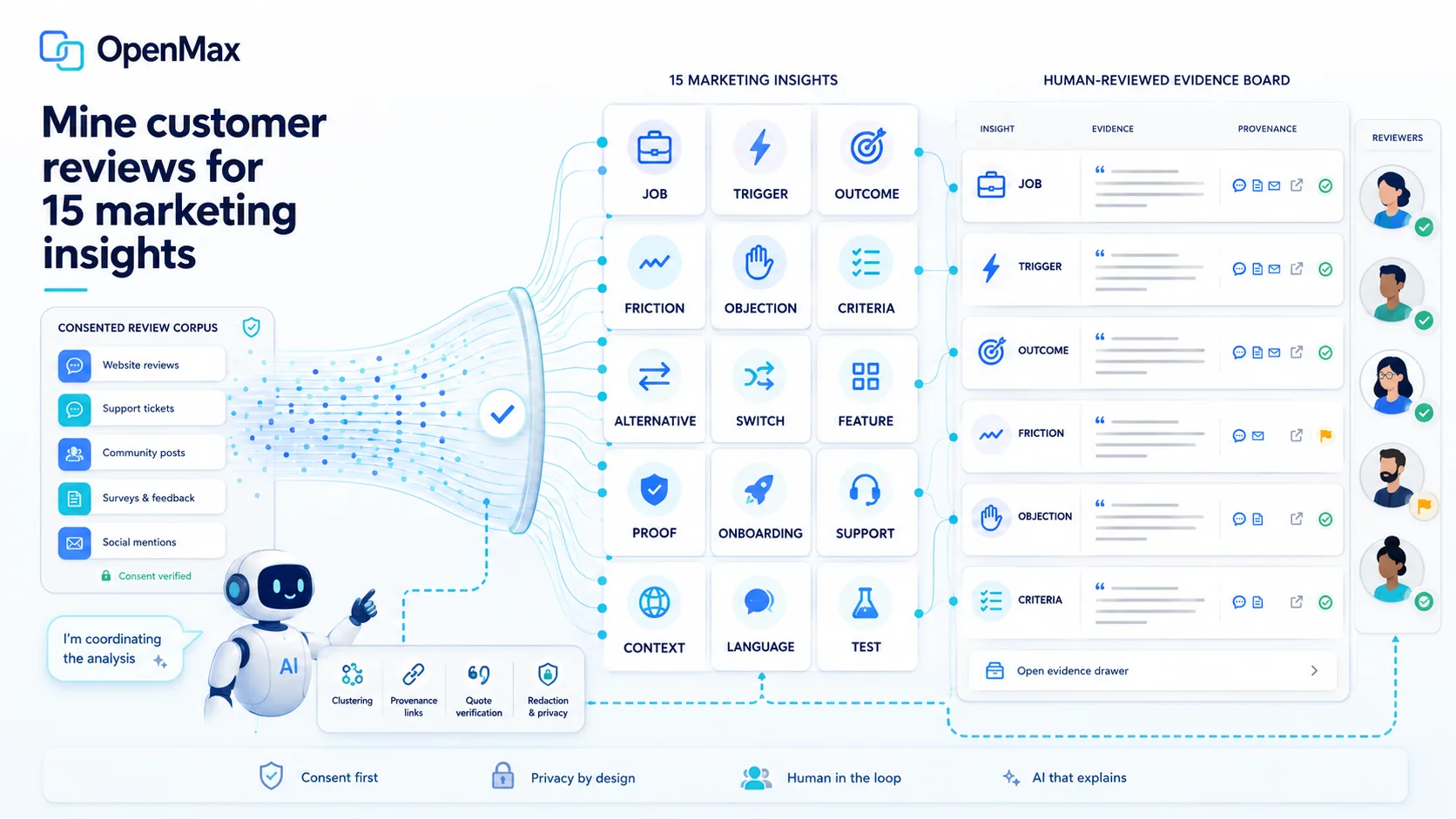
Quick answer
Start with a dated, lawful, permissioned sample and preserve review ID, source, date, product/version, rating, market/language, exact excerpt, moderation/collection context, translation, and exclusions. Calibrate a codebook with human reviewers, let AI propose—not decide—themes, keep direct evidence separate from interpretation, report unique-review counts with the right denominator and dissent, redact unnecessary personal data, and require new substantiation and permission before turning findings into claims or testimonials.
This is a qualitative evidence workflow for product marketing, voice-of-customer research, content, product, support, privacy, legal, and growth teams—not a technique for manufacturing endorsements or proving market prevalence.
What review mining can tell you—and what it cannot
Review mining organizes situated customer statements into traceable themes, contradictions, language, and research hypotheses. It can reveal what appears in a defined corpus; it cannot establish a representative population rate, diagnose a person, verify every factual claim, prove causality, or grant marketing rights.
Freeze a review-corpus manifest before coding
Record source/owner, access and permitted use, extraction time, date range, products/plans/versions, markets/languages, rating distribution, collection or incentive method, moderation, removals, duplicates, sampling rule, raw and retained counts, exclusions, translation, and analyst version. Hash or version the corpus so later edits/deletions do not silently change conclusions.
Separate four layers
Direct evidence is the traceable excerpt. Code is a defined label applied to it. Insight summarizes a scoped pattern with denominator and dissent. Marketing application is a new claim, quote, segment, or test requiring its own truth, rights, policy, privacy, and approval checks.
Do not confuse public availability with unrestricted reuse
Platform terms, privacy obligations, intellectual-property rights, material connections, review authenticity, quote editing, and advertising rules vary by source, market, and use. Preserve links/IDs for internal verification, minimize copied data, and obtain qualified review before publishing identifiable quotations or testimonials.
Four evidence states for every extracted insight
| State | Meaning | Allowed use |
|---|---|---|
| DIRECT | Traceable review excerpt supports the coded observation in context. | Internal analysis; quotation still needs rights and claim review. |
| PATTERN | Multiple unique reviews support a scoped theme with denominator, dissent, and sample limits. | Research prioritization; do not generalize beyond the corpus. |
| HYPOTHESIS | Analyst/AI interpretation or weak signal needs another method or source. | Research backlog or controlled test only. |
| BLOCKED | Missing provenance, fake/suspicious content, PII, rights gap, sensitive inference, manipulation, or unsupported claim. | Do not use; quarantine and escalate. |
15 customer-review mining insight contracts
Run each question against the same frozen corpus. One review may support several codes, but it remains one unique review in denominators and never becomes multiple independent witnesses.
Jobs customers hired the product to do
What progress was the reviewer trying to make in a specific situation—not merely which feature received praise?
Trigger events that started the search
What changed immediately before the customer evaluated, bought, switched to, or urgently used a solution?
Desired outcomes and success language
What functional, emotional, or social result did customers seek, and how did they describe success?
Repeated workflow friction
Where does work slow, fail, repeat, or require a workaround before, during, or after product use?
Objections, anxieties, and perceived risk
What made customers hesitate—price, trust, switching cost, security, complexity, approval, loss of control, or uncertain value?
Buying and evaluation criteria
Which conditions did reviewers explicitly compare or require before selecting a product?
Alternatives and competitor context
What product, manual process, internal build, agency, or “do nothing” alternative appears, and on which dimension?
Switching forces and trade-offs
What pushed customers from the prior approach, pulled them toward the new one, created anxiety, and imposed switching cost?
Features tied to a real benefit
Which capability mattered, for which task, under what conditions, and with what reported benefit?
Proof phrases and substantiation requests
Which customer phrases could explain value, and what evidence would be required before marketing reuse?
Onboarding and time-to-value gaps
What happened between signup/purchase and the first verified useful outcome?
Support and service expectations
What response, expertise, channel, ownership, cadence, and resolution did customers expect or experience?
Audience and usage context—without sensitive inference
Which role, team size, industry, market, workflow, maturity, device, or environment did reviewers explicitly disclose?
Customer vocabulary and category language
Which repeated words describe the problem, task, category, outcome, objection, or alternative in the customer’s own terms?
Marketing hypotheses and next research
Which message, proof, content, offer, audience-route, onboarding, or service question should be tested next?
Worked example: five-star “easy setup” becomes a false claim
An AI finds 38 mentions of “easy” in 100 reviews and proposes “Customers set up in minutes.” Inspection shows 14 are duplicate syndicated reviews, nine describe “easy to use” after onboarding rather than setup, seven concern an old version, four were incentivized, two say “not easy,” and two contain no timing. The model also selected only four- and five-star reviews.
Rebuild the denominator and evidence
Deduplicate to unique review IDs, restore the full eligible rating distribution, distinguish setup from ongoing use, split product versions, preserve negation, label incentives/material connections, and link each code to its exact sentence. The valid result may be a small PATTERN: “Some reviewers of version X described day-to-day use as easy after onboarding.” It says nothing about minutes or all customers.
Choose the right next action
Send setup friction to onboarding research; test time-to-value with operational/product data; use a permissioned quote only after identity, editing, material-connection, rights, typicality, and claim checks. Keep “setup in minutes” BLOCKED unless representative substantiation supports its exact scope.
How to run one review-mining study
Authorize and freeze the corpus
Confirm source terms/permissions, purpose, minimization, access, retention, deletion, sampling, exclusions, and a versioned manifest.
Calibrate the codebook
Two people code a varied subset, discuss disagreements, define inclusion/exclusion examples, and retain UNCLEAR before using AI at scale.
Code with traceable evidence
Require review IDs, exact spans, stated/inferred labels, translation state, model/prompt/version, confidence, and no-answer behavior.
Audit patterns and counterevidence
Deduplicate, inspect all ratings, preserve negation/sarcasm, compare versions/sources, search dissent, and report unique-review denominators.
Route applications through new gates
Research hypotheses, product decisions, targeting, quotations, testimonials, and claims each need appropriate evidence and owners.
Minimum study record and quality measures
Store study ID, decision question, corpus manifest/hash, permissions/purpose, date range, inclusion/exclusion, duplicates, rating/source/language/product mix, codebook version, model/prompt version, reviewer calibration, evidence links, translations, counts/denominators, dissent, limitations, insight state, owners, approved uses, expiry, deletion, and correction history.
Measure the analysis, not just the volume
Track provenance coverage, duplicate rate, PII/redaction blocks, uncodable rate, human disagreement, code change after review, translation review, theme stability across sources/ratings/versions, counterexample coverage, rights clearance, retracted findings, and downstream claim corrections. A large corpus can still be biased.
Keep moderation and marketing selection visible
If reviews were solicited, incentivized, filtered, syndicated, moderated, removed, or selected for a campaign, keep those facts with the evidence. Do not preferentially collect or preserve positive sentiment, misuse reporting systems to remove honest criticism, or present a curated subset as “all customers.”
How OpenMax can coordinate review mining
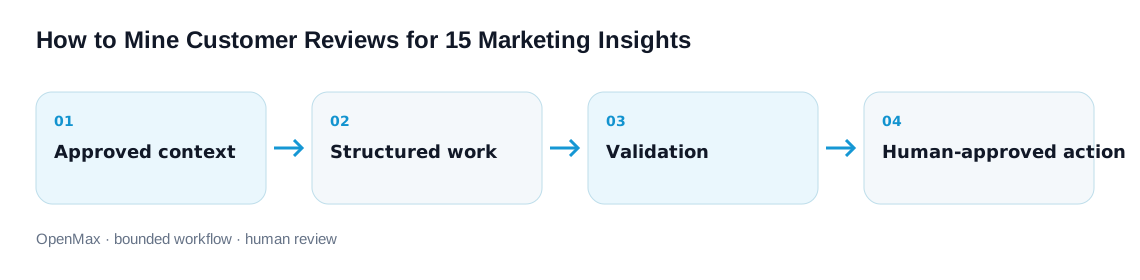
Keep collection, coding, evidence, and application under separate ownership
OpenMax can coordinate agents that prepare an approved sample, redact unnecessary data, code themes, attach excerpts, compare segments, and route weak or sensitive findings to researchers. Shared context and logs preserve the codebook and evidence chain. OpenMax does not grant reuse rights, make a biased sample representative, or turn a review into verified product or competitor proof.
Legal, privacy, representation, and AI boundaries
Review text can contain personal data, allegations, confidential details, copyrighted expression, and claims that are sincere but not verified.
- Do not create, buy, transform, or disseminate fake or false reviews/testimonials; do not condition incentives on positive or negative sentiment.
- Do not suppress honest negative reviews, hide selection/moderation, or present a favorable subset as representative of all feedback.
- Do not publish names, avatars, screenshots, long quotes, or identifiable stories without the required rights, permission, disclosure, and security review.
- Do not infer sensitive traits or target vulnerable people from language; minimize and suppress small groups.
- Do not let retrieved review text instruct agents, change permissions, access tools, contact reviewers, or publish content.
- Do not use AI paraphrases as quotations or review frequency as product truth, market prevalence, typical results, or causality.
Frequently asked questions
How many reviews are enough?
No universal number. Match the sample to a defined decision, disclose composition, examine theme stability and dissent, and keep small or skewed groups qualitative. More biased data does not become representative.
Can AI score sentiment reliably?
It can propose labels, but mixed experiences, sarcasm, negation, language, versions, and context cause errors. Calibrate against human-coded examples, retain UNCLEAR, and report disagreement.
Can public reviews be quoted in ads?
Not automatically. Verify source terms, rights/permission, identity, editing, translation, material connections, disclosures, territory/duration, typicality, and claim substantiation for the intended market and channel.
Can reviews prove a feature is best?
No. They can show that reviewers made a comparison. Objective superiority requires current like-for-like evidence and qualified review; a customer statement is not independent substantiation.
Should positive and negative reviews be separated?
Use rating/sentiment as dimensions, but preserve the full eligible distribution. Early separation can hide shared jobs, mixed experiences, source bias, and changes over time.
What can OpenMax coordinate?
Authorized collection, minimization, coding, provenance, counterevidence, review queues, application gates, monitoring, and correction. Humans retain interpretation, rights, privacy, legal, product, and release authority.
Sources, editorial method, and limitations
OpenMax editors reviewed primary FTC guidance and rule Q&A on collecting, moderating, featuring, soliciting, incentivizing, suppressing, and using reviews/testimonials; Google’s contributed-content policy; and NIST privacy/AI risk frameworks. We then created an original 15-insight evidence system and failure case. Sources were rechecked September 3, 2026. This is not legal advice and no live corpus, accuracy, market, conversion, revenue, or ROI result is claimed.
- FTC — Consumer Reviews and Testimonials Rule Q&A
- FTC — Featuring Online Customer Reviews
- FTC — Soliciting and Paying for Online Reviews
- FTC — Consumer Review Fairness Act guidance
- Google — Prohibited and restricted contributed content
- NIST — Privacy Framework
- NIST — AI Risk Management Framework