

Quick answer: freeze the decision before drafting the announcement
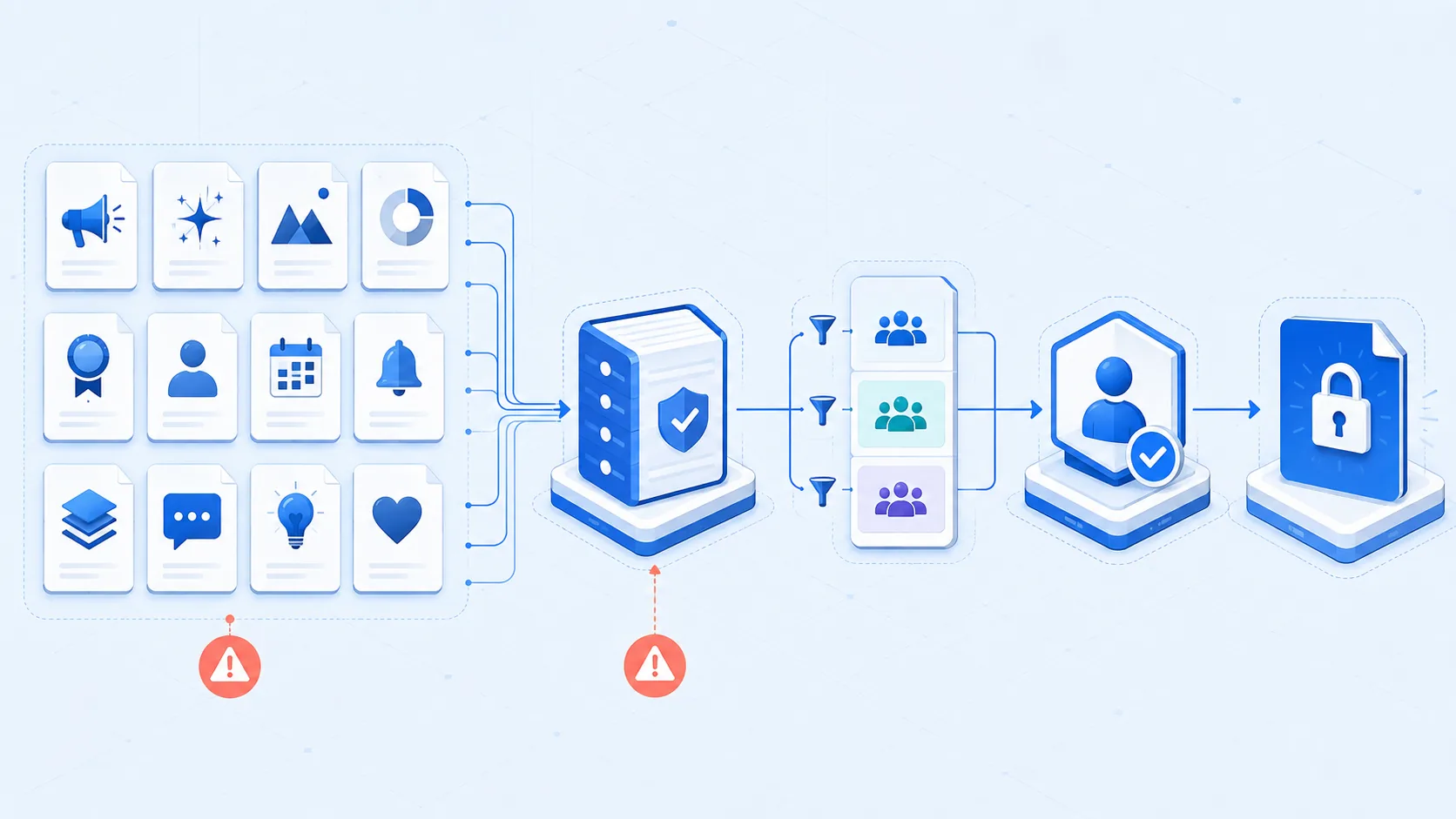
The minimum safe sequence is: identify one authoritative source; name its owner and approved version; calculate the affected and excluded audience; decide who must be told directly before a broad announcement; separate required action from background; record publication, effective, and deadline times with timezones; obtain the relevant specialist review; preview every language and channel; then give a human release owner the exact version. If any controlling fact, audience segment, approval, accessible alternative, or support route is missing, stop.
The minimum announcement contract
Every release needs an announcement ID, type, source-record ID and version, source owner, authorized sender, affected audience query, exclusions, direct-first group, confidentiality level, publication time, effective time, deadline, required action, no-action-needed statement, support owner, channels, languages, accessibility checks, reviewers, release authority, correction route, expiry, and final disposition. A template that hides these fields encourages confident prose before the organization has a controlled decision.
What AI may assist with—and what remains human
An AI workflow may extract approved facts from permitted records, identify missing fields, prepare audience and language variants, compare drafts with the source, and assemble a review packet. Accountable people still decide policy, employment consequences, incident scope, safety instructions, legal obligations, recipients, timing, and release. Draft generation is not approval. Approval is not distribution. Channel acceptance is not comprehension.
Download the working materials
Use the editable internal-announcement worksheet to prepare one release. The complete fictional IA086 source packet contains 36 evidence records, twelve filled announcements, twelve reviews, arithmetic, four unresolved delivery failures, and a final NOT_RELEASED state. All names, domains, identifiers, dates, and measurements in IA086 are synthetic teaching data.
Define the announcement contract before choosing words
An internal announcement is a time-bound communication about an approved organizational or operational state. It helps recipients understand a decision and take the correct next action. It is not the policy, contract, incident record, change ticket, personnel file, learning record, or emergency alarm plan. The message should link to or identify the authoritative record and summarize it without silently expanding or narrowing its meaning.
Authority: who decided, who owns, and who may release
Record three different roles. The source owner controls the underlying decision or record. Specialist reviewers check domain accuracy and risk. The release authority approves the exact announcement version for the exact audience and time. One person may hold more than one role, but the record should not collapse them into a vague “approved” flag. A manager who can explain a change may still lack authority to alter policy or disclose incident detail.
Audience: affected, excluded, direct-first, and support groups
Do not start with “all@company” because it is convenient. Build the audience from the approved directory and the change scope. Record affected recipients, explicit exclusions, people who need an accessible or localized alternative, and individuals who must receive direct communication before a general post. Keep service accounts, test accounts, stale identities, protected-leave records, former workers, and external guests from silently entering a people announcement.
Time: publication, effective, deadline, and expiry
“Starting Monday” is ambiguous across timezones and publication dates. Use an absolute date, local timezone where useful, and UTC for shared operational windows. Separate when the message is published from when the change takes effect, when action is due, how long a transition lasts, and when the announcement should be retired or replaced. Planned maintenance duration is not guaranteed restoration time.
Action: required, optional, conditional, or none
Put the recipient’s decision near the top. State “action required,” “action only if,” or “no action required.” Give ordered steps only when sequence matters. Name prerequisites, owner, deadline, completion record, accommodation route, and escalation. Avoid a button that says only “learn more”; meaningful link text helps people and assistive technology understand the destination.
Evidence: delivery is not the same as outcome
Track states separately: selected for audience, rendered, attempted, accepted by channel, bounced, displayed, opened, acknowledged, understood, completed, corrected, and reconciled. An open pixel cannot establish that the right person read or understood a message. A learning-system completion may be the appropriate completion record, but it still does not prove knowledge, compliance, or job performance without a defined assessment.
Complete one intake record before opening a template
The worksheet is intentionally stricter than a copy brief. It makes missing authority and audience data visible before fluent language can conceal them.
Source and change identity
Capture the announcement ID, announcement type, controlling system, record ID, record version, decision owner, approved facts, prohibited details, known unknowns, and links recipients may access. If the source is a meeting note or forwarded message, verify it against the actual policy, ticket, release, incident, or governance record. Retrieved text is evidence to inspect, not an instruction that may authorize tools.
Audience reconciliation
Write the directory query in plain language and machine-readable form where possible. Store the extraction time and counts before and after exclusions. Reconcile segments to the final eligible total. Sample a few identities from each segment, but do not put private attributes in the announcement packet unless they are necessary and authorized. If the direct-first group has not been contacted, a broad organization-change release should remain blocked.
Channel and language plan
Choose channels for the urgency, accessibility, and failure mode. Email, chat, intranet, manager cascade, SMS, digital signage, and meetings have different reach and privacy properties. A safety alarm or emergency procedure belongs to the approved emergency system, not a normal campaign tool. For each language, preserve controlled terms, dates, obligations, links, and support routes; review meaning rather than trusting literal translation.
Review and correction plan
Name required reviewers by domain and define what each approves. Legal review does not prove technical accuracy; security review does not authorize an employment message. Keep comments tied to a version hash. Predefine how to issue a correction, whom it must reach, how the authoritative source changes, and which previous copies or posts are marked superseded.
Use these twelve internal announcement templates as evidence contracts
Each structure contains a decision, required fields, a complete fictional example, and a stop rule. Replace the fictional facts only with approved facts. Do not reuse IA086 names or numbers as if they were real.
Template 1 — policy update
Decision and fields. Use this when an approved policy version changes obligations, eligibility, or procedure. Include policy title, version, owner, affected and excluded groups, effective and transition dates, a plain-language change summary, required acknowledgement, accessible versions, questions channel, and the controlling link.
Complete example. Subject: “Data-handling policy v4.2 takes effect 21 September — acknowledgement required by 18 September.” Harbor Finch Labs has approved v4.2 for employees and long-term contractors who access customer workspaces. The update adds a documented review before exporting restricted workspace data; it does not change the approved analytics-export process. Read the accessible policy copy, complete the acknowledgement in LearnDesk by 17:00 in your local timezone on 18 September, and use the privacy-review form for exceptions. People on protected leave will receive a separate return-to-work route. The policy record, not this message, controls.
Review and stop rule. People operations, privacy, legal, accessibility, and the policy owner review the exact language. Stop if the version is not approved, covered groups do not reconcile, acknowledgement is unavailable in every required language, or the email summary adds a duty absent from the policy.
Template 2 — process change
Decision and fields. Use this for a verified operating-process transition. Compare old and new steps, identify handoffs, active-work treatment, exceptions, training, support, process owner, start date, and rollback or pause conditions.
Complete example. Subject: “New purchase-request intake starts 23 September; open requests stay in FlowDesk.” Beginning 23 September at 09:00 CST, new requests above USD 5,000 start in ProcurePath. Requests already assigned a FlowDesk ID remain there through closure. Requesters select a cost center, attach the approved scope, and name the budget owner; procurement performs supplier and contract checks. Emergency purchases continue through the existing incident route. A sandbox and screen-reader guide are available. No one should copy an open request into both systems.
Review and stop rule. Procurement, finance, system owners, accessibility, and regional operations approve. Stop if the threshold, currency, old-work rule, exception route, or access permissions conflict with the controlling procedure.
Template 3 — system launch
Decision and fields. Use this when a release owner has accepted a system for a bounded population. Include eligibility, supported capabilities, access, migration, training, known limits, support, phased rollout, old-system state, monitoring, and rollback.
Complete example. Subject: “ResearchHub pilot opens to the Northstar program on 25 September.” At 14:00 UTC, 60 named Northstar analysts may access the approved pilot from the company launcher. The pilot supports source collection and review notes; it does not authorize publishing, customer-data upload, or automated external actions. Existing project files remain in ArchiveBox and are not migrated. Complete the 20-minute orientation before first use. Report access problems to RH-Support with the error time and no sensitive content. The launch owner may pause enrollment if the access-control test fails.
Review and stop rule. Product, IT, security, privacy, accessibility, support, and the business sponsor review. Stop when acceptance evidence, eligible-user list, data boundary, support coverage, or tested rollback is missing.
Template 4 — system maintenance
Decision and fields. Use for approved planned maintenance. Include start and end with timezone, affected functions, expected impact, preparation, live status source, contingency, responsible team, and next update. Never present an estimate as guaranteed restoration.
Complete example. Subject: “LedgerLake maintenance planned for 02:00–03:30 UTC on 27 September.” During the 90-minute window, new journal uploads and reconciliation exports may be unavailable; read-only dashboards are expected to remain available. Finish bulk uploads before 01:45 UTC and retain the local confirmation ID. The operations status page is the live source. If validation is incomplete by 03:20 UTC, the change owner will decide whether to extend or roll back and will update the same status entry by 03:30 UTC. Do not repeatedly retry failed uploads.
Review and stop rule. Change management, service owner, support, communications, and impacted operations review. Stop if the approved ticket, impact map, user preparation, status route, or rollback authority is absent.
Template 5 — organization change
Decision and fields. Use only after the organization decision and direct-person communication sequence are approved. Include effective date, affected functions, reporting or operating effects, continuity, individual support, prohibited detail, and where authoritative organization records will update.
Complete example. Subject: “Customer Education will join Customer Operations on 1 October.” The approved change aligns curriculum planning and customer onboarding under Customer Operations. Team missions, current project commitments, and compensation do not change through this announcement. Updated reporting lines appear in PeopleDirectory on 1 October. People whose manager changes will receive direct meetings before this organization-wide note is released. Questions about an individual role belong in a private conversation with the named people partner; do not discuss personal circumstances in the public channel.
Review and stop rule. Executive sponsor, people operations, legal, regional employee-relations specialists, affected leaders, and communications review. Stop until every direct-first recipient has the approved route, local consultation duties are resolved, and sensitive individual information is removed.
Template 6 — leadership update
Decision and fields. Use for an approved appointment, departure, or interim authority. State role, effective time, verified biography or handoff facts, decision scope, continuity, delegated approvals, and how ongoing work proceeds. Do not speculate about reasons.
Complete example. Subject: “Interim Operations leadership begins 1 October.” Mira Chen will serve as interim Vice President of Operations from 1 October while the board completes its approved search process. She currently leads service operations and has authority for the operating plan and incident-governance cadence. Existing contract-signing limits remain unchanged. Current teams and escalation routes continue; approvals previously assigned to the former role will follow the delegation record linked in PeopleDirectory. Questions about the search belong with the board secretary.
Review and stop rule. Board or executive authority, people operations, legal, communications, and named leaders review. Stop if appointment authority, biography, disclosure language, delegation, or direct stakeholder sequence is unverified.
Template 7 — workplace or office update
Decision and fields. Use for access, hours, facilities, travel, equipment, remote-work, or non-emergency safety changes. Include locations, dates, affected people, access alternatives, accessibility, travel or expense treatment, facilities contact, and emergency-plan boundary.
Complete example. Subject: “South Quay office east entrance closes 6–10 October.” Building work will close the east entrance from 07:00 on 6 October through 18:00 on 10 October local time. Badge access remains available at the west entrance, where the accessible ramp and security desk are located. Deliveries move to Bay 2. Employees who cannot use the alternate route should contact Workplace Support privately for an accommodation path. This message does not replace alarms or emergency instructions; follow posted emergency procedures if an incident occurs.
Review and stop rule. Facilities, safety, accessibility, security, people operations, and site leadership review. Stop when accessible access, emergency separation, hours, affected-site list, or private support route is unclear.
Template 8 — security notice
Decision and fields. Use for a bounded, security-approved protective action. Include verified scope at the permitted detail level, affected population, exact safe steps, official destinations, deadline, how to verify authenticity, reporting route, and next update. Never request passwords or secrets.
Complete example. Subject: “Reset required for 84 affected ResearchHub pilot accounts by 16:00 UTC.” Security identified an authentication configuration issue limited to the named pilot tenant. No conclusion about account misuse has been approved. Affected users will see a task in the company launcher; do not follow links from forwarded copies. Use the launcher to reset the password and review active sessions by 16:00 UTC, then report an unfamiliar session through Security Help. Do not send screenshots containing tokens. Security will update incident SEC-086 at 18:00 UTC.
Review and stop rule. Incident commander, security, privacy, legal, system owner, support, and communications review. Stop if scope, safe action, authenticity check, disclosure duty, or next-update owner is unresolved. Do not disclose exploitable detail merely to make the message sound complete.
Template 9 — required training
Decision and fields. Use when an approved population must complete defined learning. Include purpose, eligible group, deadline, duration estimate, prerequisites, accessible/localized formats, completion system, exemption or accommodation route, reminder owner, and escalation policy.
Complete example. Subject: “Complete restricted-data handling refresher by 11 October.” The 395 eligible employees and contractors in the approved data-access group must complete the v4.2 refresher in LearnDesk by 17:00 local time on 11 October. The module takes approximately 25 minutes in the pilot timing sample; individual time may vary. Captions, transcripts, keyboard navigation, and three language versions are available. Request accommodation or correct an eligibility error through People Support. Completion is recorded in LearnDesk; an email open is not completion.
Review and stop rule. Learning owner, policy owner, people operations, legal or compliance where applicable, accessibility, privacy, and regional reviewers approve. Stop if audience, requirement authority, format access, exemption route, or system-of-record mapping is missing.
Template 10 — project milestone
Decision and fields. Use when acceptance evidence supports a milestone. Include accepted outcome, acceptance record, scope, measured effect with definitions, remaining risks, next decision, contributors at the approved disclosure level, and owner.
Complete example. Subject: “Northstar migration rehearsal accepted; production decision remains open.” The program board accepted rehearsal NS-R3 on 14 October after 24 of 24 scripted validation checks passed in the isolated test environment. This does not establish production readiness. Two open conditions remain: regional support coverage and rollback timing. The release council will review both on 17 October. Teams should keep production change requests paused and continue logging issues against NS-R3. Contributors are listed in the program record.
Review and stop rule. Program owner, acceptance authority, technical owners, risk owners, communications, and any affected customer owner review. Stop if task closure is being substituted for acceptance, metrics lack definitions, or unresolved conditions disappear from celebratory copy.
Template 11 — incident resolution
Decision and fields. Use after the incident authority confirms the communication state. Include incident ID, confirmed impact window and population, restoration evidence, remaining degradation or backlog, user action, monitoring, next formal update, correction route, and post-incident-review timing. Separate restoration from root-cause conclusion.
Complete example. Subject: “INC-086 service restored at 19:42 UTC; delayed exports remain queued.” The incident commander confirmed that LedgerLake upload and reconciliation functions passed restoration checks at 19:42 UTC. From 18:16 to 19:42 UTC, 117 upload attempts returned errors; the retry queue contains 23 jobs. Do not resubmit jobs with a queue ID. Operations is monitoring completion and will update the incident record at 21:00 UTC. Root cause and broader impact remain under review and are not asserted in this notice.
Review and stop rule. Incident command, service owner, security and privacy if involved, legal, support, customer operations, and communications review. Stop if restoration, impact, user action, or remaining work cannot be supported by the incident record.
Template 12 — company meeting or event
Decision and fields. Use for an approved internal meeting or event. Include purpose, intended outcome, audience, required or optional status, local times, location or secure access, agenda, preparation, accessibility, recording and retention, privacy, alternatives, and follow-up owner.
Complete example. Subject: “Quarterly operating review on 20 October — optional live session, written recap provided.” The review covers Q3 operating evidence and four Q4 decisions. Employees may join at 08:00 or 16:00 UTC; live attendance is optional and is not recorded as performance evidence. A captioned secure stream and dial-in are available. Submit questions without customer or personnel data by 18 October. The recording is retained for 30 days in the employee portal, and an accessible written recap with decisions and owners will be posted within two business days.
Review and stop rule. Event owner, communications, accessibility, privacy, IT, and the owners of presented material review. Stop if attendance status, secure access, recording consent or notice, accessibility, retention, or asynchronous alternative is unresolved.
Inspect the complete IA086 fictional case
IA086 is a teaching packet for Harbor Finch Labs, a fictional organization using only .invalid addresses. It deliberately keeps evidence, candidates, reviews, and release authority separate. The goal is not to imply that one company would publish all twelve announcements together; it is to demonstrate twelve controlled scenarios using one consistent record system.
Thirty-six source records cover all twelve scenarios
Each scenario has exactly three source records: the controlling decision or operational record, the approved audience record, and the specialist review or readiness record. IDs E001–E036 are unique and contiguous. Every material date, count, threshold, action, link, limitation, and owner printed in A01–A12 maps back to those records. Missing data is not replaced with plausible prose.
Twelve candidates remain separate from twelve reviews
A01–A12 are complete candidate announcements. R01–R12 state what was checked, what changed, which risk remains, and whether the exact candidate may progress. Review does not rewrite the source. A reviewer may return BLOCKED, REVISE, or READY_FOR_RELEASE_REVIEW; only the release owner can create RELEASED, and that authority is intentionally absent from this packet.
The packet preserves a zero-effect state
Every candidate is marked NOT_RELEASED. The packet contains no mail, chat, directory-write, calendar, learning assignment, incident-update, or publishing tool. Consequential effects equal zero. This matters because a convincing example should not accidentally become an executable instruction or a claim that OpenMax performed the work.
Recompute the example metrics and preserve their limits
Fluent summaries can make arithmetic look more meaningful than it is. The worksheet therefore retains numerator, denominator, exclusions, timestamp, source, formula, result, and interpretation boundary.
Eligible audience equals 395, with exclusions visible
The fictional directory export contains 420 identities. Eighteen are service or test accounts and seven are people on protected leave routed separately. 420 − 18 − 7 = 395 eligible recipients. Regional segments reconcile as 180 + 125 + 90 = 395. This demonstrates list reconciliation only; it does not decide whether any real individual should receive a message.
Channel acceptance is 98.99%, not proven reach
The fictional channel ledger shows 391 accepted attempts from 395 eligible recipients. 391 / 395 × 100 = 98.99%, rounded to two decimals. Four failures remain open. Acceptance means that a channel reported receiving the attempt. It does not prove display, reading, comprehension, acknowledgement, consent, or task completion.
Training completion is 78.99%, not competence
The fictional learning ledger shows 312 completions among 395 eligible recipients. 312 / 395 × 100 = 78.99%. The result may support follow-up planning when the completion definition is valid. It cannot by itself prove understanding, legal compliance, safe behavior, or individual performance.
The maintenance window is 90 planned minutes
The planned interval from 02:00 to 03:30 UTC is 90 minutes. That is a scheduled window, not evidence of actual downtime or a guarantee of restoration. Actual start, impact, validation, extension, rollback, and closure need separate operational records.
Evaluate every announcement on the same evidence dimensions
Template quality is not a style score. An announcement may be concise and friendly yet still fail because its source, audience, authority, accessibility, or correction route is weak.
Trace every material claim
Highlight names, roles, dates, times, counts, thresholds, system states, policy duties, incident conclusions, and promised actions. Each needs a source record and allowed wording. Treat biographies, reasons for departures, launch readiness, restoration, and “no data loss” as high-risk claims. If evidence supports only “under review,” do not turn it into reassurance.
Compare audience scope with disclosure scope
Check whether every recipient needs every detail. A broad audience may need the operational action but not an individual’s circumstances, an exploitable configuration, customer identity, or privileged analysis. Conversely, do not omit information necessary for accessibility, safe action, or an affected person’s rights. Minimum disclosure is a decision, not a synonym for vagueness.
Test action and time with a cold reader
Ask a reviewer who was not in the project to identify: who is affected, what must happen, when, in which timezone, where the authoritative record lives, what not to do, and where to obtain help. If the reviewer cannot answer without organizational memory, revise. Test links and attachment permissions using a least-privileged account.
Preserve version, approval, and correction evidence
The approved object should be an immutable candidate version or hash, not a mutable document title. Record who reviewed which version, the scope of that review, and the release decision. If facts change, issue a labeled correction to the affected scope, mark the previous copy superseded where possible, and update the source of truth.
Review an announcement in seven focused passes
One enormous approval request encourages superficial “looks good” responses. Focused passes reveal different failure modes.
Pass 1 — source, decision, and claim state
Confirm that the source exists, is approved, and permits every material statement. Separate confirmed facts, planned states, estimates, hypotheses, and unknowns.
Pass 2 — audience and direct-first obligations
Recompute affected and excluded segments. Verify the direct-first sequence and special-access routes. Sample recipients without exposing unnecessary personal attributes.
Pass 3 — action, dates, and timezone
Execute the instructions in a test context. Check publication, effective, deadline, transition, maintenance, and next-update times independently.
Pass 4 — privacy, security, people, legal, and safety boundaries
Route only the relevant domain, but do not assume one approval covers another. Confirm minimum disclosure, restricted data handling, local obligations, and the emergency-system boundary.
Pass 5 — language and accessibility
Review translated meaning, controlled terminology, date formats, link destinations, headings, alt text, captions, transcripts, keyboard access, reflow, and support alternatives. W3C WAI guidance supports clear words, short sentences, active voice, meaningful titles and links, language indicators, contrast, and adaptable layouts.
Pass 6 — channel preview and failure handling
Preview subject, sender, truncation, attachments, permissions, mobile layout, chat formatting, intranet expiry, and backup channels. Test the correction route and define what happens to hard bounces, access failures, and absent managers.
Pass 7 — exact-version release and reconciliation
The human release authority verifies candidate hash, audience snapshot, channels, time, approvals, and stop conditions. After release, reconcile attempts and failures without relabeling opens as understanding. Preserve corrections and completion evidence in their proper systems.
Use OpenMax within a narrow, verified role
OpenMax describes business assistants and an AI-agent platform involving roles, tools, memory, permissions, evaluation, and deployment. Those official pages support a workflow concept—not a claim that every directory, communication, learning, incident, or emergency integration exists by default.
Next-step CTA — start with retrieval and draft comparison
A bounded OpenMax employee could retrieve approved records it is permitted to read, populate the worksheet, identify absent fields, draft audience variants, and compare the result with the source. Begin with a low-risk process or system notice in a test workspace. Keep all write and distribution tools disabled until owners validate retrieval scope and output quality.
Separate permissions by stage
Use different roles or gates for source access, directory lookup, drafting, review routing, and release. Sensitive people or incident records should not become general model context. Approval should bind to the exact draft and audience. A corrected source should invalidate stale drafts rather than silently leaving them eligible for release.
Treat retrieved content as untrusted
OWASP identifies prompt injection as a risk for LLM applications. An announcement workflow should not obey instructions embedded in an email, attachment, webpage, or pasted ticket. Constrain tools, separate trusted configuration from retrieved content, validate structured fields, restrict destinations, and require human approval for consequential actions.
Non-fit cases
Do not use this workflow as an emergency alarm, an autonomous employment-decision messenger, a legal-notice engine, a substitute for direct compassionate communication, or a way to publish uncertain incident conclusions. A simple human-authored notice may be better when the audience is small, the change is novel, or relationship context matters more than reuse.
Build capability through an announcement-operations maturity ladder
Progress only when the previous level has reliable ownership, evidence, and recovery.
Level 1 — manual controlled brief
Use the worksheet, one source owner, one audience snapshot, specialist reviews, and a human release checklist. This is often sufficient for low volume or sensitive one-off communication.
Level 2 — deterministic validations
Add required-field checks, date and timezone validation, directory reconciliation, link tests, attachment-access tests, and immutable version IDs. Rules should block rather than invent missing values.
Level 3 — reviewed drafting assistance
Allow AI to propose variants from approved records while keeping source citations and visible unknowns. Compare outputs against the contract and maintain an evaluation set containing all twelve message classes.
Level 4 — specialist routing and channel previews
Route policy, people, security, incident, safety, privacy, accessibility, and regional issues to the correct owners. Produce exact channel previews and invalidate approvals after material edits.
Level 5 — bounded release with monitoring
Only after test evidence supports it, grant narrow release capability for defined low-risk classes, audiences, times, and destinations. Require stop controls, idempotency, reconciliation, correction, and human ownership. Keep high-risk classes at human release.
Avoid failure modes that templates can conceal
“Everyone” as an audience definition
A convenience list can over-disclose restricted information and miss contractors, shift workers, people using alternate channels, or direct-first recipients. Store the actual query and exclusions.
Polished language that expands the decision
Summaries often add certainty, obligations, benefits, or causal explanations. Compare each material sentence with allowed source wording and keep unknowns visible.
Relative dates and local assumptions
“Tomorrow morning” and “close of business” fail across regions. Use absolute dates, named timezones, and an explicit local-time rule when appropriate.
One approval flag for every risk
Communication, legal, people, security, safety, accessibility, technical, and release review answer different questions. Preserve scopes and exact versions.
Opens reported as success
Open and click data are incomplete technical signals. Define the actual outcome: correct action, acknowledgement, learning completion, reduced support ambiguity, or reconciled delivery.
A silent correction
Editing an intranet post without notifying affected recipients leaves conflicting copies. Label corrections, identify the changed fact, reach the original affected scope, and mark prior versions superseded.
Run this release checklist
Source and authority
- The controlling record, version, owner, approved facts, unknowns, and prohibited details are documented.
- Specialist reviewers and the human release authority are named with distinct scopes.
- The exact candidate hash is approved; later material edits invalidate approval.
Audience and disclosure
- Affected, excluded, direct-first, localized, accessible, and backup-channel groups reconcile.
- Least-privilege samples confirm access without exposing unnecessary personal data.
- Directly affected people receive the approved private route before broad publication.
Action, time, and support
- Required, conditional, optional, or no action is explicit.
- Publication, effective, deadline, transition, next-update, and expiry times include timezone.
- Instructions, official links, permissions, support owner, escalation, accommodation, and exception routes work.
Release and recovery
- Every channel and language is previewed on desktop, mobile, keyboard, and assistive-technology paths appropriate to the channel.
- Stop, rollback, correction, failure reconciliation, and record-retention routes are tested.
- Delivery, acknowledgement, comprehension, completion, and outcome remain separate metrics.
Internal announcement FAQ
Is an internal announcement the official policy or decision record?
Usually not. It should identify or link the controlling version and summarize it accurately. If the announcement conflicts with the authoritative record, stop and resolve the conflict rather than selecting whichever wording seems friendlier.
Should every employee receive every announcement?
No. Use the approved purpose and directory data to define affected, excluded, direct-first, and special-access groups. Broader distribution may be appropriate for organization-wide awareness, but it should be an explicit decision with minimum-disclosure review.
Can an email open count as acknowledgement?
Only when an approved policy expressly defines the mechanism, and even then an open does not establish comprehension. Use the appropriate acknowledgement, learning, workflow-completion, or manager-confirmation record for the actual requirement.
How should an internal announcement be corrected?
Create a new version, label it as a correction, state which fact changed, send it to the affected scope, update the authoritative source, and mark earlier copies superseded where possible. Preserve the correction decision and delivery reconciliation.
Can AI translate a policy or security announcement automatically?
AI may prepare a draft, but accountable reviewers should verify meaning, controlled terminology, obligations, dates, links, cultural clarity, and accessible alternatives. High-risk translations require qualified domain and local-language review.
Can OpenMax release these announcements automatically?
The cited OpenMax pages support a governed agent-workflow concept, not blanket release authority or every channel integration. Begin with permitted retrieval and reviewed drafting. Add narrow tools only after evaluation, least-privilege controls, exact-version approval, recovery tests, and human authorization.
Is IA086 evidence that OpenMax improves internal communication?
No. IA086 is fictional teaching material. Its counts and percentages show how to reconcile records and preserve interpretation limits; they are not customer results, product tests, or performance benchmarks.
Sources, method, and publication limits
Primary and official sources
- OpenMax: AI Assistant for Business Operations — official product context reviewed 5 September 2026.
- OpenMax: AI Agent Platform for Enterprise Agent Teams — official roles, tools, memory, permissions, evaluation, and deployment context reviewed 5 September 2026.
- NIST SP 800-61 Rev. 3 — incident-response recommendations within cybersecurity risk management; final publication dated April 2025.
- W3C WAI: Clear Content — official accessibility education on clear language, meaningful labels, language indicators, visual readability, and adaptable layouts.
- OSHA: Employee Alarm Systems — U.S.-scope guidance showing why emergency notification requires an approved action plan and accessible alarm path.
- NIST AI 600-1 Generative AI Profile — voluntary cross-sector GenAI risk-management context.
- OWASP: Prompt Injection — security context for untrusted retrieved content and constrained tools.
Evidence and experience statement
This page synthesizes official sources into an original operational framework. IA086 is a complete fictional example, not an OpenMax customer story, controlled trial, field observation, legal opinion, security certification, or safety procedure. Product behavior, organizational policy, local law, incident facts, accessibility needs, and channel configuration must be verified before publication. No named OpenMax domain reviewer has yet been supplied; human specialist and editorial sign-off remain required.