

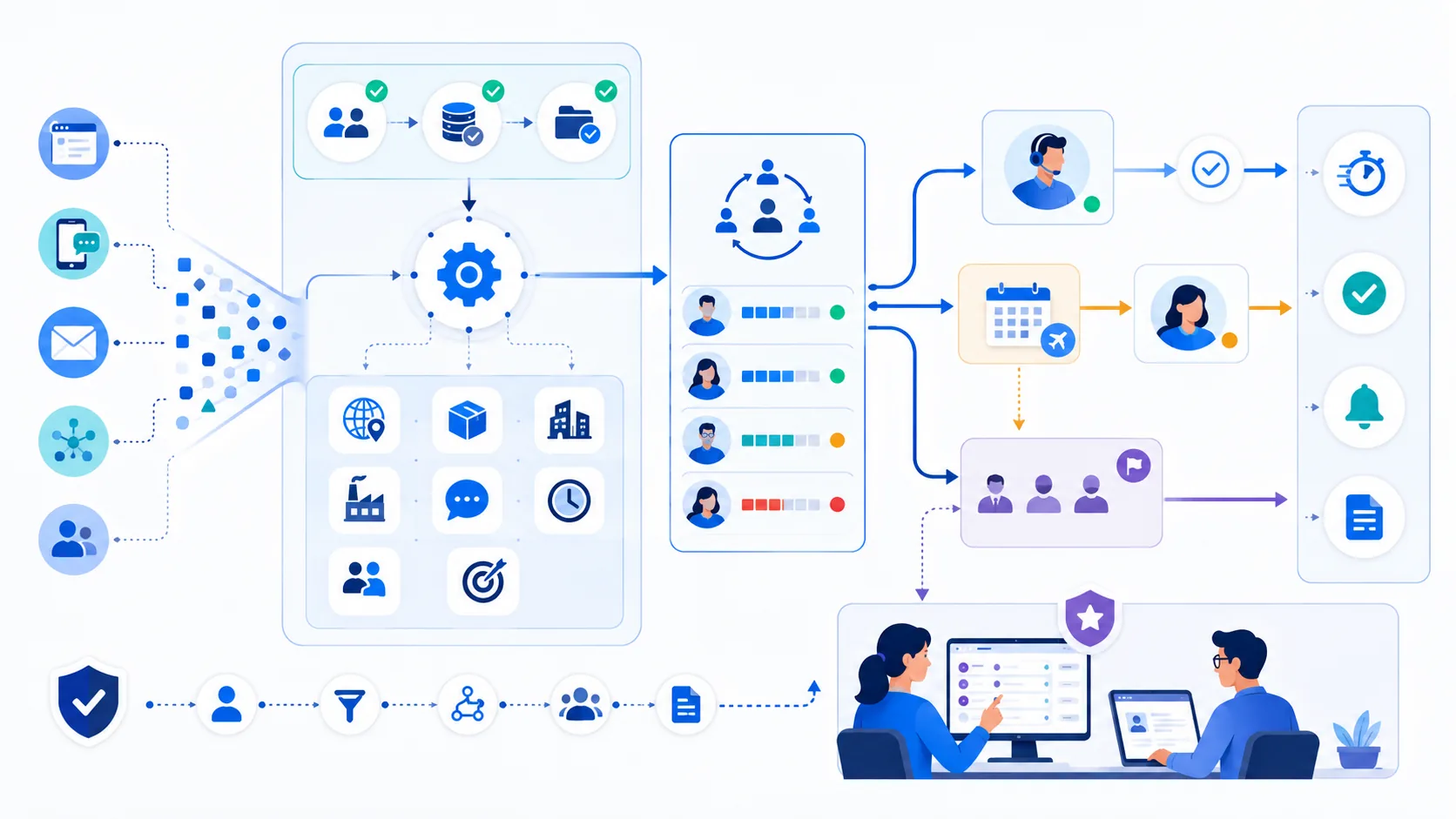
Quick answer
Start with the business decision, restrict the agent to approved territory table, account ownership, product interest, language, time zone, consent, seller capacity, and SLA, require a routing rule with priority, owner, fallback, SLA, reason code, and exception path, and name the person who approves consequential actions.
This guide is for: revenue, operations, marketing, support, and enablement teams that need repeatable work with visible ownership.
Lead routing is an ownership state machine, not a list of if-statements
A routing workflow begins when an eligible record becomes ready for sales and ends only when a valid owner accepts it—or the record enters a visible exception queue with a deadline. Assignment alone is not acknowledgement, and a notification alone is not ownership.
Separate eligibility, assignment, and response
First decide whether the record may enter sales routing: validate identity, minimum fields, consent and suppression state, duplicate risk, and lifecycle stage. Then choose a destination. Finally, track delivery, owner acceptance, first meaningful action, SLA status, requeue, and closure as separate timestamps.
Make precedence deterministic
Rules can conflict: an existing account may sit in one territory while asking about a product owned by another team. Publish a priority order and stop condition. Record every evaluated rule, not only the winner, so operations can explain why a lead moved and diagnose silent gaps.
A six-gate routing contract
| Gate | Decision | Safe failure |
|---|---|---|
| Eligibility | Is the record valid, contactable for the intended purpose, and ready for sales? | Quarantine, suppress, or request data correction |
| Identity | Does it match an account, contact, open opportunity, or duplicate? | Hold for match/merge review; never create parallel ownership |
| Coverage | Which named, territory, product, segment, industry, and language team qualifies? | Route to a governed general pool with a reason |
| Availability | Which qualified seller is scheduled, active, and below capacity? | Use backup coverage or keep visibly unassigned |
| Priority | What verified source/intent tier and SLA apply? | Default priority; never invent urgency from missing data |
| Acceptance | Did the owner acknowledge and perform a meaningful next step? | Escalate, requeue idempotently, and preserve the trace |
15 lead routing rules with acceptance tests
Implement these as ordered, versioned contracts. Adapt the fields and precedence to your CRM; preserve the failure state and evidence.
Existing account owner
Preserve relationship context when the incoming person or domain resolves to one active account owner.
Open opportunity owner
Keep a new inquiry with the person already accountable for an active deal when the relationship is verified.
Named account rule
Honor an approved strategic-account map without embedding names in fragile workflow branches.
Geographic territory
Route by an authoritative business territory, not an unverified IP address or free-text country.
Product specialization
Match verified product interest to qualified coverage while keeping one accountable commercial owner.
Company size segment
Use a documented segment definition and a confidence state rather than treating missing headcount as small business.
Industry specialization
Use a controlled industry taxonomy and route only when evidence is specific enough for specialist value.
Language match
Match service language to a seller who can support it, using explicit preference over inferred locale.
Time-zone coverage
Route to qualified coverage that can acknowledge within SLA, based on service location and published schedules.
Lead source priority
Assign an SLA tier from a verified acquisition event without letting source bypass ownership, consent, or qualification.
High-intent fast lane
Accelerate only from a verified action whose meaning and recency are defined.
Capacity-aware round robin
Distribute fairly only among qualified, available sellers with remaining capacity.
Out-of-office fallback
Move work from an unavailable owner without losing relationship context or creating competing owners.
Duplicate and merge queue
Resolve identity before parallel sellers contact the same person or create conflicting CRM states.
Unmatched lead exception
Guarantee that every eligible record without a deterministic destination remains visible and owned by a queue.
Worked trace: a Friday demo request with competing rules
This hypothetical trace demonstrates precedence and recovery. It is not a customer incident or a claim about a specific CRM.
Acceptance test
Only one accountable work item exists; the duplicate cannot trigger a second contact; the relationship owner remains visible; the qualified specialist is attached; the unavailable owner does not receive a doomed assignment; acknowledgement stops escalation; and an auditor can replay the decision from frozen inputs and the rule-set version.
Test the routing system before production
Build a decision table
List ordered rules, required fields, winners, stop conditions, fallbacks, and exception codes. Review every overlap pair.
Replay historical records in shadow mode
Compare proposed destinations with ownership context and inspect disagreements; do not rewrite live owners.
Exercise concurrency and failure
Submit duplicates simultaneously, remove capacity, expire schedules, delay notifications, retry jobs, and force CRM errors.
Measure the whole SLA
Track eligible_at, assigned_at, delivered_at, acknowledged_at, first_meaningful_action_at, requeue, and exception resolution.
How OpenMax supports this workflow
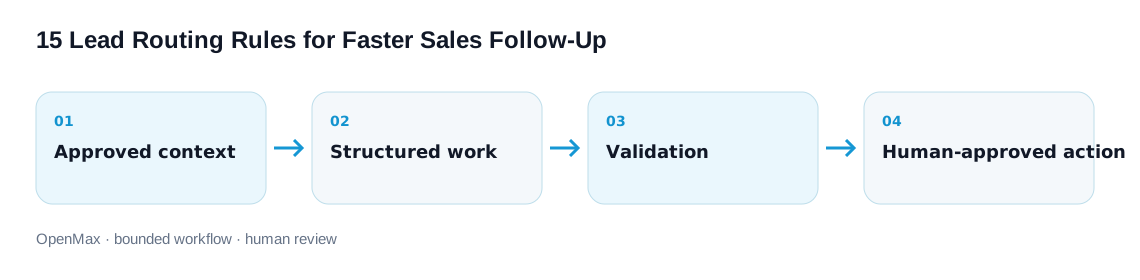
From prompt to governed OpenMax workflow
OpenMax can turn a reviewed instruction into an AI employee workflow with shared context, tool connections, task ownership, logs, and human review. The template defines the job; permissions and approval gates control what can happen next.
Limits and human-review boundaries
Routing automates work ownership; it does not prove consent, intent, identity, entitlement, or sales quality.
- Do not route from sensitive or unapproved proxy traits, or infer nationality and identity from language, name, or location clues.
- Do not let priority, enrichment, or AI classification override verified account ownership, suppression, legal holds, or access controls.
- Do not treat assignment or notification as a completed follow-up; measure acknowledgement and a defined meaningful action.
- Do not silently discard unmatched, duplicate, over-capacity, unavailable, or failed records. Give every exception a queue, owner, reason, and deadline.
- Test changes in a sandbox/shadow mode, version the rule order, use idempotent writes, preserve rollback, and review workload/service differences across relevant groups.
Frequently asked questions
What makes a good lead routing rules workflow?
A clear outcome, approved sources, explicit boundaries, a structured output, and a named review or escalation point.
Can the AI take action automatically?
Only if the action is explicitly permitted, technically constrained, logged, reversible where possible, and appropriate for the workflow risk.
How should teams test these entries?
Use a small labeled set containing normal, missing, conflicting, stale, and adversarial inputs. Record failures and revise the workflow, not just the wording.
Where does OpenMax fit?
OpenMax coordinates AI employees, shared context, connected tools, workflow ownership, and human review for repeated business work.
Are the examples guaranteed to improve results?
No. They are structured starting points. Results depend on models, source quality, tools, policy, evaluation, and reviewer judgment.
Sources, editorial method, and limitations
OpenMax editors reviewed current first-party CRM documentation for ordered assignment criteria, users and queues, owner rotation, overwrite behavior, duplicate matching, round robin, load balancing, schedules, and capacity. We converted those mechanisms into 15 vendor-neutral operational contracts and added eligibility, acknowledgement, idempotency, audit, and exception controls. Sources were reviewed September 3, 2026. No response-time improvement or customer result is claimed.
- Salesforce Help — Guidelines for Assignment Rules — ordered criteria and assignment to users or queues.
- Salesforce — Lead Management Implementation Guide — automatic assignment and lead queue behavior.
- Salesforce Help — Matching Rules — identifying duplicate accounts, contacts, and leads.
- HubSpot Knowledge Base — Assign and rotate record owners — workflow enrollment, owner fields, teams/users, rotation, and overwrite choice.
- Microsoft Learn — Record distribution in assignment rules — round robin, load balancing, work schedules, availability, and unassigned states.
- Microsoft Learn — Seller attributes and capacity — skills/attributes, work hours, maximum capacity, and available capacity.