

Quick answer
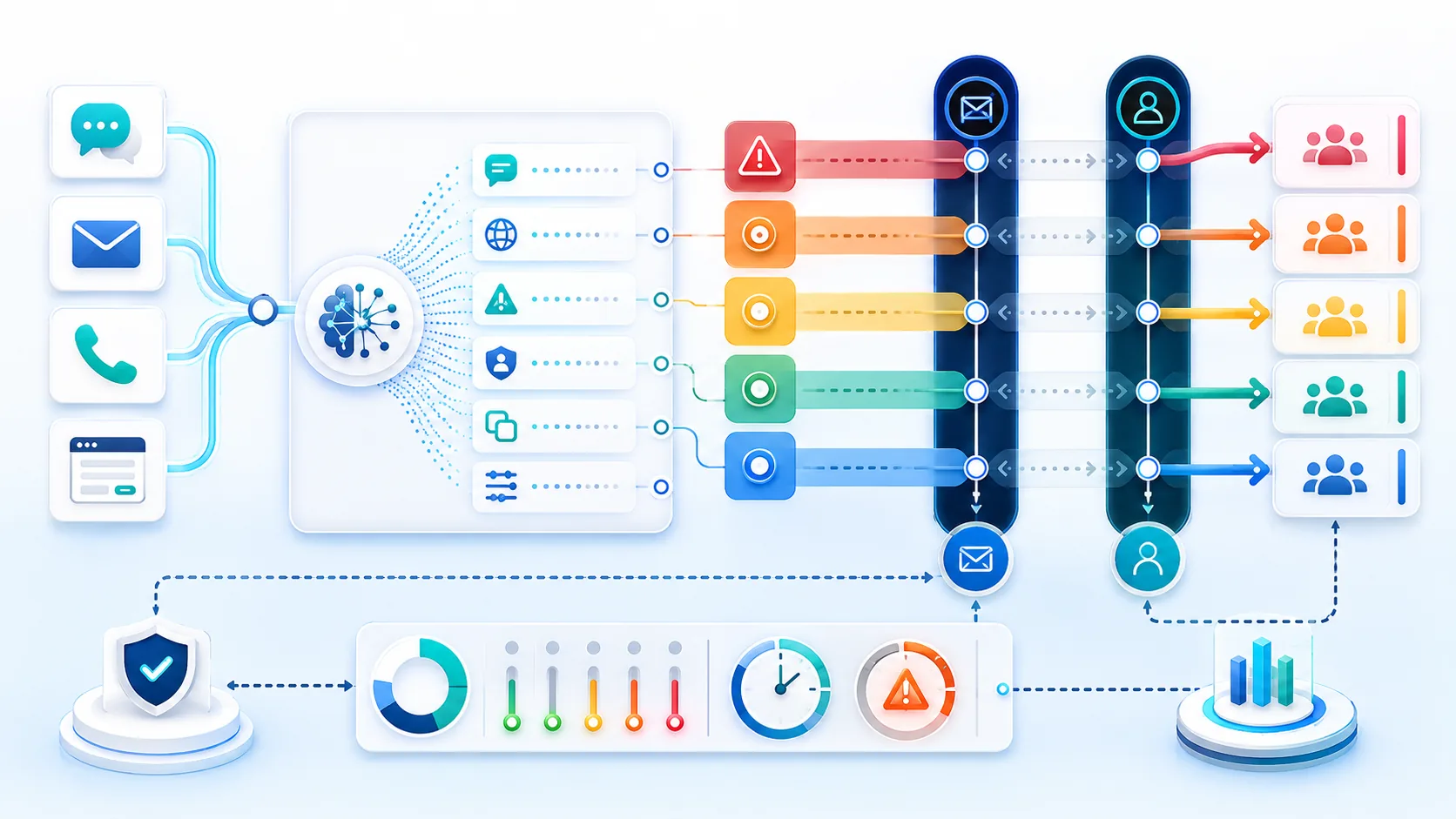
Freeze the first-response metric first: eligible conversation, start event, stop event, human or bot actor, office-hours rule, time zone, exclusions, cohort, and aggregation. Then use AI to classify, detect risk, group likely incident duplicates, enrich minimal context, route by skill and authority, balance capacity, draft grounded replies, resolve narrowly eligible work or hand off without loss, and predict breach risk. Compare like-for-like cohorts and monitor quality and safety with time.
Write the metric contract before optimizing the queue
Define the clock
Document ticket or conversation eligibility, creation or customer-message start, first public human reply or another stop event, calendar versus business time, office-hours source, time zone, reopen behavior, bot handling, and no-reply exclusions. Platform definitions differ and can change.
Freeze the cohort
Compare conversations that began under the same date rule, channel, locale, product, priority, customer segment, support hours, incident state, staffing regime, and automation eligibility. Preserve tickets with no reply instead of silently dropping them from operational review.
Choose the summary correctly
Use a distribution: count eligible and replied, no-reply count, median, upper percentiles or time buckets, SLA breaches, and confidence intervals where appropriate. Means can move sharply with outliers, and different date anchors produce incomparable populations.
Minimum metric record
metric_id · definition_version · eligible_population · start_event · stop_event · actor_type · bot_time · office_hours · time_zone · exclusion · date_anchor · cohort_fields · aggregation · no_reply_count · data_refresh · owner · change_log
Nine AI triage plays that reduce avoidable waiting
Each play below changes a specific delay mechanism and includes the controls and measurements needed to learn whether it worked. Deploy independently where possible so the team can attribute corrections and failures.
Normalize intent, language, product, and channel at intake
Convert the first customer message and permitted metadata into a controlled routing envelope: primary and secondary intent, language, product/version, channel constraints, customer segment, and confidence. Preserve the original words and allow unknown or multiple intents.
- Required controls
- Current taxonomy and examples; language detection; product/account evidence; confidence threshold; fallback queue; correction history.
- Measure and guard
- Measure arrival-to-classification latency, coverage, human correction, abstention, and downstream misroute. Do not count a fast classification as a response.
Detect safety, security, privacy, and incident signals first
Run a narrow high-recall screen for account takeover, exposed credentials, payment harm, threats, regulated requests, vulnerable users, widespread failures, and other specialist signals. Route matches to approved people; do not let ordinary priority scoring dilute critical gates.
- Required controls
- Signal definition/version; exact evidence; affected scope; false-positive route; specialist availability; immediate containment; customer-safe message.
- Measure and guard
- Measure detection and miss review by signal, specialist acceptance, time to containment, and false-positive burden. Never infer protected traits or dangerousness from tone alone.
Collapse duplicates into a governed incident lane
Compare new messages with verified active incidents and recent requests using product, environment, error signature, time, customer-visible symptom, and counterexamples. Link probable duplicates without closing them or claiming a shared root cause before incident review.
- Required controls
- Incident ID/status/version; similarity features; counterexamples; customer/account impact; link confidence; unlink control; mass-update approval.
- Measure and guard
- Measure duplicate-link precision, human unlink rate, incident-lane FRT, update reach, and incorrectly closed tickets. A shared keyword is not a verified incident.
Enrich only the context required for the first decision
Before assignment, retrieve the minimum permitted account, entitlement, plan, region, product state, recent events, known incident, and prior-contact context that changes routing or the first safe response. Mark stale, unavailable, conflicting, and restricted values.
- Required controls
- Field purpose and owner; system of record; retrieval time; freshness rule; permission; sensitivity; failure fallback; source pointer.
- Measure and guard
- Measure enrichment availability and latency, stale-value corrections, privacy exceptions, and whether enriched fields actually reduce reassignment or clarification. More data is not automatically better.
Route to a team with the skill and authority to act
Match intent and risk to a versioned routing matrix that includes required knowledge, language, product, jurisdiction, permissions, customer tier, action authority, queue hours, and fallback. Verify that the receiving team accepts the handoff.
- Required controls
- Rule ID/version; required skill and permission; eligible destinations; queue state; tie-break; owner; acceptance event; timeout/escalation.
- Measure and guard
- Measure first-touch assignment accuracy, transfers before first response, blind handoffs, acceptance latency, and final correction. Do not route solely from model confidence or agent speed.
Balance queue load against capacity and deadlines
Use eligible skills, active workload, schedule, concurrency, channel, predicted handling band, current backlog, SLA risk, and availability to recommend assignment. Recompute when capacity, incident state, or ownership changes; preserve manual override and fairness review.
- Required controls
- Capacity definition; workload source; schedule/time zone; concurrency limit; predicted band and uncertainty; SLA clock; reassignment rule; override reason.
- Measure and guard
- Measure queue wait, FRT distribution, breach rate, reassignment, workload concentration, and outcome quality by comparable cohort. Avoid optimizing one fast queue by starving another.
Draft a grounded first response before the agent opens the ticket
Prepare a concise response that states the verified issue, asks only decision-changing questions, supplies safe steps from current approved knowledge, cites relevant evidence internally, and sets a truthful next checkpoint. Show unsupported, stale, conflicting, or permission-sensitive claims to the agent.
- Required controls
- Approved knowledge/version; customer words; verified context; tool state; policy; draft provenance; risky-claim flags; response-language reviewer.
- Measure and guard
- Measure draft acceptance by section, factual corrections, stale citations, unsafe suggestions, edit time, response quality, and customer-visible FRT. A fast bad draft is negative capacity.
Resolve narrowly eligible requests or create a lossless handoff
For stable, low-risk, well-evidenced intents, an approved automation may answer or complete bounded actions. Define eligibility, identity, permissions, confidence, confirmation, failure, rollback, and human handoff. Preserve the conversation, actions, unresolved need, and customer preference for the receiving person.
- Required controls
- Automation boundary/version; source evidence; action receipt; customer-visible result; abstention; handoff trigger; summary; receiving acceptance.
- Measure and guard
- Report automated resolution separately from human FRT because some platforms exclude bot replies or bot-resolved conversations. Measure reopen, correction, escalation, abandonment, and customer outcome.
Predict breach risk and recover before the timer expires
Continuously compare each unanswered eligible conversation with the correct SLA clock, office-hours rule, channel, priority, queue capacity, owner state, dependencies, and confidence. Alert the current owner and an escalation path early enough to act, then record what happened.
- Required controls
- SLA rule/version/start event; counted/excluded time; remaining band; owner; queue and dependency state; alert threshold; acknowledgement; recovery action.
- Measure and guard
- Measure alert precision and recall, lead time, acknowledged alerts, recovered breaches, alert fatigue, silent failures, and post-response quality. A prediction is not permission to send an empty reply.
Worked example: the fastest queue is not the best route
This hypothetical example explains the decision logic and is not an OpenMax result. A customer writes “urgent—our users cannot sign in.” General Support has the shortest queue. The intake model detects authentication language, but account context shows a recent enterprise SSO change and the message includes no evidence of account takeover or a widespread outage.
- Preserve uncertainty. The triage record says multi-user impact is customer-stated, SSO change is verified, outage is not observed at the check time, and security compromise is unknown—not false.
- Route by authority, not speed. The identity team can inspect SSO configuration and has the required tenant permission. General Support cannot, so shortest-queue assignment would create a transfer and reset attention.
- Draft a bounded first response. The draft acknowledges the sign-in impact, asks for the exact error and affected identity-provider connection, avoids claiming an outage, gives no unsafe reset steps, and states the identity team’s real next checkpoint.
- Measure the complete path. Record classification latency, assignment acceptance, time to first human reply, transfer count, response correctness, time to safe resolution, reopen, and any later incident linkage. A faster acknowledgement alone is not success.
Measure speed, quality, safety, and capacity together
Primary responsiveness view
Show eligible starts, human replies, no replies, median and tail FRT, time buckets, SLA breaches, queue wait, assignment acceptance, and transfers. Segment only when sample sizes and definitions support comparison.
Quality and safety counter-metrics
Track first-response correctness and completeness, unsupported claims, unsafe steps, privacy or permission errors, specialist misses, customer clarification, resolution, reopen, escalation, complaint, accessibility, and satisfaction response rate.
Evaluation design
Use staged rollout, predeclared cohorts and definitions, holdout or comparable queues where feasible, risk-stratified review, human adjudication, and sufficient follow-up. Record staffing, incidents, seasonality, channel mix, product releases, and policy changes as confounders.
How OpenMax can coordinate AI triage
OpenMax can normalize permitted intake signals, run critical gates, propose incident links, retrieve minimal context, evaluate skill and authority rules, recommend capacity-aware assignment, prepare grounded drafts, preserve lossless handoffs, monitor SLA risk, and record human corrections and outcomes. Humans retain metric ownership, staffing decisions, specialist judgment, consequential actions, customer promises, fairness review, overrides, and final acceptance.
Measurement, workforce, and customer-safety boundaries
- Do not claim improvement after changing the clock, actor, office-hours rule, exclusions, date anchor, channel mix, automation eligibility, or aggregation. Version the definition and reconcile old and new series.
- Do not optimize agents through opaque surveillance or automated employment consequences. Define necessity, transparency, access, retention, contestability, calibration, bias review, and human authority.
- Do not infer severity, vulnerability, fraud, protected traits, intent, or customer value from emotion, accent, grammar, language, or channel alone. Use defined evidence and approved specialist review.
- Do not sacrifice correct resolution, privacy, security, accessibility, consent, honest expectations, or safe escalation to make the first-reply chart faster.
Sources, editorial method, and limitations
OpenMax editors reviewed Zendesk’s current first-reply definitions, support metrics, SLA behavior, and operational guidance; Intercom’s current responsiveness definitions, bot-time and office-hours variants, reporting behavior, and SLA targets; and the NIST AI RMF Core for role, oversight, measurement, monitoring, and risk controls. We synthesized the nine operating plays and hypothetical SSO case. Sources were rechecked September 3, 2026.
- Zendesk — Native Support time duration metrics
- Zendesk — Support metrics and attributes
- Intercom — Responsiveness reporting
- Intercom — Set SLAs for conversations and tickets
- NIST — AI RMF Core
Frequently asked questions
Does an automatic acknowledgement count as first response?
It depends on the platform and report. Even when a configuration stops a timer, label the event honestly and report meaningful human response, bot resolution, and acknowledgement separately.
Should we use average or median FRT?
Use a distribution. Median is less sensitive to outliers than the mean, but neither shows the tail alone. Include eligible and no-reply counts, time buckets or upper percentiles, and SLA breaches.
Can AI choose the fastest available agent?
Speed is one input. The recipient must also have the necessary skill, language, product context, permissions, jurisdiction, action authority, capacity, and accepted ownership.
How should bot-resolved conversations be reported?
Keep them as a separate eligible population with explicit resolution and handoff definitions. Do not use their removal from the human-reply denominator to claim that human operations became faster.
What can OpenMax automate?
It can coordinate classification, risk gates, incident proposals, context, routing, capacity, drafts, handoffs, SLA alerts, evidence, review, correction, and measurement while people retain consequential authority.