

Quick answer
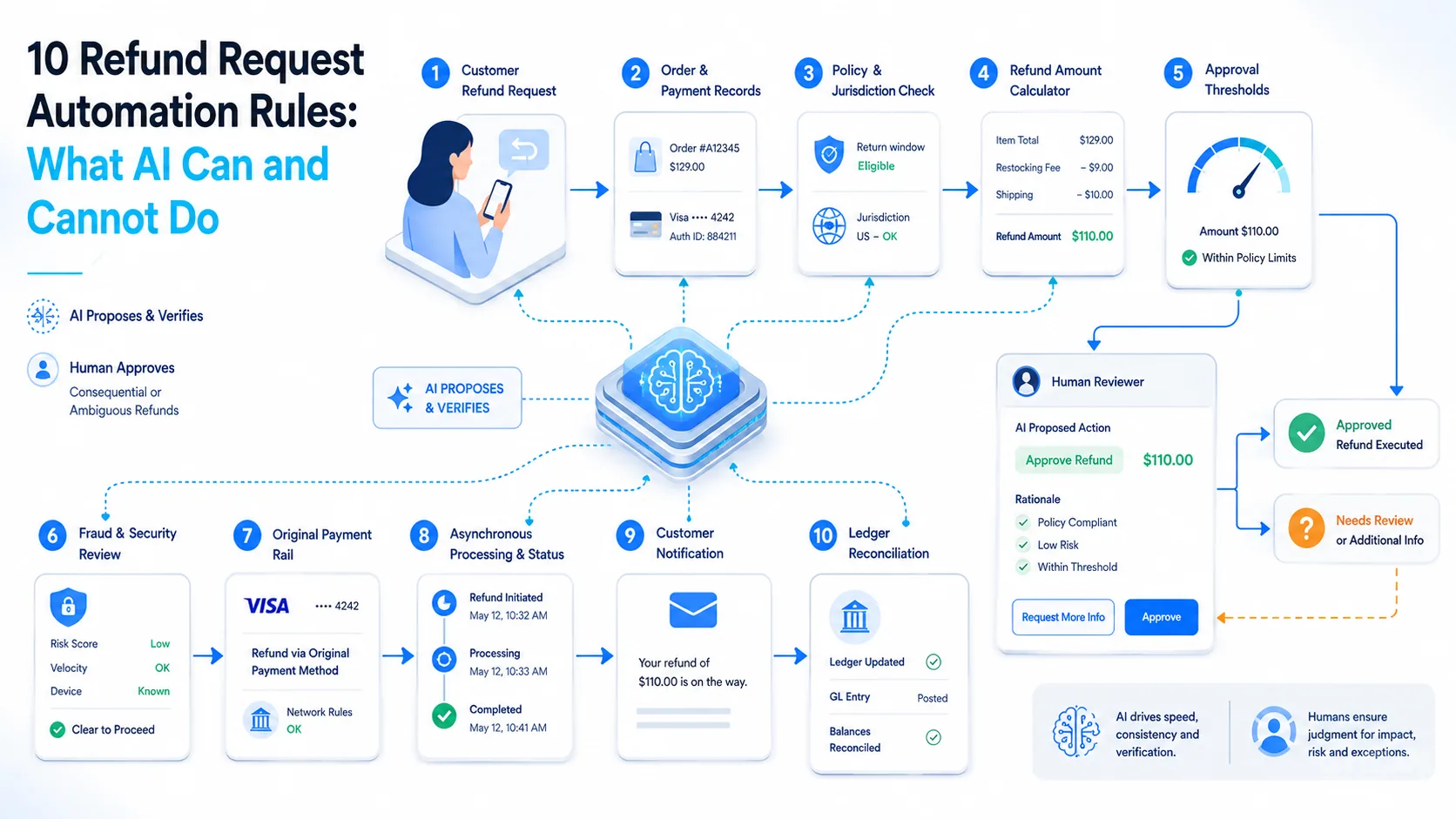
Automate evidence collection, rule lookup, calculations with deterministic verification, routing, status monitoring, messaging drafts, and reconciliation checks. Do not let a language model independently choose the transaction, interpret uncertain legal rights, accuse fraud, calculate unverified amounts, change a destination, approve outside authority, retry an unknown payment response, or declare success before reconciliation.
What refund automation may safely decide
Safe automatic execution is a narrow intersection: verified requester and transaction, one applicable rule, deterministic amount, permitted action, current authority, supported rail, low-risk signals, no conflict or dispute, and reversible or recoverable failure handling. “Looks eligible” is not enough.
Eligibility
Whether a validated legal, contractual, policy, or goodwill rule permits an action for this exact transaction and request.
Authorization
Whether the current actor may approve and execute that action, amount, currency, entity, and exception version.
Completion
Whether provider and internal records reconcile, dependent actions finished, the customer was informed, and exceptions have owners.
Decision states before any refund moves money
| State | Evidence gate | Allowed action |
|---|---|---|
| AUTO-ELIGIBLE | Exact transaction, one rule, deterministic amount, authority, low risk | Execute within a tightly validated limit |
| REVIEW | Ambiguity, exception, high value, conflict, specialist trigger | Human approve, change, deny with reason, or escalate |
| HOLD | Identity, destination, dispute, security, missing or conflicting evidence | No money movement; preserve and investigate |
| EXECUTING | Approved version, idempotency, provider request and observed status | Monitor; never blind-retry unknown responses |
| RECONCILED | Provider, ledger, tax, entitlement, inventory, notification aligned | Close or retain an owned exception/reopen path |
10 refund request automation rules
Treat each rule as a release gate. A refund advances only when required evidence is current, the rule version is known, and the next owner can recover from failure.
Verify the requester, transaction, and authority
Operating rule
Resolve the exact order, invoice, charge, payer, account, merchant entity, currency, and request channel before deciding eligibility. Verify whether the requester is the buyer, an authorized representative, an administrator, or an unrelated contact without collecting unnecessary identity data.
Evidence to retain
order_id, invoice_id, payment_id, payer/account match, merchant entity, currency, request provenance, representative authority, identity confidence, access restrictions.
Decision gate
Hold on ambiguous identity, multiple matching payments, account takeover indicators, third-party requests without authority, or a mismatch between customer, payer, and refund destination. AI may propose candidates; it must not choose a convenient transaction silently.
Snapshot the applicable policy, contract, product, and jurisdiction
Operating rule
Evaluate the rule version that applied to the transaction and request time, not today’s default policy. Separate statutory rights, contract commitments, goodwill policy, marketplace terms, subscription terms, digital-content conditions, product exceptions, and regulator or card-network duties.
Evidence to retain
policy and contract IDs/versions, effective dates, sale channel, customer and merchant location where lawfully known, consumer/business classification, product/service type, delivery or performance state, exception evidence.
Decision gate
Automatic eligibility requires one unambiguous validated rule path. Conflicting terms, regulated products, cross-border uncertainty, minors, accessibility barriers, disputed classification, or legal-right questions go to qualified human review. UK and EU examples are never treated as global defaults.
Classify the requested action before moving money
Operating rule
Determine whether the correct action is cancellation before capture, void, full or partial refund, credit note, replacement, service correction, goodwill credit, payout reversal, transfer reversal, or chargeback response. These actions have different accounting, inventory, entitlement, tax, provider, and customer consequences.
Evidence to retain
payment lifecycle state, capture/settlement state, fulfillment and consumption, return state, dispute/chargeback state, prior credits, requested outcome, allowed action types, system-of-record owner.
Decision gate
The workflow names one authorized action and its dependencies. It must not issue a refund merely because the customer used that word when a void, correction, replacement, or dispute workflow is required; uncertainty routes to the owning finance or operations team.
Calculate the refundable amount from line-level evidence
Operating rule
Reconstruct gross amount, eligible lines, quantity, fulfilled or consumed portion, discounts, coupons, credits, gift value, standard or premium delivery, tax, fees, restocking rules, currency, rounding, and prior adjustments. Preserve both the formula and source values; do not let a language model perform unverified arithmetic.
Evidence to retain
line items and quantities, price/tax/discount allocation, delivery method, return condition, consumed units, prior refund/credit, currency and precision, calculation version, expected ledger entries.
Decision gate
The calculated amount reconciles to the transaction and applicable rule with independent arithmetic validation. Negative, above-paid, cross-currency, zero-value, high-value, fee-deduction, tax-uncertain, or allocation-conflict results require review.
Prevent duplicate execution with state and idempotency controls
Operating rule
Check prior refund attempts, credits, cancellations, disputes, manual adjustments, retries, and webhooks across every system before creating a new action. Reserve a stable idempotency key derived from the approved case and action version, lock the eligible amount, and reject replay with a different payload.
Evidence to retain
case/action version, idempotency key, prior refund and credit IDs, available refundable balance, dispute state, lock owner and expiry, request/response hashes, webhook event IDs, retry history.
Decision gate
One approval can create at most one intended financial action. Timeouts and uncertain responses are reconciled by querying the provider and ledger—not by blind retry. Changed amount, destination, policy, or approval creates a new reviewed version rather than reusing a key.
Screen fraud and security signals without automatic accusation
Operating rule
Use permitted signals to detect account takeover, refund abuse, collusion, stolen instruments, return fraud, unusual velocity, or manipulated evidence. Treat a signal as a reason to restrict execution or request specialist review—not as proof of wrongdoing, a customer-facing accusation, or permission to retain unlimited data.
Evidence to retain
signal source and time, rule/model version, reason codes, confidence and known limitations, device/account context where permitted, false-positive path, restricted evidence location, reviewer and expiry.
Decision gate
Low-risk cases may continue only under validated rules. Any material fraud, identity, security, discrimination, bias, or adverse-action question receives trained human review with a contestable route. Customer communication uses verified facts and does not reveal exploitable controls.
Apply approval thresholds and separation of duties
Operating rule
Route by amount, cumulative exposure, customer and merchant risk, irreversible action, legal or regulatory trigger, exception type, precedent, and available authority. Separate the requester, evidence preparer, approver, executor, and reconciler when risk warrants; prevent self-approval and stale delegations.
Evidence to retain
approval matrix/version, amount and cumulative exposure, exception reason, initiator, approver role and delegation, conflict check, decision/rationale/time, expiry, second approval, execution authority.
Decision gate
The named approver has current authority for the exact version, amount, entity, currency, and action. High-value, novel, regulated, cross-border, manual-destination, policy-exception, or employee-related cases cannot inherit a low-risk auto-approval path.
Execute through the correct payment rail and control destination changes
Operating rule
Submit the approved amount against the verified payment or provider object using supported refund operations. Prefer the original payment rail where required or supported. Never ask a customer to send full card credentials in chat or let an agent redirect funds to a new bank, wallet, or card without a separately governed payout process.
Evidence to retain
provider/account, payment and refund object IDs, approved amount/currency, destination rule, API version, idempotency key, execution actor, request/response, provider status, next action, failure data.
Decision gate
The provider accepted one request tied to the approved record, and the response is stored without sensitive credential leakage. Unsupported rails, manual bank details, split-platform liability, connected accounts, charge disputes, destination changes, or requires_action states follow specialist procedures.
Communicate initiated, pending, completed, and failed states accurately
Operating rule
Tell the customer what was approved, the amount and currency, destination description safe to disclose, action time, current provider state, realistic next update, and reference. Do not say “refunded” merely because an API request was accepted; pending, requires-action, failed, canceled, and succeeded states need different messages.
Evidence to retain
approved response version, amount/currency, safe destination descriptor, provider status and timestamp, expected-not-guaranteed timing basis, delivery state, reference, next update, failure or action instructions.
Decision gate
Customer wording matches the observed state and avoids guaranteed arrival dates. Failed delivery or refund state creates an owned follow-up; sensitive provider data is redacted; accessibility/language needs are honored; changes trigger a corrected message rather than editing history.
Reconcile finance, entitlement, inventory, and customer outcomes
Operating rule
A provider success event is not complete business recovery. Reconcile the refund and balance transaction to the ledger; adjust invoice, tax, revenue, commission, inventory, entitlement, subscription, fulfillment, vendor payout, and analytics only where the approved action requires it. Confirm customer delivery and preserve reopen conditions.
Evidence to retain
provider final state, balance transaction, general-ledger and subledger entries, credit note/tax record, entitlement and inventory changes, commission/vendor effects, customer confirmation, residual balance, exception and reopen owner.
Decision gate
Closure requires matched provider and internal records, completed dependent actions, customer notification, and no orphan exception. Pending, failed, disputed, mismatched, over-refunded, unreturned, or entitlement-conflict cases stay open. Aggregate outcomes with denominators and review false approvals/denials.
Worked case: a “full refund” would duplicate recovery
A customer asks for a full USD 1,200 annual-subscription refund and says the charge is unauthorized. A shallow system sees the word “unauthorized,” selects the invoice total, and proposes an immediate full refund. The controlled workflow stops it.
- Resolve the payment. The account has two similar invoices; only one matches the payment reference. The requester is an authorized billing administrator, but not the cardholder.
- Reconstruct prior recovery. The matched invoice already has a USD 300 service credit, and the charge is subject to an open card dispute. Refunding USD 1,200 would exceed the available refundable balance or duplicate recovery depending on provider rules.
- Separate allegation from action. “Unauthorized” triggers security and payment-specialist review; it is not converted into a fraud accusation or a refund reason automatically.
- Calculate and approve the valid path. Finance reconciles credit, dispute, tax, and refundable balance. An authorized reviewer chooses whether to wait for the dispute, issue a corrected residual refund, or use another permitted remedy.
- Communicate observed state. The customer receives the verified invoice reference, current review state, next update, and dispute-safe contact route—never a false “refund completed” message.
How to operate and test refund automation
Rule ownership
Assign owners for consumer rights, contracts, tax, fraud/security, payment providers, finance, entitlements, inventory, customer communication, and exception recovery. Version effective dates and approval limits.
Test matrix
Test full, partial, multiple-line, tax-inclusive, discounted, mixed-currency, prior-credit, disputed, failed, pending, requires-action, destination-change, connected-account, duplicate, and late-event cases.
Outcome review
Measure false approvals and denials, amount corrections, duplicate attempts, unknown-state recovery, provider failures, ledger mismatches, notification errors, reopen rates, time by state, and unresolved exceptions—with volume and exposure denominators.
Minimum auditable record
case_id · request_source · requester_authority · order_id · invoice_id · payment_id · merchant_entity · jurisdiction_basis · policy_contract_version · eligibility_path · payment_state · refundable_balance · calculation_inputs · amount_currency · risk_signals · decision_state · owner · approval_version · idempotency_key · provider_request_response · refund_status · ledger_entries · dependent_actions · customer_message · delivery_state · exception · reopen_state · retention_event
How OpenMax can coordinate refund operations
OpenMax can connect case, CRM, order, billing, payment, policy, risk, approval, communication, and ledger systems; collect permitted evidence; propose a decision state; call deterministic calculators and rule services; route authorized approval; execute only the approved version; monitor provider events; and open reconciliation exceptions. Use least privilege and keep raw credentials out of prompts and logs.
Financial, legal, privacy, and customer-harm boundaries
- Never treat one country’s refund window, a provider status model, or an internal goodwill rule as a universal customer right.
- Do not collect full card credentials, expose bank or dispute data, or place sensitive payment evidence in model prompts when tokenized references suffice.
- Require human review for ambiguous rights, fraud/security, high value, irreversible/manual destination, cross-border, regulated, employee, precedent-setting, or complaint cases.
- Use deterministic money arithmetic, bounded inputs, versioned rules, separation of duties, idempotency, state machines, and reconciliation; a fluent explanation is not a financial control.
- Do not automatically accuse fraud, waive rights, deny a statutory remedy, change payout destination, destroy evidence, or close an unresolved refund.
Frequently asked questions
Can AI approve refunds automatically?
Only within a narrowly validated path with exact identity/transaction, one applicable rule, deterministic amount, current authority, supported execution, low risk, idempotency, and recovery. Exceptions need humans.
Is a provider “succeeded” status enough to close?
No. Reconcile provider and ledger records, dependent tax/entitlement/inventory actions, customer notification, and exceptions first.
Should a refund go to a new bank account?
Not through the ordinary automated path. Destination changes require separately governed identity, fraud, payout, legal, and approval controls.
Can AI calculate partial refunds?
It may assemble inputs and explain a formula, but deterministic decimal/currency logic must calculate and validate the amount against source records and rules.
What if the provider response times out?
Keep the state unknown, query by the same idempotency/reference identifiers, reconcile webhooks and ledger events, and do not create a fresh refund blindly.
What is OpenMax’s role?
It can orchestrate evidence, rules, calculators, routing, approvals, provider actions, status, communication, and reconciliation while humans retain consequential financial and legal decisions.
Sources, editorial method, and limitations
OpenMax editors reviewed official UK and EU consumer-return guidance, Stripe refund-state documentation as one provider implementation example, and the NIST AI RMF for human-AI accountability. We synthesized an original ten-rule general-business workflow, state model, controls, and duplicate-recovery case. Sources were rechecked September 3, 2026. This is operational guidance, not legal, tax, accounting, fraud, payment-network, or provider advice.
- GOV.UK — Accepting returns and giving refunds
- Your Europe — Consumer shopping rights
- Stripe Docs — Refund object and states
- NIST — AI Risk Management Framework