

Quick answer
Start with the business decision, restrict the agent to official company pages, regulatory filings where relevant, approved databases, CRM history, current news, and buyer-provided information, require a dated account brief with source URLs, confidence, unknowns, relevance to the meeting, and owner, and name the person who approves consequential actions.
This guide is for: revenue, operations, marketing, support, and enablement teams that need repeatable work with visible ownership.
A sales account research template is a verification map, not a company biography
The brief should help a seller ask a better question in the next call. Every material statement needs a source, publication or observation date, retrieval time, exact entity match, evidence status, and owner. Anything not confirmed by the customer remains public evidence or a hypothesis.
Use four evidence classes
Verified public fact comes from an attributable primary source; internal record comes from a versioned, permissioned CRM or support record; third-party signal requires source caveats; hypothesis is an explicitly testable interpretation. AI-generated summaries are never their own source.
Resolve the entity before researching it
Record legal/brand names, official domain, headquarters or operating region, parent/subsidiary relationship, and a stable identifier when available. Similar names, acquired brands, franchisees, and regional entities can otherwise contaminate every later field.
The source and recency contract
| Evidence class | Required metadata | Safe use |
|---|---|---|
| Primary public | Publisher, page/document, direct URL, publication/event date, retrieved UTC, exact excerpt/field | State the sourced fact with date and scope |
| Internal record | CRM object/ID, field or activity, owner, version/updated time, permission purpose | Summarize only what the seller is authorized to use |
| Third-party signal | Provider, source basis if disclosed, observed date, coverage caveat, license/use state | Present as a signal requiring verification |
| Hypothesis | Supporting facts, reasoning, alternative explanation, disconfirming evidence, verification question | Use to prepare a question, never as an account fact |
| Unknown/stale | What is missing, last reliable date, why reliability is insufficient | Leave blank or ask; do not backfill from inference |
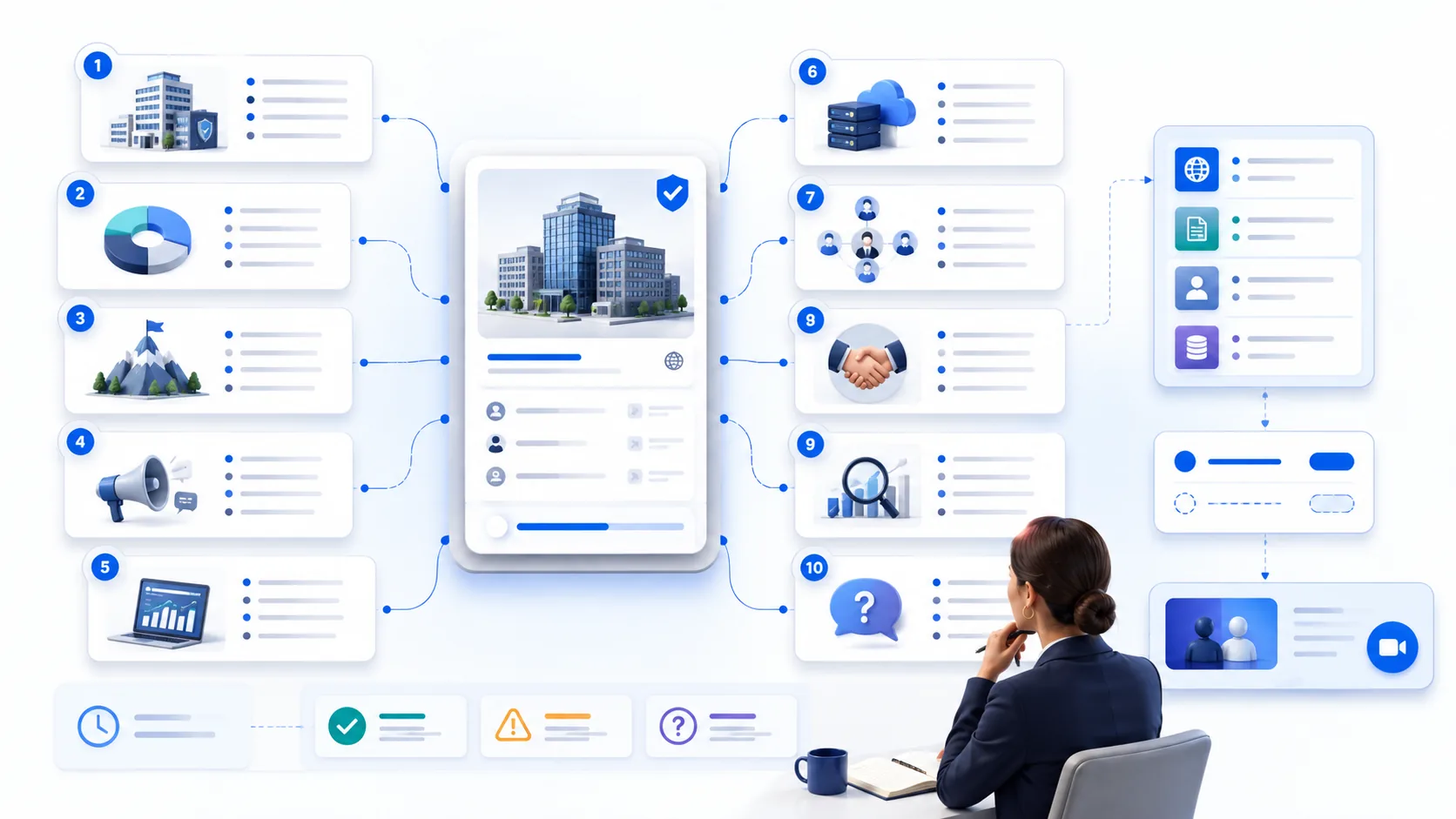
10 fields in the sales account research template
Complete each field independently. An explicit unknown is safer and more useful than a polished unsupported statement.
Company snapshot
Establish exactly which organization the call concerns before adding industry, size, location, or ownership facts.
Business model
Describe how the account creates and captures value using attributable customer, offering, channel, and revenue evidence.
Strategic priorities
Extract management-stated objectives and the metrics, owner, period, and trade-offs attached to them.
Recent trigger events
Record events that may change priorities, timing, stakeholders, or risk—without treating news as buying intent.
Relevant initiatives
Identify a currently evidenced program or workflow that could overlap with the conversation, then expose the missing facts.
Technology environment
Document only observable or authorized technology evidence, its scope, and its freshness.
Known stakeholders
Map observed people, roles, relationships, and information needs without guessing decision authority.
Relationship history
Build a chronological, permissioned record of prior contact, commitments, outcomes, and open obligations.
Opportunity hypothesis
Connect sourced account evidence to a testable workflow problem while preserving alternatives and disconfirming evidence.
Questions to verify live
Turn the highest-impact unknowns into concise, non-leading questions the participant can answer or redirect.
Worked example: a hiring signal is not a transformation program
This hypothetical record illustrates research discipline; it is not a real company, customer, or sales result.
Research record to preserve
Store the exact URLs/CRM IDs, event and retrieval dates, excerpts, entity match, evidence classes, hypothesis owner, expiry, and corrections. If the buyer rejects the hypothesis, record that disconfirming evidence instead of defending the personalization.
How to operate the template before a call
Set the call objective and research budget
Define who is attending, the decision to support, allowed sources, and a time limit so research remains proportional.
Resolve entity and deduplicate records
Confirm domain, legal/operating unit, parent relationship, CRM IDs, and contact status before enrichment.
Research facts before hypotheses
Capture source metadata first, then form a falsifiable interpretation with alternatives and expiry.
Review and convert gaps into questions
The call owner removes irrelevant or sensitive data, checks recency, and chooses the smallest set of useful questions.
How OpenMax supports this workflow
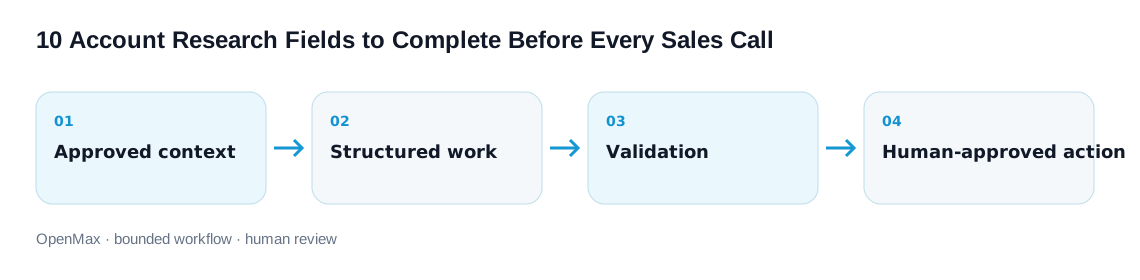
From prompt to governed OpenMax workflow
OpenMax can turn a reviewed instruction into an AI employee workflow with shared context, tool connections, task ownership, logs, and human review. The template defines the job; permissions and approval gates control what can happen next.
Limits and human-review boundaries
Public availability does not automatically make data accurate, current, relevant, licensed for reuse, or appropriate for a sales brief.
- Do not scrape, bypass access controls, violate platform terms, expose credentials, or collect sensitive personal data for superficial personalization.
- Do not infer protected traits, private circumstances, financial condition, buying intent, authority, urgency, or technology deployment from weak signals.
- Keep publication date, event date, retrieval time, record version, entity match, and source class visible.
- Respect do-not-contact states, privacy requests, access permissions, retention, deletion, purpose limitation, and regional requirements.
- Require human approval before outreach, consequential CRM changes, stakeholder labels, or sharing the brief beyond its permitted audience.
Frequently asked questions
What makes a good sales account research template workflow?
A clear outcome, approved sources, explicit boundaries, a structured output, and a named review or escalation point.
Can the AI take action automatically?
Only if the action is explicitly permitted, technically constrained, logged, reversible where possible, and appropriate for the workflow risk.
How should teams test these entries?
Use a small labeled set containing normal, missing, conflicting, stale, and adversarial inputs. Record failures and revise the workflow, not just the wording.
Where does OpenMax fit?
OpenMax coordinates AI employees, shared context, connected tools, workflow ownership, and human review for repeated business work.
Are the examples guaranteed to improve results?
No. They are structured starting points. Results depend on models, source quality, tools, policy, evaluation, and reviewer judgment.
Sources, editorial method, and limitations
OpenMax editors reviewed first-party guidance on pre-call account research, public-company filings, CRM account/contact/history records, and data provenance. We translated those mechanisms into ten source-aware fields and independently added entity resolution, evidence classes, publication/event/retrieval dates, falsifiable hypotheses, alternatives, correction, and permitted-use controls. Sources were reviewed September 3, 2026. No data-coverage, response-rate, pipeline, or customer-result claim is made.
- LinkedIn Sales Navigator Help — Research an account before a sales call — company priorities, stakeholders, account insights, alerts, and CRM context.
- LinkedIn Sales Navigator Help — Account IQ — centralized summaries and explicit warning that account summaries can contain errors.
- U.S. SEC — Using EDGAR to Research Investments — public access and the information provided by 10-K, 10-Q, and 8-K filings.
- Salesforce Trailhead — Work with an Account Record — account details, associated relationships, and past activity.
- HubSpot Knowledge Base — Understand and use the record page — properties, activities, change sources, timestamps, and property history.
- NIST — FAIR Data Principles — identifiers, rich metadata, qualified references, provenance, access, and reuse context.