

Quick answer
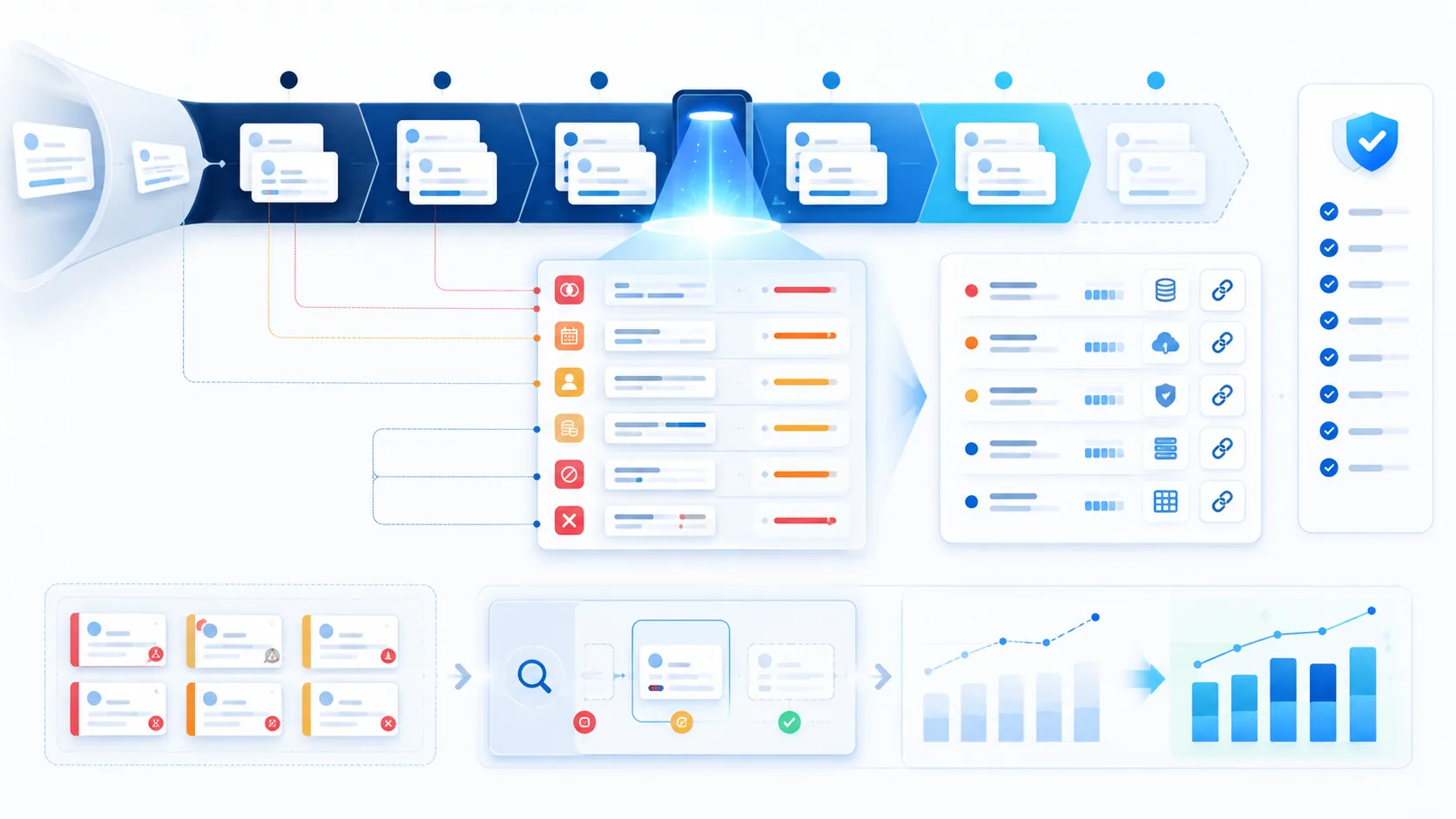
A clean sales pipeline is not one with fewer deals; it is one where every open opportunity represents one real buying motion, has a current owner and stage, links amount and close date to evidence, names a dated next action, and maps consistently into the forecast. Run the 20 checks below at record level, route uncertainty to the seller or manager, and never auto-delete or advance a deal merely to improve a dashboard.
Use the checklist before forecast calls, territory changes, CRM migrations, automation launches, and model training. Preserve an audit trail for every merge, exclusion, close, owner change, and material field correction.
Pipeline hygiene protects decisions, not cosmetic completeness
Missing values matter when they make the opportunity impossible to interpret. Populated values also matter when they are stale, copied, contradictory, or unsupported. A hygiene workflow should distinguish harmless blanks from errors that change qualification, seller action, forecast rollup, customer experience, access, or reporting.
Evidence beats mandatory fields
A close date filled with quarter end is not cleaner than a blank if no event supports it. A next step saying “follow up” is not operational. Require the source event, actor, date, and confidence behind consequential values rather than maximizing fill rate.
Detection and correction need different authority
Automation can safely flag many anomalies. Merging accounts, changing ownership, moving stages, adjusting amount, closing a deal, or removing it from forecast can destroy context or change compensation and access. Those actions need explicit ownership, previews, reason codes, version checks, and reversible procedures where the CRM allows them.
Four outcomes for every hygiene check
| Outcome | Use when | What to record | Allowed automation |
|---|---|---|---|
| PASS | Current evidence supports the value and no conflict is found. | Check ID, evidence/version, checked time, policy version. | Mark checked; do not rewrite the value unnecessarily. |
| REVIEW | The value may be valid, but evidence is missing, stale, ambiguous, or contradictory. | Exact conflict, evidence links, question, named owner, due date. | Create a task or review queue; preserve the existing value. |
| HOLD | The record could affect forecast, customer action, permissions, or downstream automation incorrectly. | Risk, affected workflows/reports, temporary hold, escalation. | Pause unsafe automation; do not silently change stage or forecast. |
| CORRECT / EXCLUDE | An authorized owner confirms the correction, merge, closure, or forecast treatment. | Before/after values, reason, approver, timestamp, source and undo path. | Apply only the approved scoped action with concurrency and duplicate checks. |
20-point sales pipeline hygiene checklist
Run each check against one immutable record snapshot and a declared cutoff time. The checklist produces evidence and a disposition; it does not authorize destructive bulk edits.
One buying motion, one opportunity
Search for open opportunities sharing account, business problem, product/scope, buying group, expected period, source and external deal identifier. Similar names alone are not enough.
A current accountable owner
Every open deal has one active primary owner whose territory, team, leave status and access are valid. Separate collaborators from accountability.
A valid account association
The opportunity links to the correct legal/commercial account and normalized domain, not an unrelated namesake, duplicate shell, former employer or parent by assumption.
A verified buying group
Identify the primary contact and distinguish evaluator, user, champion, economic buyer, procurement and approver states. “Contact present” is not proof of authority.
Stage supported by exit evidence
Compare current stage with the organization’s explicit entry/exit criteria. Activity volume or time elapsed does not prove progression.
Stage age within a contextual threshold
Calculate time since the last verified stage transition and compare with segment, motion, stage and cycle benchmarks—not one global limit.
Amount tied to scope and currency
Validate amount, currency, quantity, term, products, services and recurring/one-time treatment. Detect zeroes, placeholders and currency conversion mistakes.
Close date tied to a dated event
A close date needs an evidence-backed event such as target go-live, procurement decision, contract expiry or approved mutual plan—not automatic quarter-end rounding.
A concrete next action
The next step names an action, owner, counterparty or internal dependency, and expected outcome. “Follow up,” “check in” and copied notes are incomplete.
A future next-action date
The next action has a date, time zone where material, and status consistent with calendars and activity. Detect overdue, impossible and completed-but-open tasks.
Last meaningful activity is fresh
Measure the latest two-way or outcome-changing activity, not any automated email, sync touch or internal edit.
Problem and use case remain explicit
The record states the current business problem, affected workflow, users, desired outcome and scope. Generic product interest is not a qualified use case.
Decision process and criteria are current
Record how a decision will be made, by whom, against which criteria, and what evidence remains missing. Do not confuse a vendor sales process with the buyer’s process.
Champion and economic-buyer claims are evidenced
A champion requires observed advocacy and influence; an economic buyer requires confirmed decision or budget authority. Meeting attendance and job title are insufficient.
Competition and status are bounded
Distinguish named competitor, incumbent, internal build, no decision, and unknown. Avoid turning silence or a seller guess into a competitive fact.
Security, legal and procurement have real states
Each review has owner, requested artifact, status, submitted/updated date, blockers, expiry and next action. “In review” without evidence is stale.
Pricing and proposal versions agree
Opportunity amount, quote, proposal, discount, term, product lines and forecast treatment refer to compatible versions.
Forecast category matches evidence—not optimism
Compare forecast category with stage, exit evidence, close date, next action, review blockers and organization definitions. Stage and category may differ legitimately, but the reason must be visible.
Closed-won and closed-lost records are complete
Closed records include actual close date, final amount/currency, products, reason, competitor/no-decision state and required downstream handoff.
Automation, imports and reports reconcile
Compare CRM record, integrations, activity sync, product/quote objects, forecast rollup and exported report as of the same cutoff. Identify lag, failed jobs and field ownership conflicts.
Worked example: two “duplicate” deals are not safe to auto-merge
This hypothetical case demonstrates record identity, forecast effect, and approval. It is not customer data or a claimed result.
What the audit record should prove
Store snapshot IDs, duplicate features, conflicts, reviewer decisions, surviving record, field-level winners, affected reports/workflows, before/after forecast values, merge event, integration reconciliation and rollback or remediation route.
How to implement a safe hygiene routine
Define policy by pipeline and stage
Name required evidence, field owner, freshness threshold, allowed states, severity and correction authority for each motion—not one universal rule.
Take a consistent snapshot
Record cutoff time, query, filters, currencies, hierarchy, stage and forecast versions so totals and underlying deals can be reconciled.
Sample before bulk action
Measure true/false positives across owners, segments and stages. Review duplicate, stage, date, amount, closure and sync changes separately.
Monitor recurrence
Track time to resolution, repeated defects by source, overrides, reopened records, recreated duplicates, forecast deltas, failed writes and customer-impacting mistakes.
How OpenMax supports this workflow
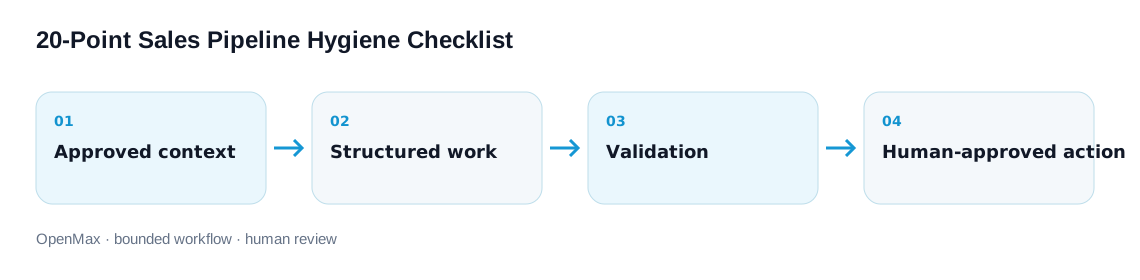
From prompt to governed OpenMax workflow
OpenMax can turn a reviewed instruction into an AI employee workflow with shared context, tool connections, task ownership, logs, and human review. The template defines the job; permissions and approval gates control what can happen next.
Limits and human-review boundaries
Data quality rules can surface inconsistency but cannot independently determine commercial truth, buying intent, authority, or the correct forecast.
- Never auto-delete, merge, close, reassign, advance, reduce amount, change forecast category, or overwrite a governing quote without explicit scoped authority and audit.
- Do not treat activity count, email tracking, model score, job title, elapsed time, or field completion as proof of buyer intent or deal health.
- Respect role-based access, field ownership, confidential notes, regional data rules, retention, legal holds, compensation and territory effects.
- Use version and concurrency checks, idempotency, preview, sampling, exception queues, before/after values, and recovery or remediation plans.
- Validate reports and forecasts against the same cutoff and configuration; stale rollups and live drill-downs can otherwise appear contradictory.
Frequently asked questions
How often should a team run pipeline hygiene?
Run lightweight detection continuously or daily, and complete human review before forecast meetings and consequential rollups. Also run focused checks after imports, routing changes, integrations, territory moves, stage-policy changes, and CRM migrations.
Should every blank field be treated as an error?
No. Requiredness should follow the decision and stage. An unknown decision maker may be honest early in discovery; a fabricated name is worse than a visible unknown. Prioritize fields that alter action, qualification, access, forecast, reporting, or customer experience.
Can AI clean the pipeline automatically?
AI can detect anomalies, assemble evidence, suggest a disposition, create a review task, and apply narrow pre-approved reversible corrections. Destructive or consequential changes need owner approval, version checks, audit and a recovery path.
Does a clean pipeline make the forecast accurate?
It removes avoidable record errors but cannot eliminate market uncertainty or poor judgment. Forecast quality also depends on definitions, seller/manager decisions, model design, cutoff timing, currency treatment and real buyer behavior.
What should a hygiene dashboard measure?
Show affected records and value by check and severity, age to resolution, repeat source, owner, overrides, false positives, forecast delta, failed changes, recreated duplicates, and customer-impacting incidents—not only a single cleanliness percentage.
Sources, editorial method, and limitations
OpenMax editors reviewed current CRM documentation for opportunity stages, pipeline/forecast views, relationship fields, conditional stage rules, duplicate review/merging, and opportunity validation. We converted those mechanisms into an original 20-check operating list and separately added evidence states, field provenance, version checks, reversible correction, idempotency, cross-system reconciliation, and forecast before/after audit. Sources were reviewed September 3, 2026. No customer pipeline, forecast, revenue, or win-rate result is claimed.
- Microsoft Learn — Move an opportunity through stages — stage progression, collected information, and current-stage importance for charts and dashboards.
- Microsoft Learn — View and manage a forecast — pipeline categories, underlying records, recalculation, hierarchy and review.
- Microsoft Learn — Relationship analytics and KPIs — activity, next/last interaction, opportunity fields and relationship-pipeline context.
- HubSpot Knowledge Base — Set up rules for object pipelines — stage creation/movement restrictions, edit limits, approvals and conditional logic.
- HubSpot Knowledge Base — Review and manage duplicate records — duplicate evidence review, field selection, merge/reject handling and audit log.
- Salesforce Help — Sample opportunity validation rules — conditional field and stage validation examples.