


Quick answer
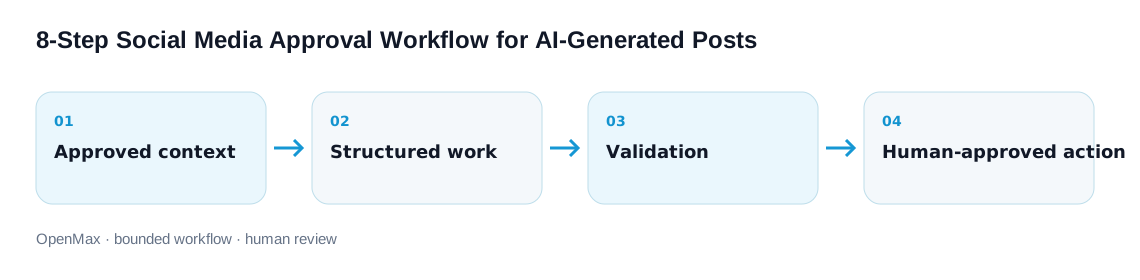
An approval-ready AI social workflow needs eight gates: lock the approval object; generate bounded variants with claim provenance; review brand, clarity, and accessibility; verify claims and destinations; clear rights, identity, provenance, and disclosure; apply risk-based specialist review; approve the exact version/account/audience/schedule; then publish with least privilege and verify the live result.
AI may draft, compare, extract, route, and check. It should not convert missing evidence into facts, infer approval from silence, broaden permissions, choose a different account or audience, hide a material connection, or make an irreversible publish/remove/spend decision outside policy.
What a social media approval workflow actually approves
It approves a specific object in a specific context. The object is the reviewed combination of copy, media, disclosure, links, account, channel, placement, organic or paid state, audience, market, language, schedule, and policy version. If one material component changes, the approval may no longer apply.
Separate content state from action authority
A draft can be factually supported yet not authorized for publication; an approved post can still fail because the wrong account or paid audience was selected. Model these as separate states: drafted, evidence checked, specialist cleared, version approved, publish authorized, live verified, and closed or corrected. Give each transition an owner, timestamp, evidence packet, expiry, and rejection path.
This separation matters for AI-generated content because polished output can conceal uncertainty. The workflow must retain sources, assumptions, model context, rights, disclosures, human decisions, and live-platform evidence rather than preserving only the final caption.
Five decision states for edits after review
Teams need explicit material-change rules. “One small edit” is not a safe category because one character can alter a price, date, URL, disclosure, negation, account mention, or eligibility condition.
| State | Meaning | Required action |
|---|---|---|
| EDITORIAL ONLY | Spelling or punctuation changes that preserve claim, disclosure, destination, audience, and tone under documented rules. | Record the diff; lightweight owner check may retain approval. |
| RECHECK GATE | A claim, source, quote, alt text, asset, link, disclosure, translation, or policy-relevant context changed. | Return to the affected evidence or specialist gate. |
| NEW APPROVAL OBJECT | Account, channel, placement, market, language, audience, paid state, offer, schedule, or campaign purpose changed. | Create and approve a new bound version. |
| HOLD | Evidence, rights, identity, jurisdiction, authority, destination, or final version is uncertain. | Do not schedule or publish; assign an owner and evidence request. |
| INCIDENT | A live post differs materially, causes harm, exposes data, breaks policy, or runs with unintended spend/targeting. | Use the approved containment, correction, removal, notification, and preservation path. |
8-step approval workflow for AI-generated social posts
Each step is a separate operating contract. Configure the fields, reviewers, jurisdictions, and stop conditions for your organization before copying it into an automation.
Lock the approval object before anyone drafts
Create one immutable approval object for one campaign, account, channel, market, language, placement, organic or paid state, scheduled window, audience, offer, CTA, destination, and content format. Assign a content owner and declare prohibited subjects before AI receives a prompt.
Generate bounded variants with claim provenance
Ask AI for a small set of channel-native options using only the approved packet. Separate proposed wording from facts, quotes, statistics, product capabilities, dates, prices, eligibility, testimonials, and disclosures. Preserve the source ID beside every material claim through all later edits.
Review brand voice, clarity, and accessibility
Compare each variant against the account voice, terminology, inclusive-language rules, reading context, and format behavior. Review the visible first lines, truncation, caption, on-image copy, alt text, audio description or transcript needs, color contrast, emoji meaning, hashtags, and locale-specific wording.
Verify claims, quotations, links, and destinations
Build a claim ledger and check the exact published meaning, not just similar words in a source. Open every destination, follow redirects, inspect mobile rendering, validate UTM syntax, and confirm availability, date, price, eligibility, geographic scope, comparison basis, customer permission, and quotation context.
Clear asset rights, identity, provenance, and disclosure
Review every image, clip, voice, logo, likeness, customer reference, testimonial, music track, stock element, AI-generated component, and edit. Decide whether material connections or other notices must be disclosed in the post itself, in the media, and in the language of the endorsement—not hidden in a profile or comment.
Apply risk-based policy and specialist review
Run documented triggers for regulated or consequential claims, endorsements, contests, comparisons, privacy, employment, finance, health, safety, politics, minors, user-generated content, crisis events, targeting, paid amplification, and market-specific law. Route only the triggered issue with its evidence and proposed correction to the accountable specialist.
Approve the exact version, account, audience, and schedule
Render a final approval card that binds copy, media, disclosures, links, account, placement, organic/paid status, audience or targeting, market/language, scheduled time and timezone, comment setting, campaign budget boundary, approvers, and expiry. Require a separate publish or promote permission from drafting/editing access.
Publish with least privilege, verify live output, and retain evidence
At the approved window, an authorized human or narrowly scoped agent publishes only the approved object. Immediately verify the live URL/post ID, account, crop, truncation, caption, alt text, disclosure, link, preview card, comment settings, paid state, and schedule. Monitor defined incidents and use an approved pause, correction, or removal path.
Worked example: an AI launch post that should not pass
A draft says, “Teams save 40% of their time with the safest AI agent platform—try it free today,” includes a customer logo pulled from an old slide, uses an AI-created executive likeness, links to a generic homepage, and is scheduled for both organic and paid distribution in three markets.
What the first review finds
The 40% figure has no approved study, “safest” is an unsupported comparative superlative, “free” does not describe eligibility, the customer-logo consent expired, the synthetic likeness has no authorized provenance or release, the destination cannot substantiate the offer, local disclosure language is missing, and paid rights/targeting were never approved. Fluent copy does not reduce any of those risks.
How the workflow corrects it
The owner narrows the claim to a documented product capability, removes the unsubstantiated outcome and superlative, replaces the logo and likeness with a rights-cleared product visual, adds truthful offer conditions, chooses a specific localized destination, supplies meaningful alt text, records AI assistance and asset history, separates organic approval from paid use, and routes required market disclosures to qualified reviewers.
What the approval card binds
The final card stores caption version 7, asset hash, source IDs, exact disclosure wording and placement, localized destination plus UTM, OpenMax LinkedIn account ID, English organic placement, September 10 at 10:00 America/New_York, named approvals, no paid spend, expiry, and material-change rules. Reusing it for another language, account, date, paid campaign, or materially edited claim requires a new approval object.
How to test the workflow before connecting a real account
Build a representative test set
Include ordinary product education, an endorsement, a customer story, a contest, a translated post, a paid variant, a time-sensitive announcement, and a crisis-sensitive draft. Label the expected route and stop reason.
Inject realistic failures
Test stale sources, altered negation, wrong account, expired rights, hidden disclosure, broken redirect, malicious text in retrieved material, unexpected UTM values, timezone mistakes, duplicate publishing, and a late material edit.
Measure decisions, not just speed
Track unsupported-claim escape rate, rights/disclosure defects, wrong-route and false-escalation rates, approval cycle time by risk tier, rework reason, unauthorized diff, live mismatch, correction time, and reviewer workload.
Rehearse revocation and recovery
Remove publish permission, rotate a credential, cancel a scheduled post, pause paid delivery, correct or remove a live item, preserve the incident record, and confirm that an agent cannot silently republish an expired version.
How OpenMax can coordinate social approval
Give drafting, review, and publishing different roles
OpenMax can coordinate specialized AI employees and reviewers around a shared brief, evidence pack, rights record, and approval card. Tool permissions can allow drafting and link checks while withholding social-account publishing or ad-spend access. Logs and ownership help investigate changes and handoffs. OpenMax does not grant content rights, provide legal advice, or make an unapproved claim safe.
Limits and mandatory human boundaries
This workflow is a control design, not legal advice or proof of compliance. Platform behavior and applicable rules vary by placement, market, audience, product, account type, and date.
- Do not treat model confidence, sentiment, similarity, a prior post, or a platform label as substantiation or specialist approval.
- Do not let retrieved comments, documents, or web pages override system rules, expand tool permissions, reveal credentials, or change the target account.
- Do not infer consent, licensing, identity, testimonial truth, endorsement status, or disclosure sufficiency from the asset alone.
- Keep drafting, approval, publishing, paid spend, credential administration, correction, and deletion as separately granted capabilities with revocation.
- Minimize personal data in prompts and logs; define retention, access, deletion, incident response, and market-specific review with qualified owners.
- Content Credentials can support provenance and tamper-evidence but do not determine whether the underlying content or claim is true.
Frequently asked questions
Does every AI-generated social post need legal review?
No universal route fits every organization. Pre-approved low-risk language may use a shorter documented path, while endorsements, regulated or comparative claims, contests, customer stories, sensitive audiences, paid targeting, and crisis contexts trigger qualified review.
Does changing one word invalidate approval?
Materiality, not word count, governs. A single word can alter negation, price, eligibility, disclosure, identity, market, or claim scope. Record the diff and return to any affected gate under explicit rules.
Can AI publish after reviewers approve?
Only if publishing is separately authorized, the final object matches the approved version, account and schedule, and policy permits that action. Many teams should retain human confirmation for paid spend, sensitive claims, crisis periods, or high-impact accounts.
Is a platform’s paid-partnership label enough disclosure?
Do not assume so. The FTC explains that tool use alone is not a guarantee of clear and conspicuous disclosure. Evaluate wording, placement, language, media format, and how ordinary users encounter the post with qualified counsel for the relevant market.
Do Content Credentials prove an AI image is true?
No. C2PA provenance can record origin and edits in a tamper-evident structure, but its explainer distinguishes provenance from a value judgment about truth. Claims and depicted events still require evidence and review.
What records should remain after publication?
Retain the approved object, hashes, sources, rights, disclosures, decisions, actor and permission, platform ID, screenshot, destination result, edits, paid activation, monitoring, corrections, incidents, and retention/deletion dates according to policy.
Sources, editorial method, and limitations
OpenMax editors reviewed primary guidance on social endorsement disclosure, generative-AI risk management, content provenance, and accessible non-text content, then synthesized an original eight-gate operating workflow. We added version-bound approval objects, claim and asset records, material-change states, least-privilege publishing, live verification, incident containment, and measurable acceptance criteria. Sources were checked September 3, 2026. No legal outcome, platform acceptance, reach, engagement, conversion, or revenue result is claimed.
- FTC — Disclosures 101 for Social Media Influencers — material connections and prominent, understandable disclosure.
- FTC — Endorsement Guides questions and answers — honesty, claim support, placement, platform tools, and language.
- NIST AI 600-1 — Generative AI Profile — generative-AI risk management, testing, provenance, and human oversight context.
- C2PA — Content Credentials explainer — provenance goals and the boundary between recorded history and truth.
- LinkedIn Help — Add alternative text — platform-specific image alternative-text support.
- W3C WAI — Understanding non-text content — accessible text alternatives based on purpose.