

Quick answer
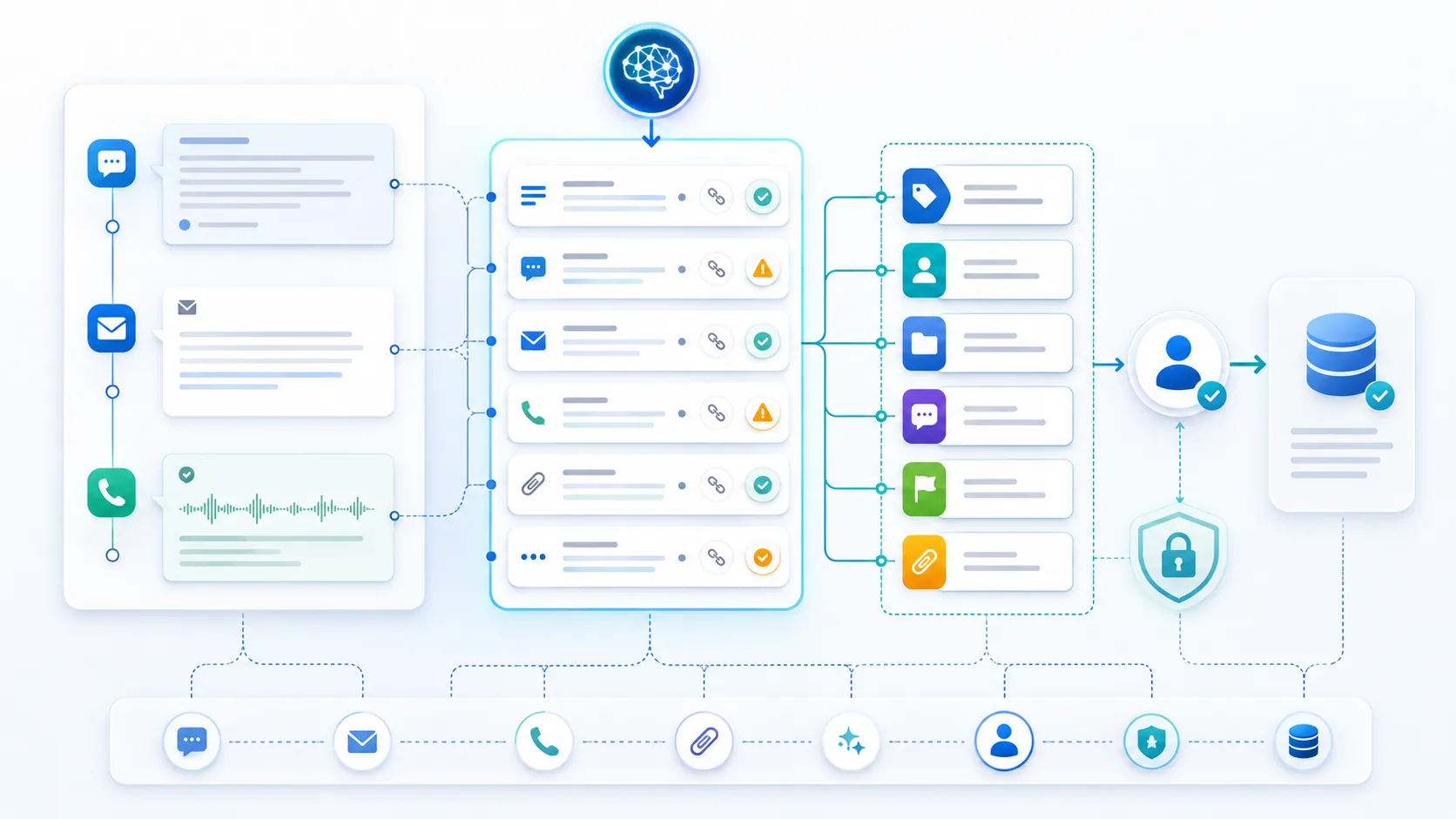
Do not ask AI for one free-form summary and paste it into CRM. Define six versioned fields: customer need; verified context; actions and observed results; current state and unresolved items; next action, owner and time; and evidence, uncertainty and handoff limits. Extract claims with source pointers, validate types and permissions, require review where impact or conflict is material, then write with idempotency and preserve the prior value.
Three design rules before choosing field names
Map to a decision
Every field must help a defined reader decide, route, act, verify, or measure. If nobody can name the downstream decision, do not create another field or send the text to a model.
Keep value and evidence separate
Store the compact operational value in the field and a permission-aware pointer to the source beside it. Copying an entire transcript increases privacy, staleness, contradiction, and access risk.
Use controlled nulls and conflicts
Unavailable, not applicable, awaiting verification, restricted, and conflicting are different states. Do not fill missing values with plausible prose; route material conflicts to a person.
The six CRM field contracts
Use these as logical contracts, then map them to the CRM’s actual object, properties, associations, sensitivity labels, pipeline and permissions. The example values are hypothetical and deliberately preserve uncertainty.
Customer need and requested outcome
customer_need
Capture the customer’s task, affected object, expected result, observed result, and requested remedy in the customer’s meaning—not the agent’s diagnosis. Split multiple needs rather than compressing them into one vague topic.
- Allowed inputs
- Customer messages, authenticated form fields, attachments the reviewer may access, and explicit corrections.
- Write and validation rule
- Write one testable statement. Quote or link the decisive phrase. Mark ambiguity; never invent motivation, urgency, sentiment, identity, or business impact.
- Example value
- Customer cannot export the August invoice CSV; expected all line items; requests a usable export before the stated finance review.
Verified context and constraints
verified_context
Record only context that changes diagnosis, permissions, policy, routing, or the safe answer: product and version, workspace or account reference, channel, locale, environment, relevant dates, plan, region, access role, and known constraints.
- Allowed inputs
- System-of-record properties, tool responses, verified identity result, current policy/version, service status, and customer-confirmed environment.
- Write and validation rule
- Label every value verified, customer-stated, inferred, stale, unavailable, or conflicting. Omit secrets and irrelevant personal data; keep restricted identifiers in protected fields.
- Example value
- Web app · export module v3 · workspace tokenized · admin role verified · en-GB · report date range August · no service incident found at check time.
Actions taken and observed results
actions_results
Create a chronological ledger of material diagnostic, communication, approval, tool, policy, and remediation actions. Pair each action with actor, time, input, result, and evidence instead of writing “troubleshooting completed.”
- Allowed inputs
- Conversation events, tool-call logs, approvals, ticket history, status checks, sent messages, and customer-visible tests.
- Write and validation rule
- Separate attempted, succeeded, failed, rolled back, skipped, and proposed. Never convert an API acknowledgement into customer-visible success or hide duplicate execution.
- Example value
- Agent reproduced empty rows; export job 842 was retried once with an idempotency key; job completed, but downloaded file still omitted tax lines.
Current state, disposition, and unresolved items
current_state
State where the request stands now, whether the original need is resolved, partially resolved, blocked, awaiting customer, awaiting internal work, monitoring, or closed, and list every unresolved issue unit.
- Allowed inputs
- Latest customer-visible verification, ticket status history, incident/problem link, dependency state, specialist decision, and reopen evidence.
- Write and validation rule
- Use one controlled disposition vocabulary. A reply, handoff, queued job, workaround, or agent belief is not resolution. Include the observation time and conditions that could make the state stale.
- Example value
- Partially resolved at 14:20 UTC: base invoice rows export correctly; tax rows remain missing; linked defect INC-217 is under finance-integrations review.
Next action, owner, and time commitment
next_action
Turn the open state into one accountable next event: the action, responsible person or team, prerequisite, due time and time zone or trigger, customer update, fallback, and escalation condition.
- Allowed inputs
- SLA or internal target, queue ownership, accepted handoff, dependency commitment, approval, calendar or workflow event, and customer preference.
- Write and validation rule
- Distinguish an internal target from a contractual promise. Do not use “ASAP” or “soon.” If timing is unknown, state the next checkpoint and who must update it.
- Example value
- Finance Integrations owns defect validation; next customer update by September 4, 16:00 UTC, even if no fix; escalate to incident lead if a second tenant is verified.
Evidence, uncertainty, and handoff guardrails
evidence_limits
Preserve the evidence map that lets the next human verify the other five fields: source message or event IDs, relevant versions, confidence or abstention, contradictions, restricted-data pointers, correction history, summary producer, and review status.
- Allowed inputs
- Immutable conversation-part IDs, timestamps, record/property history, tool request/result references, policy links, model/workflow version, reviewer decision, and override reason.
- Write and validation rule
- Never paste unnecessary transcript text into the CRM. Do not cite inaccessible evidence as if the next owner can inspect it. Keep facts, customer statements, model proposals, human decisions, and unknowns distinct.
- Example value
- Need: messages 18–21 · context: property history P55 · action: tool event T90 · timing disputed between message 24 and SLA v6 · human review required before write.
Worked example: correct a fluent but false summary
This hypothetical case demonstrates review logic and is not an OpenMax customer result. A customer reports an invoice CSV with missing tax lines. The first model summary says “Export fixed after retry; customer needs file today.” Both clauses sound useful, but neither is supported: the retry still omits tax rows, and the customer named a finance review without saying “today.”
- Reject unsupported resolution. Tool completion is retained as an action result; customer-visible export failure remains the current state.
- Correct the timing claim. The requested outcome records the stated finance review without inventing a date. The next-action field contains the team’s actual checkpoint and time zone.
- Preserve issue boundaries. Base rows exporting and tax rows missing coexist as partial resolution; neither is allowed to erase the other.
- Gate the write. A human reviews the conflicting result, sees the proposed diff, approves five fields, returns the evidence field for an inaccessible link, and writes only after the pointer is corrected.
A safe seven-step extraction and CRM write workflow
1–2 · Scope and assemble
Select eligible channels, event range, CRM object, target properties, purpose, roles, sensitivity and retention. Retrieve the complete permitted conversation and related tool, policy, identity, status and record history; preserve message order and missing segments.
3–4 · Extract and reconcile
Extract atomic claims with actor, source pointer, time and state. Map them to one field only. Reconcile customer statements against system evidence without silently overwriting either; mark conflict, stale data, missing context and abstention.
5–7 · Validate, write, verify
Validate schema, enumerations, locale, dates, associations, permissions, sensitivity and field length. Route consequential or conflicting changes to a human. Show the diff, write with an idempotency key and actor identity, preserve history, read the record back, and monitor corrections or failed handoffs.
Minimum write receipt
summary_run_id · conversation_id · source_event_range · target_object_id · schema_version · field_name · prior_value_hash · proposed_value · evidence_pointer · value_state · producer · reviewer · approval · idempotency_key · write_result · read_back · correction_link · retention_class
How OpenMax can coordinate evidence-linked summarization
OpenMax can gather authorized conversation and system context, extract atomic evidence-linked claims, populate the six draft fields, surface contradictions and abstentions, validate the target schema and permissions, request human approval, write an idempotent diff, verify the saved record, and route corrections. Humans retain the customer remedy, policy interpretation, sensitive-data access, conflict decision, consequential write, and final acceptance.
Privacy, accuracy, and system-of-record boundaries
- Do not place credentials, full payment details, health or employment narratives, security artifacts, secrets, or unrelated personal data in general CRM summary fields.
- Do not overwrite the transcript, recording, ticket history, approval or tool log with a generated summary. The summary is a derived handoff artifact, not the source of truth for every fact.
- Do not infer sentiment, intent, protected traits, causality, urgency, customer value, churn risk, fault or resolution without defined, permitted evidence.
- Do not perform consequential writes solely because model confidence is high. Use field validation, conflict rules, role permissions, human approval, idempotency, history, read-back, rollback and monitoring.
Sources, editorial method, and limitations
OpenMax editors reviewed HubSpot’s current ticket API and property architecture, including custom properties, history, associations, internal identifiers, and sensitivity behavior; Intercom’s conversation-part model for messages, actors and timestamps; and NIST’s AI RMF and Generative AI Profile on oversight, evaluation and confabulation. We synthesized the six-field schema, safe-write workflow and hypothetical export case. Sources were rechecked September 3, 2026.
- HubSpot — CRM API: Tickets
- HubSpot — CRM API: Properties
- Intercom — Conversation Part model
- NIST — AI RMF Core
- NIST — Generative AI Profile
Frequently asked questions
Should the summary replace the transcript?
No. Preserve authorized source records according to policy. The summary is a derived, compact handoff artifact with evidence pointers, version, producer and correction history.
Why not use one notes field?
One field mixes customer meaning, facts, actions, state, promises and uncertainty, making routing, validation, permissions, history and measurement unreliable. The six logical fields may map to native or custom properties.
Can the model infer a missing owner or due date?
No. It may propose a route from a current controlled rule, clearly labeled as a proposal. The actual owner must accept the handoff, and unknown timing needs a checkpoint—not an invented promise.
What if customer and system evidence conflict?
Preserve both with actor, source and time. Mark the field conflicting, avoid consequential writes, and route it to a person who can inspect permissions and authoritative records. Do not silently choose the more convenient value.
What can OpenMax automate?
It can coordinate authorized retrieval, claim extraction, source mapping, six-field drafting, schema and permission validation, human review, idempotent writes, read-back, handoff and correction monitoring while consequential judgments remain human-owned.