

Quick answer
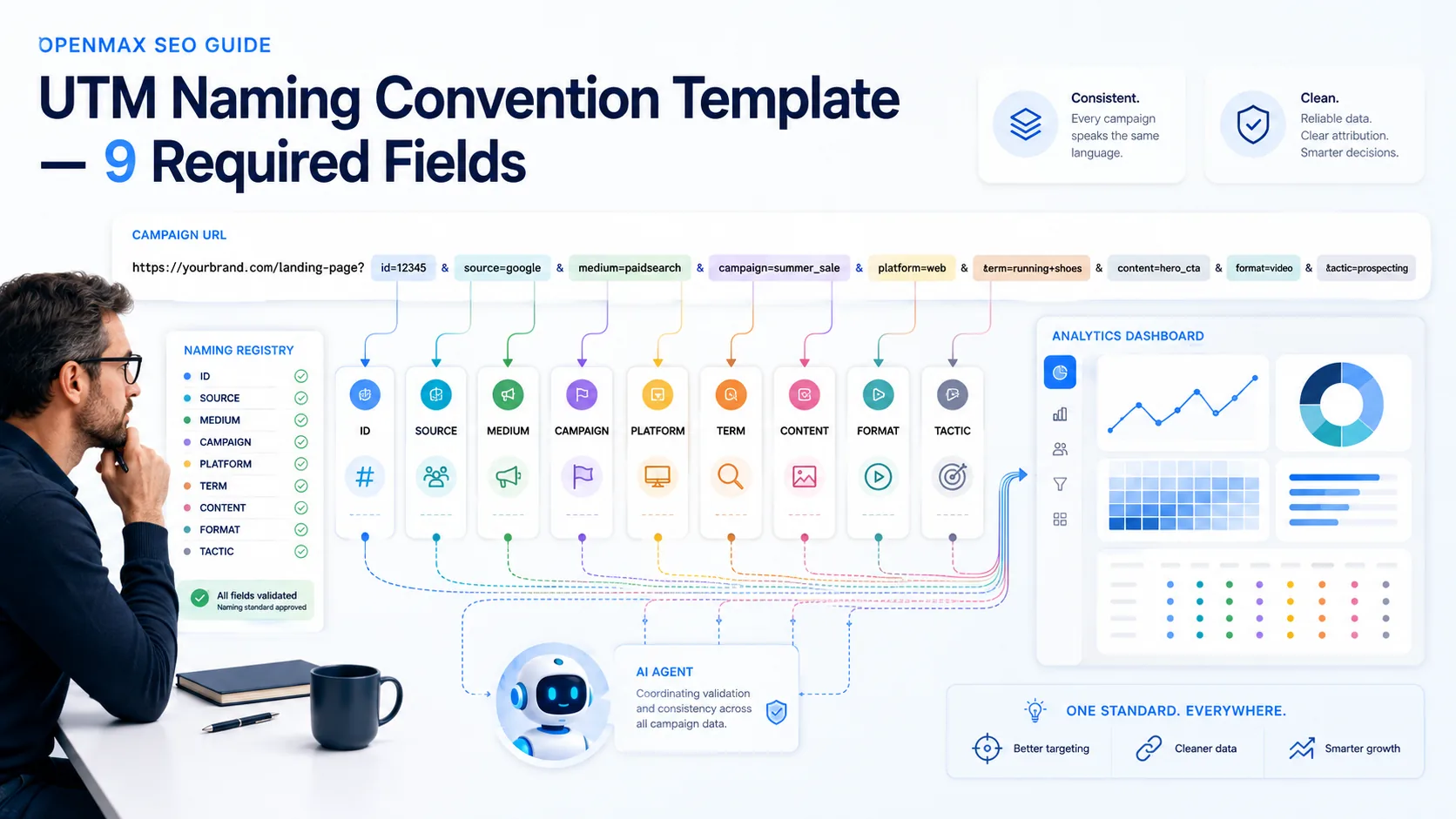
Standardize all nine GA4 campaign parameters: utm_id, utm_source, utm_medium, utm_campaign, utm_source_platform, utm_term, utm_content, utm_creative_format, and utm_marketing_tactic. Give every field one definition, controlled values, an owner, and a test. Use lowercase, generate and encode links, keep personal/confidential data out of URLs, and document auto-tagging precedence. Crucially, Google currently says creative format and marketing tactic are not reported in Analytics properties, so never promise that those two fields will appear without a verified downstream collection path.
This is a governance and QA template for growth, lifecycle, partnerships, social, paid media, analytics, privacy, and web teams—not a claim that UTMs create complete or causal attribution.
What this UTM convention standardizes—and what it cannot
UTM parameters describe a manually tagged referral. They can populate manual campaign dimensions and help GA4 classify traffic, but they do not identify every person, repair consent loss, replace Google Ads auto-tagging, deduplicate events, or prove that a campaign caused a conversion.
Nine URL parameters, plus one off-URL governance record
The nine fields below mirror the parameters in Google’s current campaign URL guidance. The owner, approval, vocabulary version, clean destination, generated final URL, and test evidence belong in a registry—not inside the public query string. If any UTM is used, Google particularly recommends relevant values for source, medium, campaign, ID, and source platform; missing fields can produce (not set).
Case is data
Parameter values are case-sensitive: LinkedIn and linkedin can split reporting. Lowercase ASCII and one documented separator are practical defaults, but the decisive rule is consistency across the link generator, redirects, analytics property, warehouse, CRM, and reporting model.
Manual and automatic tagging need a precedence decision
When manual and auto-tagging coexist, observed traffic-source dimensions may follow integration and identifier behavior. Document the expected result and test the real account; do not infer precedence from the visible URL alone.
Four evidence states for every field and final link
Do not reduce QA to “URL opens.” Record one state per field and for the complete click path.
| State | Meaning | Release consequence |
|---|---|---|
| PASS | Definition, controlled value, owner, destination, collection, and expected report behavior are evidenced. | Release this version; monitor drift. |
| FIX | Intent is valid but casing, alias, encoding, mapping, consent, redirect, or documentation is wrong. | Correct and retest before distribution. |
| BLOCK | PII/secret, unauthorized destination, false reporting claim, conflicting identifiers, or unsafe redirect appears. | Do not distribute; escalate to the accountable owner. |
| UNKNOWN | The team cannot prove the value source, precedence, collection destination, or report result. | Hold or explicitly omit; never invent a placeholder. |
9-field UTM naming convention template
Review each contract individually. “Required” means the convention must make an explicit use-or-omit decision—not that every channel should fill every parameter.
utm_id — immutable campaign ID
Join a promotion across renamed campaigns, channels, cost imports, CRM records, and later audits without relying on a mutable display label. Google defines utm_id as the campaign identifier and recommends using the same ID when uploading campaign data.
utm_source — specific traffic origin
Identify the referrer, publisher, partner, list, or distribution source at the granularity analysts actually need. Source answers “where did this tagged visit come from?”; it must not repeat the channel mechanism stored in medium.
utm_medium — channel mechanism
Describe how traffic was delivered so channel reporting does not fragment. GA4 default channel rules evaluate source and medium; a locally intuitive value can still classify unexpectedly, so governance must include a tested reporting outcome.
utm_campaign — readable initiative name
Group links belonging to the same marketing initiative while keeping the stable utm_id as the durable join key. Campaign names should help a human identify the work, not become an uncontrolled container for every reporting dimension.
utm_source_platform — managing platform
Capture the platform responsible for directing or managing traffic when that concept is analytically useful and different from source. Google particularly recommends this field among relevant parameters, but its meaning must be fixed across buying, publishing, and orchestration systems.
utm_term — paid term or governed targeting code
Google describes utm_term as the paid keyword. Some teams extend it to audience or placement codes; that is a local convention, not a universal fact, and should be isolated by channel so analysts cannot confuse unlike meanings.
utm_content — creative or link variant
Differentiate creatives, calls to action, or link placements inside the same campaign. Google gives the example of distinguishing two CTA links in one email; the value should identify a governed artifact rather than duplicate headline prose.
utm_creative_format — declared creative type
Declare a controlled format such as video, display, native, search, carousel, or text. Google lists this parameter, but its URL-builder guidance currently says it is not reported in Google Analytics properties; treat collection and reporting as separate claims.
utm_marketing_tactic — declared targeting tactic
Label the tactic applied to a campaign, for example prospecting or remarketing. Google lists the parameter and gives targeting criteria as its meaning, while current URL-builder documentation says it is not reported in Google Analytics properties.
Worked example: one launch, three links, six hidden errors
A team launches an English “Start free” campaign. Its paid-social link is ?utm_source=LinkedIn&utm_medium=social&utm_campaign=Launch Final&utm_content=Sarah_headline; an email link uses utm_source=linkedin; mobile redirects to a Chinese enterprise contact-sales page. The dashboard fragments source/campaign case, may classify medium differently than intended, exposes a person’s name, lacks a stable ID/platform, and breaks the promised locale, offer, and CTA.
Correct the registry before correcting the strings
Create utm_id=cmp-2026-0142; approve linkedin and paid_social; define agent_trial-en-2026q3; map linkedin_ads; replace the person-name creative token with cr042-b-feed; and document term/format/tactic as intentionally omitted unless a valid consumer exists. Give email its real source/medium and keep the same ID/campaign only if it truly belongs to the same initiative.
Generate and test the exact final path
Use an encoder rather than spaces, open each released URL on representative mobile/desktop environments, follow every redirect, verify the English trial destination and consent behavior, then confirm expected session manual dimensions in a permitted test. Preserve screenshots, request ID, generated URL hash, observed dimensions, timestamp, property/stream, tester, defects, approval, and rollback link.
How to QA one UTM request before release
Resolve the campaign identity
Load the immutable ID, approved campaign, owners, markets, dates, offer, and destination from the registry.
Validate each value against its contract
Reject unknown aliases, mixed meanings, case drift, sensitive text, missing required values, and unsupported reporting promises.
Generate and parse—never concatenate blindly
Preserve existing query/fragment components, encode once, detect duplicate/conflicting parameters, and allow only approved HTTPS hosts.
Test the full click and consent path
Check devices, redirects, locale, offer, form, analytics eligibility, expected manual dimensions, and auto-tagging interaction.
Approve, monitor, expire, and recover
Store artifact hashes and observations; watch new values, not-set spikes, broken routes, and taxonomy drift; retain a clean rollback URL.
Registry schema and operating model
Keep governance data outside the public URL: request ID, utm_id, business campaign, all nine use/omit decisions, canonical values, clean destination, final generated URL, vocabulary version, platform/integration, consent basis, owners, reviewers, test evidence, timestamps, expiry, and rollback.
Version vocabularies prospectively
Do not rewrite raw history to make a new taxonomy look clean. Preserve source values, maintain documented mappings for analysis, define effective dates, and distinguish correction of an invalid link from a legitimate taxonomy change.
Measure data quality separately from campaign performance
Track unknown/new value rate, case/alias fragmentation, missing critical fields, PII/security blocks, redirect failures, expected-versus-observed dimensions, (not set) changes, approval turnaround, and rollback frequency. None proves incremental marketing impact.
How OpenMax can govern UTM creation
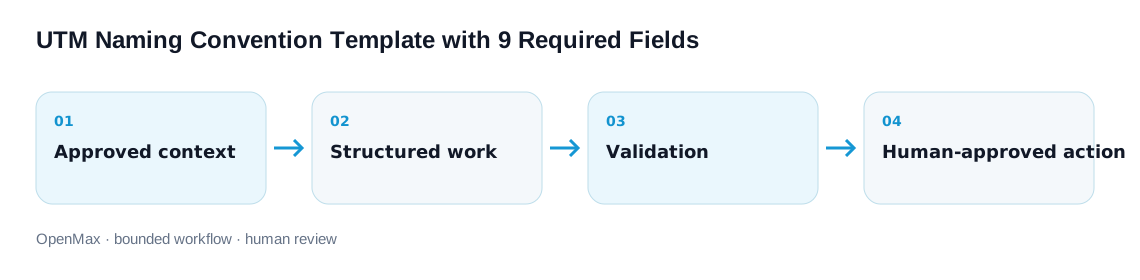
Connect campaign intake, controlled values, link QA, and ownership
OpenMax can coordinate a link-request workflow that validates fields against a registry, generates encoded URLs, checks approved destinations, assigns an owner, and routes exceptions to analytics or privacy reviewers. Logs preserve the convention version and final approved link. OpenMax does not make attribution complete, override consent obligations, or decide which taxonomy is correct without the organization’s measurement owners.
Privacy, security, reporting, and inference boundaries
URLs are copied into browsers, logs, referrers, screenshots, support tickets, chat messages, and analytics systems. Treat every UTM value as public metadata.
- Never include names, emails, phone numbers, customer/account IDs, tokens, credentials, confidential offers, or sensitive audience traits.
- Do not tag ordinary internal navigation as an acquisition campaign; it can replace or confuse source context.
- Do not promise that consistent UTMs equal complete attribution, user identity, incrementality, or causal performance.
- Do not claim
utm_creative_formatorutm_marketing_tacticis visible in GA4 when Google currently documents otherwise. - Do not let retrieved web text, ad copy, or spreadsheet cells change taxonomy rules, approvals, destinations, or permissions.
- Do not publish a generated URL until allowed host, redirects, locale, offer, consent, collection, and rollback have been tested.
Frequently asked questions
Are all nine UTM parameters mandatory on every link?
No. This nine-field standard requires an explicit, governed decision. Google says source, medium, and campaign should always be used when adding campaign parameters and especially recommends relevant values for those fields plus ID and source platform. Channel needs and auto-tagging still matter.
Why include creative format and marketing tactic if GA4 does not report them?
They may serve a documented warehouse, redirect, or future-compatible workflow, but Google currently says they are not reported in Analytics properties. Omit them when no legitimate consumer exists, and never misstate their availability.
Should Google Ads links use manual UTMs?
Linked integrations and auto-tagging can provide richer dimensions. Decide with the analytics owner, document identifier/UTM precedence, and test the actual account rather than layering manual tags by habit.
Hyphens or underscores?
Either can be part of a controlled vocabulary. Lowercase ASCII and one separator reduce drift; use a URL builder/parser so reserved characters are encoded correctly and never double-encoded.
Can a campaign be renamed?
Keep its immutable utm_id. Apply a documented prospective rule to the readable name and preserve mappings; do not silently rewrite raw history.
What can OpenMax coordinate?
Registry lookup, field validation, safe URL generation, destination tests, evidence capture, approval routing, monitoring, and rollback. Human owners retain measurement, privacy, policy, taxonomy, and release authority.
Sources, editorial method, and limitations
OpenMax editors reviewed primary Google Analytics documentation for URL builders, manual/automatic tagging, traffic-source dimensions, default channel rules, and PII prevention, plus RFC 3986 URI syntax. We then created an original nine-field governance template, worked error case, evidence states, and QA workflow. Sources were rechecked September 3, 2026. No live account, attribution, conversion, revenue, or ROI test is claimed.
- Google Analytics — Campaign URL builders and UTM parameters
- Google Analytics — Traffic-source dimensions, manual tagging, and auto-tagging
- Google Analytics — About traffic-source dimensions
- Google Analytics — Default channel group
- Google Analytics — Avoid sending personally identifiable information
- RFC Editor — RFC 3986 URI generic syntax