

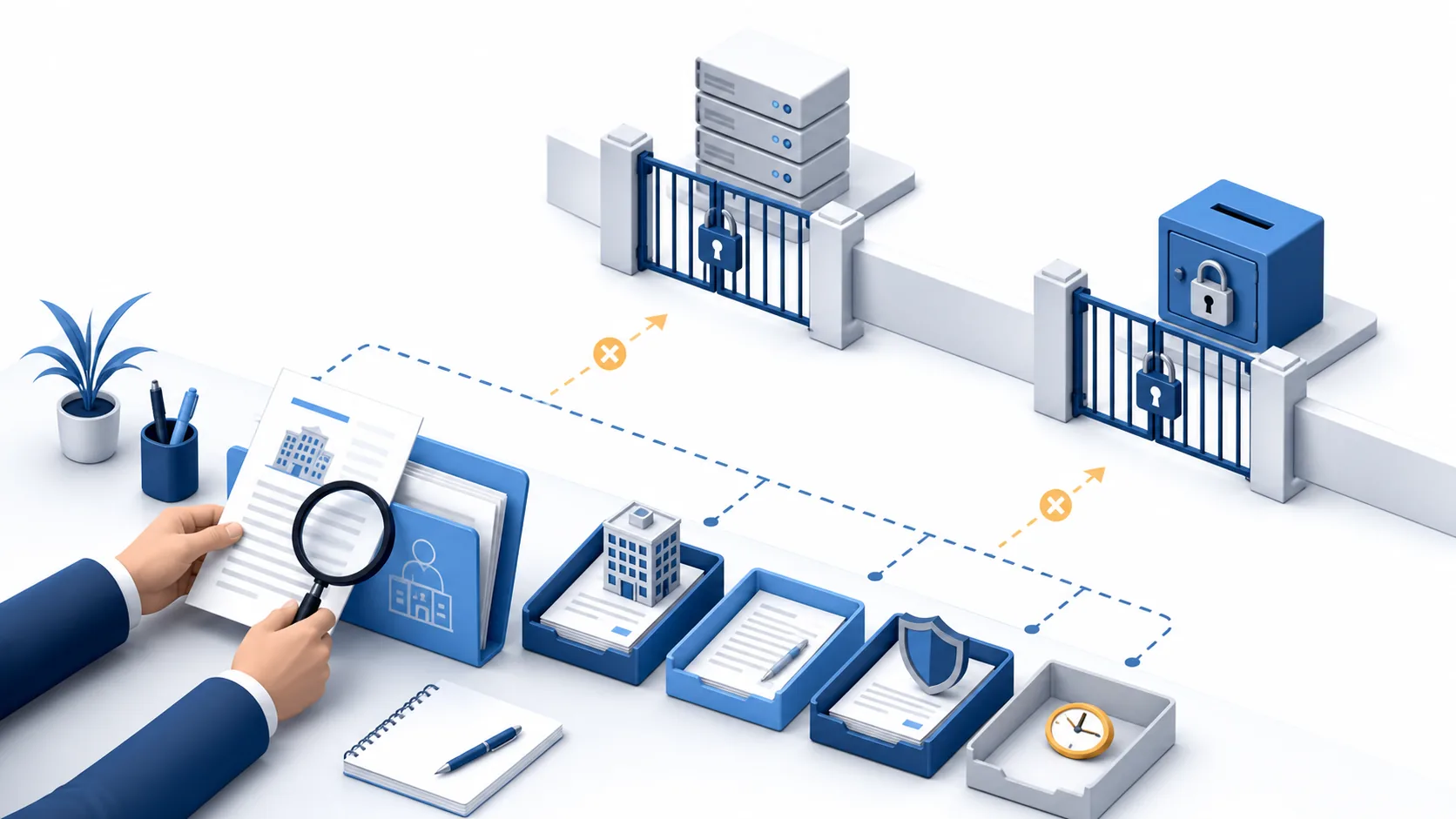
Quick answer: qualify the relationship before enabling transactions
Vendor onboarding establishes who the supplier is, what the organization intends to buy, which evidence and reviews apply, and which activities may begin. A supplier record can exist before the supplier is authorized to receive an order, connect to systems or receive payment. Your checklist should name those separate decisions instead of using one ambiguous “approved” checkbox.
Oracle's registration documentation illustrates this distinction: prospective suppliers can participate in negotiation and qualification, while spend authorization involves a further approval path for financial transactions. That is a product-specific example, not a promise about every procurement system. Oracle: supplier registration process.
Use a base intake plus conditional reviews. A one-off physical-goods supplier, an on-site contractor and a software provider processing employee records need different evidence. Mark an item “not applicable” only with an accountable reason. Missing, not requested, expired and rejected are different states and must not be silently converted into approval.
Define scope, evidence states and the accountable reviewer
Before sending a questionnaire, record the buying entity, service or goods, intended locations, expected relationship duration, data and system access, payment method, operational dependency and business owner. These facts determine which reviews to request. A small contract can still have substantial data access; spend alone is not a sufficient risk classification.
For each applicable item, retain the requirement, source reference, version or effective period, reviewer, result, unresolved question, due date and restricted activity. Keep sensitive originals in the approved repository and place access-controlled links in the coordination record. A copied identity or banking document can create unnecessary exposure without improving verification.
| Evidence state | Meaning | What to do next |
|---|---|---|
| Required, not received | A scoped requirement lacks evidence | Send a precise request through the approved channel |
| Received, not reviewed | A file or answer is present | Assign the qualified reviewer; do not mark accepted |
| Clarification or correction needed | Evidence is inconsistent, expired or insufficient | Ask for the particular correction and preserve history |
| Accepted for stated scope | The authorized reviewer recorded a decision | Use only within its scope, validity and downstream permissions |
| Not applicable, with reason | An owner documented why the requirement does not apply | Reopen if the service, country, data or risk changes |
| Exception requested | A requirement is unmet and a decision is sought | Keep the restriction unless the proper authority grants a bounded exception |
Download the editable vendor onboarding review worksheet. It includes the twenty-item register, status fields and separate activation decisions. Do not place actual taxpayer numbers or full bank details in a broadly shared checklist.
Data minimisation is not the same as collecting nothing: obtain what the defined purpose needs, without requesting unrelated personal data. The UK Information Commissioner's Office explains this principle for UK GDPR processing; its guidance is currently marked under review, so legal owners should check the applicable version and jurisdiction. ICO: data minimisation.
Twenty documents, checks and approvals to include where applicable
1. Business request and named sponsor
Capture what is being purchased, why an existing supplier cannot meet the need, the intended scope and the internal owner. Identify who can confirm delivery and who owns the relationship after onboarding. An urgent start date is context for prioritization, not authority to bypass a review.
Procurement should return a vague request such as “set up this company” with a specific question about the purchase. Without scope, security, insurance and tax reviewers cannot determine what evidence is relevant. Retain the approved request as the reference for later scope changes.
2. Legal business name and entity identity
Distinguish the legal counterparty from a brand, trading name or parent company. Compare identifiers across the proposed contract, registration evidence and supplier master. A shared logo does not prove two entities are interchangeable.
The supplier-data owner should resolve mismatches and record the accepted identity and aliases. Do not create a second supplier simply because punctuation or a trading name differs. Conversely, do not merge different entities because their names look similar.
3. Registration or equivalent business evidence
Request evidence appropriate to the entity type and relevant country: an official register reference, incorporation record or accepted alternative where that is the approved requirement. Check the issuing source, entity identifier and status rather than trusting a screenshot alone.
Procurement or compliance should determine whether the evidence is sufficient for this purchase. Registration establishes particular identity facts; it does not prove financial stability, required licensing, service quality or freedom from sanctions. Do not describe a registered vendor as comprehensively verified.
4. Registered, operating and remittance addresses
Capture addresses by purpose. The registered office, delivery location, service location and address used for remittance correspondence may legitimately differ. Identify which belongs on the contract, supplier site and purchasing documents.
Ask about an unexplained mismatch rather than automatically rejecting it or copying whichever address appeared first. Cross-border delivery or service locations may change the required review. The owner should record the explanation and authoritative source, not silently normalize all addresses to one value.
5. Applicable tax form or identifier
Ask the tax or AP owner which form and identifiers are needed for the payee, paying entity, payment type and jurisdiction. A US tax form is not a global onboarding requirement. The US Internal Revenue Service (IRS) describes Form W-9 as providing a taxpayer identification number and certification for specified information-reporting purposes. IRS: about Form W-9.
Use the approved secure channel and restrict access. An AI assistant may flag a missing field for the reviewer but should not choose a tax classification, certify a taxpayer identity or determine withholding. Do not publish an automatic rule that every foreign supplier must provide the same alternative form.
6. Verified business contacts and role ownership
Record separate contacts for commercial matters, service delivery, invoices and security incidents where needed. Confirm who is authorized to submit onboarding information and request profile changes. A valid email address alone does not prove authority to change banking details.
Keep an internal owner and backup as well as the supplier contact. If a contact leaves, the relationship must not lose its review history or inherit unlimited access through a forwarded mailbox. Verify replacements through the approved process before changing sensitive permissions.
7. Contract or approved terms
Identify the executed agreement or other approved purchasing terms, correct entities, effective dates and authorized signatories. A draft with a familiar filename is not evidence of execution. Preserve the exact accepted version and link any amendments.
Legal and procurement owners should determine whether the terms cover the proposed relationship. Confidentiality, liability, termination and subcontracting questions belong with those owners. If only evaluation activity is authorized, record that boundary instead of calling the vendor fully contracted.
8. Statement of work and acceptance criteria
A statement of work should make delivery review possible: what is included, what is excluded, dependencies, milestones and who accepts the result. For services, distinguish hours worked from an accepted deliverable when the agreement treats them differently.
The business sponsor should resolve vague success criteria before the supplier starts. If the planned work later expands from a demonstration to processing production records, reopen the relevant reviews. An existing contract does not necessarily authorize a new data flow or service scope.
9. Pricing schedule and charging basis
Record the agreed price version, currency, unit, included services, usage charges, discounts and renewal or change mechanism as applicable. “USD 100” is incomplete without knowing whether it means per user, per month, per shipment or something else.
The commercial owner should reconcile the pricing schedule with the order and contract. Keep proposed prices separate from accepted prices. An onboarding tool should not resolve a discrepancy by selecting the cheaper number or by treating a quote as the final agreement.
10. Purchase-order and invoice-submission requirements
Document whether a purchase order is required, which entity issues it, the invoice destination, required reference fields and the exception route. Tell the supplier how to submit one invoice once; avoid parallel inboxes that encourage duplicate processing.
AP should confirm the route before the first invoice. If a purchase is legitimately non-PO, record the approved alternative rather than inventing an order afterward. Supplier onboarding establishes the route; it does not approve a future invoice merely because the vendor exists.
11. Insurance evidence when the activity requires it
Let the risk or legal owner determine whether insurance is required for the service, location, contract and exposure. Where required, review the named insured, relevant coverage, policy period and any required supporting wording. A certificate logo does not establish that the actual work is covered.
Do not impose one universal coverage limit in an article. Record an expiry or review trigger and the owner of follow-up. If evidence is insufficient, identify the restricted activity and approved exception path; an uploaded expired certificate is not an accepted current record.
12. Security questionnaire and relevant supporting evidence
Scope security review to the proposed access and dependency. A provider receiving production credentials requires a different review from a supplier delivering stationery. Use the security team's accepted questionnaire and evidence requirements; do not equate questionnaire completion with verified controls.
The US National Institute of Standards and Technology (NIST) published SP 1326 in July 2026, providing due-diligence considerations specifically for information and communications technology suppliers. It is a useful reference for the security owner, not a certification that a supplier or this checklist has passed. NIST: due-diligence assessment quick-start guide.
For material services, ask the reviewer to consider the relevant product, report scope and period, unresolved findings, incident contact and continuity/exit arrangements. A report covering a different service or historical period may not answer the actual question.
13. Privacy and data-processing review
Identify whether the supplier receives personal data, the relevant roles, purpose, categories, locations, retention and onward access. Privacy or legal owners should decide the necessary agreement and assessment. A non-disclosure agreement is not automatically a substitute for a required data-processing arrangement.
The ICO's UK controller–processor contract guidance discusses processing details and required terms. It is jurisdiction-specific and marked under review; do not turn it into a worldwide contract template or legal sign-off. ICO: controller–processor contract contents.
If the scope changes, recheck the data map, subprocessors and approved instructions before granting access. Store the decision and unresolved conditions alongside the contract reference.
14. Applicable compliance screening and licensing review
Compliance should define the screening obligations and sources for the entity, locations, goods, services and jurisdictions. Where relevant, this may include sanctions, ownership, required professional licenses or procurement restrictions. There is no single universal list of checks that proves a vendor is compliant everywhere.
Record the approved method, search date, identifiers and human disposition of possible matches. A name similarity is not a confirmed finding. Do not let a model clear a potential match, infer citizenship from a name or collect unrelated personal information “just in case.” Unresolved issues go to the authorized specialist.
15. Conflict-of-interest and related-party disclosure
Where policy requires it, obtain the defined disclosure from the appropriate internal and supplier parties. The purpose is to identify a relationship requiring review, not to generate allegations from social connections or shared surnames.
The designated ethics, legal or procurement owner should record the disposition, any recusal and conditions. Keep access limited to people who need the information. “No disclosure received” and “no conflict identified after review” are different states.
16. Banking or payment-account documentation
Collect the information required for the actual payment method through the approved secure process. Check that account-holder information and any third-party payment arrangement are explained and reviewed. A bank letter or voided check is supplied evidence, not independent confirmation of the requester's authority.
AP or treasury should control sensitive fields and acceptance. Do not spread full account details across emails, task summaries or copied spreadsheets. Preserve a restricted source reference and enough masked information for authorized reviewers to identify the record.
17. Independent verification of payment instructions
Keep payment verification separate from document collection. Use a trusted, independently established contact route and your approved verification procedure, especially for account changes. Calling the new number included in the same suspicious request does not independently verify that request.
The US Federal Bureau of Investigation (FBI) recommends verifying payment requests and changes to account or payment procedures, and independently looking up contact information rather than relying on an unsolicited message. FBI: business email compromise.
Record who checked what, when, and the accepted outcome without exposing unnecessary bank data. Urgency should not remove the control. An unresolved verification restricts the affected payment setup; it is not by itself a finding that the supplier committed fraud.
18. Currency, payment terms and payment method
Reconcile the accepted currency, due-date basis, payment method, beneficiary arrangement and agreed terms with the contract and supplier setup. A master-data default should not silently replace the negotiated terms.
AP and treasury should resolve exceptions and record approved configuration. Define the change path before the first payment: a later email asking for a new currency or beneficiary is a new request to verify, not an automatic continuation of the original approval.
19. Review and approval matrix
Identify the decisions required from procurement, sponsor, finance and any applicable legal, security, privacy or compliance owners. Each decision should identify the scope, evidence version, conditions and authority. One person's “looks fine” is not a substitute for all required reviews.
The onboarding coordinator can chase outstanding decisions but should not award them. If a bounded exception is requested, preserve the unmet requirement, compensating conditions, approver and expiry. Do not let a system convert elapsed time or a high completion percentage into implicit approval.
20. Controlled supplier creation and activation record
Record the resulting supplier and site IDs, duplicate check, accepted master-data version and permitted activities in the enterprise resource planning (ERP) or other system of record. Creating a record, authorizing ordering, granting application access and enabling payment are separate events even if a product combines some of them in one workflow.
An authorized administrator should confirm the actual resulting state, not just a successful submission message. Reconcile uncertain retries before creating another supplier. Retain who activated which capability and what remains restricted, along with the next review and change triggers.
Run onboarding through six explicit handoffs
- Approve the scope and review route. Procurement and the sponsor agree on the purchase, risk questions, reviewers and allowed pre-contract activity. Determine the applicable subset of the twenty records before requesting sensitive documents.
- Invite the correct supplier contact. Use the approved intake channel with specific document instructions and a way to ask questions. Record the invitation and case ID; do not send unnecessary taxpayer or bank details in reminder messages.
- Check completeness without pretending to assess suitability. A coordinator can identify missing pages, inconsistent names or dates and route them for correction. Only the responsible reviewer accepts the evidence for the declared scope.
- Run independent specialist reviews. Finance, security, privacy and other owners record separate results. Parallel review can reduce waiting, but one completed track does not release another track's restrictions. Keep the first request date and original outstanding issue visible when reassigning work.
- Authorize and verify activation. After the applicable decisions, the authorized administrator applies only the permitted changes. Check actual supplier, order, access and payment states and reconcile retries. A notice saying “approved” is insufficient if the live configuration differs.
- Monitor changes and expiry. Define review triggers for new services, data access, ownership, payment instructions, incidents and expiring evidence. Reopen affected decisions and assign an owner. Offboarding should address access removal, outstanding obligations and data return or deletion under the applicable agreement.
Measure waiting by cause: supplier response, internal review, correction or activation failure. If reporting a completion measure, define its denominator and show unresolved blockers separately. A dashboard should reveal whether a vendor can do a specific thing, not hide that decision behind a percentage of populated fields.
Worked example: a populated folder still leaves three blockers
Separate six selected controls in a software-vendor request
This is a hypothetical example, not an OpenMax customer case. A business team wants an analytics service to process customer records. Six selected controls from the broader checklist are shown below; this is not the complete twenty-item assessment. The responsible owners have not authorized production data access or payment activation.
| Selected control | Current evidence | Review state and consequence |
|---|---|---|
| Legal identity | Accepted entity and registration references | Accepted for the named counterparty only |
| Commercial agreement | Executed agreement for the proposed service | Accepted commercial record, not data-access approval |
| Security review | Questionnaire uploaded, relevant findings unresolved | Pending security decision; no production access |
| Privacy review | Processing agreement remains a draft | Pending privacy/legal decision; no customer-data transfer |
| Independent bank verification | Banking letter uploaded, confirmation not completed | Pending verification; payment setup not enabled |
| Final activation | Requester wants an immediate start | Blocked until the required decisions permit the requested activity |
Two selected controls are accepted, three reviews are pending and final activation is blocked. Counting five evidence files as “five of six done” would confuse receipt with acceptance. The next action is not to collect another generic certificate: it is to obtain the three specific decisions and then recheck activation authority.
Change the scope instead of silently changing the answer
If the team proposes a demonstration using synthetic data, record it as a different, bounded request. The responsible owners may authorize that activity under defined conditions; this does not approve later production use or payment. Keep the original blockers visible and specify what the demonstration may not access.
If the supplier later changes its beneficiary account or introduces a new subprocessor, reopen the affected review rather than copying the prior result. The worksheet's scope and version fields make that change visible. This example demonstrates decision separation, not a universal permission policy or a guaranteed safe workaround.
Choose the intake and coordination method that fits
A controlled form and shared register can work for a small supplier population when ownership is clear. It is inexpensive to understand, but attachment permissions, history and manual activation checks require care. A publicly shared spreadsheet is not an appropriate vault for bank or tax records.
Native procurement or ERP supplier registration is the first option to inspect when it already supports the relevant relationships and approvals. Confirm actual conditional fields, duplicate checks, supplier sites and activation states. Existing software may solve the intake problem without adding an agent.
A vendor-risk platform or specialist process may be appropriate for material security, privacy, regulatory or continuity review. Compare its scope and evidence with the actual purchase. A risk score does not replace your own authority decision, and a platform badge does not verify every supplier claim.
Controlled integrations and agent-assisted coordination can help when information and reviewers span systems. Evaluate source links, access restrictions, reminder behavior, version changes and retry recovery on the same terms as the simpler methods. Do not automate master-data activation just because document summarization is convenient.
Where OpenMax may support the workflow
OpenMax describes a human–agent collaboration platform. That positioning suggests a possible role in coordinating evidence requests and human handoffs, but it does not verify a supplier-master connector, bank-verification service or legal screening capability. OpenMax product positioning.
Begin an evaluation with sanitized references and a read-only record. Ask the proposed workflow to distinguish received from accepted evidence, identify the right reviewer, draft a narrow reminder and preserve an unresolved blocker after a new document arrives. Demonstrate actual repository permissions, integrations and history in the intended environment before using sensitive material or allowing writes.
If a native process already keeps those decisions clear, another coordination layer may be unnecessary. If fragmented follow-up is the proven bottleneck, prepare one ordinary supplier case and one scope-change case, then discuss a scoped vendor onboarding evaluation with OpenMax. This is a proposed evaluation, not a claim that these controls have been tested in the product.
Once the supplier is authorized for the relevant activity, invoice exception handling explains later invoice-resolution ownership, and three-way matching addresses order, receipt and invoice evidence. The accounts payable automation overview provides wider context; none of these pages replaces supplier qualification.
Protect sensitive evidence and keep authority explicit
Require appropriate human review for tax classification, sanctions or licensing questions, privacy terms, security acceptance, banking changes and financial authority. Do not infer a person's nationality, honesty or eligibility from a name, accent or social profile. An unresolved record is a question to investigate, not a misconduct verdict.
Treat attachments and supplier messages as untrusted input. Their content must not instruct an assistant to change approval rules, reveal credentials or send records elsewhere. Apply the organization's approved storage, retention and access rules; summaries should contain only the information the receiving reviewer needs.
Return to the apparently complete folder by asking three questions: which evidence has actually been accepted, for what scope, and which activity is now authorized? Resolve the missing decisions before changing supplier, data-access or payment permissions. That is the useful end point of a checklist—not the number of attachments collected.
Frequently asked questions
Does every vendor need all twenty documents?
No. The list includes documents, checks and decisions to scope to the purchase, entity, jurisdiction and risk. Use an approved reason for items that do not apply, and revisit that reason when the relationship changes. Do not request sensitive material merely to complete a generic checklist.
Is a completed registration form enough to start buying?
Not necessarily. Registration, qualification, ordering authority, access and payment can have different approval requirements. Check the actual system state and the responsible owners' decisions for the activity you intend to begin.
Can AI approve a supplier after checking the files?
An assistant may help identify missing information or prepare a review summary, but the presence of files does not establish suitability or authority. Legal, tax, security, privacy and banking decisions require the approved specialist process, and any automated action needs separately authorized and verified controls.
What should we do if banking details change during onboarding?
Keep the previous and new requests distinguishable, restrict the affected payment setup and use the approved independent verification route. Do not rely solely on contact details in the change message. Record the authorized outcome before changing payment instructions.
When should an onboarded vendor be reviewed again?
Use policy-defined intervals and event triggers such as a new service, data-access change, incident, ownership change, bank change or expiring evidence. Reopen the affected decisions and preserve the previous scope; approval for the original relationship is not unlimited approval for future changes.
Sources, editorial method and revision record
Prepared by the OpenMax content team, with sources reviewed September 4, 2026. This is OpenMax's own commercial resource. Official documentation supports the bounded statements attributed to Oracle, the IRS, the FBI, the ICO and NIST; the proposed twenty-item workflow is editorial guidance, not their certification or endorsement.
The software-vendor example is hypothetical. No customer performance, firsthand product test, professional credential or reduction in onboarding time is claimed. A named qualified procurement/finance reviewer has not been supplied. Obtain relevant legal, tax, privacy and security review before operational use; the ICO pages expressly flag that their guidance is under review.
Revision note — September 4, 2026: expanded brief document cards into applicability, evidence and reviewer guidance; separated submission from acceptance and activation; added a scoped software-vendor example and editable review register; replaced unverified OpenMax control assurances with evaluation requirements.
Primary references: Oracle supplier registration, IRS Form W-9, FBI business email compromise, ICO data minimisation, ICO processor contracts, NIST SP 1326, and OpenMax.