

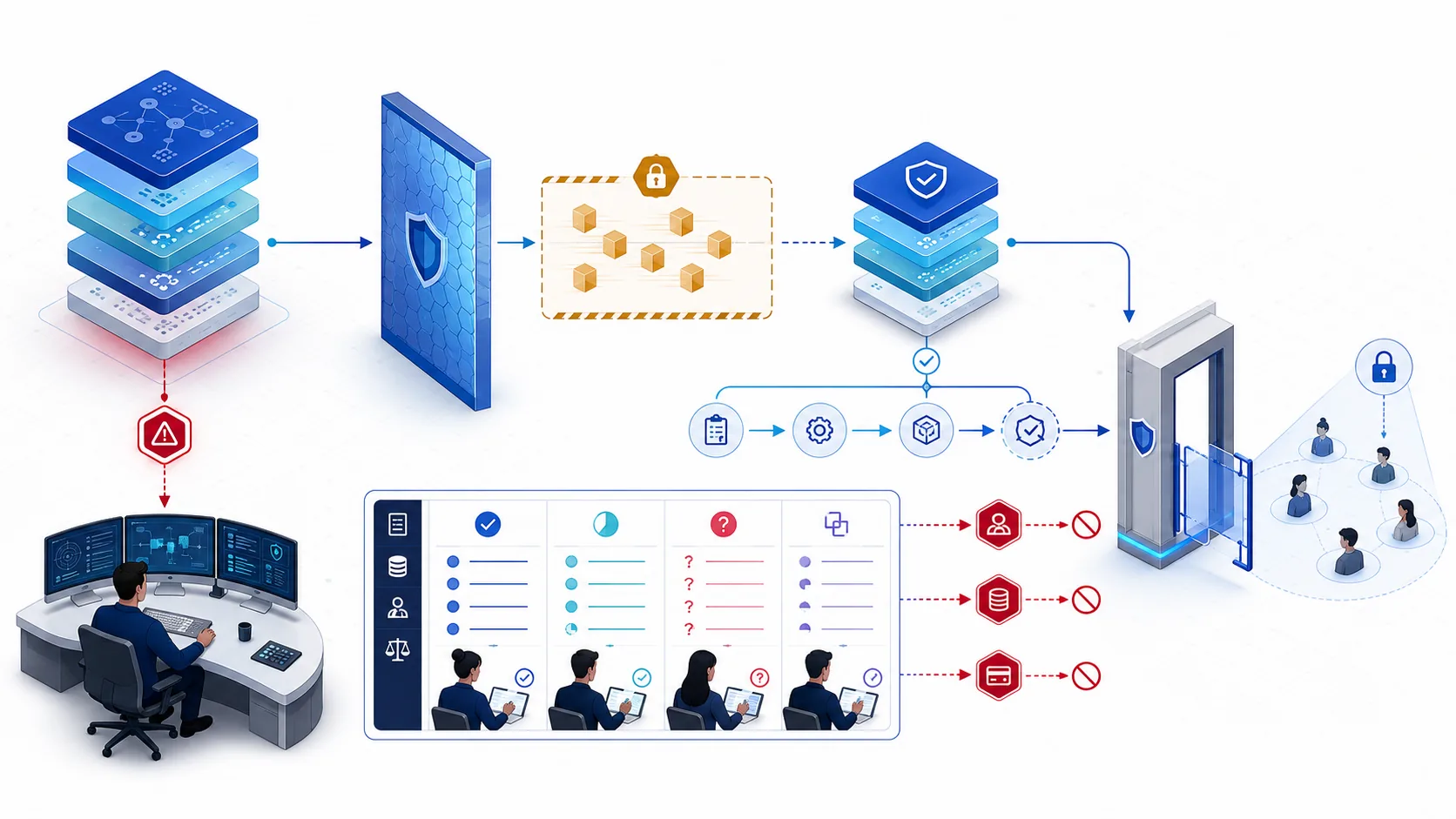
Quick answer: restore configuration and business state separately
Contain before changing the evidence
Declare one incident, assign command and freeze unrelated deployments, prompt edits, policy changes and index refreshes. Restrict new high-impact actions and quarantine in-flight work while preserving version markers, operation identities, approvals, traces and authoritative downstream state. If continued operation can create harm, containment outranks diagnostic convenience.
Restore one complete compatible manifest
Select an immutable target that binds the model route, trusted instructions, policy, retrieval, memory, tools, permissions, schemas, workflow, locale assets, evaluator, telemetry and queue semantics. Verify artifacts, access and migrations before restoration. “The version before this one” is a chronology label, not proof that the target is safe, compatible or still authorized.
Reconcile effects before reopening
Classify every material operation as not started, completed, failed, unknown, partial, duplicated or compensated using the authoritative connected system. Never translate unknown commit state into failure and blindly retry. Run isolated smoke, regression, permission, isolation, idempotency and monitoring checks, then reopen a bounded cohort under explicit stop rules. Close only when remaining harm, communications and corrective work have owners.
Rollback, forward fix, failover and compensation solve different problems
Rollback restores a prior compatible operating unit
A rollback replaces the faulty active configuration with a previously verified deployable unit. It is appropriate when the failure is linked to the change, the target remains compatible and restoration risk is lower than continued operation or an emergency patch. It does not erase actions the faulty unit already initiated.
A forward fix changes the faulty unit
A forward fix creates a new configuration that repairs the defect without returning to the earlier one. Use it when data migration is irreversible, the previous target is vulnerable or incompatible, or a small well-understood repair is safer. It still needs identity, review, testing, staged release and a recovery path; urgency does not make an untracked console edit acceptable.
Failover moves service to another operating path
Failover shifts work to a redundant region, provider, model route or non-AI/manual process. It can preserve service when the primary path is unavailable, but it introduces its own capacity, data, permission and behavioral assumptions. Validate the failover path and record what work moved, paused or remained unknown.
Compensation addresses an already committed effect
A compensating action corrects or offsets a business effect, such as restoring a record, revoking an access grant or issuing an approved refund. It is not the same as replaying the original command in reverse. The domain owner must verify authority, amount, recipient, timing and whether compensation can itself duplicate harm.
Define rollback triggers before an incident
Safety and authority triggers
Stop or restrict the release when it attempts prohibited access or action, bypasses a required approval, crosses tenant boundaries, exposes credentials or creates an unreconciled irreversible effect. These events should not be averaged into a task-quality score.
Reliability and integrity triggers
Define thresholds for malformed tool calls, state corruption, duplicate operations, missing records, uncontrolled retries, queue growth, incompatible schemas and monitoring blind spots. A single integrity failure may be more consequential than many harmless wording changes.
Quality and segment triggers
Monitor critical-task success, unsupported claims, refusal behavior, language and role segments, human escalation and source use. Preserve denominators and affected segments. A global average can hide failure in a small regulated workflow or locale.
Trigger evidence and authority
For each trigger record signal owner, source, measurement window, severity, required corroboration, containment action, rollback decision authority and expiry. Allow an emergency kill action where justified, but require retrospective review and do not let the agent grant itself deployment or waiver authority.
Prepare one recovery record before touching production
Incident and decision identity
Record incident ID, severity, start time, detection signal, commander, technical recovery owner, business-effect owners and the people authorized to stop, restore, compensate and reopen. Preserve dissent and unresolved questions rather than turning the timeline into a success narrative.
Active and target manifests
Capture exact identifiers and hashes for the active unit and proposed target. Include model, prompts, policy, retrieval corpus/index, memory behavior, tool adapters, permissions, output schema, orchestration, feature flags, locales, evaluators, telemetry, queues, caches and migrations.
Affected-work boundary
Define time window, tenants, roles, workflows, regions, releases, queues and operation types potentially affected. Link every run to its manifest and each material side effect to an idempotency or business-operation identity. State what cannot yet be bounded.
Containment, validation and reopening contract
Record the selected kill, degrade, queue, quarantine or failover controls; preservation and privacy rules; target verification; isolated tests; stage cohorts; observation periods; stop thresholds; communication duties; residual risks; and closure criteria. The record should make “recovered” independently reviewable.
Step 1 — declare the incident and freeze unrelated changes
Open one accountable incident
Create one authoritative incident record and timestamp the initial signal in a consistent time zone. Assign severity provisionally and update it when impact evidence changes. Link related alerts rather than opening competing timelines that obscure decisions.
Freeze behavior-relevant edits
Pause unrelated model routes, prompts, policies, retrieval updates, schema changes, permission grants and deployment automation for the affected path. Emergency work should be attached to the incident and produce new immutable identity. Do not erase the faulty state needed for comparison.
Preserve evidence lawfully and proportionately
Retain the minimum logs, traces, approvals, tool responses and state snapshots necessary for diagnosis and recovery. Protect secrets and personal or sensitive business data with access and retention controls. Legal or regulatory preservation needs a qualified owner; this guide does not determine them.
Step 2 — establish command, authority and decision rules
Separate incident command from technical execution
The commander coordinates priorities, scope and communication. Technical owners diagnose and execute controlled changes. Business-system owners decide compensation. Security, privacy, legal, finance or safety owners join when their boundaries are affected.
Confirm stop, restore and reopen authority
Verify who may disable tools, drain traffic, quarantine queues, revoke credentials, deploy the target, compensate effects and reopen cohorts. If an approver is unavailable, use the documented alternate or remain restricted. An agent or deployment job cannot infer approval from silence.
Use predefined rules without becoming rigid
Apply severity and rollback criteria written before the incident where possible. Record why the actual situation fits or departs from them. Novel harm may require containment even when no numeric threshold has fired; document the accountable judgment.
Step 3 — snapshot the active manifest, signal and timeline
Resolve the behavior-producing configuration
Capture what actually served each affected request, not merely the repository default. Resolve aliases and feature flags to immutable versions. Include dynamic retrieval, cached content, runtime policies and provider routes that can change behavior without a code commit.
Preserve the triggering observation
Record the input class, role, locale, relevant state, decision, tool attempt, approval path, output, effect and detection source. Minimize sensitive content while preserving the causal conditions. A screenshot without run and operation identity is weak recovery evidence.
Build a decision timeline
Log signal, declaration, containment, target selection, execution, validation, stage and communication events with actor, artifact and rationale. Correct entries appenditively; do not silently rewrite earlier uncertainty after the outcome becomes known.
Step 4 — bound affected runs and downstream systems
Start broad, then narrow with evidence
Use the earliest possible faulty activation and all dependent workflows as the initial boundary. Narrow only when version markers, routing logs, policies and authoritative system records support exclusion. Missing telemetry is uncertainty, not proof that a tenant was unaffected.
Trace runs to operations
Connect agent runs, tool calls, approvals, queue messages and retries to business-operation IDs. One run can create multiple effects, and several retries can target one effect. Preserve both relationships so a count of traces is not mistaken for a count of customer impacts.
Assign owners for every affected system
Identify the authoritative owner for CRM, ticketing, identity, messaging, billing, storage or other connected state. The agent platform may show attempts and responses; the connected system determines whether the effect committed.
Step 5 — contain new and in-flight work
Choose kill, degrade, queue or failover deliberately
Kill the path when continued operation is unacceptable. Degrade by removing write tools or requiring human approval when safe read-only service remains useful. Queue new work only when expiry, order, consent and replay semantics are understood. Fail over only to a verified path.
Quarantine in-flight and retryable work
Preserve run, operation, idempotency, approval and manifest identity. Stop automatic retries with unknown commit state. Mark ownership and review deadlines; do not leave quarantined work invisible to service teams or users who depend on it.
Contain credentials and access
Revoke or rotate credentials when exposure or misuse is plausible, following authorized security procedures. Verify that the recovery target has only the access it needs. Credential work can break rollback compatibility, so record it in the target manifest rather than treating it as an unrelated action.
Step 6 — verify the known-good target
Prove identity and artifact availability
Resolve a signed or otherwise protected immutable target and verify hashes, images, prompts, policies, indexes, schemas and configuration. Confirm that required artifacts still exist and can be reconstructed without fetching mutable “latest” dependencies.
Check compatibility before deployment
Review data and schema migrations, tool contracts, permission models, queue formats, memory state, caches, retrieval indexes, locales and provider availability. Where backward restoration would corrupt state, use a forward fix or isolated compatibility layer instead.
Review target history and current risk
Check the target's past incidents, vulnerabilities, expired access, unresolved defects and current policy fit. Recent successful operation is useful evidence, not permanent certification. Record who accepted the residual risk and the exact recovery scope.
Step 7 — restore the complete configuration through a controlled path
Use the ordinary protected deployment mechanism
Prefer the same audited deployment path used for normal releases, with required review, immutable identity and observable status. An emergency lane may shorten waiting but should not bypass identity, authorization or logging.
Restore dependent state in the correct order
Sequence schemas, adapters, policies, prompts, model routes, indexes, caches and traffic so incompatible combinations are not exposed. Define what happens if restoration fails midway and how to return to containment.
Verify the active version after the command
Check runtime markers, healthy instances, configuration hashes and provider routes, not just a successful CLI response. Kubernetes documentation, for example, requires verifying rollout status and notes that a deployment revision covers only its managed pod template; AI workflow dependencies and business effects need separate checks.
Step 8 — reconcile in-flight work and external effects
Classify operation state without guessing
For each material operation use authoritative evidence to mark not started, committed, failed, unknown, partial, duplicated or compensated. Preserve observation time and source. A timeout means the caller lacks an answer; it does not prove the receiver did nothing.
Resume, cancel, replay or compensate with authority
Resume only compatible work whose business need and consent remain valid. Cancel expired or unsafe work visibly. Replay only when idempotency and authoritative state make it safe. Compensate through the connected system's approved process with a domain owner.
Communicate material impact
Coordinate affected-party, customer, regulator, partner or internal communication with authorized owners. State known facts, actions, uncertainty and next update. Do not expose sensitive incident details or claim complete recovery while material effects remain unresolved.
Step 9 — validate recovery and reopen in bounded stages
Test the triggering failure and universal invariants
Run isolated smoke and regression tests against the exact restored manifest. Include the triggering case plus permissions, tenant isolation, tool schemas, required approvals, idempotency, retrieval boundaries, memory, locale and monitoring checks.
Reopen one bounded cohort
Define tenants, roles, workflows, region, duration, request/effect limits and human supervision. Start read-only or approval-gated where appropriate. Do not use a live cohort to discover whether the target violates a known critical boundary.
Observe stop rules and authoritative effects
Monitor critical task outcomes, refusals, escalations, tool failures, unknown commits, duplicates, queue age, latency, cost and security signals. Stop on the predefined severe event even when aggregate quality looks normal. Record every scope increase as a decision.
Step 10 — communicate, close provisionally and improve controls
Separate service restoration from incident closure
Service may be stable while compensation, notifications, privacy review or root-cause work remains open. Mark the incident recovered, monitored or restricted using explicit criteria. Do not close merely because traffic returned.
Preserve a reviewable record
Retain the manifest pair, affected boundary, timeline, operations, decisions, tests, stage results, communications, residual risks and owners under approved access and retention rules. Correct mistakes appenditively and link superseding evidence.
Convert failure into preventive evidence
Add minimized regression fixtures, repair missing telemetry, rehearse containment and restoration, review permissions and queue semantics, and assign dated corrective actions. Root cause should describe supported causal evidence, not the person nearest to the failure.
Twenty-four recovery cases to include in a rollback rehearsal
1. Model route returns structurally valid but unsafe actions
Verify that containment can disable high-impact tools independently of conversational service. Restore the complete compatible model-and-policy pair and test refusal, approval and effect rules.
2. Trusted instruction change weakens a refusal
Preserve the exact assembled prompt and dependencies. Roll back the bundle, not one fragment, then rerun the triggering and adjacent authority cases before reopening.
3. Policy service supplies stale decisions
Freeze cached decisions, identify their scope and restore a compatible policy path. Recheck authorization in the downstream system; an agent-side allow decision must not replace enforcement.
4. Retrieval index exposes restricted material
Disable affected retrieval or fall back to an approved corpus. Bound queries and recipients, revoke cached context where possible and involve privacy or security owners before resuming.
5. Memory migration changes user identity
Quarantine sessions using the migrated representation. Do not force old code over new state until compatibility is proven. Use a forward repair when reversal would corrupt history.
6. Tool schema maps a field to the wrong target
Pause writes and identify every call using the faulty schema. Restore the compatible adapter and schema together, then reconcile connected records by business-operation ID.
7. Required approval is skipped
Disable the action path, identify unapproved attempts and involve the responsible domain owner. Restoring the gate does not retroactively authorize or reverse completed actions.
8. Cross-tenant existence is disclosed
Contain the affected path, preserve minimized evidence and activate security/privacy response. Do not copy disclosed data into broad incident channels. Reopening remains blocked until isolation and notification decisions are reviewed.
9. Retry budget creates an operation storm
Stop retries, preserve attempt and idempotency identities and inspect authoritative effects. Restore compatible retry policy, backoff and queue limits before any controlled replay.
10. Provider timeout leaves commit state unknown
Query the receiving system with operation identity. Do not mark timeout as failed or issue a new write with a new key. Hold the task until state is known or an authorized reconciliation path exists.
11. Duplicate message is sent
Stop the sending path and find all recipient-operation pairs. A configuration rollback cannot unsend messages; customer communication and suppression need approved business handling.
12. Record update is only partially applied
Compare intended atomic fields with authoritative current state and audit history. Apply a compensating correction only after the record owner verifies the desired state and concurrency risk.
13. Payment or entitlement action is uncertain
Disable financial or access effects and escalate to the system owner. Use provider status and ledger identity, not model reasoning, to determine commit and any refund or revocation.
14. Queue payload is incompatible with the target
Do not replay old queued items automatically. Classify compatible, transformable, expired and manual-review work, and preserve the original payload and transformation version.
15. Feature flag splits manifest identity
Resolve which cohort saw which effective configuration. Restoring a repository commit is insufficient when remote flags, tenant overrides or experiments continue routing the faulty path.
16. Cache serves mixed prompt or policy versions
Drain or invalidate caches through documented controls and verify runtime identity on sampled instances. Avoid broad cache deletion when it can remove required evidence or overload dependencies.
17. Credential rotation breaks the known-good target
Do not re-enable an expired or overprivileged credential just to make rollback work. Update the recovery manifest through security-approved access and revalidate least privilege.
18. Regional route behaves differently
Bound the incident by region, provider and locale. Validate equivalent target artifacts and data residency or availability constraints before shifting traffic or declaring global recovery.
19. Duplicate record update remains unreconciled
Keep full reopening blocked for the affected operation class. Preserve both write attempts and current authoritative state; domain ownership is required for a safe correction.
20. Monitoring changed with the faulty release
Use an independent signal where possible and restore monitoring rules with the application path. A green dashboard from a broken detector is not recovery evidence.
21. Rollback command succeeds but instances are mixed
Compare runtime hashes across instances, routes and warm pools. Drain nonconforming instances and keep traffic restricted until the served manifest matches the decision record.
22. Degraded mode silently drops work
Expose rejected, queued and expired requests to operators and users according to policy. A safe read-only response should not falsely claim that a requested action completed.
23. Payment authorization has unknown state
Preserve the original synthetic operation key, prohibit blind retry and require authoritative provider reconciliation. This remains a release blocker even if all conversational tests pass.
24. Recovery passes tests but user reports continue
Treat new reports as evidence, link them to manifest and operation identity and reassess the affected boundary. Do not dismiss post-recovery reports solely because the regression suite is green.
Complete fictional rollback exercise: RB101
Frozen organization, workflow and manifests
RB101 models the fictional Harbor Desk Member Service Agent at fictional Seaborne Mutual Cooperative. Faulty active manifest AM18 and proposed known-good target KG17 bind model, prompt, policy, retrieval, memory, tools, permissions, schema, workflow, locales, evaluator, telemetry and queue semantics. Synthetic adapters replace all connected systems.
Affected work and recovery records
The exercise contains 24 affected runs U001–U024 and 48 downstream-operation rows O001–O048. It also records 12 compensation decisions, 20 isolated recovery tests and eight staged-reopening observations. Every row retains source, observation time, state, owner and next action; missing evidence remains visible.
Three blockers and restricted service
U008 contains a synthetic cross-tenant disclosure, U019 an unreconciled duplicate record update and U023 unknown synthetic payment-authorization state. These cannot be averaged away. The exercise restores read-only, approval-gated service for a bounded cohort but ends SERVICE_RESTRICTED, not fully recovered.
Downloads and zero real effects
Use the editable RB101 rollback worksheet to prepare a real plan and the complete RB101 evidence packet to reproduce the fictional exercise. Production requests 0, customer records 0, live credentials 0, real tool writes 0, external messages 0, charges 0 and deployments 0.
Reproduce all eight RB101 metrics
Manifest identity: 24/24 = 100.00%
All affected runs resolve AM18, KG17 and the relevant dependency and fixture versions. Identity completeness makes the exercise traceable; it does not prove that either manifest is correct or safe.
Containment evidence: 22/24 = 91.67%
Twenty-two run records show an accountable containment decision, timestamp and scope. U006 and U014 deliberately lack one required element and remain failures rather than being dropped from the denominator.
Operation-state classification: 45/48 = 93.75%
Forty-five operation rows have authoritative not-started, committed, failed, partial, duplicate or compensated state. Three are explicitly unknown. Unknown is an actionable state, not a zero, failure or permission to retry.
Effect reconciliation: 42/48 = 87.50%
Forty-two operations bind current authoritative state, intended state, owner and next action. Six remain unresolved, including the duplicate record and payment-authorization blockers.
Compensation readiness: 10/12 = 83.33%
Ten compensation decisions identify authority, target state, operation key and verification. Two lack sufficient authorization or evidence. A complete form cannot make an unauthorized compensation safe.
Isolated recovery validation: 18/20 = 90.00%
Eighteen tests pass the triggering, task, permission, isolation, tool, idempotency and monitoring contracts. T012 and T017 fail, so their affected paths remain closed.
Staged-reopening observation: 7/8 = 87.50%
Seven simulated cohorts preserve scope, duration, limits, monitoring and stop evidence. One observation lacks complete effect-ledger reconciliation and cannot justify expansion.
Complete closure readiness: 19/24 = 79.17%
Nineteen runs satisfy all applicable recovery requirements. Three critical blockers and two incomplete records keep the final disposition SERVICE_RESTRICTED. The percentage is descriptive teaching evidence, not a threshold for a real incident.
Choose among rollback, forward fix, failover and continued containment
Prefer rollback when compatibility and target evidence are strong
Rollback is credible when the failure aligns with the change, a complete target is available, state remains backward-compatible and the target's risk is lower. Confirm that security and policy changes since the target was active do not make restoration unacceptable.
Prefer a forward fix when reversal would worsen state
Use a new repaired unit when migrations cannot safely reverse, the target contains a known vulnerability, or a narrow repair is better understood. Keep containment active while the fix receives appropriate review and isolated evidence.
Use degraded or manual service when neither path is safe
Offer read-only answers, human routing or explicit unavailability when those modes are tested and honest. Do not silently pretend an action succeeded. Track queued work, expiry and customer obligations.
Keep full service closed while critical effects are unresolved
Unknown financial state, cross-tenant exposure, uncontrolled credentials, duplicate irreversible effects or failed isolation should block the affected path. A human incident authority may define a narrower safe service, but must record its limits and residual risk.
Prepare the rollback before the release
Version the full behavior-producing unit
Store reconstructable manifests, not isolated prompt text or container tags. Resolve mutable aliases and preserve compatibility data for tools, schemas, indexes, permissions, locales and telemetry.
Maintain at least one verified recovery mode
Exercise the last-known-good target and a degraded non-AI or read-only mode. Review access expiry, provider availability and migrations. A target that exists only in documentation is not operationally ready.
Instrument run and effect identity
Expose active manifest, run, approval, tool-call, operation and idempotency identity in protected telemetry. Make authoritative business state queryable by approved operators without copying secrets into general logs.
Rehearse hard conditions
Test unknown commits, partial writes, duplicates, queue incompatibility, cache mixtures, credential rotation, unavailable approvers, regional failure and rollback failure midway. Record realistic time, capacity and manual workload.
Assign business recovery ownership
Preassign owners for access, financial correction, customer communication, privacy/security response, data integrity and postmortem action. Technical restoration cannot make these responsibilities disappear.
How OpenMax fits a governed recovery workflow
Use documented workflow controls as part of the evidence
The OpenMax deployment and validation guide describes responsible ownership, approved access, representative inputs, workflow-specific validation, exception routing, monitoring and recovery. The OpenMax enterprise AI agent platform guide describes roles, tools, permissions, evaluation, logs, review and controlled deployment.
Keep product and connected-system authority distinct
Those documented controls make OpenMax relevant to identifying agent work, restricting tools, preserving review evidence and coordinating controlled release. They do not prove a native one-click rollback registry, automatic compensation, connected-system commit truth or any RB101 result. Confirm current tenant capabilities and integration behavior.
Start with one narrow rehearsal
Choose one consequential workflow, freeze active and target manifests, simulate a timeout with unknown commit state, contain retries, query a synthetic authoritative ledger and practice read-only reopening. Have product, domain, security, privacy and operations owners review the record before expanding authority.
Limits of an AI agent rollback
Rollback cannot reverse every effect
Messages may be read, access used, data copied or decisions acted upon before recovery. Compensation and communication reduce or address impact but cannot always restore the prior world.
Historical compatibility decays
Schemas, indexes, credentials, providers, policies and data change. A target verified last month may be unsafe today. Continuously reassess recovery artifacts and exercise them against representative current state.
Telemetry can be missing or misleading
Logs may be delayed, sampled, corrupted or changed by the same release. Use authoritative system state and independent signals where possible. Preserve uncertainty and avoid precise impact claims unsupported by coverage.
Recovery tests sample known conditions
Passing tests cannot prove absence of unknown failures or attacks. Keep stage limits, monitoring, human escalation and further incident response available after restoration.
Incident obligations vary
Notification, preservation, privacy, security, employment, financial and safety duties depend on context and jurisdiction. Use qualified accountable professionals; this operational guide is not legal or regulatory advice.
Common rollback failures and repairs
Reverting only the prompt
The earlier prompt may be incompatible with current tools, policies or retrieval. Repair by restoring or forward-fixing one complete versioned manifest and testing its dependencies.
Treating deployment success as recovery
A command can succeed while instances, caches or routes remain mixed. Repair by verifying effective runtime identity, health, behavior and authoritative effects.
Blindly replaying timeouts
A timeout hides commit state and replay can duplicate an effect. Repair by preserving operation identity, querying the receiver and using approved idempotent reconciliation.
Selecting “previous” without target review
The previous release may contain a vulnerability, expired credential or incompatible schema. Repair with target identity, compatibility, history and current-risk review.
Dropping queued work
Containment can silently violate user expectations or deadlines. Repair by classifying queued work, exposing status, assigning ownership and applying expiry, consent and replay rules.
Averaging severe harm into a green score
Strong ordinary-task results can hide one isolation or authority failure. Repair with dimension-level evidence and predefined non-averagable vetoes.
Closing before business recovery
Traffic restoration can precede refunds, access repair, notifications or record correction. Repair with separate service, effect, communication and corrective-action closure criteria.
Recovery checklist and next step
- One incident, commander, time basis and severity record exist.
- Unrelated behavior changes are frozen and emergency edits receive immutable identity.
- Active and target manifests resolve every behavior-relevant dependency.
- Affected users, runs, operations, queues and systems are bounded or explicitly unknown.
- High-impact new and in-flight work is killed, degraded, queued, quarantined or failed over under policy.
- Evidence is minimized, protected and retained under accountable rules.
- The target's artifacts, access, compatibility, history and current risk are reviewed.
- Restoration uses an authorized observable path with a midway-failure plan.
- Effective runtime versions are verified across instances, routes, caches and regions.
- Each material operation has authoritative state, owner and next action.
- Unknown commits are not blindly replayed.
- Compensation is independently authorized and verified.
- The triggering case and universal permission, isolation, idempotency and monitoring invariants pass.
- Reopening has cohort, duration, request/effect limits, supervision and stop rules.
- Service restoration, effect recovery, communication and postmortem closure remain distinct.
- Residual risk, affected-party communication and corrective actions have owners and dates.
Frequently asked questions (FAQ)
Does rolling back an AI agent undo its past actions?
Usually not. Rollback changes the configuration serving current or future work. Messages, records, permissions, payments and other committed effects require authoritative reconciliation, and some cannot be fully reversed.
What is a known-good version?
It is an immutable, reconstructable and currently compatible manifest with relevant test and operating evidence and no unresolved disqualifying issue for the recovery scope. It is not simply the numerically previous release.
What should happen to in-flight runs?
Preserve their run, manifest, approval, operation and idempotency identities; stop unsafe retries; classify current state; then let an authorized owner resume, cancel, replay, compensate or keep them quarantined.
When is a forward fix safer than rollback?
When state cannot move backward safely, the earlier target is vulnerable or incompatible, or a narrow repair has clearer evidence and lower risk. Maintain containment until the forward fix is reviewed and validated.
When can traffic return?
After the exact recovery target passes applicable critical checks and an authorized incident owner approves a bounded cohort with monitoring, operation limits and stop rules. Full traffic should remain closed for affected paths with critical unresolved effects.
How often should teams rehearse rollback?
Use a risk-based cadence and rehearse after material architecture, permission, migration, provider or workflow changes. Include difficult conditions, not only a clean deployment reversal. Record gaps as owned corrective work.
Where does OpenMax fit?
OpenMax's documented roles, permissions, evaluation, logs, review, controlled deployment, monitoring and recovery context can support a governed workflow. Confirm current tenant and integration capabilities; connected systems and accountable humans remain authoritative for committed effects and incident decisions.
Sources and editorial method
The NIST AI RMF Core Manage function supports documented response, recovery, communication, monitoring, override, change management and procedures to supersede, disengage or deactivate AI systems. The framework is voluntary and not a certification of this playbook.
NIST SP 800-61 Rev. 3, finalized in April 2025, supports integrating preparation, detection, response, recovery and improvement into cybersecurity risk management. The Kubernetes deployment rollback documentation provides a concrete infrastructure example of revision history, rollback to a specified revision and status verification, while its scope does not cover agent prompts, policies, connected business systems or compensation.
OWASP's official LLM06:2025 Excessive Agency guidance supports minimum permissions, downstream authorization, human approval and control of high-impact actions. It does not prescribe this entire recovery method.
OpenMax editors synthesized these primary and official sources into an original operational guide. Sources were reviewed on September 6, 2026. RB101 is wholly fictional. No first-hand product test, customer outcome, production deployment, universal threshold, security result or certification is claimed.