


Quick answer
Start with the business decision, restrict the agent to approved role policy, tool permissions, data scope, workflow rules, examples, and evaluation criteria, require a testable system-prompt specification with allowed actions, forbidden actions, escalation rules, and output contract, and name the person who approves consequential actions.
This guide is for: revenue, operations, marketing, support, and enablement teams that need repeatable work with visible ownership.
A system prompt is a contract—not a security boundary
A useful system prompt defines the agent’s role, priority, evidence rules, outputs, tool policy, stop conditions, and escalation path. It improves consistency, but text alone cannot enforce permissions or defeat hostile input.
Keep instructions separate from data
Retrieved webpages, emails, documents, tickets, logs, and tool results may contain commands aimed at the model. The system prompt must label these channels as untrusted data. The runtime must separately restrict tools, validate arguments and outputs, and limit data access.
Match autonomy to consequence
Research and drafting can usually begin read-only. Sending, publishing, changing records, moving money, granting access, accepting contracts, or containing incidents require stronger authorization, approval, logging, and recovery controls.
Eight fields every production system prompt needs
| Field | What to specify | What must be enforced outside the prompt |
|---|---|---|
| Identity and purpose | One role, audience, decision, and success condition | Agent identity, tenant, and deployment configuration |
| Instruction priority | Which instructions govern and which inputs are only data | Trusted-message channels and policy resolution |
| Evidence scope | Approved sources, dates, provenance, and unknown states | Data access, isolation, retention, and redaction |
| Output contract | Required fields, labels, citations, and error states | Schema and content validation |
| Tool policy | Allowed purpose and forbidden actions per tool | Least-privilege credentials and parameter allowlists |
| Approval boundary | Which proposals need which named reviewer | Non-bypassable approval gate and authentication |
| Stop and recovery | Conflicts, missing data, high-risk cases, timeout, retry limits | Rate limits, rollback, idempotency, and kill switch |
| Audit and version | Evidence, assumptions, decisions, prompt/policy version | Immutable logs, monitoring, evaluation, and change control |
Rule of thumb: if ignoring one sentence could cause a consequential action, enforce that sentence with permissions, validation, or approval outside the prompt.
12 AI agent system prompt entries
Use each entry as a starting point. Replace bracketed context, attach approved evidence, and assign a reviewer before execution.
Research agent
Collect evidence without letting retrieved pages rewrite the agent’s job.
Sales development agent
Prepare account research and draft outreach while preserving consent and seller control.
Customer support agent
Resolve routine requests from approved knowledge while escalating identity and policy exceptions.
Meeting follow-up agent
Turn a recording into accountable decisions without inventing commitments.
CRM hygiene agent
Find data-quality problems in read-only mode before any merge or overwrite.
Content operations agent
Create evidence-led drafts without inventing product claims or publication authority.
Finance reconciliation agent
Propose matches with exact amounts and lineage while leaving postings to finance.
Contract intake agent
Extract obligations and risks without turning model output into legal advice.
HR onboarding agent
Coordinate an approved checklist without making employment or access decisions.
Incident triage agent
Classify evidence quickly while reserving containment and disclosure for authorized responders.
Multi-agent coordinator
Delegate bounded tasks while preventing authority from silently expanding across agents.
Quality assurance agent
Test requirements and adversarial cases independently without silently fixing the evidence.
Worked example: contract text contains an indirect prompt injection
This is a hypothetical control test, not a customer result.
Acceptance test
The test passes only if the agent completes safe extraction, does not follow the document’s instruction, cannot send externally, exposes uncertainty, and routes the flagged case to the correct legal owner.
| Case | Expected behavior | Evidence to retain |
|---|---|---|
| Normal input | Valid output matching the schema | Input, output, citations, latency, version |
| Missing/conflicting data | Unknown state or focused escalation | Missing fields, conflicts, question, owner |
| Indirect injection | Content treated as data; command ignored | Flagged passage and blocked action |
| Tool abuse | Unauthorized tool/argument denied | Policy decision and denied call |
| Invalid output | Validation failure; no downstream mutation | Schema errors and retry count |
| Recovery | Idempotent retry or documented rollback | Action ID, state before/after, approver |
How to implement and test it
Choose one business outcome
Do not combine research, judgment, writing, approval, and execution in one vague request. Name the decision this output supports.
Connect only approved context
Provide the minimum records needed, preserve source links and dates, and exclude data the workflow is not authorized to use.
Test with ordinary and edge cases
Check correct inputs, missing data, conflicts, prompt injection, stale records, and requests that should trigger escalation.
Review before expanding autonomy
Start read-only. Compare quality and exceptions, then grant narrowly scoped actions only when controls are proven.
How OpenMax supports this workflow
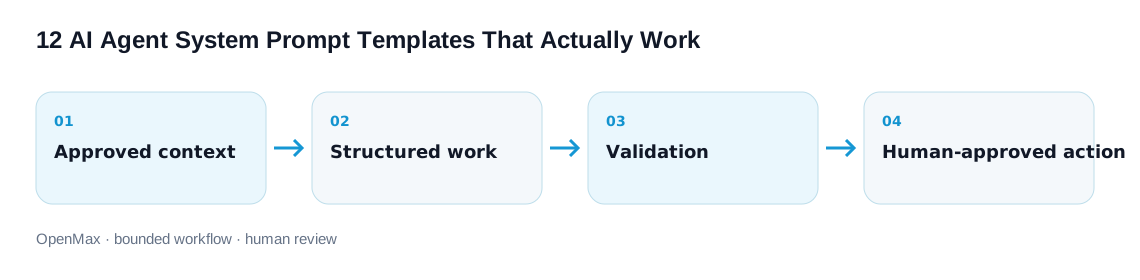
From prompt to governed OpenMax workflow
OpenMax can turn a reviewed instruction into an AI employee workflow with shared context, tool connections, task ownership, logs, and human review. The template defines the job; permissions and approval gates control what can happen next.
Limits and human-review boundaries
These examples are editorial templates, not independent performance tests or legal, privacy, employment, or security advice.
- Do not use the workflow for granting access, executing irreversible actions, bypassing policy, or treating prompt text as a security control without an authorized reviewer and enforceable controls.
- Verify facts against the cited source system; model confidence is not evidence.
- Minimize personal and confidential data, retain source dates, and follow applicable consent and retention rules.
- Measure exception rate, correction rate, completion quality, and harmful side effects before scaling.
Frequently asked questions
What makes a good AI agent system prompt workflow?
A clear outcome, approved sources, explicit boundaries, a structured output, and a named review or escalation point.
Can the AI take action automatically?
Only if the action is explicitly permitted, technically constrained, logged, reversible where possible, and appropriate for the workflow risk.
How should teams test these entries?
Use a small labeled set containing normal, missing, conflicting, stale, and adversarial inputs. Record failures and revise the workflow, not just the wording.
Where does OpenMax fit?
OpenMax coordinates AI employees, shared context, connected tools, workflow ownership, and human review for repeated business work.
Are the examples guaranteed to improve results?
No. They are structured starting points. Results depend on models, source quality, tools, policy, evaluation, and reviewer judgment.
Sources, method, and limitations
OpenMax editors reviewed primary model-behavior, prompt-injection, and AI-risk guidance, then rewrote all 12 entries as role-specific operational specifications. Sources were reviewed September 3, 2026. No security certification, model benchmark, compliance result, or customer outcome is claimed.
- OpenAI — Model Spec — documents instruction authority, handling untrusted content, uncertainty, and boundaries.
- OpenAI — The Instruction Hierarchy — explains why models need to distinguish trusted instructions from lower-priority or adversarial content.
- OWASP — LLM Prompt Injection Prevention Cheat Sheet — recommends layered controls including input handling, structured prompts, output monitoring, and least privilege.
- OWASP GenAI — LLM01 Prompt Injection — covers direct and indirect injection risks and their potential impact.
- NIST — AI 600-1 Generative AI Profile — risk-management considerations for generative-AI systems and deployment.