

Quick answer
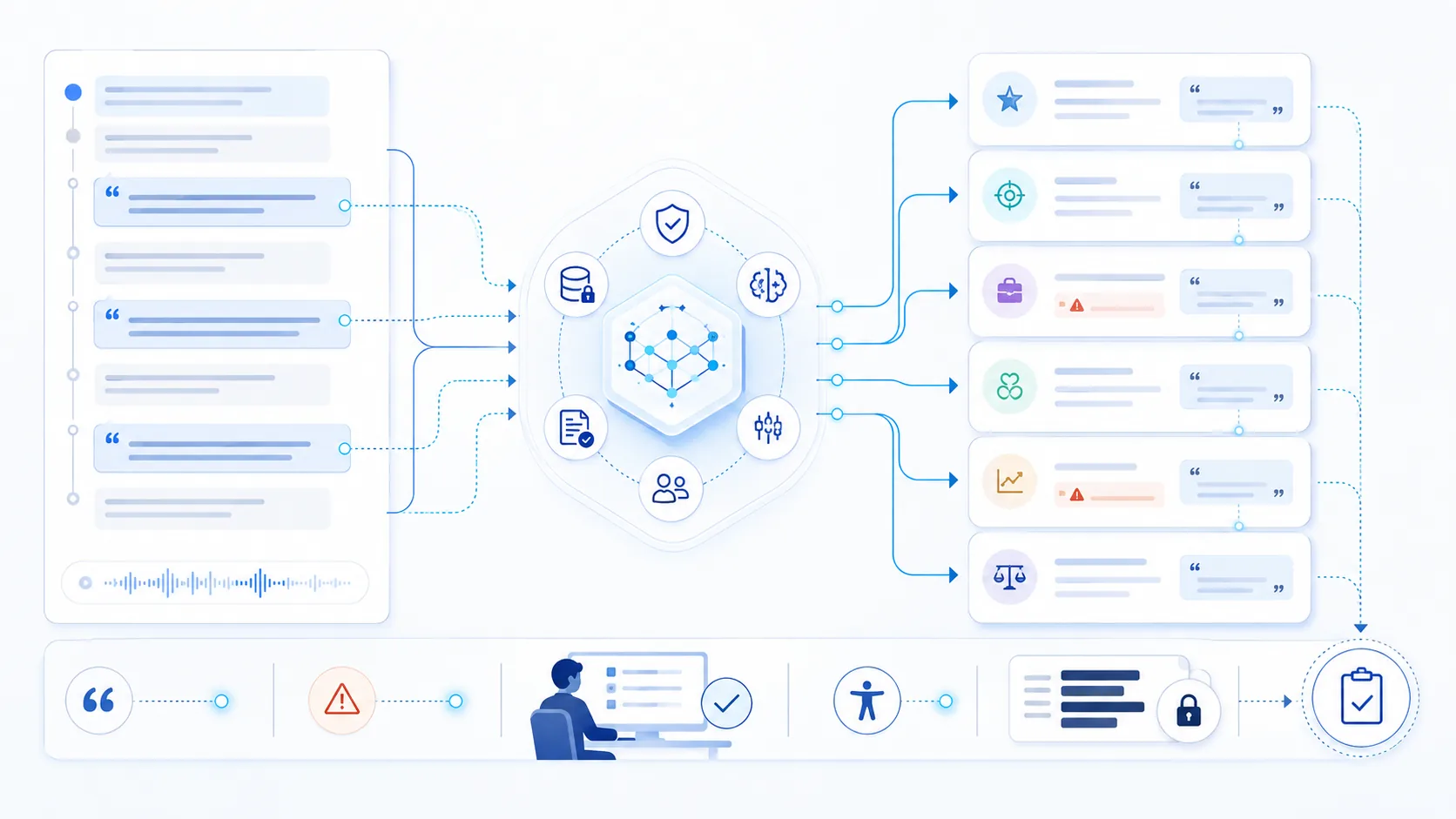
Turn interview notes into six separate sections: administration, role evidence, competency assessments, missing information, reviewer differences, and decision handoff. Every evaluative sentence should point to an exact response or faithful note and a predefined job-related anchor. Label uncertainty instead of completing it. Exclude protected or irrelevant information. Preserve independent reviewer views, accommodations, corrections, and the authorized human decision.
The candidate-summary contract
Allowed input
Approved questions and anchors, attributable interviewer notes, transcript spans where lawfully captured, work-sample evidence, administration records, accommodation status, and authorized corrections.
Required output
Six clearly separated parts; evidence citation; criterion and anchor; evidence state; uncertainty; reviewer provenance; next action, owner, authority, and audit history.
Forbidden transformation
No personality diagnosis, protected-trait inference, sentiment-based fit, invented achievement, unsupported ranking, hidden global score, automatic rejection, or removal of inconvenient disagreement.
Release gate
A named reviewer confirms source fidelity, role relevance, comparable administration, accessibility, redaction, uncertainty, disagreement, rule version, and authorized handoff before the summary enters a decision workflow.
The 6-part candidate interview summary template
Copy the six contracts below into the workflow, then adapt them only after qualified HR, assessment, accessibility, privacy, security, and legal owners approve the role-specific design. The labels are not a validated selection instrument by themselves.
Interview scope and administration
Record the role, interview version, date, interviewers, format, approved questions, permitted probes, accommodations provided, and any interruption that changed comparability.
- Required evidence discipline
- Use schedule records and the approved interview package. Mark facts as facts and unresolved administration issues as pending.
- Do not write or infer
- Do not infer disability, health, age, nationality, family status, personality, attention, enthusiasm, or credibility from appearance, voice, camera use, pauses, or an accommodation.
Role-relevant evidence
For every assessed competency, capture the candidate’s claim, the exact response span or faithful note that supports it, the question or probe that elicited it, and the applicable scorecard anchor.
- Required evidence discipline
- Prefer short attributable evidence units. Preserve whether an example was personal work, team work, hypothetical reasoning, or an unverified assertion.
- Do not write or infer
- Do not replace evidence with adjectives such as strong, impressive, senior, confident, articulate, polished, cultural fit, or executive presence.
Competency-by-competency assessment
Summarize each approved competency separately with its evidence state: demonstrated, partially demonstrated, insufficient evidence, contradicted, not assessed, or accommodation pending.
- Required evidence discipline
- Explain the criterion-level reason and cite the anchor. Keep missing evidence distinct from negative evidence and keep disagreement visible.
- Do not write or infer
- Do not calculate a global personality score, silently average away a required control, invent a rating for an unasked question, or let one vivid answer contaminate unrelated criteria.
Constraints, uncertainty, and missing information
List facts that could not be confirmed, ambiguous ownership, incomplete examples, unavailable work samples, inconsistent notes, translation limits, technology failures, and evidence affected by unequal conditions.
- Required evidence discipline
- For each gap, state why it matters, whether a consistent approved follow-up can resolve it, who owns the next action, and the stop condition.
- Do not write or infer
- Do not fill gaps from a résumé, LinkedIn profile, demographic proxy, interviewer memory, external search, model prior, or another candidate’s answer unless the validated process explicitly permits and governs that source.
Reviewer differences and adjudication
Show material differences between interviewer notes or ratings, the evidence each reviewer cited, the anchor in dispute, and whether the issue is factual, interpretive, procedural, or accommodation-related.
- Required evidence discipline
- Require independent notes before discussion. Route material conflicts to the authorized adjudicator and preserve the original positions, resolution, reason, and timestamp.
- Do not write or infer
- Do not force consensus, reveal one reviewer’s score before independent capture, treat agreement as proof of accuracy, or let AI choose which reviewer is right.
Decision handoff and next actions
State the authorized decision stage, applicable rule version, criteria that are ready, criteria on hold, required verification or accommodation action, owner, due point, notice, correction route, and retained audit record.
- Required evidence discipline
- Use an explicit status such as ready for authorized review, evidence follow-up required, accommodation hold, procedural remediation, or closed under the approved rule.
- Do not write or infer
- The summary must not declare hired, rejected, qualified, dishonest, risky, or unsuitable unless an authorized person applies a validated rule with required review, notices, rights, and documentation.
Eight-step production and review workflow
- Freeze the approved package. Store the role, competency map, question and probe version, anchors, format, jurisdiction, retention rule, and accommodation path.
- Validate capture conditions. Confirm consent or other lawful basis, transcript accuracy, speaker attribution, access controls, and any interruption.
- Segment evidence before summarizing. Link each note to its question, response span, competency, interviewer, and time; quarantine unattributed text.
- Draft the six parts. Use only allowed evidence, concise neutral language, explicit states, and visible omissions.
- Run source-fidelity review. A reviewer opens every cited span, checks negation, ownership, numbers, timing, and whether the summary changed certainty.
- Run fairness and access review. Remove irrelevant protected information, resolve accommodation holds, compare administration, and inspect proxy features and model errors.
- Adjudicate, correct, and release. Preserve independent views, resolve material differences through the authorized owner, version corrections, and apply the release gate.
- Monitor the complete funnel. Track citation errors, omissions, overrides, accommodation outcomes, progression and selection rates, complaints, corrections, drift, incidents, and downstream validity without claiming causation from a dashboard alone.
Worked example: a fluent summary hides a material gap
This is a hypothetical quality-control example, not a real candidate or hiring result. For an incident-response role, the raw note says the candidate would “move quickly and keep the customer calm.” A first AI draft says the candidate demonstrated strong crisis leadership. That sentence is fluent but unsupported: the notes do not show authorization, containment, evidence preservation, customer-notice duties, recovery verification, or the candidate’s own role.
Unsafe draft
“The candidate is a confident crisis leader who should advance.” It turns style into competence, fills six missing control dimensions, collapses evidence and decision, and hides uncertainty.
Controlled record
“Communication—partial evidence: candidate proposed a rapid response and customer reassurance [Q4, note 02]. Safety/control—insufficient evidence: authorization, containment, preservation, notice, and recovery were not captured. Ownership—unclear. Use the approved control probe if consistently available; otherwise retain insufficient evidence for authorized review.”
The corrected version is less dramatic and more useful. It tells a reviewer exactly what exists, what does not, why the gap matters, and which next action is allowed. It does not predict performance or decide advancement.
How OpenMax can coordinate the summary workflow
OpenMax can coordinate approved interview packages, lawful evidence capture, speaker-linked notes, six-part draft generation, citation checks, redaction, independent reviewer assignments, accommodation holds, discrepancy queues, authorized adjudication, corrections, notices, decision handoff, audit samples, and ongoing monitoring. People retain job analysis, legal scope, validation, accommodation decisions, sensitive-data policy, interpretation of material evidence, selection rules, and final employment decisions.
Legal, fairness, privacy, and accessibility boundaries
- Before use, qualified counsel and assessment experts must determine applicable employment, discrimination, disability, privacy, labor, recording, automated-decision, notice, audit, retention, correction, and candidate-rights duties for every role, location, entity, interview mode, and vendor.
- Do not ask about, retain unnecessarily, summarize, score, or infer protected traits, medical or disability information, family status, religion, age, nationality, pregnancy, genetic information, or proxies. Apply lawful redaction without deleting relevant accommodation or procedural evidence.
- Provide accessible interviews and a clear accommodation process. Test recording, transcription, speaker attribution, timing, interfaces, interpreters, alternatives, and summary review across relevant disabilities and languages; accommodation use must not lower a rating.
- Do not treat a citation, transcript, structured interview, panel agreement, AI summary, vendor claim, bias audit, impact ratio, dashboard, or human approval click as proof of accuracy, validity, legality, fairness, or job performance. Validate the whole process and stop harmful use.
Sources, editorial method, and limitations
OpenMax editors reviewed current U.S. Office of Personnel Management guidance on structured interviews and job-related response notes; U.S. EEOC guidance on prohibited employment practices; U.S. Department of Justice guidance on disability discrimination and algorithmic hiring; and NIST AI RMF guidance on documentation, human roles, testing, impact, and contextual limits. We then independently synthesized the six-part contract, eight-step workflow, and hypothetical correction example. Sources were rechecked September 3, 2026.
- U.S. OPM — Structured Interviews
- U.S. OPM — What structured interview notes should record
- U.S. EEOC — Prohibited employment policies and practices
- U.S. DOJ — Algorithms, AI, and disability discrimination in hiring
- NIST — AI RMF Core
Frequently asked questions
Can AI decide whether a candidate advances?
It should not own the decision. AI may organize cited evidence and flag gaps; authorized people must validate the procedure, resolve accommodations and conflicts, apply the approved rule, and remain accountable.
Should missing evidence count as failure?
No. Use insufficient evidence or not assessed. Resolve the gap only through a consistent approved follow-up, a permitted work sample, or a procedural remedy.
Should the summary include demeanor or sentiment?
Only observable behavior that is validated as job-related may be considered, with an anchor and evidence. Do not score appearance, accent, eye contact, facial expression, camera behavior, disability-related speech, charisma, or inferred emotion.
Can interviewers edit an AI summary?
Yes, through versioned corrections that preserve the original, editor, reason, evidence, and time. Never allow silent edits that break provenance or erase disagreement.
What can OpenMax automate?
OpenMax can coordinate evidence capture, six-part drafting, citation checks, reviewer queues, holds, adjudication, corrections, handoff, and monitoring while people retain validation and employment decisions.