

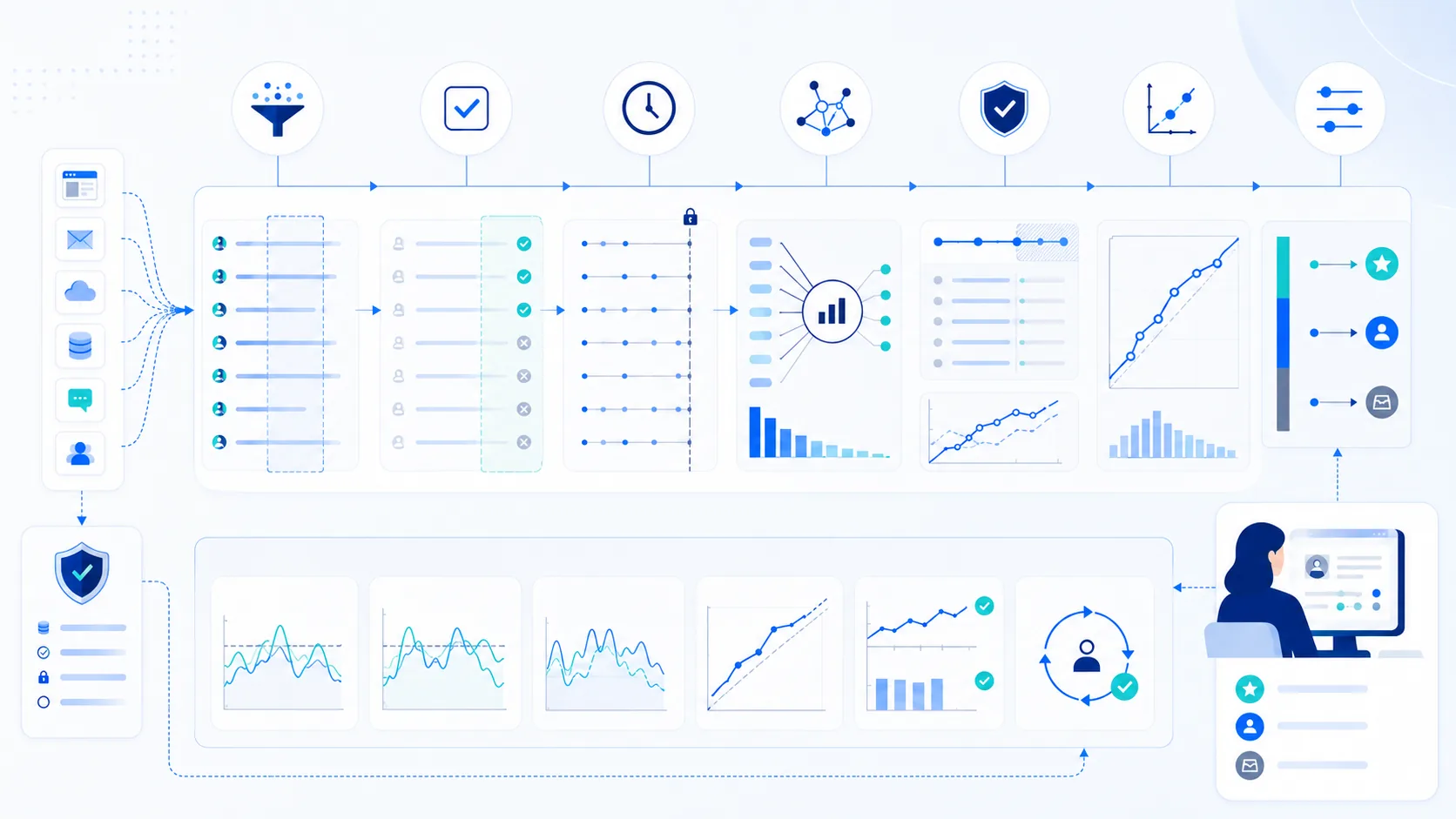
Quick answer
Start with the business decision, restrict the agent to historical opportunity outcomes, approved ICP fields, consented engagement events, routing rules, and seller feedback, require a documented scoring model with feature definitions, weights, validation results, thresholds, owners, and monitoring plan, and name the person who approves consequential actions.
This guide is for: revenue, operations, marketing, support, and enablement teams that need repeatable work with visible ownership.
A lead score is a conditional estimate, not a verdict
A useful AI lead scoring model estimates a defined outcome for a defined unit at a defined moment—for example, the probability that an eligible account becomes a sales-qualified opportunity within 30 days, using only information available at scoring time.
Separate prediction from permission
The score can prioritize review, but it does not create consent, a lawful basis to contact someone, eligibility for an offer, or authority to reject a person. Contact rules, suppression lists, territory policy, account ownership, and human approval remain separate controls.
Write the model contract before choosing an algorithm
Record the decision, population, unit, observation time, outcome label, outcome window, allowed features, exclusions, evaluation metrics, threshold owner, fallback state, and monitoring cadence. Without that contract, a high score can be mathematically valid yet operationally meaningless.
The seven-part model contract
| Part | Required decision | Failure to prevent |
|---|---|---|
| Business decision | Who will do what, for which eligible records, and within what capacity? | A score with no accountable action or owner |
| Outcome label | What observable event counts, and during which outcome window? | Ambiguous positives and hindsight leakage |
| Feature time | Which fields existed before the score timestamp? | Using future, post-outcome, sensitive, or proxy data |
| Baseline | What simple, inspectable approach must a model beat? | Complexity without incremental value |
| Validation | Which later period and unseen entities form the holdout? | Optimistic test results from repeated people or preprocessing leakage |
| Threshold policy | Which precision, recall, coverage, workload, and cost tradeoff is acceptable? | Treating a default cutoff as a business policy |
| Monitoring | Who watches drift, calibration, errors, overrides, and delayed outcomes? | Silent degradation and self-reinforcing feedback |
7 steps to build an AI lead scoring model
Use these as model-development contracts. Replace brackets with approved definitions and preserve the evidence, owner, and acceptance test for every step.
Define the business decision
Turn “score our leads” into one accountable decision with a population, action, owner, service level, and explicit exclusions.
Create the outcome label
Define a reproducible positive event and separate the observation window from the future outcome window.
Select permitted, time-safe features
Build a feature registry that proves availability, provenance, purpose, and permitted use at prediction time.
Build a transparent baseline
Start with an inspectable benchmark so additional complexity has something honest to beat.
Validate on truly held-out data
Simulate future use with later data, unseen entities, training-only preprocessing, and threshold-aware metrics.
Set routing thresholds as policy
Translate probabilities into workload and review rules; do not treat 0.5 or a vendor default as neutral.
Monitor drift and close the feedback loop
Watch inputs, probabilities, calibration, threshold performance, workload, and human overrides after launch.
Worked example: choose a threshold from capacity, not intuition
The following numbers are hypothetical and illustrate the calculation only; they are not OpenMax customer data or a performance claim.
Verify probability meaning too
If records scored near 0.70 become positive far less or more than roughly 70% over repeated, sufficiently large cohorts, the probabilities are not well calibrated for that population. Calibration and discrimination are different properties; a ranking can separate records reasonably while its numeric probabilities still misstate risk.
Implementation sequence before live routing
Run in shadow mode
Score eligible records without changing queues. Compare predictions with later outcomes and the current baseline.
Review errors and explanations
Inspect false positives, false negatives, missing-data cases, repeated entities, and implausible feature effects with data and revenue owners.
Pilot one bounded queue
Use a documented threshold, capacity limit, consent checks, human review, reason codes, and a kill switch.
Expand only after delayed outcomes mature
Recheck calibration, threshold metrics, workload, overrides, and segment limitations before changing scope or autonomy.
How OpenMax supports this workflow
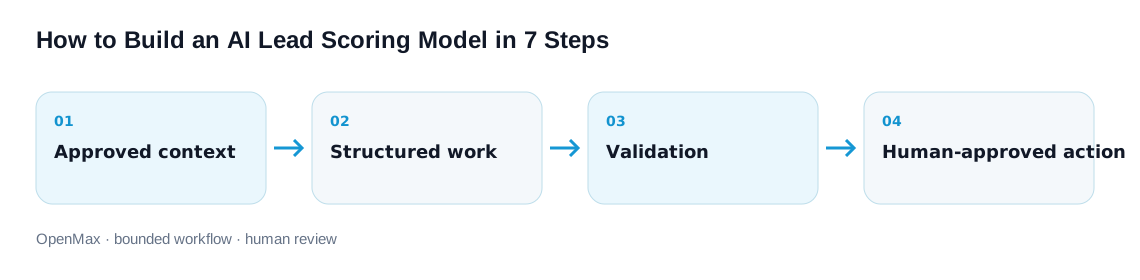
From prompt to governed OpenMax workflow
OpenMax can turn a reviewed instruction into an AI employee workflow with shared context, tool connections, task ownership, logs, and human review. The template defines the job; permissions and approval gates control what can happen next.
Limits and human-review boundaries
A lead score describes a model’s estimate under its data and label definition. It does not establish intent, causation, identity, consent, legal eligibility, or a salesperson’s authority to act.
- Do not use protected traits or unreviewed proxies, and do not repurpose data beyond its permitted purpose.
- Do not train on fields unavailable at scoring time or report test results contaminated by preprocessing, entity overlap, or repeated tuning.
- Do not auto-reject people, suppress service, make contractual promises, or send outreach solely because of a score.
- Do not compare models on accuracy alone when positives are rare; show error counts, precision, recall, coverage, workload, and calibration.
- Keep a documented fallback, abstain state, audit trail, appeal/correction path where appropriate, and named pause authority.
Frequently asked questions
What makes a good AI lead scoring model workflow?
A clear outcome, approved sources, explicit boundaries, a structured output, and a named review or escalation point.
Can the AI take action automatically?
Only if the action is explicitly permitted, technically constrained, logged, reversible where possible, and appropriate for the workflow risk.
How should teams test these entries?
Use a small labeled set containing normal, missing, conflicting, stale, and adversarial inputs. Record failures and revise the workflow, not just the wording.
Where does OpenMax fit?
OpenMax coordinates AI employees, shared context, connected tools, workflow ownership, and human review for repeated business work.
Are the examples guaranteed to improve results?
No. They are structured starting points. Results depend on models, source quality, tools, policy, evaluation, and reviewer judgment.
Sources, editorial method, and limitations
OpenMax editors reviewed first-party technical documentation on classification metrics, threshold tradeoffs, data leakage, probability calibration, and AI risk governance. We translated those concepts into a revenue-operations workflow, added explicit consent and authority boundaries, and wrote each of the seven contracts independently. Sources were reviewed September 3, 2026. No model accuracy, lift, conversion, or customer result is claimed.
- Google for Developers — Accuracy, precision, recall, and related metrics — confusion outcomes, imbalanced classes, and choosing metrics from error costs.
- Google for Developers — ROC and AUC — evaluating behavior across thresholds and the limits of threshold-independent summaries.
- scikit-learn — Common pitfalls and recommended practices — keeping test data and learned preprocessing out of model fitting to prevent leakage.
- scikit-learn — Probability calibration — reliability diagrams, proper scoring rules, and independent calibration data.
- NIST — AI Risk Management Framework 1.0 — lifecycle governance, measurement, documented roles, and risk management.
- U.S. enforcement agencies — Joint statement on automated systems — reminder that automated systems can create discriminatory impacts and remain subject to existing law.