

Quick answer
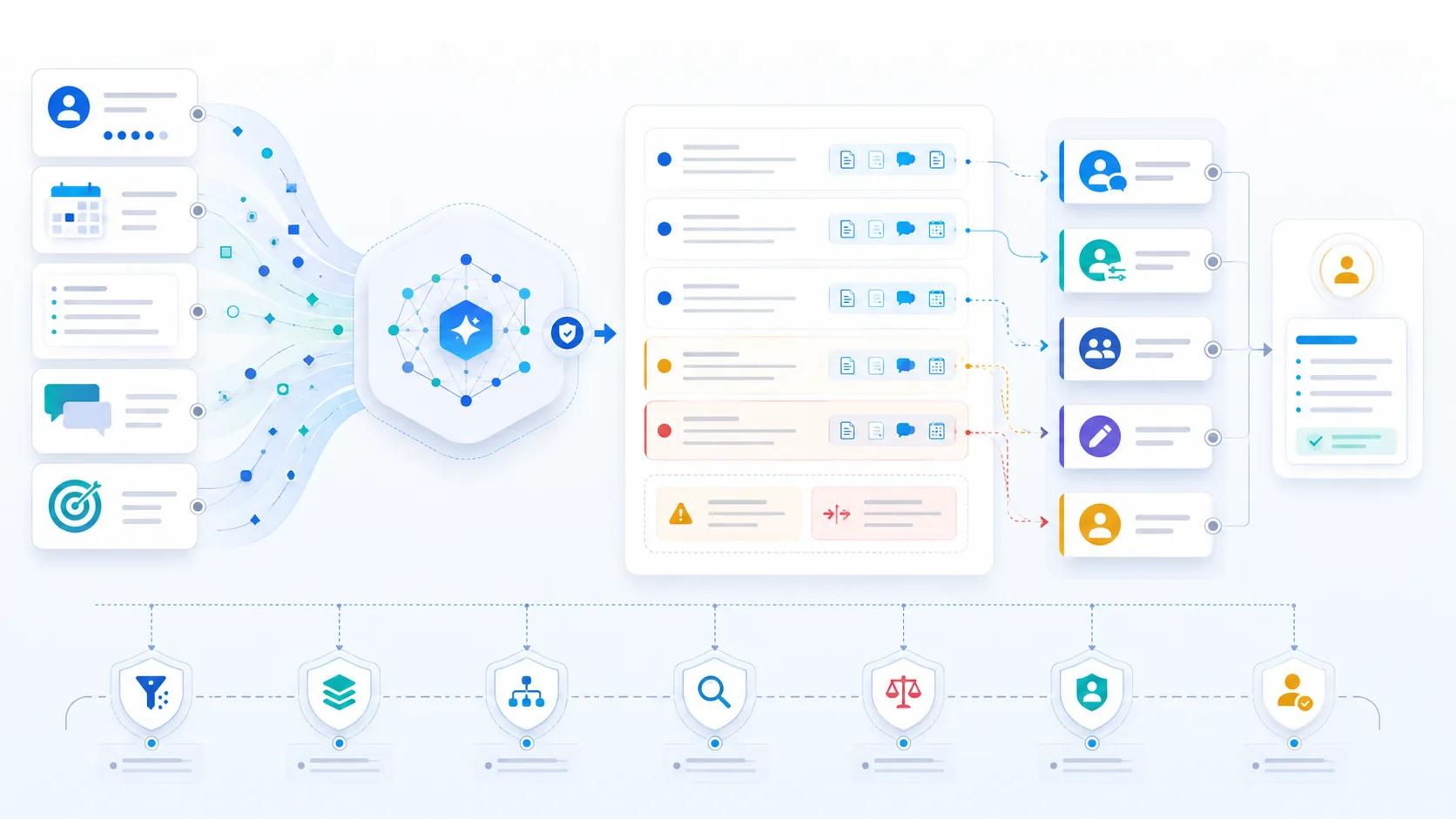
Before releasing an AI performance review summary, run seven checks: confirm the pre-existing role standards and evaluation period; attach every material sentence to its source; separate observation, interpretation, and decision; preserve missing, contrary, and changing-context evidence; test consistent application and prohibited proxies; protect accommodation, leave, complaint, and retaliation context; and capture employee response, correction, and authorized release. A shorter summary is useful only when a reviewer can still reconstruct what happened and why the decision was made.
Define the summary contract before compression
Permitted evidence
List approved systems, artifacts, metrics, observations, feedback, self-reports, checkpoints, date range, access, reliability, and prohibited sources. Keep personnel and restricted data need-to-know.
Evidence statement
Store criterion, exact factual statement, source reference, period, context, employee role, contrary evidence, uncertainty, reviewer interpretation, and evidence state as separate fields.
Decision boundary
Name who may summarize, verify, correct, adjudicate, rate, decide compensation or employment action, access restricted context, notify the employee, and stop unsafe use.
Release record
Retain input versions, generated draft, citations, validation results, human edits and reasons, employee response, corrections, approval, recipients, notices, retention, appeal route, and downstream action.
Seven checks for an evidence-preserving review summary
Use the checks as separate release gates. Passing one does not compensate for a missing source, inaccessible process, unresolved dispute, or unauthorized decision elsewhere.
Lock the review contract and evaluation period
Before summarizing, identify the role and level, essential functions, approved standards and weights, evaluation period, reviewer authority, policy version, prior goals, permitted evidence, accommodation status, and decision the summary may support.
- Release evidence
- A reviewer can trace every criterion to a pre-existing job-related standard and see changes made during the period.
- Failure to prevent
- Do not reverse-engineer criteria after seeing results, import another role’s expectations, or treat an AI-generated competency as approved.
Preserve source provenance for every material statement
Link each claim to a dated work artifact, system record, approved metric, customer or stakeholder feedback, manager observation, employee self-report, or prior checkpoint. Record author, context, access, and whether the source is direct or hearsay.
- Release evidence
- Every sentence that changes a criterion state has an openable source reference and faithful excerpt or structured fact.
- Failure to prevent
- Do not convert unverified recollection, anonymous sentiment, surveillance data, message volume, presence, or model inference into a performance fact.
Separate observation, interpretation, and decision
Write what happened and the source first; state the criterion-level interpretation second; keep the rating, compensation, promotion, discipline, development, or employment decision in an authorized field.
- Release evidence
- The reader can distinguish direct fact, employee claim, reviewer inference, disputed interpretation, and final authorized determination.
- Failure to prevent
- Do not use fluent adjectives—leadership, attitude, commitment, ownership, executive presence, fit—as evidence without defined observable behavior and source.
Keep missing, contrary, and changing-context evidence visible
For every criterion, search for supporting and contrary evidence, incomplete periods, changed scope, leave, delayed access, unavailable resources, transferred ownership, metric changes, and unresolved dependencies. Use explicit evidence states.
- Release evidence
- The summary names coverage dates, gaps, contrary examples, context changes, owner-caused blockers, and what would resolve uncertainty.
- Failure to prevent
- Do not fill missing months with an average, assume silence means success, erase a failed experiment that produced learning, or blame the employee for inputs the organization did not provide.
Check consistency, comparability, and prohibited proxies
Compare how the same standard, evidence window, data source, rounding rule, opportunity, support, and reviewer discretion were applied across similarly situated employees; investigate justified differences without exposing others’ data.
- Release evidence
- Document the comparison group definition, tested dimensions, material differences, explanation, reviewer, correction, and monitoring decision.
- Failure to prevent
- Do not rank people by protected traits or proxies such as age, disability, leave use, accent, caregiving, location, schedule, camera behavior, network centrality, complaint activity, or social similarity.
Protect accommodation, leave, complaint, and retaliation context
Route known or possible accommodation requests through the approved confidential process; treat protected leave, complaints, investigations, safety reports, and participation in protected activity under applicable rules and need-to-know access.
- Release evidence
- The performance record contains only necessary job evidence while restricted context, hold status, authorized adjustments, and non-retaliation review remain separately controlled.
- Failure to prevent
- Do not diagnose, request medical detail in the summary, rate an approved absence as missed output, or lower a review because someone requested accommodation, reported misconduct, discussed conditions, or challenged data.
Require employee response, correction, and authorized release
Give the employee the summary, cited evidence, standards, and applicable process in an accessible format; capture their response, disputed facts, additional evidence, correction outcome, reviewer, and appeal or complaint route before authorized use.
- Release evidence
- Release record shows employee access, response window, corrections, unresolved disputes, approval, rule version, notices, recipients, retention, and downstream action.
- Failure to prevent
- Do not treat “seen,” silence, signature, or a manager click as agreement, waive rights, overwrite the employee’s response, or let AI issue the final rating or employment action.
Keep criterion evidence states distinct
Demonstrated or partially demonstrated
Cited evidence meets all or defined parts of a pre-existing anchor during the period. Name the exact dimension and retain contrary evidence.
Insufficient evidence or not assessed
Coverage cannot support a conclusion or the criterion was not validly assessed. Do not convert absence into poor performance.
Contradicted or disputed
Material sources disagree or the employee challenges accuracy or interpretation. Preserve both positions and route adjudication.
Context or accommodation hold
Changed scope, missing organizational input, protected leave, or an unresolved accommodation may affect valid interpretation. Restrict context and pause the affected use.
Worked example: activity volume does not prove delivery quality
This hypothetical example is not a real employee or validated rating. An AI draft says an analyst “showed low engagement because message activity fell 32% in the final six weeks.” The approved role standard concerns accurate monthly forecasts and documented escalation, not message volume. The employee was on approved leave for part of the period; access to a required data source was delayed; and the completed forecast artifact met the approved error and review criteria.
Unsafe compression
The draft converts a prohibited proxy into performance evidence, ignores the approved standard and leave context, deletes the actual artifact, and implies causation from a percentage.
Evidence-preserving correction
“Forecast accuracy—demonstrated for the four completed monthly artifacts [links]; each passed the approved error and reviewer criteria. Escalation—partially demonstrated [two cited records]; one period is not assessed because required access was unavailable. Approved leave and restricted accommodation context are excluded from output scoring. Message activity is not an approved criterion and is removed. Employee response and final rating remain pending authorized review.”
The corrected summary is shorter than the evidence file but retains the links, approved standard, coverage, missing period, prohibited proxy decision, employee response status, and human authority needed to review it.
How OpenMax can coordinate evidence-preserving summaries
OpenMax can coordinate approved review contracts, permissioned evidence collection, source-linked draft statements, contrary-evidence searches, coverage and context flags, independent reviewer assignments, consistency checks, accommodation holds, employee review, corrections, adjudication, authorized release, audit samples, and monitoring. Humans retain job and performance standards, legal scope, accommodation decisions, sensitive context, compensation, discipline, promotion, appeal, and employment decisions.
Employment, fairness, privacy, and accessibility boundaries
- Qualified local legal, HR, labor, compensation, benefits, accessibility, privacy, security, employee-relations, records, localization, and AI-governance owners must approve every role, standard, data source, comparison, workflow, notice, retention rule, and decision use.
- Use job-related, pre-existing, consistently applied standards and provide effective accommodation and accessible participation as applicable. Keep medical and other restricted facts outside the performance summary except through authorized need-to-know handling.
- Do not penalize protected leave, accommodation requests, discrimination or safety complaints, participation in investigations, protected discussion of working conditions, corrections, or challenges to automated evidence. Review retaliation and disparate treatment risks through qualified channels.
- Do not treat a detailed summary, source link, consistency check, bias audit, manager approval, employee signature, metric, or dashboard as proof of lawful, accurate, fair, predictive, non-retaliatory, or valid performance management. Evaluate real outcomes, corrections, appeals, and impacts and stop harmful use.
Sources, editorial method, and limitations
OpenMax editors reviewed current U.S. Equal Employment Opportunity Commission guidance on performance evaluations, consistent standards, disability and accommodation, internal discrimination complaints, corrections, and retaliation, plus NIST AI RMF guidance on human roles, documentation, uncertainty, testing, independent review, and impact. We independently synthesized the seven checks, evidence states, and hypothetical activity-volume correction. Sources were rechecked September 3, 2026.
- U.S. EEOC — Conducting performance evaluations
- U.S. EEOC — Performance and conduct standards for employees with disabilities
- U.S. EEOC — Handling discrimination complaints about evaluations
- U.S. EEOC — Treating employees consistently
- NIST — AI RMF Core
Frequently asked questions
Can AI assign the final performance rating?
It should not own the rating. AI can organize cited evidence and flag gaps; authorized people must validate standards, resolve context and accommodations, consider employee response, adjudicate disputes, and remain accountable.
Should a summary include every source document?
Keep the full evidence file under approved access. The summary should link every material statement to the smallest sufficient source and preserve contrary or missing evidence that could change interpretation.
Is message volume a useful performance metric?
Not by default. Use only validated, job-related measures approved in advance and interpreted with scope, opportunity, support, context, uncertainty, and prohibited-proxy review.
What if the employee disputes a fact?
Preserve the original statement, employee response, additional evidence, reviewer, correction decision and reason, unresolved issue, and appeal or complaint route. Do not silently overwrite either side.
What can OpenMax automate?
OpenMax can coordinate evidence collection, source-linked drafts, gap and consistency checks, review, employee response, correction, adjudication, release, and monitoring while people retain standards and employment authority.