


Quick answer
Start with the business decision, restrict the agent to approved ICP rules, lead and account fields, consent status, campaign source, interaction history, and product fit criteria, require a lead-work queue with evidence, confidence, routing reason, owner, and review flag, and name the person who approves consequential actions.
This guide is for: revenue, operations, marketing, support, and enablement teams that need repeatable work with visible ownership.
What AI lead-generation prompts should control
A lead workflow is not just a writing task. It processes records across collection, matching, enrichment, scoring, routing, contact, retention, and deletion. A useful prompt therefore specifies why the data may be used, where it came from, what identity match is allowed, how unknowns are represented, and who approves the next action.
Company fit is not personal intent
An account can match an ICP while a person remains uncontactable, uninterested, or unrelated to the buying process. Keep company eligibility, individual identity, contact permission, qualification evidence, and routing as separate decisions.
How this page differs from the sales prompt library
This guide focuses on the marketing-to-sales data pipeline. Use ChatGPT prompts for sales after a lead has entered seller research, discovery, proposal, or opportunity work.
Five gates before a lead becomes sales work
| Gate | Required evidence | Common false shortcut | Human-owned decision |
|---|---|---|---|
| 1. Source | Collection method, timestamp, provider, notice, fields, allowed purpose | “Public” means unrestricted | Whether the source can enter the workflow |
| 2. Identity | Deterministic match keys, conflicts, parent-child context, duplicates | A similar name is the same person | Whether records may be linked or merged |
| 3. Permission | Channel, purpose, jurisdiction, consent/objection, suppression timeline | One permission covers every channel | Whether the intended processing/contact is allowed |
| 4. Qualification | ICP rule, buyer-confirmed need, prerequisites, unknowns, disqualifiers | Page activity proves intent | Whether the lead is ready, nurtured, returned, or disqualified |
| 5. Handoff | Source links, stated request, gaps, owner, SLA, next question | A score is enough context | Whether sales accepts and what happens next |
Privacy principle: Minimize data to the stated job. Do not silently expand an allowed collection purpose into enrichment, profiling, sharing, or outreach.
20 AI prompts for lead generation entries
Use each entry as a starting point. Replace bracketed context, attach approved evidence, and assign a reviewer before execution.
ICP fit screen
Check company-level fit from approved evidence without profiling a person or inventing intent.
Account list criteria
Translate a campaign goal into auditable inclusion, exclusion, and evidence rules.
Industry segment brief
Define a segment from verifiable operating characteristics rather than stereotypes.
Territory prospect list
Create a dry-run territory list that exposes ownership conflicts and data gaps.
Trigger event research
Identify dated business events while preventing signal-to-intent overreach.
Website intent summary
Summarize consented first-party behavior without identifying or overinterpreting visitors.
Form response enrichment
Add only necessary, permitted context while preserving the submitted record.
Lead source validation
Verify provenance and permitted use before a source enters scoring or outreach.
Duplicate lead check
Find likely duplicates without silently merging distinct people or companies.
Consent status check
Resolve what contact or processing is allowed for the intended purpose and channel.
Persona hypothesis
Create a testable job-context hypothesis without assigning personal traits.
Qualification questions
Design questions that collect decision evidence without interrogating or leading the lead.
Lead score explanation
Explain an existing score as data lineage, not as a prediction of a person.
High-intent flag
Test whether a flag meets its written evidence threshold and has not expired.
Disqualification reason
Apply a documented reason code while separating permanent ineligibility from missing evidence.
Lead routing recommendation
Recommend an owner from explicit rules while exposing collisions, capacity, and exceptions.
Sales handoff brief
Package the minimum verified context sales needs to accept or reject a lead.
Nurture track suggestion
Select education based on explicit needs and permissions, not covert profiling.
Follow-up timing
Recommend a review window from an explicit request, event, or policy—not a guessed buying mood.
Lead quality review
Evaluate the system that produces leads, not just blame individual records.
Worked example: a webinar lead that should not go straight to sales
This hypothetical illustrates control logic; it is not a customer result.
Acceptance test
The review passes only when another operator can reproduce the source, identity, permission, qualification, and routing states; see why the lead was not sent to sales; and confirm no preference, record, task, or message changed automatically.
How to implement and test it
Choose one business outcome
Do not combine research, judgment, writing, approval, and execution in one vague request. Name the decision this output supports.
Connect only approved context
Provide the minimum records needed, preserve source links and dates, and exclude data the workflow is not authorized to use.
Test with ordinary and edge cases
Check correct inputs, missing data, conflicts, prompt injection, stale records, and requests that should trigger escalation.
Review before expanding autonomy
Start read-only. Compare quality and exceptions, then grant narrowly scoped actions only when controls are proven.
How OpenMax supports this workflow
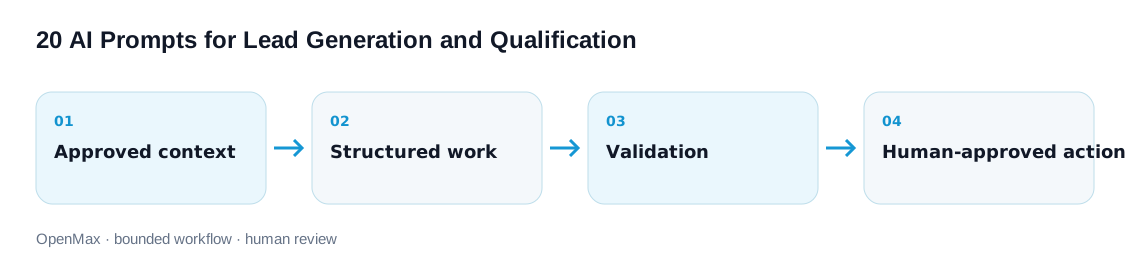
From prompt to governed OpenMax workflow
OpenMax can turn a reviewed instruction into an AI employee workflow with shared context, tool connections, task ownership, logs, and human review. The template defines the job; permissions and approval gates control what can happen next.
Limits and human-review boundaries
These examples are editorial templates, not independent performance tests or legal, privacy, employment, or security advice.
- Do not use the workflow for purchasing unverified data, inferring sensitive traits, contacting people without permission, or automatically rejecting a lead without an authorized reviewer and enforceable controls.
- Verify facts against the cited source system; model confidence is not evidence.
- Minimize personal and confidential data, retain source dates, and follow applicable consent and retention rules.
- Measure exception rate, correction rate, completion quality, and harmful side effects before scaling.
Frequently asked questions
What makes a good AI prompts for lead generation workflow?
A clear outcome, approved sources, explicit boundaries, a structured output, and a named review or escalation point.
Can the AI take action automatically?
Only if the action is explicitly permitted, technically constrained, logged, reversible where possible, and appropriate for the workflow risk.
How should teams test these entries?
Use a small labeled set containing normal, missing, conflicting, stale, and adversarial inputs. Record failures and revise the workflow, not just the wording.
Where does OpenMax fit?
OpenMax coordinates AI employees, shared context, connected tools, workflow ownership, and human review for repeated business work.
Are the examples guaranteed to improve results?
No. They are structured starting points. Results depend on models, source quality, tools, policy, evaluation, and reviewer judgment.
Sources, method, and limitations
OpenMax editors reviewed primary guidance on prompting, privacy-risk management, lead collection/data brokers, and CRM lead conversion, then rewrote all 20 entries as original governed workflows. Sources were reviewed September 3, 2026. No model benchmark, legal-compliance result, conversion lift, or customer outcome is claimed.
- OpenAI — Prompt engineering best practices for ChatGPT — supports clear, specific instructions and iterative refinement.
- NIST — Privacy Framework — a voluntary framework for identifying and managing privacy risk across data processing.
- UK ICO — Collect information and generate leads — primary guidance on fair collection, matching, appending, and channel choice.
- UK ICO — Using marketing services of data brokers — due diligence, transparency, lawful basis, and responsibility for brokered data.
- Salesforce — Converting Leads — primary CRM documentation separating qualification from conversion into contacts, accounts, and opportunities.