25 ChatGPT Prompts for Sales: Prospecting to CRM Follow-Up
Twenty-five sales workflows for account selection, discovery, proposals, follow-up, CRM hygiene, and deal learning. Each prompt exposes its sources, unknowns, output contract, prohibited actions, and human decision owner.
OpenMax Product and Content Team24 min read
Reviewed for sales operations, evidence boundaries, outbound safeguards, and human approval points
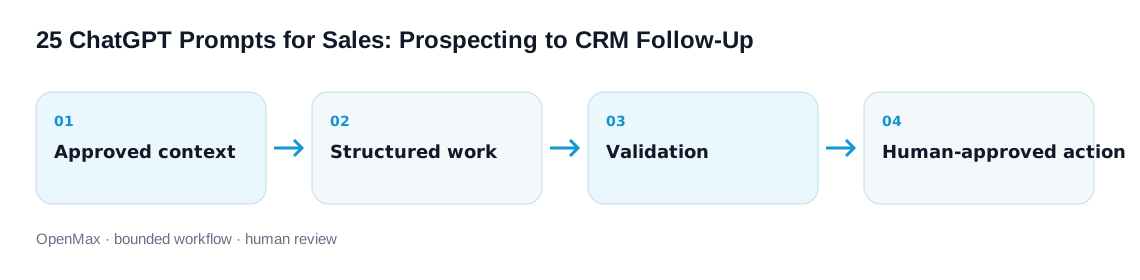
A governed sales workflow keeps source evidence, qualification gaps, CRM changes, and outbound approval visible.
Editorial and commercial disclosure OpenMax publishes this educational guide and provides a human-agent collaboration platform. The prompts are editorial templates—not OpenAI endorsement, legal advice, a performance benchmark, or customer results. Verify current product capabilities, contact rules, pricing, and organizational policy before use. Corrections: contact@openmax.com.
Quick answer
Start with the business decision, restrict the agent to approved account data, CRM fields, call notes, product documentation, and current pricing or policy, require a sales draft with cited account facts, qualification gaps, owner, and next action, and name the person who approves consequential actions.
This guide is for: revenue, operations, marketing, support, and enablement teams that need repeatable work with visible ownership.
What these sales prompts are—and are not
A useful sales prompt is a controlled work specification. It names the account decision, approved evidence, output fields, uncertainty labels, prohibited actions, and reviewer. It does not turn public data into buyer intent or give a model authority to contact people, change CRM records, quote prices, or promise terms.
Separate evidence, hypothesis, and action
Account facts should remain traceable to dated CRM fields, buyer statements, product documentation, or approved public sources. A relevance idea is a hypothesis until the buyer validates it. A drafted action remains a proposal until an authorized seller, sales operations owner, or specialist approves it.
Use the right page for the right intent
This guide focuses specifically on sales lifecycle decisions. For cross-functional business conversations, use ChatGPT prompts for business. For reusable task specifications across departments, use AI prompts for work.
What reliable sales output requires
Source-level traceabilityAccount claims retain the field, note, transcript timestamp, URL, and date that support them.
Explicit uncertaintyVerified, inferred, contradicted, missing, and not-applicable states stay distinct.
Human-owned actionOutreach, record changes, pricing, legal, security, and commitments wait for an authorized owner.
Record changes, forecast treatment, and playbook updates
Rule: Prompt wording cannot create consent, authority, or data rights. Enforce those boundaries through source access, workflow permissions, approval gates, suppression checks, and retained logs.
25
25 ChatGPT prompts for sales entries
Use each entry as a starting point. Replace bracketed context, attach approved evidence, and assign a reviewer before execution.
01
Ideal customer profile check
Decide whether an account merits human research without inventing fit signals.
Compare [account record] with the approved [ICP definition and exclusion rules]. First list every usable source with its date. Build a table for firmographic fit, operating trigger, problem evidence, buying constraints, exclusions, and missing data. Mark each row Verified, Inferred, Contradicted, or Unknown and quote the supporting field or passage. Do not infer budget, urgency, intent, or technology from job titles alone. Return Fit, Possible fit, or Insufficient evidence—not a numeric score—plus the smallest next research step. A sales owner must approve any routing or outreach.
02
Target account shortlist
Create a reviewable shortlist whose ordering can be explained and challenged.
Using only [approved account list], [ICP rules], [territory rules], and dated [intent or trigger evidence], prepare a shortlist for [segment]. Ask me to confirm the selection criteria and exclusions before ranking. Show each account’s qualifying evidence, disqualifier, freshness date, missing field, territory owner, and reason for its provisional tier. Keep “no evidence” separate from “negative evidence.” Flag duplicates, subsidiaries, existing customers, active opportunities, suppression records, and ownership conflicts. Do not add contacts, enrich personal data, change ownership, or start a sequence. End with the records a human must verify before activation.
03
Account research brief
Turn scattered public and first-party facts into a source-linked call-preparation asset.
Research [account] only from the supplied CRM record and approved public sources. Start with a source ledger containing publisher, URL, publication date, access date, and whether the source is first-party or third-party. Produce: company context, confirmed initiatives, relevant operational changes, current relationship, plausible OpenMax use cases clearly labeled as hypotheses, five discovery questions, and unresolved risks. Preserve exact dates and distinguish the company’s statements from outside commentary. Do not guess headcount, spend, stack, pain, or executive priorities. If sources disagree, show both versions and ask the account owner which can be used.
04
Buyer role hypothesis
Map likely participation without pretending a title reveals authority or intent.
Given [opportunity context], [org information], and [past interactions], draft a buyer-role hypothesis for named stakeholders. For each person, show verified role, observed involvement, possible concern, evidence source, unanswered question, and confidence reason in words. Use the categories business sponsor, technical evaluator, user, procurement, legal/security, finance, blocker, and decision authority only as hypotheses until confirmed. Never infer sensitive traits, personality, budget ownership, sentiment, or influence from title, seniority, or communication style. Suggest one neutral question the seller can ask to validate each role; do not update contact records automatically.
05
Trigger event scan
Identify dated events worth human review without converting correlation into buying intent.
Review the approved [news, filings, job posts, product updates, CRM notes] for [accounts] within [date range]. Record the exact event, source, date, affected function, and why it may be relevant to [approved value proposition]. Separate confirmed event, sales hypothesis, and disconfirming evidence. Exclude undated reposts, scraped biographies, rumors, personal events, and sources outside the allowed geography. Do not label an event “intent” or recommend outreach unless the relevance can be explained from evidence. Return a review queue with freshness, owner, suggested research question, and expiry date for each signal.
06
Prospecting email draft
Draft a truthful first touch that can pass account, claim, and compliance review.
Draft one prospecting email for [recipient] using only [approved account facts], [approved OpenMax claim library], and [permitted contact context]. Before writing, list the single business hypothesis, its evidence, jurisdiction, contact basis, suppression status, and required footer or opt-out elements; stop if any required compliance field is missing. Write a specific subject, 80–120 word body, one evidence-based relevance sentence, one low-friction question, and no false familiarity. Do not invent pain, imply surveillance, use deceptive urgency, or send the message. Provide a claim-to-source checklist for the seller and compliance reviewer.
07
LinkedIn outreach draft
Prepare a restrained social message without scraping, automation, or fabricated rapport.
Using the supplied public profile excerpt, approved account research, and relationship notes, draft a LinkedIn connection note and one follow-up. Identify which details come from the profile, which come from the account, and which are hypotheses. Keep the note relevant to the person’s stated work; do not mention sensitive attributes, inferred personal interests, hidden tracking, or information from unapproved scraping. Avoid pretending we met, praising content not provided, or claiming a mutual connection without proof. Return the drafts, the evidence used, and a human checklist for platform rules, local direct-marketing requirements, tone, and manual sending approval.
08
Cold call opener
Create a permission-based opener and branches for common first responses.
Build a 30-second cold-call opener for [persona and account] from [approved relevance evidence]. Include identity, reason for calling, one evidence-grounded hypothesis, and a permission question. Then provide branches for “not now,” “not relevant,” “send information,” “how did you get my details,” and genuine interest. For every branch, specify what to record and when to stop. Do not disguise the commercial purpose, pressure the listener, manufacture urgency, or claim knowledge of their internal problems. Add a pre-call checklist for calling rules, suppression, recording consent, time zone, contact source, and seller approval; never place the call.
09
Discovery call agenda
Design a buyer-centered agenda tied to a real decision and usable evidence.
Prepare a [duration]-minute discovery agenda for [participants]. Ask first for the buyer’s stated objective, stage, known context, prior commitments, and decisions the meeting can actually make. Allocate time to confirm goals, current process, impact evidence, constraints, stakeholders, success measures, alternatives, and agreed next step. Put seller presentation after discovery and only if relevant. Mark questions already answered in the CRM so they are not repeated. Include a two-minute recap and consent to document decisions. Do not treat attendance as qualification or create a next meeting unless the buyer agrees.
10
Discovery questions
Generate adaptive questions that test a hypothesis without leading the buyer.
Using [confirmed context] and [sales hypothesis], create a discovery question tree rather than a generic list. For each branch, provide an open question, the business reason for asking, evidence to capture, a neutral follow-up, and a stop condition. Cover current process, affected users, frequency, measurable impact, workarounds, decision criteria, security/data limits, stakeholders, timing source, and consequences of no change. Remove questions whose answers already exist in approved notes. Do not ask for confidential information unnecessarily, turn a hypothesis into a fact, or use manipulative “pain” questions. End with fields requiring buyer confirmation.
11
Call preparation brief
Give the seller a compact, dated briefing with uncertainty visible.
Create a one-page call brief from [CRM], [last correspondence], [approved research], and [meeting invitation]. Include meeting purpose, participants with verified roles, relationship timeline, confirmed facts, unresolved hypotheses, relevant product evidence, commitments already made, prohibited claims, five priority questions, and the desired but buyer-controlled next step. Cite every account-specific statement and show stale or conflicting records. Add a “do not say” section for unapproved pricing, roadmap, security, legal, and competitor claims. Ask the account owner to resolve material conflicts before producing the final brief; do not contact attendees or alter records.
12
Call summary
Convert notes into a buyer-confirmed record without upgrading discussion into commitment.
Summarize [transcript and notes] using timestamps where available. Separate buyer-stated facts, seller statements, hypotheses, decisions, objections, commitments, open questions, and next actions. For each action include exact deliverable, owner, due date, dependency, and confirmation status; write “not stated” instead of guessing. Preserve contradictions and flag any pricing, security, legal, roadmap, or product claim that needs specialist review. Draft a short confirmation email but do not send it. Ask the seller to verify names, commitments, and sensitive details before the summary is copied into CRM.
13
Pain point extraction
Translate customer language into testable problems while preserving the original evidence.
From [approved call transcript, notes, or tickets], extract problem statements with a short source excerpt or timestamp, affected role/process, frequency if explicitly stated, observed consequence, current workaround, desired outcome, and missing evidence. Keep customer language separate from the seller’s interpretation and from a possible OpenMax capability. Do not inflate inconvenience into strategic pain, calculate impact from unsupported assumptions, or generalize one speaker to the whole account. Group duplicates only when their meaning matches. Return validation questions and identify statements that require customer confirmation, product review, or privacy redaction.
14
Qualification gap analysis
Show what is known and unknown without turning a framework into false certainty.
Evaluate [opportunity record and notes] against the team’s approved [qualification framework]. For each required element, provide status—Verified, Partial, Contradicted, Unknown, or Not applicable—plus source, date, missing evidence, and a neutral validation question. Treat budget, authority, need, timing, competition, security, procurement, and success criteria according to the organization’s actual definitions. Do not infer authority from title, timing from enthusiasm, or budget from company size. Highlight stage-entry requirements that are not met, but leave stage changes and disqualification decisions to the opportunity owner.
15
Stakeholder map
Make relationship and decision gaps visible without profiling people.
Build a stakeholder map from [CRM contacts], [meeting attendance], and [buyer-confirmed notes]. List verified role, involvement observed, decision responsibility if confirmed, stated priorities, unanswered questions, relationship owner, last interaction, and source. Show missing functions such as security, legal, procurement, finance, users, or executive sponsor only when the buying process requires them. Never infer personality, political allegiance, protected traits, private relationships, or support/opposition from tone. Mark unconfirmed influence as a hypothesis and suggest respectful validation questions. Do not enrich, message, score, or assign contacts automatically.
16
Objection response draft
Answer the buyer’s actual concern with evidence and an honest escalation path.
Given the exact objection, surrounding conversation, account context, and approved product evidence, classify it provisionally as misunderstanding, missing proof, fit gap, risk, priority, process, commercial constraint, or unresolved. Quote the objection before interpreting it. Draft a concise response that acknowledges the concern, answers only what evidence supports, asks one clarifying question, and offers the next appropriate proof or specialist. Include claims and source links in a reviewer note. Do not invent customer examples, roadmap, security assurance, discounts, competitor weaknesses, or urgency. Escalate legal, privacy, security, pricing, and contractual questions.
17
Competitor comparison
Create an account-relevant evidence table rather than a winner narrative.
Compare [OpenMax and named alternatives] only against buyer-confirmed criteria. First establish a dated source ledger and distinguish official documentation, buyer experience, independent evidence, and “not verified.” Build a table for required capability, evidence, edition/region, limitation, implementation dependency, and buyer validation question. Use the same evidence standard for every vendor. Do not convert missing documentation into absence, compare unlike plans, quote stale pricing, or make superiority claims without support. End with trade-offs, unknowns, and a proposed proof plan; the seller and product owner approve any external comparison.
18
Mutual action plan
Draft a genuinely mutual plan with buyer-confirmed owners and dependencies.
Using the buyer’s target outcome, decision process, target date, and agreed participants, draft a mutual action plan. Include milestone, buyer outcome, deliverable, customer owner, seller owner, dependency, evidence of completion, planned date, confirmation status, and risk. Backward-plan only from a date the buyer actually confirmed. Label proposed items as proposals until each owner accepts them. Add security, legal, procurement, technical validation, success criteria, and implementation readiness when relevant. Do not invent a compelling event, assign work to the buyer, or treat silence as agreement. Return a version ready for joint review, not automatic CRM writeback.
19
Proposal outline
Connect the buyer’s verified requirements to approved evidence, scope, and open decisions.
Create a proposal outline from [confirmed discovery record], [approved solution scope], [claim library], and [commercial inputs]. Include executive answer, buyer situation in their language, desired outcomes, requirement-to-capability evidence, proposed workflow, responsibilities, assumptions, exclusions, implementation phases, success measures, risks, open decisions, and commercial placeholders. Trace each account claim to notes and each product claim to current documentation. Do not fabricate ROI, references, integrations, delivery dates, terms, or roadmap. Flag conflicts between discovery and the requested solution. Legal, product, security, services, and pricing owners must review their sections before release.
20
Pricing question escalation
Route a pricing request with enough context for an authorized answer.
Turn [buyer pricing question] into a structured escalation. Capture account, opportunity, region/currency, requested product and quantity, term, start date, approved price-book reference, discount request, competitor context if sourced, procurement deadline, prior commitments, and the exact decision needed. Separate buyer facts, seller interpretation, and missing information. Draft a holding response that confirms receipt without quoting, discounting, or implying approval. Identify the authorized pricing or deal-desk owner and due date. Never calculate nonstandard terms, expose internal margins, promise exceptions, or change CRM pricing fields.
21
Follow-up email
Write a concise recap whose claims and commitments match the meeting record.
Draft a follow-up email from the verified [call summary]. Open with the buyer’s stated priority, recap only confirmed decisions, list actions with owner and date, answer questions using approved sources, and ask for correction where the record is uncertain. Keep proposed dates, value hypotheses, and product fit clearly labeled. Include links or attachments only from the approved list. Do not introduce new claims, revise commercial terms, imply agreement, add unapproved recipients, or send. Return a source/commitment checklist so the seller can compare every sentence with the transcript and CRM before approval.
22
CRM note normalization
Convert free text into defined fields without deleting nuance or source traceability.
Normalize [notes, emails, and transcript excerpts] into the supplied CRM schema. For each field return proposed value, exact source, source date, confidence reason, and status: Confirmed, Inferred, Conflicting, Missing, or Not applicable. Keep raw notes intact and place nuance in an audit comment. Never infer opportunity stage, close date, amount, forecast category, authority, consent, sentiment, or next step from weak cues. Detect duplicate contacts and contradictory values. Return a dry-run change set for the opportunity owner; do not write, merge, delete, or overwrite CRM records.
23
Next-step reminder
Create a useful reminder from an explicit commitment, not seller wishful thinking.
Review [latest interaction and CRM activity] for a confirmed next action. If present, capture agreed outcome, owner, due date with time zone, dependency, evidence, source, and contact preference; draft a neutral internal reminder and an optional buyer message. If no commitment exists, label the record “next step unconfirmed” and suggest a respectful clarification rather than inventing a deadline. Check suppression, channel rules, prior follow-up frequency, and unresolved questions. Do not send, create tasks, or move stages. Ask the opportunity owner to approve timing and wording.
24
Stalled-deal review
Diagnose missing evidence and process friction without blaming the buyer or rep.
Analyze [opportunity history] using the organization’s explicit stalled-deal definition. Build a dated timeline of buyer interactions, seller actions, stage changes, commitments, unanswered questions, stakeholder gaps, dependencies, and external constraints. Separate observed inactivity from hypotheses about cause. Test data-quality explanations such as missing logging or duplicate opportunities before recommending action. Offer options: gather evidence, re-engage with a relevant question, involve a specialist, revise timing, nurture, close, or leave unchanged—each with conditions and risks. Do not infer sentiment or automatically change forecast, stage, owner, or close date.
25
Win-loss learning brief
Produce defensible learning from multiple sources without turning one deal into a universal rule.
Synthesize [buyer feedback], [CRM history], [proposal versions], [competitive notes], and [internal debrief] for a closed opportunity. Create a source timeline; separate buyer-stated reasons, observed process events, seller hypotheses, product gaps, commercial factors, and data-quality limitations. Identify supporting and contradictory evidence for each theme. Do not label a person as the cause, rewrite history to match the result, or generalize one outcome across the market. Return account-specific findings, hypotheses to test across a defined sample, corrective actions with owners, and questions for an independent interviewer. Leadership reviews before any playbook change.
Worked example: qualify an opportunity without inventing momentum
This is a hypothetical review pattern, not a customer outcome or benchmark.
Inputs CRM stage “evaluation,” two call summaries, an approved qualification definition, a dated price-book link, and no confirmed economic buyer or security owner.
AI draft The gap analysis marks business problem and technical fit as Verified, decision authority and security process as Unknown, and target date as Contradicted because two notes disagree. It cites each source and proposes neutral validation questions.
Human decision The account owner keeps the current stage, asks the buyer to clarify decision ownership and timing, and routes the security question to the approved specialist. No automatic stage, forecast, or outreach change occurs.
Retained evidence Prompt version, source list, draft, corrections, reviewer, final decision, and any CRM change set remain linked.
Acceptance test
The output passes only if another reviewer can trace every account-specific statement, distinguish buyer facts from seller hypotheses, see all qualification gaps, identify the authorized next-action owner, and confirm that no outbound message or CRM mutation happened automatically.
How to implement and test it
Choose one business outcome
Do not combine research, judgment, writing, approval, and execution in one vague request. Name the decision this output supports.
Connect only approved context
Provide the minimum records needed, preserve source links and dates, and exclude data the workflow is not authorized to use.
Test with ordinary and edge cases
Check correct inputs, missing data, conflicts, prompt injection, stale records, and requests that should trigger escalation.
Review before expanding autonomy
Start read-only. Compare quality and exceptions, then grant narrowly scoped actions only when controls are proven.
How OpenMax supports this workflow
From prompt to governed OpenMax workflow
OpenMax can turn a reviewed instruction into an AI employee workflow with shared context, tool connections, task ownership, logs, and human review. The template defines the job; permissions and approval gates control what can happen next.
These examples are editorial templates, not independent performance tests or legal, privacy, employment, or security advice.
Do not use the workflow for sending outreach, changing CRM stages, promising terms, quoting unapproved pricing, or making unsupported claims without an authorized reviewer and enforceable controls.
Verify facts against the cited source system; model confidence is not evidence.
Minimize personal and confidential data, retain source dates, and follow applicable consent and retention rules.
Measure exception rate, correction rate, completion quality, and harmful side effects before scaling.
Frequently asked questions
What makes a good ChatGPT prompts for sales workflow?
A clear outcome, approved sources, explicit boundaries, a structured output, and a named review or escalation point.
Can the AI take action automatically?
Only if the action is explicitly permitted, technically constrained, logged, reversible where possible, and appropriate for the workflow risk.
How should teams test these entries?
Use a small labeled set containing normal, missing, conflicting, stale, and adversarial inputs. Record failures and revise the workflow, not just the wording.
Where does OpenMax fit?
OpenMax coordinates AI employees, shared context, connected tools, workflow ownership, and human review for repeated business work.
Are the examples guaranteed to improve results?
No. They are structured starting points. Results depend on models, source quality, tools, policy, evaluation, and reviewer judgment.
Sources, method, and limitations
OpenMax editors reviewed official prompting, CRM-stage, US commercial-email, and UK direct-marketing guidance, then rewrote all 25 entries as original sales workflows. Sources were reviewed September 3, 2026. This page does not claim cross-model testing, conversion lift, legal compliance, or customer results.
Scope note Contact and privacy rules depend on jurisdiction, channel, recipient, data source, and circumstances. The prompts require local policy and qualified review rather than treating one country’s rule as universal.