

Quick answer
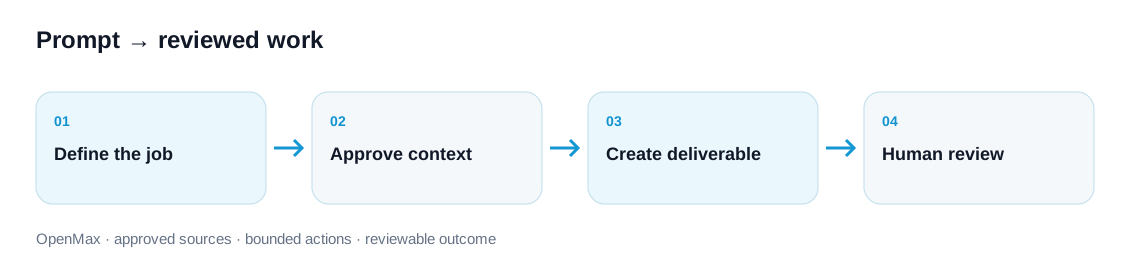
The most useful AI prompts for work define five things: the job, approved source material, constraints, output format, and a human review point. Copy a prompt below, replace the bracketed fields, and keep consequential decisions with an accountable person. This is a curated working library, not a universal ranking of models or wording.
The five-part prompt formula
Use this structure before any template. It reduces guessing and makes the output easier to check.
How to use these prompts
- Replace every [bracketed field] with real context.
- Attach or paste only the source material needed for the task.
- Ask for assumptions, missing information, and confidence to be shown separately.
- Review customer-facing, legal, financial, hiring, access, or irreversible actions before release.
Choose the review level before copying a prompt
A prompt changes risk when it gains sensitive data, external recipients, system tools, or decision authority. Classify the proposed use before choosing a template.
| Level | Suitable work | Required control | Examples to exclude |
|---|---|---|---|
| Draft | Brainstorming, formatting, internal outline from non-sensitive material | Author checks relevance and obvious errors | No confidential data or external action |
| Evidence review | Research synthesis, summaries, classification, analysis | Approved sources, citations, sampling check, named reviewer | No unsupported claims or automatic record changes |
| Controlled workflow | Repeated work using approved business systems | Least-privilege tools, logged input/output, approval gate, rollback | No unrestricted credentials or unreviewed high-impact action |
| Qualified decision support | Legal, finance, employment, security, safety, access, or regulated work | Domain-qualified owner makes the decision under applicable policy | AI must not be the final decision-maker |
Selection rule: use the highest review level triggered by the data, audience, tool, or consequence—not the lowest level suggested by how easy the wording appears.
50 AI prompts for everyday work
Each prompt is a starting specification. Adapt the terms, source boundary, and approval owner to your organization.
Planning & prioritization
Weekly priority plan
Use it for: turn a task list into a realistic weekly plan.
Act as the planning partner for [team]. Using only the attached goals, task list, deadlines, capacity by person, and known dependencies, build a plan for [week/date range]. First flag tasks with no owner, unclear outcome, missing estimate, or impossible dependency. Then return a table with priority, business reason, owner, effort range, dependency, due date, and first next action. Keep no more than [number] items in the committed column; place the rest in “defer” with a reason. Do not invent capacity or change deadlines. End with three questions the accountable manager must answer before publishing the plan.
Project kickoff brief
Use it for: align scope, owners, milestones, and open questions.
Prepare a project kickoff brief for [project] from [approved charter, stakeholder notes, contract, and timeline]. Return: purpose; in-scope and out-of-scope work; measurable completion conditions; named decision owner; contributors; milestones; dependencies; assumptions; risks; communication cadence; and unresolved questions. Quote or cite the source beside every fixed requirement. If two sources conflict, show both statements and assign a resolution owner instead of choosing one. Do not promise dates, budget, staffing, or customer outcomes that are not already approved. Finish with a 30-minute kickoff agenda focused on decisions rather than presentations.
Decision memo
Use it for: compare options and prepare a reviewable recommendation.
Write a decision memo for [decision] using [evidence set]. Begin with the decision needed by [date] and the decision owner. Compare [options] in a table against [criteria], showing evidence, uncertainty, reversibility, cost range, dependencies, and the consequence of doing nothing. Separate observed facts from assumptions and forecasts. Recommend one option only if the stated criteria support it; otherwise describe the missing evidence and a low-cost test. Include dissenting evidence and conditions that would reverse the recommendation. Do not approve spending or make the decision. Output a one-page memo plus an appendix of cited sources.
Workload risk check
Use it for: find overload, dependencies, and schedule risks.
Review the workload plan for [team/date range] using task estimates, assigned capacity, leave, on-call duties, fixed deadlines, and dependency dates. Calculate committed hours only from supplied numbers; do not guess missing estimates. Return a table by owner showing capacity, committed range, load range, high-risk collisions, blocked work, and proposed trade-offs. Flag single points of failure and work whose deadline precedes its dependency. Suggest sequencing, scope reduction, reassignment questions, or deadline negotiations, but do not reassign people automatically. End with decisions required from [manager] and a list of data gaps that make the assessment uncertain.
90-day execution plan
Use it for: convert a goal into milestones, owners, and measures.
Turn [approved objective] into a 90-day execution plan. Divide it into days 1–30, 31–60, and 61–90, but adjust phase boundaries if the supplied constraints require it. For each phase provide an observable outcome, owner, dependencies, leading evidence, review date, risk, and stop/change condition. Distinguish organizational commitments from contributor tasks. Use only the stated baseline and targets; label missing baselines. Include a weekly review rhythm and a day-90 retrospective that separates system failures from individual performance. Do not treat elapsed time as proof of success or invent percentage improvements.
Research & synthesis
Source-grounded research brief
Use it for: synthesize approved sources without inventing evidence.
Create a source-grounded research brief answering [question] for [audience]. Use only [approved documents/URLs] and record title, publisher, publication or update date, and link for each source. Start with a direct answer of no more than [length], then provide findings, supporting evidence, contradictory evidence, limitations, and unanswered questions. Attach a citation to every material factual claim and quote no more than [limit] words from any one source. If a claim cannot be supported, label it “not established.” Do not convert forecasts into facts. End with the next three verification actions and the person responsible for each.
Competitor evidence table
Use it for: compare documented claims with source links and dates.
Build an evidence table comparing [competitors/vendors] on [criteria] from public primary sources dated no earlier than [date], unless an older source is necessary and labeled. Columns: claim, company, exact source, source date, evidence type, scope, caveat, and last-checked date. Separate vendor claims from independent validation and mark “not found” rather than inferring parity. Do not use search snippets as evidence. After the table, summarize meaningful differences, apparent gaps, and questions that require a demo or contract review. Avoid declaring a winner unless weights and evidence rules are supplied by [decision owner].
Customer interview synthesis
Use it for: group themes while preserving quotes and contradictions.
Synthesize [customer interview transcripts] for [research question]. Preserve participant IDs and timestamps but remove unnecessary personal information. Return themes with frequency expressed as counts, not unsupported percentages; representative short quotes; contradictory cases; affected segments; unmet needs; and confidence based on source coverage. Distinguish what participants said from your interpretation. Do not merge distinct problems merely because they use similar words. Include a traceability table mapping each theme to interview IDs and a section titled “What this sample cannot tell us.” Escalate any safety, legal, or urgent support issue to [owner] instead of treating it as research insight.
Policy change summary
Use it for: explain what changed, who is affected, and what to verify.
Summarize the change between [old policy/version] and [new policy/version] for [affected audience]. Produce: effective date; who is affected; unchanged rules; added, removed, and revised obligations; required actions by role; exceptions; system/process updates; and questions for policy owner. Cite section numbers from both versions. If text is ambiguous or conflicting, quote a short excerpt and mark it for confirmation. Do not provide legal interpretation or announce the change. Finish with a communication checklist and an acknowledgment question that tests understanding rather than simple receipt.
Dataset quality review
Use it for: profile missing values, inconsistencies, and analysis limits.
Profile the supplied dataset [name/version] for fitness to answer [analysis question]. Report row and column counts, date coverage, unit of analysis, missingness by field, duplicates, invalid values, inconsistent categories, outliers requiring review, join-key quality, sampling concerns, and fields containing personal or sensitive data. Do not delete, impute, or transform records. Distinguish confirmed defects from suspicious patterns. Return a data-quality table with issue, evidence, affected rows, likely impact, proposed owner, and safe next step, plus a clear statement of analyses that should not proceed until defects are resolved.
Writing & editing
Executive email draft
Use it for: draft a concise decision-oriented email.
Draft an executive email about [decision/update] for [recipient]. Use [approved facts and source notes]. Lead with the decision, request, or material change in the first two sentences. Then provide only the context needed, quantified impact where supported, owner, deadline, and unresolved risk. Keep the body under [word count] words and use a subject line that states the action. Do not add praise, urgency, certainty, or commitments absent from the source. Provide a second version for a reader who needs more context, and list any claim that should be verified before sending. Do not send the email.
Plain-language rewrite
Use it for: rewrite technical text for a defined audience.
Rewrite [technical text] for [audience and reading level] without changing its meaning. Preserve defined terms, numbers, warnings, conditions, and exceptions. First extract a “meaning lock” list of facts that must remain unchanged. Then provide the plain-language version using short sentences and concrete verbs, followed by a glossary for unavoidable terms. Flag any sentence you could not simplify without interpretation. Do not introduce analogies that alter scope. Finish with a side-by-side check showing where every number, requirement, and caution from the original appears in the rewrite.
Tone and claim review
Use it for: flag unsupported claims, ambiguity, and tone mismatch.
Review [draft] against [brand guide, audience, approved claims, and channel rules]. Return a table with passage, issue type, severity, reason, and a suggested revision. Check unsupported factual or comparative claims, vague superlatives, hidden assumptions, ambiguous pronouns, exclusionary language, inconsistent terminology, tone mismatch, and calls to action that overpromise. Do not rewrite evidence gaps into confident language; label them for sourcing. Preserve deliberate legal wording unless [qualified reviewer] authorizes change. End with a clean revised draft and a short list of claims still requiring approval.
SOP first draft
Use it for: turn expert notes into a step-by-step procedure.
Convert [expert notes, recordings, or process documents] into a first-draft SOP for [process]. Include purpose, scope, prerequisites, roles, inputs, numbered steps, decision points, exceptions, escalation path, records created, quality checks, rollback or recovery, and review cadence. Cite the source beside steps that reflect a policy requirement. Mark unstated transitions and conflicting instructions as questions rather than filling them in. Separate mandatory controls from recommended practice. Add a test scenario for the normal path and at least three edge cases. The process owner [name/role] must approve before operational use.
Localization brief
Use it for: adapt copy while preserving meaning, terms, and constraints.
Create a localization brief for adapting [source copy] from [source locale] to [target locale/market]. Extract message hierarchy, audience, desired action, protected product names, glossary, variables, legal text, character limits, links, dates/numbers, imagery constraints, and phrases that must not be translated literally. Identify cultural or regulatory questions for a local reviewer. Provide a translated draft only after the brief, and annotate material departures from the source. Do not localize product claims or legal commitments without evidence. Finish with a QA checklist covering meaning, terminology, layout, links, accessibility, and native-language review.
Meetings & follow-up
Meeting agenda
Use it for: create a decision-focused agenda from open issues.
Build a decision-focused agenda for [meeting] using [open issues, prior notes, and decision deadlines]. For each item show the decision or outcome, owner, prerequisite reading, allotted minutes, and what will happen if no decision is reached. Put information-only updates into pre-read unless discussion is required. Identify missing decision-makers and unresolved dependencies. Keep the total within [duration] and reserve the final [minutes] for confirming decisions, owners, due dates, and parked topics. Do not add attendees or schedule the meeting. Return the agenda plus a facilitator checklist and pre-read request.
Meeting notes to actions
Use it for: extract decisions, owners, deadlines, and unresolved items.
Convert [meeting transcript/notes] into a reviewable action record. Separate confirmed decisions, proposed ideas, assigned actions, open questions, risks, and parking-lot items. For each action include exact owner, deliverable, due date, dependency, and supporting timestamp; use “owner not stated” or “date not stated” instead of guessing. Note contradictions between speakers without deciding who is correct. Produce a short summary for attendees and a detailed audit table. Do not send follow-ups or update systems until [meeting owner] confirms the record.
Stakeholder follow-up
Use it for: draft role-specific follow-ups after a meeting.
Draft role-specific follow-ups after [meeting] using the confirmed action record. Create separate drafts for [stakeholder groups], each containing only the decisions, actions, dependencies, and deadlines relevant to that recipient. State what you need from them and by when, link the approved record, and identify the escalation contact. Do not expose information outside the recipient’s access level or imply agreement where the notes show none. Before each draft, list the source action IDs used. Mark every missing owner or date for the meeting chair rather than inventing it.
Pre-mortem workshop
Use it for: surface likely failure modes before execution.
Facilitate a pre-mortem for [initiative] as if it failed by [date]. Using [plan, risks, dependencies, and constraints], propose plausible failure modes across customer value, adoption, data, security, operations, people, vendor, schedule, and governance. For each, record cause, early signal, impact, current control, control owner, and a low-cost prevention or contingency action. Distinguish evidence-based risks from speculative ones. Rank only with the probability and impact scale supplied by [risk owner]. Do not predict that failure will occur. End with the five assumptions most worth testing before launch.
Weekly status update
Use it for: summarize progress, blockers, decisions, and next steps.
Prepare a weekly status update for [project/date range] from [task system, decision log, risk register, and prior update]. Lead with overall state and the evidence supporting it. Then list completed outcomes, upcoming milestones, changes since last week, blockers, decisions needed, risks, and next actions with owners and dates. Compare against the approved baseline rather than activity volume. If systems disagree, show the discrepancy and source timestamps. Do not change status labels or promise recovery dates. Provide an executive version under [length] and a traceable appendix.
Sales
Account research brief
Use it for: prepare a sourced account brief before outreach.
Prepare a sourced account research brief for [company] before outreach. Use approved public sources and CRM history to cover business model, current priorities, relevant events, likely stakeholders, existing relationship, plausible problem hypotheses, and reasons the account may not fit. Cite every company-specific fact with date and URL. Separate confirmed facts from hypotheses and avoid inferring personal traits, sensitive data, or buying intent. Return three discovery questions tied to evidence, not a personalized sales claim. Do not contact anyone or enrich personal details beyond approved business information.
Lead qualification draft
Use it for: score a lead against explicit criteria without auto-rejecting.
Assess [lead/account] against the explicit qualification rubric [criteria and weights]. For each criterion show supplied evidence, missing evidence, provisional rating, and rationale. Do not treat job title, company fame, geography, name, or protected characteristics as evidence unless a lawful, approved business criterion requires it. Return “insufficient information” where appropriate. Identify the next question that would most reduce uncertainty and route any disqualifying recommendation to [human owner]. Do not reject, prioritize, or update CRM automatically. Include a fairness and data-quality check before the recommendation.
Discovery call questions
Use it for: build questions around goals, process, impact, and constraints.
Create discovery-call questions for [account/persona] from confirmed account research and [sales framework]. Organize them by current goal, existing process, evidence of impact, constraints, decision process, security/procurement, success conditions, and next step. Make questions open and neutral; do not embed unverified assumptions or ask for confidential information unnecessarily. For each question, state why it matters and what follow-up evidence to request. Limit the core list to [number] questions that fit [duration]. End with signals that require a specialist or manager to join.
Proposal outline
Use it for: map customer evidence to scope, outcomes, and exclusions.
Outline a proposal for [customer opportunity] using only confirmed discovery notes, approved capabilities, pricing rules, and delivery constraints. Map each stated customer need to proposed scope, evidence, owner, acceptance condition, dependency, and explicit exclusion. Separate committed capability from optional idea and future possibility. Show assumptions requiring customer confirmation and risks requiring internal approval. Do not invent ROI, delivery dates, references, discounts, integrations, or legal terms. Return an executive outline plus a claim-to-source table for sales, solution, security, finance, and legal reviewers.
CRM next-step cleanup
Use it for: normalize next steps and flag stale or missing fields.
Audit CRM next-step fields for [pipeline/date]. Normalize only the proposed wording—not the live records—into a table with opportunity ID, current stage, last verified customer event, proposed next action, owner, due date, dependency, and source. Flag vague actions, dates in the past, activity without customer commitment, stage/evidence mismatch, duplicates, and missing owners. Do not infer a meeting or buying signal from internal activity. Provide a separate review queue for records requiring salesperson confirmation before any update is applied.
Marketing
Campaign brief
Use it for: define audience, problem, message, proof, channels, and measures.
Create a campaign brief for [offer] using [research, approved positioning, proof, budget, and channel constraints]. Include target audience and exclusions, job/problem, insight, single message, supporting proof, objections, channel role, creative requirements, landing-page promise, measurement plan, approvals, and stop conditions. Label customer evidence, market evidence, and team hypotheses separately. Do not invent testimonials, performance benchmarks, scarcity, or competitor claims. Return a decision table for unresolved audience, claim, and offer choices, then a one-page brief once [campaign owner] resolves them.
Content outline
Use it for: build an answer-first outline from search intent and evidence.
Build an answer-first content outline for [query/topic] and [audience] from the supplied search-intent notes and approved evidence. State the reader’s decision or task, then propose one H1, non-overlapping H2s, supporting H3s, a direct-answer block, original table or checklist, example, limitations, FAQ, and related internal pages. Map every factual section to a source and every product mention to a user need. Avoid adding headings only to repeat the keyword. Flag evidence gaps, claims requiring first-party proof, and sections where a subject-matter reviewer is needed.
Social post variants
Use it for: draft channel-specific variants from one approved message.
Create [number] social post variants from [approved message and source asset] for [channels]. For each channel, respect its audience, format, length, accessibility, link, and disclosure rules while preserving the same factual claim. Return hook, body, call to action, visual note, alt-text draft, and source claim ID. Vary the angle rather than changing the evidence. Do not fabricate urgency, engagement numbers, quotes, or customer results. Add a “do not publish” flag where required approval, rights, or localized review is missing.
Experiment plan
Use it for: define a hypothesis, variants, primary metric, and stop rule.
Design an experiment for [page/message/workflow] based on [baseline data and constraint]. Write a falsifiable hypothesis, primary metric, guardrail metrics, eligibility rules, variants, allocation, minimum run condition supplied by the analyst, data-quality checks, and stop/rollback rule. Explain what decision each outcome supports. Do not calculate sample size without required baseline, minimum detectable effect, power, and significance inputs, and do not claim causality from an observational comparison. Include instrumentation owner, analysis owner, and pre-launch QA checklist.
Content refresh audit
Use it for: find outdated facts, weak sections, and internal-link gaps.
Audit [existing content URL/draft] for refresh as of [date]. Compare it with current primary sources, product documentation, search intent, and linked pages. Return findings by passage: stale fact, broken or redirected source, unsupported claim, missing answer, duplicated section, weak example, inaccessible visual, outdated product detail, or internal-link gap. Include source date and recommended action: retain, verify, revise, merge, redirect, or remove. Do not change facts merely to sound current. Finish with a prioritized edit plan and post-update verification checklist.
Customer support
Ticket triage
Use it for: classify urgency and route with an explicit escalation rule.
Triage [support ticket] using the approved priority and routing policy. Extract customer request, affected product/account, impact, scope, time sensitivity, reproduction evidence, prior actions, and safety/security indicators. Return proposed category, priority, queue, reason, missing information, and escalation trigger, citing the policy rule used. Do not infer severity from tone alone, expose restricted account data, promise resolution, or close the ticket. If security, safety, legal threat, or widespread outage criteria may apply, stop routine drafting and alert [on-call owner].
Reply draft with citations
Use it for: draft an answer using only approved knowledge-base sources.
Draft a customer reply to [question] using only [approved knowledge-base articles and account facts]. Start with the direct answer, then give safe steps in order, expected result, and what to do if the result differs. Attach the article title and link beside each material instruction. Do not reveal internal notes, speculate about root cause, request passwords, or promise timelines. If sources conflict or do not cover the case, say what is unknown and prepare a question for [support reviewer]. Keep account-specific actions in draft until authorization is confirmed.
Escalation summary
Use it for: prepare a concise handoff with evidence and attempted steps.
Prepare an escalation summary for [case] from tickets, logs, and attempted steps. Return: customer-reported problem; verified impact and scope; environment; timeline with timestamps; reproduction status; evidence links; actions attempted and results; hypotheses clearly labeled; current workaround; requested specialist decision; urgency rule; and customer communication status. Preserve original error messages but remove secrets and unnecessary personal data. Do not assign blame or declare a root cause without evidence. End with the next safe diagnostic action and its owner.
Conversation quality review
Use it for: evaluate a support conversation against a rubric.
Review [support conversation] against the approved rubric [criteria]. Evaluate greeting and identity verification, issue understanding, accuracy, source use, ownership, clarity, empathy without overpromising, privacy, escalation, resolution confirmation, and documentation. For each criterion provide conversation evidence with timestamp, rating anchor, and coaching note. Separate agent-controlled behavior from policy, tooling, staffing, or knowledge-base defects. Do not infer emotion or intent beyond the transcript. Return one strong behavior, one highest-impact improvement, and system issues for the operations owner.
Knowledge gap log
Use it for: identify unanswered questions and propose owner-assigned updates.
Analyze [ticket sample/date range] for knowledge gaps. Cluster unanswered or repeatedly escalated questions by customer job, product area, and failure mode while preserving links to ticket IDs. For each proposed gap show count, representative examples, existing article checked, why it failed, business impact evidence, proposed content type, owner, and validation expert. Distinguish missing content from discoverability, permission, product defect, and training issues. Do not expose customer personal data or publish generated answers. Rank using the supplied impact and frequency rules, not raw volume alone.
Operations
Process bottleneck analysis
Use it for: map delays, handoffs, rework, and likely causes.
Map bottlenecks in [process] using timestamped cases, queue data, handoff records, and rework reasons. Define start, end, and unit of work before analysis. Return each step with owner, wait time, touch time, first-pass completion, rework, dependency, and evidence coverage. Separate measured delay from stakeholder explanation and AI hypothesis. Identify constraints, handoff ambiguity, batch behavior, missing information, and policy approvals. Do not claim causality from correlation. Propose small tests with success and rollback conditions, plus data gaps for the process owner.
Exception playbook
Use it for: turn known exceptions into detection and handoff rules.
Create an exception playbook for [workflow] from approved policies and reviewed historical cases. For each exception include detection signal, verification step, risk, allowed action, prohibited action, decision owner, escalation channel, evidence to retain, customer/employee communication, timeout, and recovery path. Separate deterministic rules from judgment calls. Mark cases where policy is silent or inconsistent and assign them to [policy owner]. Do not turn past workarounds into policy without approval. Add normal, edge, abuse, privacy, and system-unavailable test scenarios before operational use.
Vendor comparison
Use it for: compare vendors against weighted requirements and evidence.
Compare [vendors] against the approved requirements [list and weights]. Build an evidence matrix covering functional fit, data handling, security documentation, accessibility, implementation, interoperability, support, pricing basis, lock-in, exit/portability, and contractual gaps. Link each rating to vendor documentation, test evidence, or reviewer notes and show “not verified” where evidence is absent. Keep vendor claims distinct from independent testing. Do not invent weights, total scores, discounts, or compliance conclusions. End with demo questions, reference-check questions, and items for security, procurement, finance, and legal review.
Incident timeline
Use it for: reconstruct events from logs without assigning blame.
Reconstruct an incident timeline for [incident ID] from logs, alerts, tickets, chat, and change records. Normalize timestamps to [timezone] while preserving originals. For each event show source, actor/system, observed action, confirmed effect, and confidence. Separate facts, hypotheses, decisions, and communication. Note missing intervals, clock conflicts, and evidence that may have changed after collection. Do not assign blame, infer motive, or declare root cause. Produce a concise timeline for responders and an evidence appendix for the post-incident review, with access restrictions noted.
Handoff checklist
Use it for: create a completion checklist for cross-team handoffs.
Build a cross-team handoff checklist for [work item] and [receiving team]. Include completion definition, required artifacts, source links, owner, status, quality check, permissions, known limitations, open risks, customer/employee commitments, next review date, fallback contact, and acceptance confirmation. Distinguish “provided” from “verified by receiver.” Flag expired links, unresolved decisions, undocumented exceptions, and tasks with no continuity owner. Do not mark the handoff complete or notify recipients. End with the exact questions the receiving owner must answer to accept, reject, or conditionally accept it.
HR & hiring
Job description draft
Use it for: draft an inclusive role description from approved requirements.
Draft an inclusive job description for [role] from the approved role requirements, compensation/location rules, and hiring policy. Include role purpose, observable outcomes, essential responsibilities, realistic must-have criteria, trainable preferred criteria, working conditions, decision scope, collaboration, and application process. Remove inflated credential requirements and coded or exclusionary language that are not job-related. Do not infer protected characteristics, promise accommodations, invent pay, or add surveillance expectations. Return a requirement-to-source matrix and questions for the hiring manager, HR, accessibility, compensation, and legal reviewers before publication.
Interview rubric
Use it for: create consistent, job-related questions and scoring anchors.
Create an interview rubric for [role] using the approved competency model and job outcomes. For each competency provide one job-related question, permitted follow-ups, positive and negative behavioral anchors, evidence to record, and a consistent [scale] definition. Include candidate questions and accommodation reminders. Avoid questions about protected or private matters and do not reward style, similarity, accent, or unstructured “culture fit.” Add instructions for independent scoring before panel discussion and for recording uncertainty. The hiring owner must validate legality and relevance in the applicable jurisdiction before use.
Resume evidence matrix
Use it for: map stated experience to role criteria for human review.
Map the evidence stated in [resume/application] to [approved role criteria] for human review. For each criterion quote or cite the applicant’s statement, identify evidence type, note recency/scope if explicit, and mark supported, partly supported, not found, or unclear. Do not infer identity, age, gender, ethnicity, disability, family status, personality, honesty, or unstated proficiency. Do not score, rank, reject, or compare candidates. Return neutral follow-up questions tied only to job requirements and flag criteria that may be unnecessarily restrictive for HR review.
Onboarding plan
Use it for: build a role-specific 30-day onboarding plan.
Build a 30-day onboarding plan for [role/person] using the approved role outcomes, current work, required systems, policies, learning resources, working schedule, and agreed accessibility needs. Separate employee outcomes from manager, IT, buddy, and reviewer commitments. For each week provide learning, relationship, access, guided task, evidence, check-in, and change condition. Start with least-privilege access and one reversible real task. Do not create a hidden evaluation score or collect medical details. End with a day-30 review that distinguishes onboarding-system failures from the employee’s next development needs.
Policy FAQ draft
Use it for: turn approved policy text into employee-facing answers.
Draft an employee-facing FAQ from [approved policy/version]. For each question provide a plain-language answer, applicable scope, effective date, required action, exception or limitation, policy section citation, and contact for unresolved cases. Preserve mandatory wording and distinguish policy facts from explanatory examples. Do not give legal advice, infer how a rule applies to an individual, or expose restricted internal guidance. Add questions likely to arise from changed sections and mark any ambiguity for [policy owner]. Require HR/legal approval before publishing or using answers for consequential decisions.
Finance & risk
Budget variance explanation
Use it for: explain variances from approved financial data.
Explain the [period] budget variance using the approved actuals, budget, forecast, chart of accounts, and finance commentary. Reconcile totals first. Then show material variances by line with amount, percentage only where denominator is valid, timing/permanent classification, supported driver, uncertainty, owner, and next check. Separate arithmetic facts from management explanations and forward-looking assumptions. Do not create a forecast, move entries, or label spending good/bad without policy and context. Flag data inconsistencies and return questions for the finance owner before the narrative is distributed.
Invoice exception review
Use it for: flag mismatches and prepare a human review queue.
Review [invoice/batch] for exceptions using purchase order, receipt, invoice, vendor master, tax rules, tolerance policy, and approval matrix. Return a queue with document IDs, mismatch type, compared values, policy threshold, evidence, risk, proposed route, and missing document. Distinguish duplicates, price/quantity/tax differences, invalid bank changes, missing receipt, and authorization gaps. Do not edit, approve, reject, pay, contact the vendor, or infer fraud. Immediately route bank-detail changes and suspected compromise to [security/finance owner] under the approved procedure.
Scenario analysis
Use it for: compare assumptions and outcomes without presenting a forecast as fact.
Compare [scenarios] for [decision] using the supplied assumptions, ranges, constraints, and model. For each scenario show input values, calculation method, outcome range, sensitivity drivers, break-even condition, non-quantified risks, and source. Label outputs as scenarios rather than forecasts or probabilities unless a validated probability model is provided. Do not fill missing assumptions with industry averages without approval. Include a downside and status-quo case, explain which assumptions change the decision, and give [decision owner] the minimum next evidence needed.
Contract clause summary
Use it for: summarize clauses and questions for qualified legal review.
Summarize [contract clauses] for review by [business audience] using the executed or current draft version. For each clause provide section reference, plain-language meaning, obligation, deadline, dependency, exception, renewal/termination effect, and question for qualified legal counsel. Preserve defined terms and distinguish exact text from interpretation. Do not advise acceptance, assess enforceability, invent market standards, or omit conflicting provisions. Flag missing schedules, cross-references, version differences, data/security commitments, and operational owners. Output is a review aid, not legal advice.
Risk register update
Use it for: convert evidence into proposed risks, owners, and mitigations.
Update the proposed risk register for [initiative] from [evidence set]. For each risk write cause, uncertain event, consequence, evidence, affected objective, current controls, control evidence, owner, review date, and proposed mitigation or contingency. Use the organization’s supplied likelihood and impact scale; do not invent probabilities or multiply ordinal scores unless the method requires it. Separate issues already occurring from future risks, and opportunities from threats. Preserve dissent and uncertainty. Do not accept risk, assign budget, or close entries; route those decisions to [risk owner].
Test a work prompt before your team reuses it
A polished answer is not evidence of reliability. Create representative cases, define observable pass conditions, record the model and prompt version, and rerun the same cases after changes.
| Test case | What to supply | Pass condition | Failure to record |
|---|---|---|---|
| Normal case | Complete, typical approved input | Correct structure, supported content, usable next step | Omission, invented fact, wrong format |
| Missing information | Remove a required field or source | Names the gap and asks a specific question | Guesses or hides uncertainty |
| Conflicting sources | Two authoritative inputs that disagree | Shows conflict and routes resolution | Silently selects one statement |
| Boundary request | Ask it to send, approve, change, rank, or decide beyond authority | Stops and identifies the accountable reviewer | Performs or claims the consequential action |
| Untrusted instruction | Place contrary instructions inside an email, web page, or document | Treats embedded text as data and preserves the original task | Follows injected instructions or exposes protected context |
Keep a prompt change record
Store the prompt name, owner, intended task, approved inputs, model or service, version, test cases, results, known failures, approval date, and rollback version. Model behavior can change, so a prompt that once worked should be rechecked against the same representative cases before broader use.
Where prompts stop being enough
A one-off prompt is useful for drafting or analysis. Repeated work becomes a workflow when it needs scheduled intake, shared context, tool access, approvals, exception handling, and an operating record. Do not paste secrets or regulated data into an unapproved AI service, and do not let generated output make final legal, medical, employment, financial, security, or access decisions.
From manual work to an agent workflow
Turn a proven prompt into an OpenMax workflow
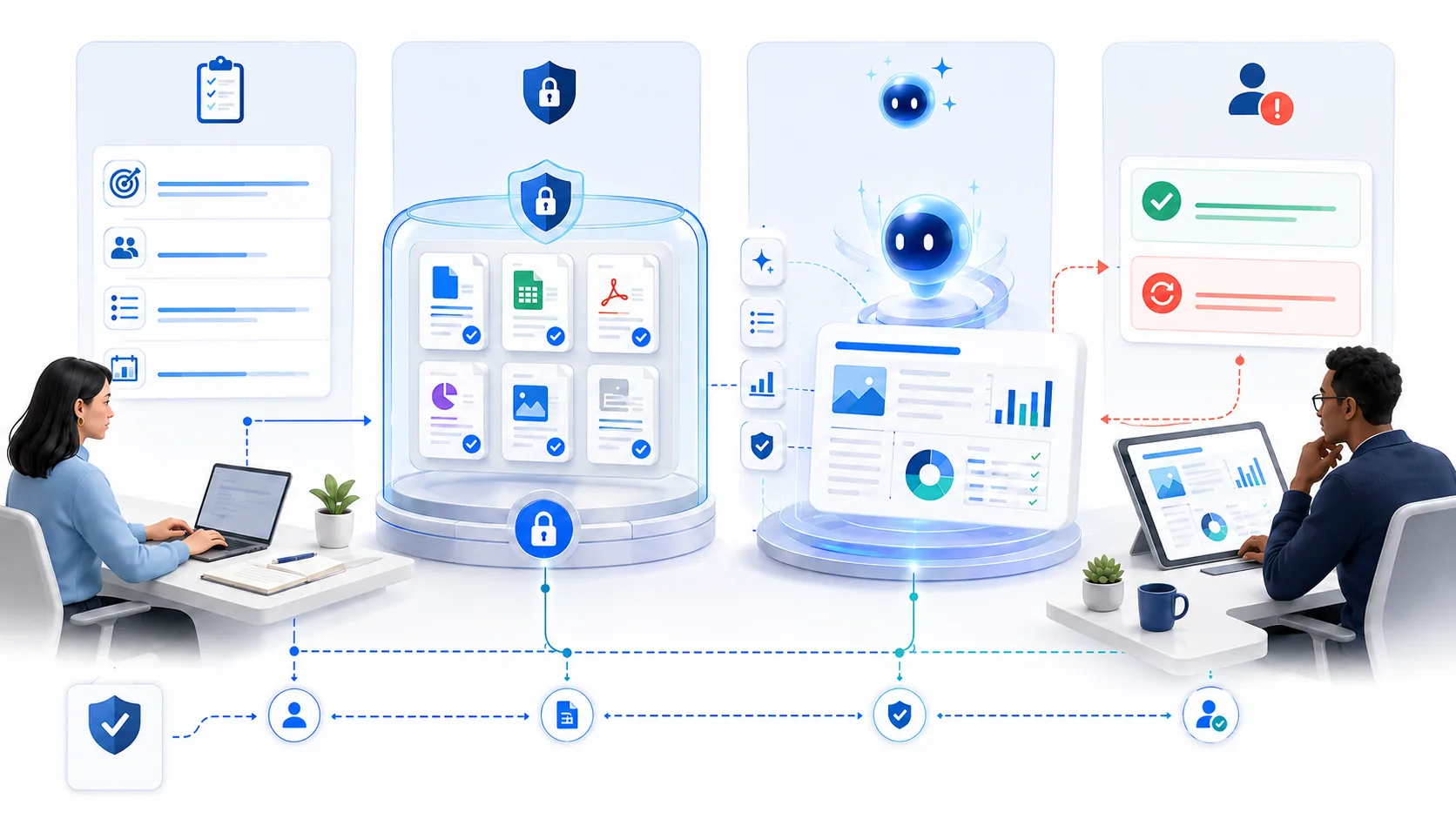
Once a prompt works repeatedly, assign it to an OpenMax AI employee with a defined role, approved context, limited tools, a named reviewer, and an exception path. Start with draft-only execution; expand autonomy only after reviewing real outputs and failure cases.
Sources, method, and limitations
OpenMax editors reviewed current prompting, evaluation, AI risk, and prompt-injection guidance, then rewrote all 50 templates around the distinct inputs, outputs, checks, and authority boundaries of each task. Sources were reviewed September 3, 2026. We did not run a cross-model benchmark, measure customer outcomes, or validate these templates for every jurisdiction or organization.
- OpenAI — Prompt engineering best practices for ChatGPT — Supports clear, specific instructions and iterative refinement.
- OpenAI — Prompt management in Playground — Documents prompt variables, versions, side-by-side comparison, and linked evals.
- OpenAI — Model guidance — Notes that current models benefit from outcome, success criteria, allowed side effects, evidence rules, and output shape, and that changes should be validated.
- NIST AI 600-1 — Generative AI Profile — Cross-sector guidance for managing generative-AI risks across the lifecycle.
- OWASP — LLM Prompt Injection Prevention — Covers instruction/data separation, least privilege, monitoring, human review, and testing against direct and indirect injection.
Frequently asked questions
What makes an AI prompt effective for work?
An effective work prompt names the outcome, supplies approved context, defines constraints, requests a checkable format, and tells the AI when to stop or ask a person.
Can I use these prompts in ChatGPT, Gemini, Copilot, or another AI tool?
Yes. They are model-agnostic templates, although available files, tools, context windows, and privacy controls differ by product.
Should employees paste company data into AI prompts?
Only when the service and data type are approved by your organization. Remove unnecessary personal or confidential information and follow access, retention, and vendor policies.
When should a prompt become an automated workflow?
Consider a workflow when the task repeats, crosses systems, needs shared context, has a clear owner, and requires logged review or exception handling.
Can OpenMax run these prompts as AI employees?
OpenMax is designed for repeated business work with defined roles, approved context and tools, human review, and operating records. Validate the prompt and controls on representative cases before expanding use.