

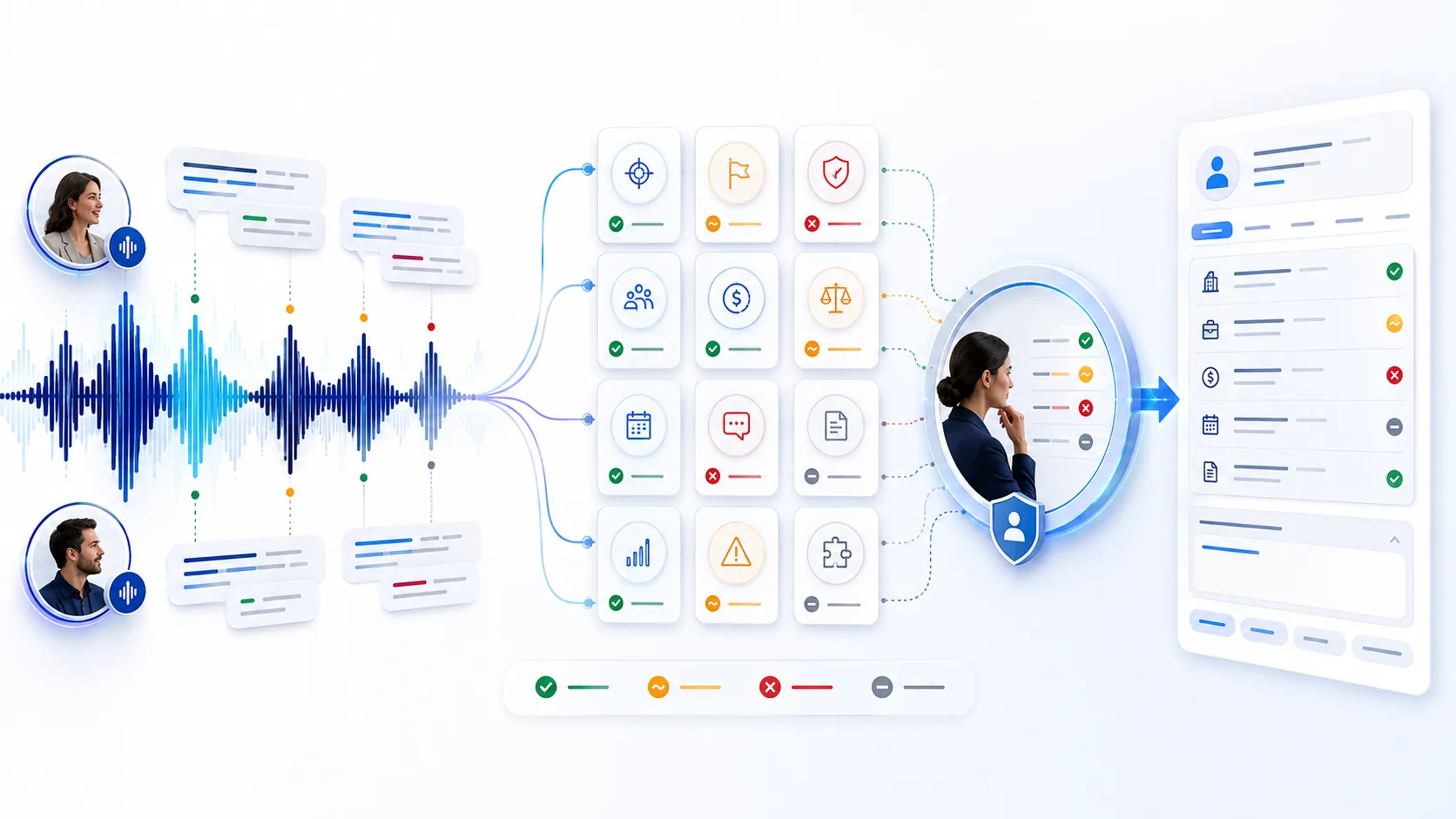
Quick answer
Start with the business decision, restrict the agent to consented transcript, account plan, CRM history, qualification framework, product constraints, and seller notes, require an evidence-linked risk review with answered, unanswered, contradictory, and follow-up questions, and name the person who approves consequential actions.
This guide is for: revenue, operations, marketing, support, and enablement teams that need repeatable work with visible ownership.
AI sales call analysis should report evidence, not manufacture confidence
A call is one bounded observation of a deal. Useful analysis identifies what a buyer actually confirmed, what a seller asserted, what conflicts with CRM, and what remains unknown. It does not award a hidden “deal health” label and present it as fact.
Use five evidence states
For every question, return CONFIRMED, PARTIAL, CONTRADICTED, NOT_STATED, or NOT_VERIFIABLE. The state must include a short rationale and transcript-span references. Confidence without addressable evidence is not a substitute.
Keep four claim types separate
Label buyer statements, seller statements, system-of-record claims, and model inferences separately. “My CFO will review it” does not identify the economic buyer; “we aim for Q4” does not confirm a close date; a friendly contact is not automatically a champion.
The evidence contract behind all 12 questions
| State | Minimum proof | Safe downstream action |
|---|---|---|
| CONFIRMED | Direct, attributable statement or verified record answers the defined question; no material conflict | Propose an evidence-linked field or note for authorized review |
| PARTIAL | Some elements are stated, but owner, value, authority, sequence, or date is missing | Preserve known elements and create a focused follow-up |
| CONTRADICTED | Current call, another speaker, or versioned CRM data disagrees materially | Show both claims; block automatic overwrite |
| NOT_STATED | No usable evidence appears in the analyzed call | Leave the field unchanged and ask, if relevant |
| NOT_VERIFIABLE | Audio, speaker identity, wording, or record association is too uncertain | Route to a person; never convert uncertainty into a fact |
12 AI sales call analysis questions that expose deal risk
Run each question as a separate evidence contract. The result is a review packet, not an automatic forecast score.
Was a measurable problem confirmed?
Find a buyer-owned baseline, operational consequence, target, and affected process—not a generic pain phrase.
Was urgency stated by the buyer?
Separate a buyer event and consequence from seller-created pressure, enthusiasm, or an aspirational quarter.
Is the decision process known?
Map the buyer’s technical validation and business approval steps, people, sequence, and dates.
Is an economic buyer identified?
Look for demonstrated purchase authority and decision responsibility, not seniority or attendance.
Are evaluation criteria explicit?
Capture the buyer’s technical, economic, risk, and relationship requirements with priority and proof method.
Is there a credible champion?
Test influence, access, motivation, and observable action; friendliness and frequent calls are insufficient.
Were competitors or alternatives named?
Include named vendors, internal build, status quo, competing initiatives, and no-decision.
Were security, legal, and procurement blockers surfaced?
Identify requirements, owners, artifacts, dependencies, and due dates—not just that “security is involved.”
Was budget discussed with evidence?
Preserve amount, currency, source, timing, authority, and approval state independently.
Are next steps mutual, owned, and dated?
A real next step has an action, accountable owner, date, and evidence that the other party accepted it.
Did call evidence conflict with CRM?
Compare versioned claims field by field and make disagreement visible before any write.
What critical question remains unanswered?
Choose the unknown that blocks the next buyer decision or carries the highest consequence—not a generic discovery prompt.
Worked example: “Q4” is not a committed close date
This is a hypothetical teaching example, not a customer call or product-performance claim.
What the reviewer should be able to verify
Every state opens the relevant speaker/time span; the system shows transcript and CRM versions, what was not said, and the exact field changes being proposed. A later call may strengthen or contradict the evidence without rewriting this analysis history.
How to implement and evaluate the analysis
Define question schemas
For each question, specify required facts, allowed evidence states, exclusions, and fields the workflow may only propose.
Build a labeled call set
Include strong, partial, contradictory, missing, vague, seller-only, crosstalk, and uncertain-speaker examples.
Score evidence, not prose style
Measure supported conclusions, unsupported additions, missed contradictions, span accuracy, abstention, and reviewer edits by question.
Test CRM conflict paths
Exercise stale records, ambiguous associations, concurrent edits, partial approval, retry, rollback, correction, and deletion.
How OpenMax supports this workflow
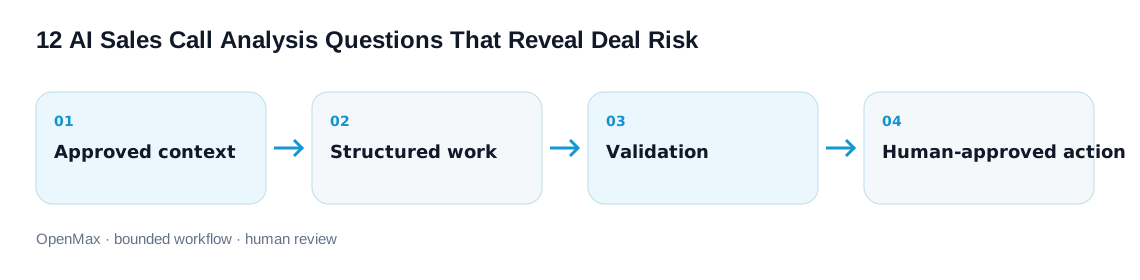
From prompt to governed OpenMax workflow
OpenMax can turn a reviewed instruction into an AI employee workflow with shared context, tool connections, task ownership, logs, and human review. The template defines the job; permissions and approval gates control what can happen next.
Limits and human-review boundaries
Call analysis can assist qualification; it cannot independently establish buyer intent, authority, legal status, or forecast truth.
- Obtain valid recording, transcription, use, retention, and access authority for every applicable participant and jurisdiction.
- Do not infer protected traits, emotion, deception, personality, authority, or willingness from voice, accent, tone, silence, or speaking time.
- Do not let a single call automatically change stage, amount, close date, probability, forecast, champion, economic buyer, legal/security status, or commitments.
- Keep speaker identity uncertainty, unintelligible audio, conflicting statements, and absent evidence explicit.
- Document reviewers, field ownership, retention, correction, deletion, model/configuration changes, incident response, and performance monitoring.
Frequently asked questions
What makes a good AI sales call analysis workflow?
A clear outcome, approved sources, explicit boundaries, a structured output, and a named review or escalation point.
Can the AI take action automatically?
Only if the action is explicitly permitted, technically constrained, logged, reversible where possible, and appropriate for the workflow risk.
How should teams test these entries?
Use a small labeled set containing normal, missing, conflicting, stale, and adversarial inputs. Record failures and revise the workflow, not just the wording.
Where does OpenMax fit?
OpenMax coordinates AI employees, shared context, connected tools, workflow ownership, and human review for repeated business work.
Are the examples guaranteed to improve results?
No. They are structured starting points. Results depend on models, source quality, tools, policy, evaluation, and reviewer judgment.
Sources, editorial method, and limitations
OpenMax editors reviewed primary documentation on enterprise qualification concepts, buyer decision processes, opportunity management, structured extraction, and AI risk management. We converted those concepts into twelve question-specific evidence contracts, then independently added claim-type separation, five evidence states, transcript-span provenance, CRM conflict handling, and field-level human authority. Sources were reviewed September 3, 2026. No win-rate, forecast-accuracy, productivity, transcription, or customer-outcome claim is made.
- MEDDICC — MEDDIC / MEDDPICC methodology and process — definitions for metrics, economic buyer, decision criteria/process, pain, champion, paper process, and competition.
- MEDDICC — Decision Process — buyer decision steps, technical validation, business approval, and the distinction between engagement and progress.
- Salesforce Trailhead — Manage Opportunities to Close Deals — opportunity methodology, stage guidance, required information, and stakeholder authority.
- Salesforce Trailhead — Qualify and Route Leads — qualification fields for need, budget, authority, and pipeline review.
- OpenAI API — Structured model outputs — constraining model output to a supplied schema.
- NIST — AI Risk Management Framework — governance, measurement, evaluation, transparency, and human-AI risk management.