


Quick answer

Start with the business decision, restrict the agent to approved briefs, records, policies, meeting notes, and source links, require a decision-ready draft with evidence, assumptions, owners, and next steps, and name the person who approves consequential actions.

This guide is for: revenue, operations, marketing, support, and enablement teams that need repeatable work with visible ownership.

What this workflow covers

ChatGPT prompts for business is useful when a team needs to turn recurring business requests into reviewable deliverables. The page treats every entry as an operational specification—not a magic phrase—and keeps evidence, permissions, and review visible.

Scope: drafting, evidence, and accountable action

The workflow begins with approved briefs, records, policies, meeting notes, and source links. It ends with a decision-ready draft with evidence, assumptions, owners, and next steps. It does not include sending messages, changing records, committing budget, or making legal, financial, hiring, or customer decisions.

What reliable output requires

Treat quality as a workflow property, not a clever sentence.

Evidence before inferenceRequire source fields, dates, and links; label assumptions and missing information separately.
A testable output contractSpecify fields, format, acceptance criteria, owner, and deadline so a reviewer can reject weak work.
Bounded actionSeparate drafting from execution. Tool permissions and approvals—not prompt wording alone—control side effects.

Use a conversation contract, not one giant request

These business prompts deliberately use checkpoints. The first turn gathers missing context; the second produces a reviewable draft; the third checks evidence, contradictions, authority, and readiness. This distinguishes the library from the single-turn 50 AI prompts for work.

Three-checkpoint ChatGPT workflow
CheckpointWhat ChatGPT doesWhat the human confirmsRecord to keep
1. FrameAsks bounded questions and reflects the job, audience, sources, constraints, and authorityThe problem and source set are complete enough to startConfirmed brief and unresolved questions
2. DraftProduces the named editable artifact with source links, assumptions, owners, and exceptionsThe evidence supports the material claims and the format is usableDraft version and source ledger
3. ChallengeChecks missing evidence, contradictions, risky action, ambiguity, and acceptance criteriaWhat to correct, approve, reject, or escalateReview decision, corrections, and final version

Important: a follow-up conversation improves context but does not create authority. ChatGPT should remain in draft and analysis mode unless a separately approved workflow constrains tools, recipients, data, logging, and approval.

27

27 ChatGPT prompts for business entries

Use each entry as a starting point. Replace bracketed context, attach approved evidence, and assign a reviewer before execution.

01

Executive brief

Turn evidence into a concise decision document for senior leaders.

Create an executive brief through three checkpoints. First, ask me up to five questions—one at a time—about the decision, audience, deadline, approved evidence, and constraints. Second, draft a one-page brief with decision required, direct answer, evidence, quantified impact where supported, options, risks, owner, and next action. Cite the supplied source beside every material fact and label assumptions. Third, audit the draft for unsupported certainty, missing dissent, vague ownership, and excess detail; then show only the changes you recommend. Do not send, approve, or invent a business commitment.
02

Weekly operating plan

Make weekly commitments realistic before work begins.

Help me build a weekly operating plan. Begin by requesting the current objectives, carryover work, fixed deadlines, capacity by owner, leave/on-call time, and dependencies. Do not draft until the minimum information is present. Return committed, stretch, blocked, and deferred work in a table with outcome, owner, effort range, dependency, due date, and proof of completion. Flag overload and deadlines that precede dependencies. Then ask me which trade-offs the manager approves and revise the plan without silently changing dates or owners. Finish with Monday kickoff and Friday review questions.
03

Decision memo

Compare options without hiding uncertainty or decision ownership.

Develop a decision memo interactively. Ask for the exact decision, decision owner, options, criteria, evidence, constraints, and latest decision date. Reflect back the decision frame for confirmation. Then compare options in a table covering evidence, uncertainty, cost range, reversibility, dependencies, and no-action consequence. Recommend only if the criteria support it; otherwise propose the smallest information-gathering step. After I respond, create a final memo with dissenting evidence and conditions that would reverse the recommendation. Do not make the decision or authorize spend.
04

Meeting agenda

Use meeting time for decisions rather than status presentation.

Prepare a decision-oriented meeting agenda. Ask what must be decided, who owns each decision, what pre-read exists, who has authority, and the total time. Move information-only updates into pre-read. Draft an agenda with outcome, owner, input, minutes, and fallback if unresolved; reserve the final five minutes for decisions and actions. Then challenge the agenda: identify missing decision-makers, topics with no evidence, and items unlikely to fit. Wait for my confirmation before producing the final shareable draft, and do not schedule or invite participants.
05

Meeting summary

Separate confirmed decisions from unconfirmed discussion.

Turn a meeting transcript into a confirmed summary. First ask for the meeting purpose, attendee names/roles, timezone, and whether the transcript is complete. Extract decisions, proposals, actions, unresolved questions, risks, and parking-lot items with timestamps. Use “not stated” for missing owners or dates. Show contradictions instead of resolving them. Ask me to confirm or correct the extracted record. Only then produce a concise attendee summary and detailed appendix. Do not send messages, update systems, or treat unconfirmed discussion as a commitment.
06

Action register

Convert scattered commitments into a traceable owner-and-date record.

Build an action register from [meeting notes, project updates, and decision log]. First identify all candidate actions and ask me to resolve any ambiguous owner, deliverable, or deadline. Then create a table with unique ID, action, business outcome, owner, due date, dependency, status source, acceptance evidence, and escalation date. Separate actions from decisions and open questions. Check for duplicate actions, circular dependencies, dates in the past, and owners not present in the source. After confirmation, return an import-ready version without changing the source system.
07

Project kickoff brief

Align scope, evidence, authority, milestones, and open questions.

Co-create a project kickoff brief. Ask one question at a time about purpose, customer or internal outcome, scope, exclusions, decision rights, budget boundary, milestones, dependencies, success evidence, risks, and communication. Stop after six questions if enough information exists; otherwise list missing items. Draft a brief with a requirement-to-source appendix and a 30-minute kickoff agenda. Run a contradiction check across charter, contract, timeline, and stakeholder notes. Ask me to resolve conflicts before the final version. Do not promise resources, dates, or outcomes that are not approved.
08

Risk register

Describe uncertain events, controls, owners, and review triggers consistently.

Create a proposed risk register for [initiative]. Ask for objectives, time horizon, risk scale, current controls, owners, and available evidence. Distinguish an issue already occurring from an uncertain future event. Draft entries using cause–event–consequence wording, with evidence, affected objective, likelihood/impact using only the supplied scale, control, control evidence, owner, review date, mitigation, contingency, and trigger. Ask the risk owner to confirm ratings and ownership. Do not accept, close, or assign budget to risks.
09

Process map

Document the normal path, exceptions, handoffs, and measurement gaps.

Map [business process] through a guided interview. Ask about the trigger, end state, unit of work, roles, systems, inputs, decisions, handoffs, exceptions, waiting, rework, and records. Reflect the normal path first, then request edge cases. Produce a numbered flow and a table with step, owner, input, action, decision rule, output, system, evidence, and escalation. Mark unverified steps and conflicting accounts. Finish with measurement questions for wait time, touch time, first-pass completion, and failure recovery; do not claim a bottleneck without data.
10

Standard operating procedure

Turn expert knowledge into a testable, owner-approved procedure.

Draft an SOP in stages. First request the process owner, purpose, scope, prerequisites, approved policy, normal path, exceptions, access rules, records, quality checks, and recovery method. Ask clarifying questions until no mandatory transition is implicit. Draft purpose, roles, inputs, numbered steps, decision points, prohibited actions, escalation, evidence, rollback, and review cadence. Create one normal and three edge-case walkthroughs, then ask the owner to validate them. Finalize only after corrections and label the document “draft pending process-owner approval.”
11

Research synthesis

Answer a business question with a source ledger and visible disagreement.

Help me synthesize research on [question]. Ask for the audience, decision supported, date boundary, approved sources, required jurisdictions, and quotation limit. Build a source ledger first with publisher, date, link, type, and relevance. Then draft a direct answer, findings, evidence, disagreements, limitations, and open questions with inline citations. Identify claims supported only by a vendor or single source. Ask me which gaps require more research, then revise. Never fabricate a citation, use a search snippet as evidence, or turn a forecast into fact.
12

Competitor comparison

Compare documented evidence without treating missing facts as parity.

Build a competitor comparison as a review process. Ask for competitors, buyer job, comparison criteria, date cutoff, allowed sources, and whether weights are approved. Create an evidence ledger before scoring, separating vendor claims, public documentation, independent tests, and “not found.” Present a table with criterion, evidence, date, scope, caveat, and verification needed. Ask me to confirm weights and unresolved evidence; only then summarize meaningful differences. Do not declare a winner from missing data or imply product parity.
13

Customer interview synthesis

Preserve interview traceability, contradictions, privacy, and sample limits.

Analyze customer interviews in two passes. Ask for the research question, participant IDs, segment fields, consent/privacy rules, and complete transcript set. First extract observations and short quotations with timestamps. Second group themes, contradictions, affected segments, unmet needs, and counts while preserving traceability to interview IDs. Present interpretation separately from what participants said and add “what this sample cannot establish.” Ask the researcher to review misclassification and missing context before creating the final synthesis. Route urgent support, safety, or legal cases outside the research report.
14

Requirements brief

Translate needs into testable requirements without locking in a solution.

Turn discovery notes into a requirements brief. Ask for the user or business problem, stakeholders, current process, constraints, must-have outcomes, non-goals, evidence, deadline, and decision owner. Draft requirements as testable statements with ID, rationale, source, priority method, acceptance evidence, dependency, risk, and open question. Separate user need from proposed solution and label assumptions. Find conflicting, duplicate, untestable, or ownerless requirements and ask me to resolve them. Do not convert stakeholder preferences into mandatory scope without approval.
15

Vendor evaluation

Create a cross-functional evaluation record before any vendor decision.

Guide a vendor evaluation. Ask for the business need, mandatory requirements, evaluation weights, security/privacy/accessibility conditions, budget basis, implementation constraints, and exit needs. Build a fact table from proposals, contracts, documentation, demos, tests, and reference notes, keeping vendor claims distinct from verified evidence. Show missing proof and questions for security, procurement, finance, legal, and users. Ask decision owners to confirm weights before calculating any result. Do not invent compliance, discounts, total cost, or a final selection.
16

Budget variance explanation

Reconcile figures and separate arithmetic from management interpretation.

Explain a budget variance collaboratively. Request the approved budget, actuals, forecast, chart of accounts, period, materiality rule, and finance commentary. Reconcile totals before narrative. Build a table with line item, amount, valid percentage, timing/permanent classification, confirmed driver, uncertainty, owner, and next check. Ask finance to resolve inconsistent totals and unsubstantiated driver explanations. Then draft a concise management narrative that separates arithmetic facts, management interpretation, and forward-looking assumptions. Do not post entries or create a forecast.
17

Invoice exception summary

Route document mismatches for review without approving payment.

Prepare an invoice exception summary. Ask for the invoice, purchase order, receipt, vendor master, tax/tolerance rules, approval matrix, and allowed fields. Compare documents and list each discrepancy with values, policy threshold, evidence, risk, missing document, and proposed reviewer. Separate duplicates, price, quantity, tax, bank-detail, receipt, and authorization issues. Immediately mark bank changes or compromise indicators for the approved security route. Ask a human to confirm disposition; do not edit, approve, reject, pay, contact the vendor, or label fraud.
18

Hiring scorecard draft

Standardize job-related evidence while preserving human hiring authority.

Build a hiring scorecard draft through an HR review. Ask for approved role outcomes, essential responsibilities, competency model, interview stages, local jurisdiction, accommodations process, and scoring scale. Draft job-related questions, permitted follow-ups, positive/negative behavioral anchors, evidence fields, and consistent rating definitions. Flag criteria that could proxy protected traits, style, accent, similarity, or vague culture fit. Ask HR/legal to approve before use. Do not rank candidates, infer personal attributes, or turn the generated rubric into an automated employment decision.
19

Onboarding plan

Make support commitments and phased employee outcomes visible together.

Create a 30-60-90 day onboarding plan with the manager. Ask about role outcomes, current work, required relationships, approved learning, system access, working schedule, known dependencies, and agreed accessibility needs. Separate employee outcomes from manager, IT, buddy, and reviewer commitments. Draft phased outcomes, guided tasks, evidence, check-ins, access gates, and change conditions. Ask both manager and employee to revise timing. End with separate system-retrospective and next-scope questions; do not create a hidden performance score.
20

Policy FAQ draft

Explain approved policy without silently inventing individual interpretation.

Draft a policy FAQ with controlled interpretation. Ask for the authoritative policy/version, affected audience, effective date, changed sections, mandatory wording, exceptions, jurisdiction, and policy owner. Extract policy facts before drafting questions. Each answer must include scope, action, exception, section citation, and contact. Mark ambiguity instead of applying policy to an individual. Ask HR/legal to review changed or sensitive answers, then produce a public draft and a separate unresolved-questions log. Do not provide legal advice or expose restricted guidance.
21

Customer escalation brief

Give specialists a fact-first case record with a precise decision request.

Create a customer escalation brief interactively. Ask for the customer report, verified impact/scope, environment, logs, timeline, attempted actions, commitments, urgency policy, and specialist decision required. Build a fact-first record with timestamps and links; label hypotheses and unknowns. Remove secrets and unnecessary personal information. Ask the case owner to confirm current workaround and communication status. Then generate a concise handoff that preserves error text without assigning blame or declaring root cause. Do not promise resolution or send the brief.
22

Support trend report

Identify repeat service patterns without confusing volume with causality.

Analyze support trends from [ticket sample]. Ask for the analysis window, inclusion rules, taxonomy, product releases, channel mix, customer segments allowed, and known data-quality problems. Profile volume, distinct customers, issue categories, repeat contacts, escalation, time measures, and knowledge gaps using supplied data only. Compare like-for-like periods and separate product, policy, staffing, routing, and measurement explanations. Ask support operations to validate top themes and outliers. Do not infer sentiment, causality, or customer health from ticket count alone.
23

Campaign brief

Connect audience, message, proof, channel, measurement, and approval.

Develop a campaign brief through a decision dialogue. Ask about audience and exclusions, customer problem, approved positioning, offer, proof, objections, channels, budget, landing page, conversion event, guardrail metrics, and approvers. Reflect unresolved choices in a decision table before writing creative direction. Draft one message hierarchy with claim-to-proof mapping, channel roles, asset requirements, measurement, and stop conditions. Ask the campaign owner to resolve unsupported claims. Do not invent testimonials, urgency, scarcity, performance numbers, or competitor comparisons.
24

Content review checklist

Find evidence, structure, accessibility, and claim problems before publication.

Review content with a traceable checklist. Ask for audience, user task, brand guide, approved claims, required sources, channel rules, accessibility requirements, and desired action. Evaluate answer quality, evidence, accuracy, structure, duplication, tone, terminology, claims, links, images/alt text, disclosures, and CTA. Return issue, passage, severity, rationale, evidence needed, proposed change, and owner. Ask me which high-severity items are approved for revision, then produce a clean draft. Do not conceal missing evidence through stronger wording.
25

KPI commentary

Explain measured change without manufacturing causes or forecasts.

Draft KPI commentary from [dashboard/data]. Ask for metric definitions, period, comparison baseline, targets, data owner, known reporting changes, and business events. Reconcile totals and identify definition or denominator changes. For each KPI state observed value, valid comparison, material movement, supported driver, uncertainty, implication, owner, and next check. Separate correlation from cause and result from forecast. Ask metric owners to confirm explanations, then create a concise narrative. Do not invent targets, attribute blame, or use percentages with invalid denominators.
26

Quarterly business review

Turn quarterly evidence into decisions instead of an activity recap.

Build a quarterly business review in checkpoints. Ask for audience, decisions needed, approved goals, KPI definitions, financial and customer evidence, major changes, initiatives, risks, and next-quarter constraints. First create an evidence index; next draft an answer-first storyline covering outcomes versus baseline, drivers, customer signal, execution, risks, decisions, and next-quarter choices. Label estimates and missing data. Ask leaders to resolve conflicting narratives before finalizing a slide/document outline with source notes. Do not turn activity into impact or promise future results.
27

Postmortem

Learn from an incident without blame or premature root-cause claims.

Facilitate a blameless postmortem. Ask for incident scope, timezone, logs, timeline, affected users/processes, detection, response, recovery, evidence access, and facilitator. Reconstruct confirmed events and keep hypotheses separate. Analyze contributing technical, process, communication, organizational, and control conditions without inferring motive. Draft impact, detection, timeline, contributing factors, what helped, what failed, corrective actions with owner/date/evidence, and follow-up review. Ask participants to challenge the record. Do not declare root cause until evidence supports it or use the document for individual performance scoring.

Worked example: turn a vague QBR request into a reviewable artifact

This is a hypothetical workflow example, not a customer result or evidence that a specific model will produce the same output.

Vague request“Make our QBR.” This omits the audience, decisions, baseline, source set, definitions, and reviewer.
Checkpoint 1ChatGPT asks for leadership audience, decisions required, approved quarterly goals, KPI definitions, financial/customer sources, and missing-data rules. The operator confirms which files are authoritative.
Checkpoint 2It produces an evidence index and storyline: outcomes versus baseline, supported drivers, customer signals, execution changes, risks, decisions, and next-quarter choices. Every chart or statement maps to a source.
Checkpoint 3It flags conflicting totals, activity presented as impact, forecast language, missing dissent, and unsupported customer claims. Finance, customer, and executive owners resolve those items before sharing.

Acceptance test

The result passes only if another reviewer can locate the evidence for every material claim, distinguish actuals from estimates and forecasts, identify the decision owner, and see which statements remain unresolved. “Looks polished” is not an acceptance condition.

How to implement and test it

Choose one business outcome

Do not combine research, judgment, writing, approval, and execution in one vague request. Name the decision this output supports.

Connect only approved context

Provide the minimum records needed, preserve source links and dates, and exclude data the workflow is not authorized to use.

Test with ordinary and edge cases

Check correct inputs, missing data, conflicts, prompt injection, stale records, and requests that should trigger escalation.

Review before expanding autonomy

Start read-only. Compare quality and exceptions, then grant narrowly scoped actions only when controls are proven.

How OpenMax supports this workflow
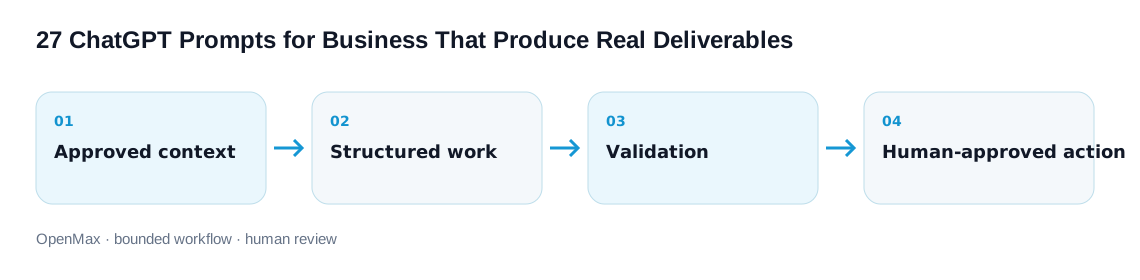
OpenMax workflow diagram for ChatGPT prompts for business

From prompt to governed OpenMax workflow

OpenMax can turn a reviewed instruction into an AI employee workflow with shared context, tool connections, task ownership, logs, and human review. The template defines the job; permissions and approval gates control what can happen next.

Explore OpenMax →

Limits and human-review boundaries

These examples are editorial templates, not independent performance tests or legal, privacy, employment, or security advice.

  • Do not use the workflow for sending messages, changing records, committing budget, or making legal, financial, hiring, or customer decisions without an authorized reviewer and enforceable controls.
  • Verify facts against the cited source system; model confidence is not evidence.
  • Minimize personal and confidential data, retain source dates, and follow applicable consent and retention rules.
  • Measure exception rate, correction rate, completion quality, and harmful side effects before scaling.

Frequently asked questions

What makes a good ChatGPT prompts for business workflow?

A clear outcome, approved sources, explicit boundaries, a structured output, and a named review or escalation point.

Can the AI take action automatically?

Only if the action is explicitly permitted, technically constrained, logged, reversible where possible, and appropriate for the workflow risk.

How should teams test these entries?

Use a small labeled set containing normal, missing, conflicting, stale, and adversarial inputs. Record failures and revise the workflow, not just the wording.

Where does OpenMax fit?

OpenMax coordinates AI employees, shared context, connected tools, workflow ownership, and human review for repeated business work.

Are the examples guaranteed to improve results?

No. They are structured starting points. Results depend on models, source quality, tools, policy, evaluation, and reviewer judgment.

Sources, editorial method, and limitations

OpenMax editors reviewed official ChatGPT prompting, Projects, Work file-creation, business-data, and leadership-rollout materials, then rewrote all 27 entries as original multi-turn business workflows. Sources were reviewed September 3, 2026. No cross-model test, customer study, productivity result, or universal legal/compliance conclusion is claimed.

About the editorial teamThe OpenMax Product and Content Team maintains practical guidance for human-agent workflows, source boundaries, permissions, review gates, exceptions, and operating evidence. This page separates general ChatGPT usage from OpenMax product context and does not claim affiliation with or endorsement by OpenAI.