

Quick answer
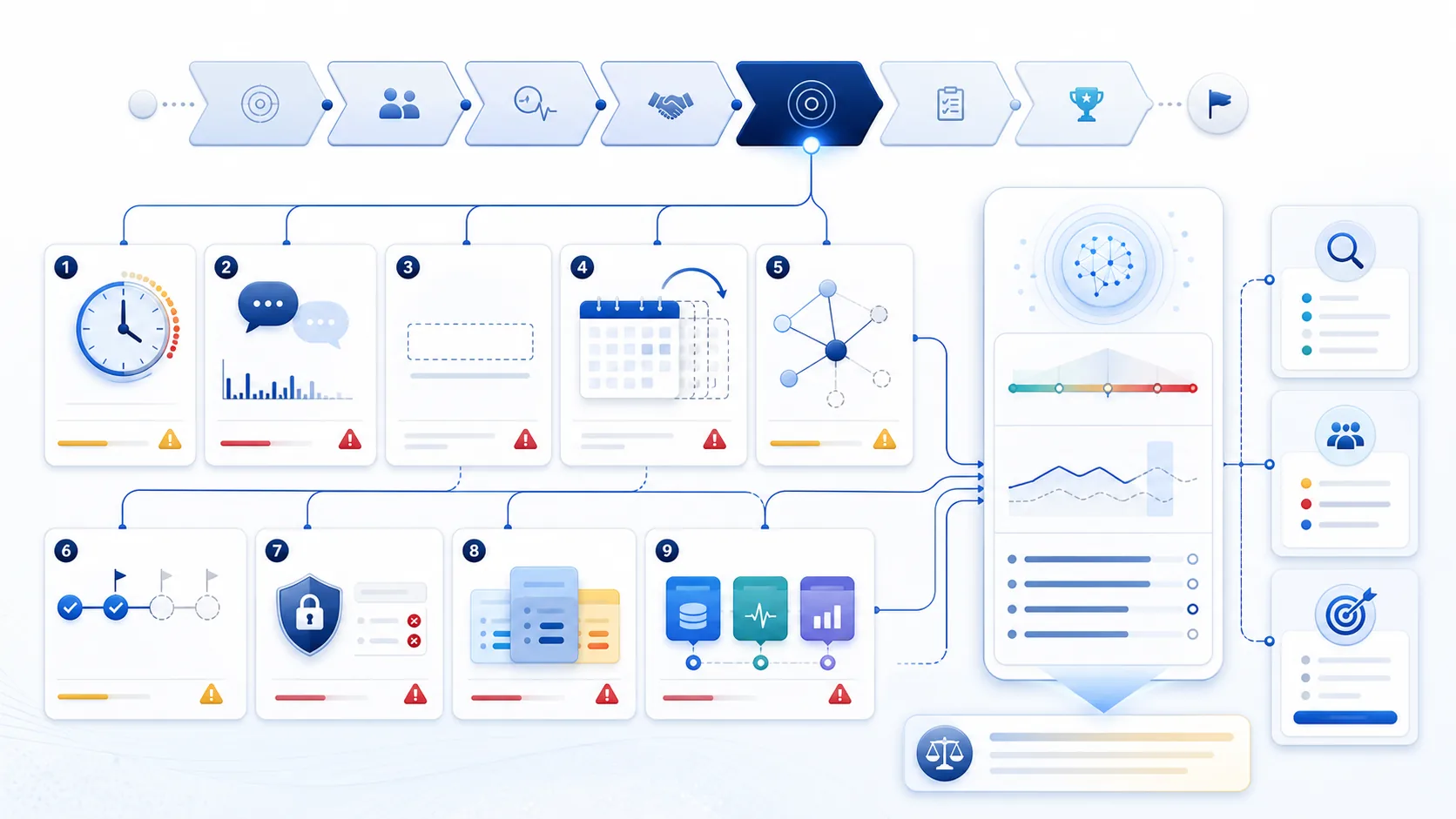
An AI agent can detect a stalled-deal candidate by combining nine explainable signals: unusual stage age, declining two-way engagement, no accepted next action, repeated close-date movement, thin buying-group coverage, inactive decision milestones, unresolved security/legal/procurement work, conflicting commercial versions, and disagreement or missingness across source systems.
No single signal proves a stall. Compare each against the correct stage and peer cohort, show the underlying records and counterevidence, classify data quality, and ask the seller or manager to confirm a reason and next action. Do not automatically mark a deal lost or lower the forecast.
A stalled deal is a review hypothesis, not a model verdict
A deal is operationally stalled when expected progress toward a verified buying decision has stopped or become unsupported—not simply when a timer expires. The workflow needs a declared sales motion, current stage criteria, an expected milestone sequence, a comparison cohort, and source-complete activity. Otherwise it may punish long enterprise cycles, planned customer pauses, seasonal procurement, or incomplete synchronization.
Activity is not the same as momentum
Eight unanswered outbound emails may create more CRM activity than one buyer-confirmed security review, yet provide less evidence of progress. Distinguish sender direction, human versus automated events, outcome, participants, and relation to the decision plan. Opens and model-generated touches are weak signals unless validated for the use case.
Missing data needs its own state
If email synchronization is disabled, stage history is incomplete, or the next-action field is not used in a region, the correct output may be INSUFFICIENT_DATA rather than stalled. Missingness can correlate with team process and should not be silently converted into buyer risk.
Four evidence states for a stall assessment
| State | Meaning | Required evidence | Next action |
|---|---|---|---|
| ACTIVE / EXPECTED | Progress fits the current stage, motion, and approved plan. | Recent meaningful event or future accepted milestone with owner and date. | Record evidence; do not create noise or unnecessary tasks. |
| WATCH | One signal deviates, but counterevidence or normal variation may explain it. | Signal value, peer baseline, counterevidence, uncertainty and expiry. | Monitor or ask one narrow question at the next normal review. |
| STALL CANDIDATE | Multiple independent signals indicate that expected progress is absent or contradicted. | At least two source-linked signals, current data-quality state, affected milestone and owner. | Create a time-bounded human review; suggest options, not a lost verdict. |
| INSUFFICIENT DATA | Sources, coverage, definitions, or history cannot support the assessment. | Exact missing/failed fields, systems, time ranges and access limitations. | Repair data or use manual review; do not impute a negative outcome. |
9 explainable signals for stalled-deal detection
Each signal includes counterevidence because ordinary sales-cycle variation is not automatically risk. Adapt definitions and baselines to a declared motion and validate them on labeled outcomes.
Stage age relative to a valid cohort
Compute time since the last verified stage transition. Compare it with historical distributions for the same sales motion, segment, region, product, stage and—where sample size supports it—deal size. A universal “30 days equals stalled” rule is not evidence.
Decline in meaningful two-way engagement
Measure buyer replies, attended meetings, completed evaluations and decision-changing interactions by direction, participant, type and recency. Compare the recent window with the opportunity’s own earlier pattern and a relevant peer baseline.
No accepted next action or an overdue one
Check whether the record contains a specific action, owner, counterparty or internal dependency, expected outcome and date. Detect “follow up,” copied notes, completed-but-open tasks, missed dates and next steps created only by automation.
Repeated close-date movement without new evidence
Count material close-date changes, direction, size and proximity to period end. Test whether each change links to a new buyer-confirmed decision event instead of habitual month/quarter-end pushing.
Buying-group coverage becomes too thin
Assess verified participation across users, evaluators, champion, economic decision, procurement, legal, security and other stage-relevant roles. Track whether the motion relies on one contact and whether previously active stakeholders disappear.
Decision milestones stop progressing
Compare the buyer-confirmed evaluation and decision plan with completed, current and overdue milestones: requirements, validation, stakeholder review, business case, procurement, decision and implementation readiness.
Security, legal or procurement review is blocked
Detect review items with no owner, missing artifact, expired document, unanswered request, unresolved exception, overdue dependency or a status that has not changed within its context-specific service window.
Commercial records conflict or expire
Compare opportunity amount, currency, scope, product lines, quote, proposal, discount, term, validity, approval and forecast treatment. Flag incompatible governing versions, expired offers, missing approval and material scope changes.
CRM, communication and forecast sources disagree
Reconcile CRM fields and histories with email/calendar sync, task/ticket systems, quote/product objects, forecast rollups and reports at the same cutoff. Detect stale jobs, missing access, failed writes and contradictory timestamps.
Worked example: high activity can hide lost momentum
This hypothetical case illustrates multi-signal reasoning and review. It is not customer data, model performance, or a forecast claim.
What the audit record should prove
Store the snapshot and cutoff, signal versions, cohort, included/excluded activity IDs, source coverage, counterevidence, human decision, corrected fields, next-review date and any override reason. Do not preserve unnecessary email content when event metadata or a bounded excerpt is sufficient.
How to validate before operational use
Define stall outcomes and observation windows
Use outcomes meaningful to the business and separate “paused,” “slow but active,” “data missing,” “recovered,” and “closed lost.” Avoid labels derived from the same rules being tested.
Backtest by cohort and time
Split by period and evaluate precision, recall, lead time, calibration, false-positive burden, missingness and subgroup performance across motions, regions and stages.
Run a shadow queue
Show signal evidence and counterevidence to sellers and managers without changing CRM. Record confirms, rejects, reasons, new facts and time to useful action.
Monitor drift and overrides
Version definitions, features and cohorts; watch data coverage, alert volume, repeated flags, override patterns, recovered deals, harmful actions and business-process changes.
How OpenMax supports this workflow
From prompt to governed OpenMax workflow
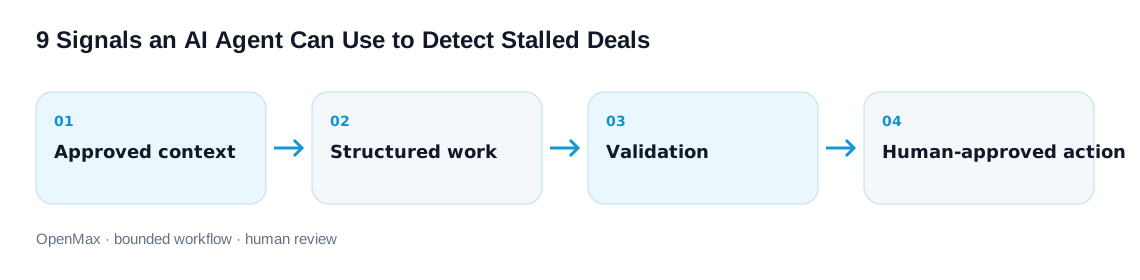
OpenMax can turn a reviewed instruction into an AI employee workflow with shared context, tool connections, task ownership, logs, and human review. The template defines the job; permissions and approval gates control what can happen next.
Limits and human-review boundaries
A stall signal or predictive score estimates a pattern in available data; it does not know buyer intent or authorize a commercial action.
- Never automatically close, downgrade, reassign, change amount/date/stage/forecast, or contact the buyer from a stall label alone.
- Do not treat missing email/calendar access, incomplete history, model delay, untracked channels or regional process differences as negative buyer behavior.
- Exclude or tightly control sensitive, private and irrelevant content; respect permissions, purpose, retention, legal holds, correction and deletion.
- Expose signal values, baselines, source records, counterevidence, missingness, model/rule version and owner. Provide a correction and override route.
- Validate on later time periods and real outcomes; monitor false positives, alert fatigue, subgroup effects, drift, overrides and downstream harm.
Frequently asked questions
How many days without activity means a deal is stalled?
There is no universal number. Use a stage- and motion-specific distribution, meaningful buyer activity, the accepted plan and known pauses. Publish the threshold and cohort, then test false positives on your outcomes.
Does one weak signal justify an alert?
Usually it should produce WATCH, not a stall conclusion. Require multiple reasonably independent signals or a high-severity contradiction, then show counterevidence and data quality to a human owner.
Can a predictive opportunity score replace these signals?
No. A score can help prioritize, but reviewers still need the influencing factors, data coverage, model age, cohort fit and source evidence. A low score is not the same as a stalled buying process.
What should the AI do after detecting risk?
Create one evidence-backed review with the smallest useful question or suggested internal action. It should not spam the seller, contact the buyer, alter the forecast or mark the deal lost without scoped authority.
How should teams measure detector quality?
Track precision, recall, useful lead time, calibration, false-positive burden, data-insufficient rate, owner acceptance, action usefulness, recovered deals, override reasons, subgroup performance and harmful downstream actions.
Sources, editorial method, and limitations
OpenMax editors reviewed current documentation for relationship activity and health, predictive opportunity scores and influencing factors, stage duration, forecast categories and recalculation, and AI risk management. We converted those mechanisms into nine original explainable signal contracts and separately added counterevidence, insufficient-data treatment, cohort baselines, multi-source reconciliation, human dispositions, time-based validation, overrides and drift monitoring. Sources were reviewed September 3, 2026. No customer detector accuracy, win rate, forecast, pipeline or revenue result is claimed.
- Microsoft Learn — Relationship analytics and KPIs — activity histories, previous/next activity, relationship health, close date and opportunity context.
- Microsoft Learn — Relationship analytics KPI calculations — included activities, weighting, contact frequency, health score and trend mechanics.
- Microsoft Learn — Predictive opportunity scoring — score trends, positive/negative factors, and stage-duration insight.
- Microsoft Learn — Move an opportunity through stages — stage progression, required information and current-stage importance.
- Microsoft Learn — View and manage forecasts — categories, underlying opportunities, recalculation, stalled pipeline and review context.
- NIST — AI Risk Management Framework — voluntary guidance for managing AI risks to individuals, organizations and society.