

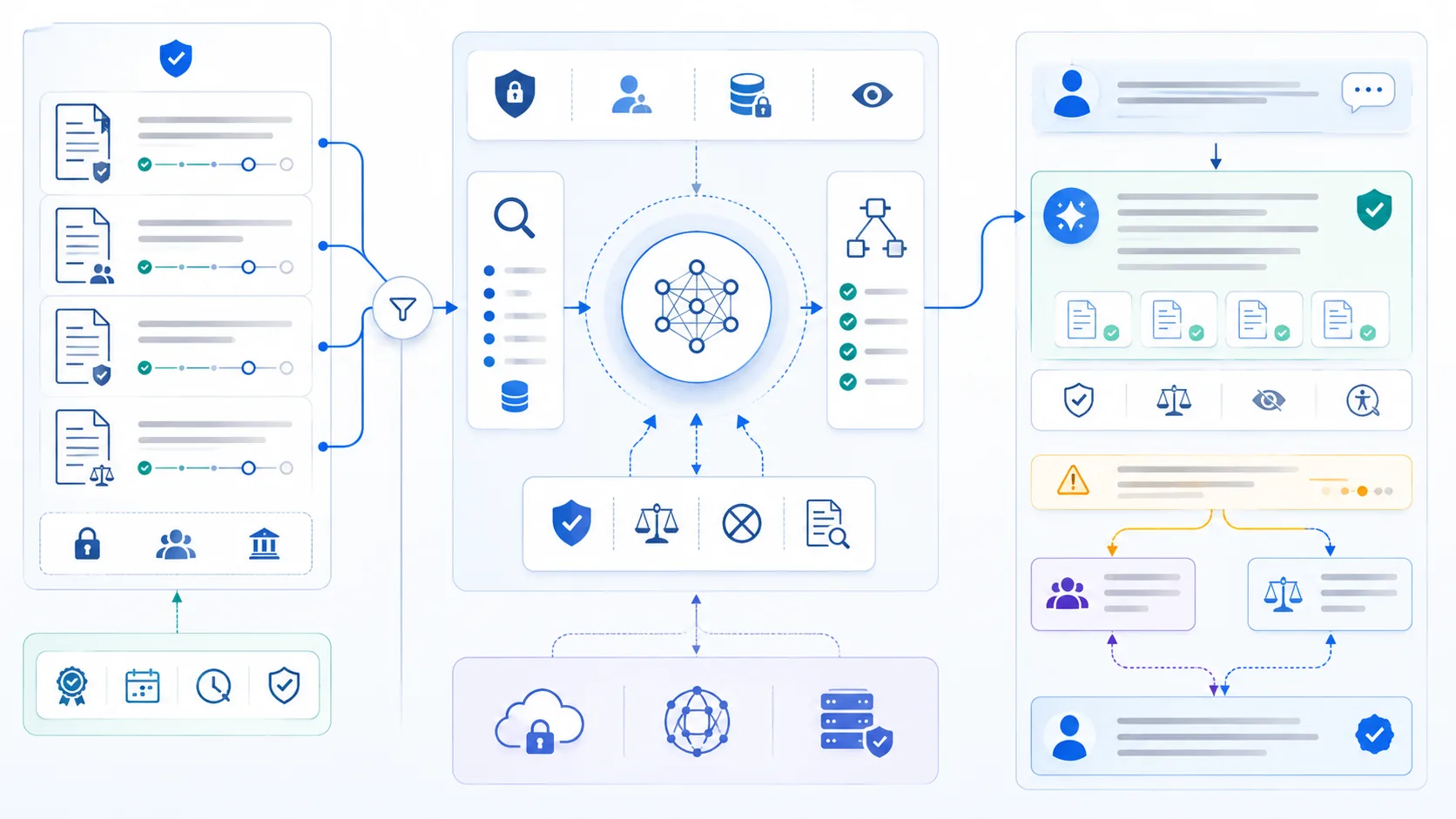
Quick answer
Build an employee policy AI assistant around eight controls: bind each question to the correct scope and effective version; retrieve only approved complete sources; cite the exact supporting passage and conditions; separate explanation from individual determination; minimize and restrict personal data; make accessibility, accommodation, and reporting routes usable; escalate risk and source conflict with context; and continuously test, correct, and retire unsafe behavior. If applicable text, facts, or authority are missing, the assistant should say so and route the question—not improvise.
Define the answer contract before connecting a model
Request envelope
Capture only what is necessary to resolve scope: policy topic, worker population, entity, location, language, accessible format, urgency, and chosen private channel. Avoid free-text sensitive facts when a secure route is required.
Evidence envelope
Return source owner, title, section, governing version, effective date, quoted or precisely mapped support, conditions, exceptions, conflicts, and access class. Keep retrieval confidence separate from answer certainty.
Decision boundary
List what the assistant may explain, what requires facts, what is restricted, who owns determination, which channel is available, response expectation, emergency route, and when no answer may be released.
Audit and correction
Record question class, selected sources, answer, model and index versions, access result, route, reviewer, user correction, final disposition, retention, and deletion without creating a hidden personnel profile.
Eight rules for a governed employee policy AI assistant
Copy these controls into the system specification and test plan. They are design requirements, not a substitute for qualified local policy, legal, security, accessibility, labor, and employee-relations review.
Bind every answer to scope and effective version
Resolve employee location, employing entity, worker population, policy family, effective date, collective agreement or local addendum, and access role before retrieval.
- Release evidence
- Answer header shows scope, governing version, effective date, source owner, and unresolved conflict.
- Do not do
- Never assume the newest file, global handbook, or similarly named policy applies to every employee.
Use only approved, complete source units
Ingest signed or owner-approved policy text with attachments, definitions, exceptions, forms, notices, translations, supersession links, and publication status. Quarantine drafts and fragments.
- Release evidence
- Every indexed unit has owner, approval, checksum, access class, version lineage, review date, and complete-context test.
- Do not do
- Do not answer from email snippets, slide summaries, obsolete FAQs, search-result text, or model memory when controlling text exists.
Cite the exact rule and preserve conditions
Return the smallest sufficient policy passage, section, source link, version, and date. State prerequisites, exceptions, approval steps, deadlines, and related notices in the answer—not only the headline rule.
- Release evidence
- Reviewer can open every citation and verify wording, negation, definitions, cross-references, and condition coverage.
- Do not do
- A citation badge is not enough if the answer changes certainty, drops an exception, merges sources, or cites a page that does not support the sentence.
Separate policy explanation from individual determination
The assistant may explain published rules and list required inputs. It must label questions that require eligibility, leave, pay, discipline, accommodation, investigation, benefits, immigration, tax, safety, union, or legal judgment.
- Release evidence
- Output uses explicit states: sourced explanation, missing facts, conflicting authority, restricted matter, or routed determination.
- Do not do
- Do not declare an employee eligible, ineligible, approved, denied, insubordinate, fraudulent, protected, or subject to discipline.
Protect privacy and enforce need-to-know access
Minimize question logs, separate identity from analytics, restrict sensitive policy and case material by role, encrypt and retain only as approved, and prevent answers from revealing another person’s data.
- Release evidence
- Data map, purpose, lawful basis, access decision, redaction, retention, deletion, export, incident, and audit evidence are testable.
- Do not do
- Do not request diagnoses, detailed medical facts, protected traits, complaint identities, salary records, immigration documents, or case files just to answer a general question.
Make access, accommodation, and reporting routes usable
Offer keyboard and screen-reader compatible interaction, plain language, approved translations, alternative channels, and a private route to request accommodation or report harassment, retaliation, safety, or wage concerns.
- Release evidence
- Tests cover relevant disabilities, languages, devices, reading levels, error recovery, urgent routes, and successful handoff—not merely interface conformance.
- Do not do
- Do not make the bot the only reporting channel, expose a complaint to a manager by default, or require medical detail in a public chat.
Escalate high-risk and conflicting questions with context
Define triggers for emergencies, imminent safety issues, harassment or retaliation, pay and leave disputes, accommodation requests, discipline, investigations, collective rights, source conflicts, missing versions, and low evidence.
- Release evidence
- Handoff includes the employee’s chosen channel, question, cited sources, scope, missing facts, urgency, privacy class, owner, response expectation, and confirmation.
- Do not do
- Do not generate a confident fallback, silently close the question, route everything to one inbox, or tell employees not to contact an agency, representative, or coworker.
Test, monitor, correct, and retire unsafe behavior
Before release and after every material policy, model, retrieval, translation, or routing change, test representative and adversarial questions across scopes. Sample live answers with privacy controls and publish correction ownership.
- Release evidence
- Track unsupported answers, wrong versions, dropped exceptions, access leaks, failed handoffs, language and accessibility errors, employee corrections, complaints, incidents, and recurrence.
- Do not do
- Accuracy on an easy test set, a high satisfaction score, a human approval click, or a vendor benchmark does not prove legal, fair, complete, or safe operation.
Use answer states that prevent false certainty
Sourced explanation
Applicable version is resolved, exact support covers the sentence, material conditions and exceptions are included, and no conflicting authority is open.
Missing facts or scope
Ask only approved non-sensitive clarification or show the choices that change the source. Do not guess identity, location, status, eligibility, or intent.
Conflict, restriction, or high risk
Withhold determination, identify the conflict or restriction at a safe level, preserve the employee’s channel choice, and route to the correct authorized role.
Confirmed handoff
The destination accepted the case, the employee received a reference and realistic response expectation, urgent alternatives remain visible, and failure is monitored.
Worked example: “Am I eligible for leave?” is not a yes-or-no retrieval task
This hypothetical example is not legal advice or a real employee case. An employee asks whether they qualify for medical leave. The global handbook contains a short leave summary, a local addendum has a different process, and the assistant does not know the employing entity, work location, hours or service facts, leave reason, applicable law, collective agreement, or whether the message itself signals an accommodation request.
Unsafe answer
“Yes, employees receive medical leave after the stated service period. Submit this form.” The assistant selects a global summary, invents applicability, collapses policy and law, ignores protected or sensitive handling, and makes an individual determination.
Controlled response
“I can explain the published leave process, but I cannot determine eligibility from the information available. The applicable source depends on employing entity and work location; medical details are not needed in this chat. Choose the private leave or accommodation route. It will carry the question, resolved scope, governing policy links, missing inputs, and response expectation to the authorized team. If the need is urgent, use the stated urgent channel.”
The controlled response gives useful process information without soliciting diagnosis, making a legal conclusion, or blocking access to a person. The handoff must still be tested end to end; a button click is not proof that the employee received help.
How OpenMax can coordinate policy Q&A
OpenMax can coordinate approved source ingestion, version and scope resolution, permission-aware retrieval, evidence-linked drafting, condition and exception checks, privacy redaction, accessible channels, risk triggers, human review queues, confirmed handoffs, corrections, source retirement, regression tests, and monitoring. Humans retain policy authorship, legal interpretation, labor and employee-relations judgment, accommodation and leave determinations, investigations, pay and discipline decisions, data governance, and final authority.
Legal, labor, privacy, and safety boundaries
- Qualified local legal, HR, labor, employee-relations, wage, leave, benefits, accommodation, safety, privacy, security, records, localization, and AI-governance owners must map every jurisdiction, worker population, entity, agreement, policy, channel, and vendor before use.
- Do not design policy or routing to deter protected complaints, concerted activity, agency contact, representation, accommodation, leave, wage or safety reports, or correction. Provide multiple understandable and accessible channels with anti-retaliation handling where required.
- Do not rely on an assistant instead of required notices, postings, direct communications, investigation, emergency response, or trained people. Some notices have coverage, placement, language, timing, content, and delivery requirements that a chatbot does not satisfy.
- Do not treat a source link, retrieval score, legal review, audit, employee satisfaction, answer acceptance, human click, or low complaint count as proof of correctness, legality, fairness, comprehension, non-retaliation, or successful resolution. Test actual outcomes and stop harmful use.
Sources, editorial method, and limitations
OpenMax editors reviewed current U.S. Equal Employment Opportunity Commission materials on prohibited practices, accommodations, harassment policy, accessible reporting, confidentiality, and retaliation; U.S. Department of Labor material on variable notice and compliance obligations; National Labor Relations Board material on protected concerted activity; and NIST AI RMF material on governance, documentation, testing, human roles, and impact. We independently synthesized the eight-rule control set, answer states, and hypothetical leave-routing example. Sources were rechecked September 3, 2026.
- U.S. EEOC — Employer anti-harassment policy checklist
- U.S. EEOC — Prohibited employment policies and practices
- U.S. Department of Labor — Workplace notices and variable coverage
- U.S. NLRB — Protected concerted activity
- NIST — AI RMF Core
Frequently asked questions
Can the assistant approve leave or accommodation?
It may explain applicable published process and collect only approved routing details. A qualified authorized person must make the individualized determination and communicate it through the approved channel.
Should every answer include a citation?
Every substantive policy statement should map to exact applicable support. Also show scope, version, date, conditions, exceptions, conflict, and whether a human determination is still required.
Can chat replace workplace notices or reporting channels?
Do not assume so. Required notices and channels may have specific coverage, placement, language, confidentiality, timing, investigation, or accessibility duties. Keep verified alternatives available.
What should happen when policies conflict?
Do not blend or choose silently. Name the conflict at a safe level, withhold the determination, preserve both sources and scopes, and route to the authorized policy or legal owner.
What can OpenMax automate?
OpenMax can coordinate source versions, scoped retrieval, citations, privacy controls, answer states, review, escalation, correction, testing, and monitoring while people retain policy and individual-decision authority.