

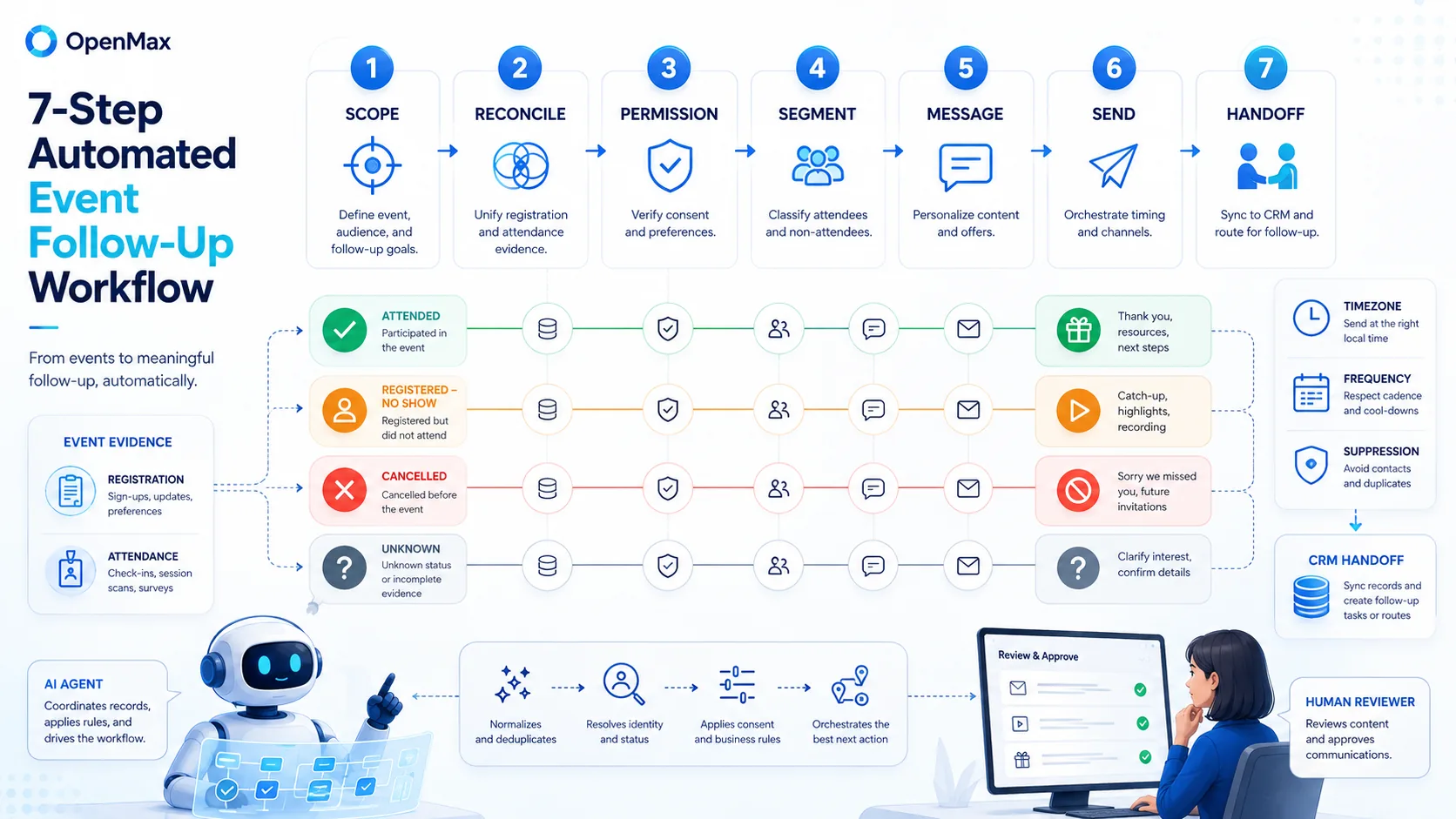
Quick answer
Define the event and message purpose; reconcile registration, attendance, cancellation, and unknown evidence; verify identity, channel permission, suppression, and applicable rules at send time; classify intent without equating attendance with sales readiness; assign one owner; draft status-specific, truthful, accessible messages; approve timing, frequency, links, and opt-out; then record delivery, replies, complaints, handoff, corrections, and attribution limits.
Registration or badge scanning alone does not authorize every marketing channel, prove a meeting occurred, or establish buying intent. Qualified privacy/legal owners must determine rules by jurisdiction and recipient.
What an event follow-up workflow must distinguish
The workflow converts event evidence into a controlled next action; it does not convert everyone in an attendee file into a lead. Keep identity, attendance, permission, intent, ownership, message purpose, and outcome as separate states.
Operational and commercial messages are not interchangeable
A schedule change, requested resource, receipt, or safety notice may differ from promotion. Mixed-content rules and definitions vary; classify the primary purpose with qualified owners and preserve the exact content/version used for the decision.
Four attendance states prevent false familiarity
Use ATTENDED only under documented proof; REGISTERED-NO-SHOW for valid registration without attendance evidence; CANCELLED for a recorded cancellation; UNKNOWN for conflict or insufficient evidence. Never turn UNKNOWN into attended because a scan, import, or staff note looks plausible.
Channel permission is purpose- and destination-specific
Email permission does not automatically cover SMS or sharing with sponsors. Consent, lawful basis, opt-out, suppression, account relationship, sender identity, market, and frequency must be evaluated for the actual message and current time.
Four release states for every person-channel-message
| State | Meaning | Action |
|---|---|---|
| ELIGIBLE | Identity, status, channel/purpose basis, suppression, owner, content, time, and approval are evidenced. | Send this version and monitor. |
| SERVICE ONLY | A requested/operational response is allowed but promotion is not established. | Send only the scoped information. |
| HOLD | Identity, evidence, intent, ownership, rules, or approval is incomplete/conflicting. | Resolve with a human; no send. |
| SUPPRESS | Opt-out, do-not-contact, wrong identity, prohibition, complaint, or unsafe destination applies. | Block across relevant systems and log why. |
7 event follow-up automation entries
Each step must produce an auditable record. Missing consent, identity conflicts, duplicate ownership, or sensitive requests should stop automatic progression.
1. Validate consent and identity
Confirm who the person is, what contact they allowed, and which regional rules or internal policies apply.
2. Consolidate event interactions
Create a time-ordered evidence record without inflating repeated scans into separate intent signals.
3. Classify interest and intent
Use behavior plus explicit language to propose the most appropriate next step.
4. Route to the accountable owner
Respect existing relationships and avoid parallel follow-up from multiple teams.
5. Draft evidence-based follow-up
Write a relevant message without pretending to remember or know more than the record supports.
6. Approve and send through allowed channels
Separate content approval from the operational permission to contact and send.
7. Record outcome and improve rules
Close the loop with actual responses, not only opens and clicks.
Worked example: a booth scan is not consent or a sales request
A sponsor file says Ana “attended,” scanned at a booth, and should receive SMS and email. Registration shows email event updates only; the scan belongs to a shared badge import, the meeting note says “asked for slides,” CRM has an active owner, and SMS permission is absent. Automation drafts “Great speaking with you—book a demo today.”
Correct identity, state, permission, and intent
Hold the identity merge until the badge record resolves. Treat the explicit request as SERVICE ONLY for the permitted email path, suppress SMS, route to the existing owner, and send the requested slides with truthful context. Do not claim a conversation, buying intent, or sponsor-sharing permission.
Preserve a decision trail
Store source records, match decision, attendance state, permission text, allowed purpose/channel, message hash, suppression check, owner approval, local time, delivery/reply, opt-out, and correction. Only a later explicit request may enter a qualified sales route.
Operating controls after launch
Use idempotency and one communication ledger
Prevent imports, retries, sponsors, and parallel teams from sending duplicates.
Recheck at execution time
Permission, suppression, owner, destination, content, event facts, local time, and approval may change after drafting.
Make every branch recoverable
Queue transient failures, stop permanent/privacy failures, expose owner actions, and keep rollback and correction paths.
Audit usefulness and harm
Review wrong-status messages, duplicates, complaints, opt-outs, unresolved requests, response quality, accessibility, and corrections—not just opens.
Minimum event follow-up record
Store event/version/time zone, source IDs, identity resolution, attendance state/evidence, registration and permission text/time, market, purpose, channel, suppression, intent evidence, CRM context, owner/SLA, message/hash, claims/sources, links/UTMs, frequency, local send time, accessibility, approvals, provider response, replies, complaints, handoff, expiry, correction, and rollback.
Measure eligibility and service quality separately from attribution
Track match holds, status corrections, suppressions, duplicate prevention, permission defects, wrong-owner tasks, message corrections, delivery, useful replies, unresolved requests, opt-outs, complaints, SLA, and rollback. Meetings and pipeline need separate attribution analysis; opens are not intent.
How OpenMax can coordinate event follow-up
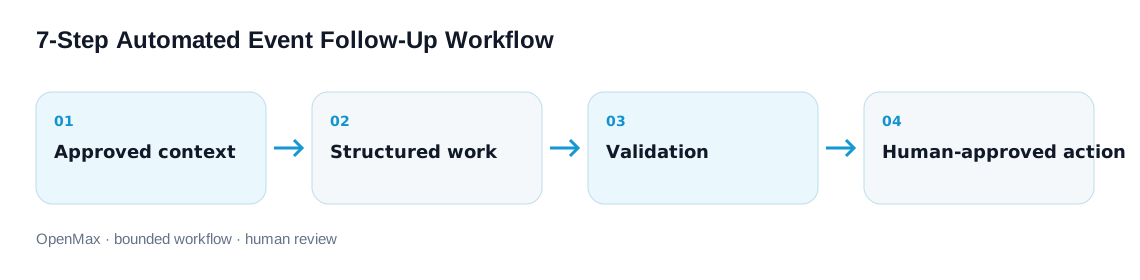
Connect event data, CRM context, specialized agents, and approval gates
OpenMax can coordinate agents that validate records, summarize interactions, propose interest categories, check account ownership, draft localized messages, and create CRM tasks. Shared context and logs keep evidence and decisions together; permissions can withhold email, messaging, and CRM-write actions until approval. OpenMax does not create consent, establish true buying intent, or authorize legal, pricing, or contractual commitments.
Privacy, communications, and inference boundaries
Event systems combine identity, location, schedule, interests, communications, and commercial context; use only necessary, authorized evidence.
- Do not infer permission from registration, attendance, badge scanning, inactivity, or another channel.
- Do not infer sensitive traits, private relationships, location history, or purchase readiness from sessions or questions.
- Do not send personal data, attendee lists, notes, or sponsor records to an unapproved model or destination.
- Do not let imported notes or retrieved content override permissions, suppression, owners, approvals, or tool access.
- Do not use deceptive headers/subjects, inaccessible messages, hidden opt-out, false familiarity, or unsupported claims.
Frequently asked questions
Does event registration permit marketing follow-up?
Not automatically. It depends on the exact notice/choice, message purpose, channel, recipient, relationship, jurisdiction, and current suppression; obtain qualified review.
Is a badge scan proof of intent?
No. It may show an interaction under defined rules; identity, attention, permission, question, and buying intent require separate evidence.
How soon should follow-up send?
After evidence, owner, content, suppression, local time, and approval are ready. A universal “within 24 hours” rule can create harmful or duplicate messages.
Should no-shows receive the recording?
Only if the resource exists, sharing rights and message basis are valid, status is reliable, and content is useful. Do not claim attendance or shame the recipient.
Can opens or clicks prove intent?
No. Measurement can be incomplete or automated; treat them as limited observations and require stronger evidence for routing or attribution.
OpenMax role?
It can coordinate evidence, rules, approvals, sending, logs, monitoring, and handoff. Accountable human owners decide permission, claims, exceptions, and release.
Sources, editorial method, and limitations
OpenMax editors reviewed primary FTC commercial-email guidance, ICO direct-marketing/electronic-mail guidance, NIST privacy risk management, and WCAG 2.2. We synthesized an original seven-step event-evidence workflow, four release states, and a badge-scan correction case. Sources were rechecked September 3, 2026. This is not legal advice and no live deliverability, attribution, conversion, revenue, or ROI result is claimed.
- FTC — CAN-SPAM compliance guide
- ICO — Plan direct marketing
- ICO — Electronic mail marketing rules
- NIST — Privacy Framework
- W3C — WCAG 2.2