

Quick answer
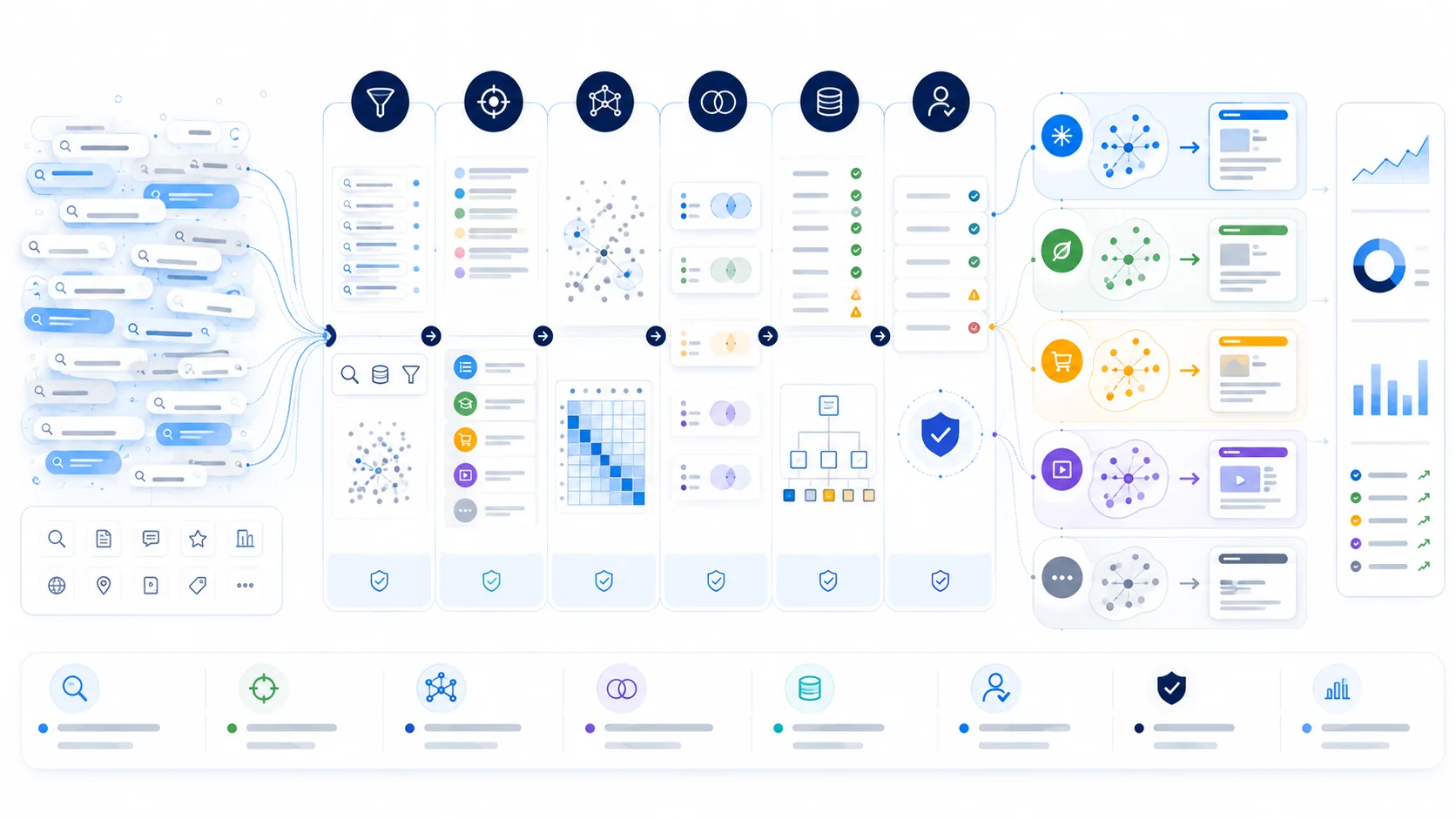
Cluster keywords with AI in six steps: define the market and page decision; assemble and normalize a provenance-rich query set; generate candidate groups using lexical, semantic, and behavioral signals; validate shared intent and result overlap; reconcile each cluster with the existing URL inventory; then assign a human-reviewed page action and measure it over time.
Semantic similarity alone is not enough. Two phrases can sound alike yet require different pages; different wording can belong on one page. The unit of clustering is the reader task and page that can satisfy it—not a color-coded group produced by an embedding model.
A keyword cluster is a page hypothesis, not a bag of similar phrases
A useful cluster proposes that one canonical page can satisfy a related set of queries for a declared market and time. It includes a primary reader task, sub-intents that fit the same journey, excluded meanings, the existing or proposed owner URL, supporting sections, and evidence for why consolidation is better than separate pages.
Similarity, intent, and page ownership answer different questions
Lexical and embedding similarity help find candidates. Search-result overlap, modifiers, result types, and first-party query-to-page data help test intent. The site inventory answers whether an existing page already owns the task. AI can assist all three, but should not collapse them into one unexplained score.
Missing query data is not zero demand
Search Console omits anonymized queries and may truncate rows; new sites have little first-party data; tools use different databases and estimates. Preserve source, date, market, device, aggregation and missingness. Do not invent volume for absent queries or treat a tool export as a complete picture of demand.
Five page dispositions for a reviewed cluster
| Disposition | When it fits | Required evidence | Action |
|---|---|---|---|
| SAME PAGE | Queries share the same reader task and can be answered coherently by one primary page. | Intent notes, result overlap, existing performance, compatible content format, and no material conflict. | Choose one owner URL and map variants to sections naturally. |
| SUBSECTION / FAQ | A query is narrower but supports the main task without deserving a separate page. | Distinct question, bounded answer, source support, and a logical place in the page. | Add a substantive H2/H3/FAQ; do not create a thin URL. |
| SEPARATE PAGE | Intent, audience, format, risk, product, geography, or decision stage materially differs. | Stable distinction, unique value and evidence, non-overlapping primary job, and internal-link plan. | Brief a new or retained URL with a clear boundary. |
| MERGE / REDIRECT | Existing pages duplicate the same task and one is the stronger representative. | Content/inbound link inventory, canonical and performance evidence, redirect impacts, and preservation plan. | Consolidate deliberately; update links, sitemap, hreflang, and monitoring. |
| HOLD / UNKNOWN | Evidence is sparse, mixed, volatile, privacy-sensitive, or contradictory. | Exact missing signals, uncertainty, next research action, owner, and review date. | Do not publish another page merely to fill the cluster. |
6 practical steps for AI-assisted keyword clustering
Each step includes the operation, evidence record, and acceptance condition. Copy the blocks into a runbook, then configure sources and thresholds for one declared market and site.
Define the market, inventory, and decision
Declare the site/property, country, language, device where relevant, search type, date window, business area, audience, and whether the task is new-page planning, updating, consolidation, internal linking, paid-search organization, or measurement. Freeze a URL inventory before grouping.
Assemble and normalize queries without erasing meaning
Combine permitted first-party queries, internal search, support language, paid-search terms, research interviews, Keyword Planner ideas, and manually observed variants. Normalize whitespace, Unicode, case where appropriate, punctuation and obvious duplicates while preserving the original string and source.
Generate candidate groups with multiple signals
Use AI to propose candidate neighbors from lexical tokens, entities, modifiers, topic taxonomy and semantic embeddings. Add first-party co-landing/co-click patterns where coverage supports them. Record model, prompt, thresholds and feature contributions; allow multi-membership before the page decision.
Validate shared intent and result overlap
For representative, high-value, ambiguous and boundary queries, compare the reader task, result types, dominant page formats, commercial versus informational balance, entity meaning, freshness/local intent, and overlap among top results using approved collection. Weight recent first-party query-to-page evidence when available.
Reconcile clusters with existing URLs and canonicals
Build a query-cluster-to-URL matrix using Search Console pages, canonical aggregation, crawl content, titles/H1s, internal links, conversions, backlinks where available, freshness and product ownership. Detect multiple pages receiving the same queries, one page spanning incompatible clusters, orphan topics, and proposed URL collisions.
Approve the map, publish carefully, and measure
Review cluster name, reader task, included and excluded queries, evidence sample, owner URL, page disposition, planned headings, internal links, content gap, confidence, risk, and expiry. Create briefs only for approved new/update actions; stage redirects or consolidations with a rollback and monitoring plan.
Worked example: similar phrases, two different page jobs
This hypothetical example illustrates a clustering decision. It is not current search-result, volume, ranking, traffic, or OpenMax performance data.
What the audit record should prove
Store the raw queries, source and period, normalized forms, candidate model/version, similarity evidence, representative result samples, intent notes, existing URL/canonical matrix, disposition, reviewer override, final mapping, changed pages, measurement window, and refresh trigger.
How to evaluate the clustering system
Label a review set before tuning
Sample common, rare, ambiguous, branded, local, multilingual, product, support and high-risk queries. Have two reviewers assign page dispositions and reasons; reconcile disagreement rather than hiding it in a score.
Measure candidates and decisions separately
Evaluate neighbor recall and precision for candidate generation, then page-assignment agreement, cluster purity, orphan rate, collision rate, review burden and harmful merge/split errors.
Use temporal and market holdouts
Test on later periods and separate languages/markets. Watch query vocabulary, result types, products, competitors and SERP composition change; do not tune and report on the same sample.
Monitor published outcomes cautiously
Track query-to-page concentration, clicks/impressions trends, task or conversion outcomes, crawl/index status, cannibalization, redirects and manual overrides. External changes and delayed data prevent simple causal claims.
How OpenMax can coordinate keyword clustering
Separate data preparation, research, mapping, and approval
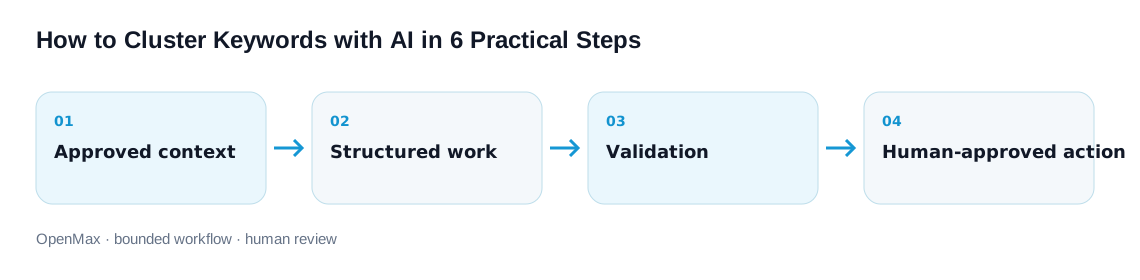
OpenMax can coordinate agents that clean exports, draft intent labels, collect allowed research, compare the content inventory, and prepare a page map for SEO review. Shared context and logs preserve why a query moved, while approval gates protect URL creation, redirects, and content consolidation. OpenMax does not provide ranking certainty or replace access to current search results and first-party performance data.
Limits and human-review boundaries
A cluster is a planning hypothesis based on incomplete, time-bound observations—not proof that a page will rank or convert.
- Do not fabricate search volume, omitted queries, result overlap, intent, traffic forecasts, or causal impact.
- Do not merge solely by embeddings or split solely by low overlap; preserve modifiers, language, entities, formats, audience, funnel stage, risk, and existing page purpose.
- Follow provider terms and privacy rules when collecting results or query data; minimize sensitive queries and never attempt to reconstruct anonymized user searches.
- Do not auto-delete, redirect, canonicalize, deindex, or publish pages from model output. Content owners and technical reviewers approve changes and rollback plans.
- Version data, models, thresholds, mappings, overrides and dates. Refresh when products, pages, query patterns, languages or search results materially change.
Frequently asked questions
What similarity threshold should I use?
There is no universal threshold. Tune candidate recall and review burden on a labeled set for one language and model, then validate actual page dispositions. A threshold proposes neighbors; it does not decide URLs.
How much search-result overlap means two keywords belong together?
No fixed percentage works across result depth, markets and volatile queries. Record the overlap method and use it with task, format, entities, first-party page evidence and existing content.
Should every cluster become a page?
No. It may map to an existing page, subsection, FAQ, redirect/consolidation, or HOLD. A cluster without distinct user value and sufficient evidence should not create a URL.
Can Search Console provide every query?
No. Anonymized queries are omitted and tables may be truncated; most performance is aggregated to canonical URLs. Preserve these limitations and supplement carefully rather than invent missing rows.
How often should clusters be refreshed?
Set time and event triggers: new products, migrations, language expansion, major result changes, rising query-to-page conflict, new support vocabulary, model changes, or performance shifts. Review high-change clusters more often.
Sources, editorial method, and limitations
OpenMax editors reviewed current first-party guidance for Search Console query/page analysis and limitations, Keyword Planner ideas, query grouping in Search Console Insights, canonicalization, and people-first page value. We transformed those mechanisms into an original six-step workflow with provenance-rich query rows, multi-signal candidate generation, intent/result validation, existing-URL reconciliation, explicit page dispositions, human overrides, and temporal monitoring. Sources were reviewed September 3, 2026. No search volume, ranking, traffic, conversion, or revenue result is claimed.
- Google Search Console Help — Performance report tasks — query/page filtering, regex, top queries/pages, and page effectiveness.
- Google Search Console Help — Dimensions and data groupings — anonymized queries, truncation, query dimensions, and canonical URL aggregation.
- Google Ads Help — Use Keyword Planner — discovery of keyword ideas from seed terms and websites.
- Google Search Console Help — Insights report — similar-query groups and their reported click/query behavior.
- Google Search Central — Canonicalization — representative URL selection for duplicate or highly similar pages.
- Google Search Central — People-first content — original, complete, audience-useful pages rather than search-engine-first scaled content.