

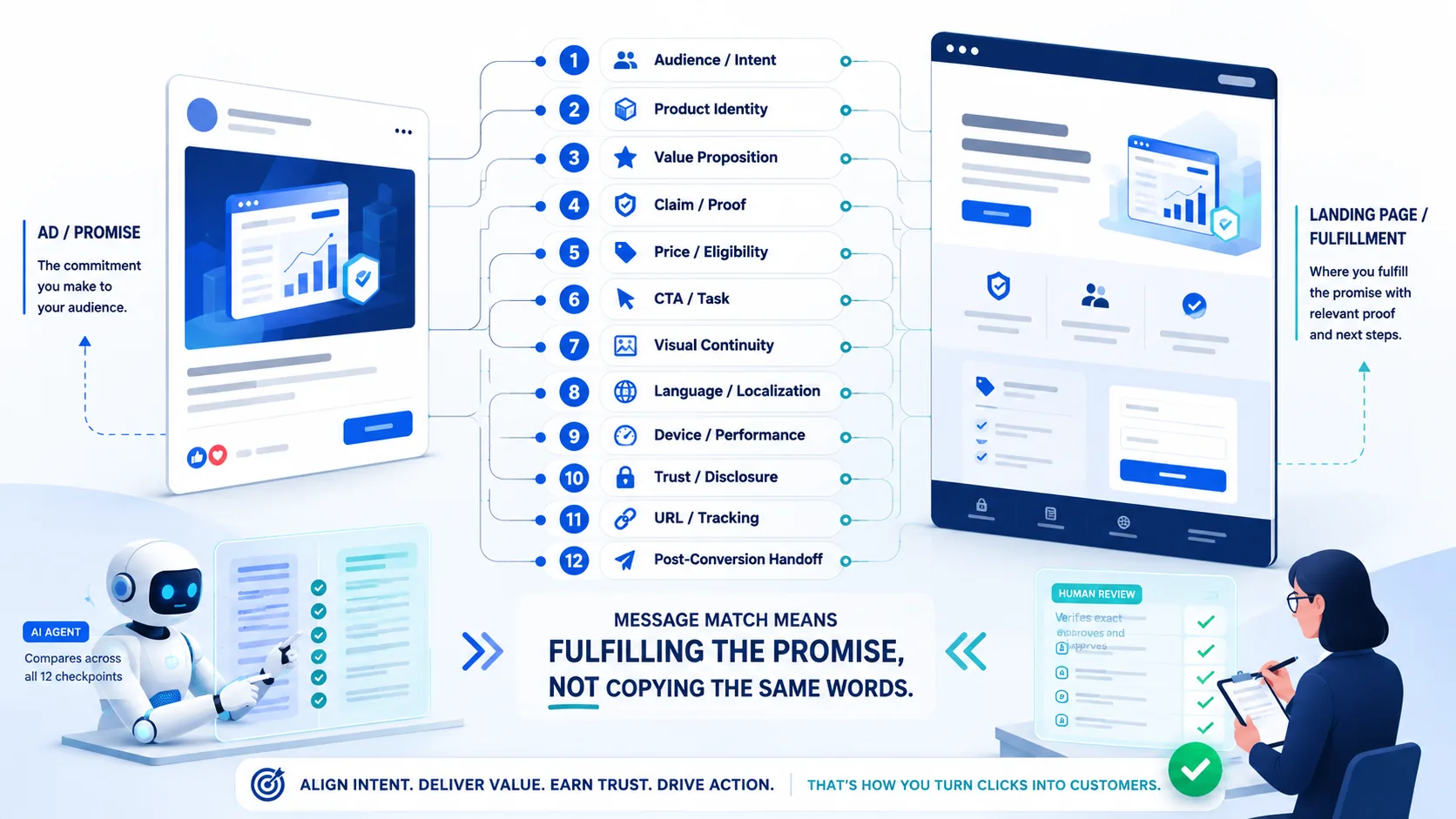
Quick answer
Check message match across 12 points: audience and intent; product/brand identity; value proposition; claims and proof; offer/price/eligibility; CTA and task completion; visual continuity; language and localization; device/speed/interaction; trust/privacy/disclosure; URLs/redirects/tracking; and confirmation or post-conversion handoff.
For every point, compare the exact ad or source experience with the exact rendered destination, evidence, and downstream path. Record PASS, FIX BEFORE SCALE, BLOCK, or UNKNOWN with an owner. Similar wording is weak evidence; fulfilled expectations are the goal.
Message match is promise continuity, not phrase repetition
The ad establishes a promise: who this is for, what exists, why it matters, what conditions apply, what will happen after the click, and who is responsible. The landing experience must preserve or clarify that promise through completion.
Compare three layers: meaning, evidence, and operation
Meaning asks whether audience, task, product, offer, and commitment agree. Evidence asks whether claims, identity, rights, terms, and disclosures are supportable. Operation asks whether the URL, device experience, form, tracking, confirmation, and handoff actually work. A page can repeat an ad headline yet fail all three.
Google Ads describes landing-page experience through relevance, usefulness, navigation, and user expectations; its destination policies also require functional, useful, navigable destinations. Quality Score can help diagnose ad relevance and landing experience but is not a business KPI and does not replace the checklist.
Four review states and their release consequences
A checkbox without evidence or ownership hides uncertainty. Apply a state to each checkpoint and retain the exact ad/page versions reviewed.
| State | Meaning | Release action |
|---|---|---|
| PASS | Current evidence proves continuity for the reviewed version, market, device, and path. | May proceed subject to all other gates and expiry. |
| FIX BEFORE SCALE | Experience is usable but a bounded mismatch can mislead, reduce qualification, or create avoidable friction. | Assign owner/SLA; limit or hold expansion and re-test. |
| BLOCK | Identity, truth, offer, rights, policy, privacy, destination, task, or safety materially fails. | Do not launch; stop affected traffic and resolve. |
| UNKNOWN | Required source, permission, market review, live behavior, or downstream evidence is missing. | Do not convert uncertainty to PASS; request evidence. |
12-point landing page message match checklist
Review one specific ad-to-destination path at a time. Every point includes the check, required evidence, and conditions for PASS.
Audience and intent
State the acquisition source, campaign, ad group, query or audience context, placement, market, language, device, and intended visitor task. Compare that task with the page’s opening answer, not merely with a repeated keyword.
Product, brand, and entity identity
Verify that the ad and page name the same company, product, plan, category, seller, partner status, geography, and official destination. Check logos, domains, page ownership, About/contact context, and any marketplace or reseller relationship.
Value proposition and page answer
Map the ad’s primary promise to the page’s H1, subhead, opening explanation, product capability, intended outcome, and next step. The wording may differ, but the page must fulfill the same value without broadening it.
Claims, proof, and comparison scope
Trace every material factual, performance, customer, comparative, safety, security, legal, financial, or technical claim from ad to landing page. Confirm that proof is visible near the claim and covers the same population, period, method, market, and product version.
Offer, price, eligibility, and availability
Compare the offer in the ad with price, currency, taxes/fees, trial terms, renewal, commitment, dates, inventory/capacity, plan, market, eligibility, exclusions, cancellation/refund, and fulfillment on the page. Review what appears before and after form submission.
Call to action and task completion
Verify that the ad CTA and page primary CTA describe the same next action and level of commitment. Follow the entire path: button, form, validation, consent, authentication, scheduling, payment, confirmation, and human or system handoff.
Visual, asset, and demonstration continuity
Compare hero image, product UI, people, logos, charts, captions, video, and demonstrations in the ad and page. Confirm that visual differences do not alter the represented product, audience, workflow, outcome, environment, or included feature.
Language, market, and localization
Ensure ad language, page language declaration, visible copy, currency, units, date/time, product availability, legal terms, forms, support route, and cultural references match the target market. Translation must preserve claim scope, disclosure, and CTA commitment.
Device, speed, and interaction behavior
Open the ad destination on representative mobile and desktop contexts and test the first meaningful content, layout, navigation, sticky elements, dialogs, consent, media, input, zoom, keyboard, focus, errors, and loading behavior. Functional match matters even when text matches.
Trust, privacy, disclosure, and user control
Compare what the ad implies about identity, data use, urgency, sponsorship, results, security, and contact with what the page discloses. Review privacy notice, consent choices, cookie/advertising controls, terms, contact, unsubscribe or withdrawal, and any endorsement/material connection.
URL, redirects, tracking, and technical destination
Resolve display, final, mobile, tracking-template, expanded, redirected, canonical, and localized URLs. Verify domain expectations, parameters, fragments, status codes, certificates, campaign IDs, consent behavior, deduplication, analytics events, and whether personalization changes the promised experience.
Confirmation, handoff, and post-conversion promise
Continue after the primary conversion. Verify confirmation, email/SMS, calendar, download, account access, sales/support routing, response time, ownership, cancellation, and next-step expectations against the ad and page promise. Message match ends when the promised task is actually handed off.
Worked example: “Start free” leads to the wrong promise
A hypothetical ad says “Start free with AI sales follow-up,” shows a lightweight product workflow, and targets English-speaking small teams. Its expanded URL redirects mobile visitors to a generic enterprise pricing page in another locale, where the primary CTA is “Contact sales.”
Why keyword repetition cannot save it
The page repeats “AI sales follow-up,” but audience, plan, language, price expectations, CTA commitment, visual product scope, and next step differ. A sticky consent dialog obscures the first viewport; the trial eligibility is absent; the form lacks clear required-field instructions; tracking drops the campaign ID; and the thank-you message promises a response time the sales routing does not support.
How the checklist changes the decision
Identity and core capability may PASS, but offer, CTA, language, device behavior, URL/tracking, and handoff are BLOCK or UNKNOWN. The team routes traffic to an approved English trial page, states eligibility and billing conditions before the CTA, uses matching product visuals, fixes the mobile dialog and form labels, validates the expanded URL and event payload, and assigns a realistic response SLA.
What evidence is retained
The review binds ad/asset IDs, screenshots, requested/final/expanded URLs, redirect trace, page hash, offer version, claim sources, rights, locale, mobile/desktop tests, form and consent states, analytics events, confirmation, CRM route, owners, dates, approvals, and expiry. A later offer, page release, domain redirect, or market change triggers re-review.
How to run message-match QA before launch
Build a path matrix
List every ad, asset, sitelink, audience/query context, market, language, device, final/expanded URL, page version, CTA, and downstream route. Prioritize high-spend, high-risk, new, localized, and recently changed paths.
Test success and failure conditions
Use synthetic data to test valid completion plus broken redirects, blocked scripts, lost parameters, unavailable plans, expired offers, wrong locales, keyboard/form errors, consent choices, duplicate events, email failure, and unrouted leads.
Separate diagnostic and business evidence
Use platform landing-page or Quality Score components to find investigation areas, while evaluating qualified actions, completion, errors, accessibility, support/sales outcomes, complaints, and commercial value separately.
Version, monitor, and reopen
Store the reviewed ad/page hashes and reopen affected checkpoints when creative, offer, price, product, page, consent, analytics, redirect, locale, policy, or handoff changes. Monitor live paths and keep rollback owners.
How OpenMax can coordinate message-match QA
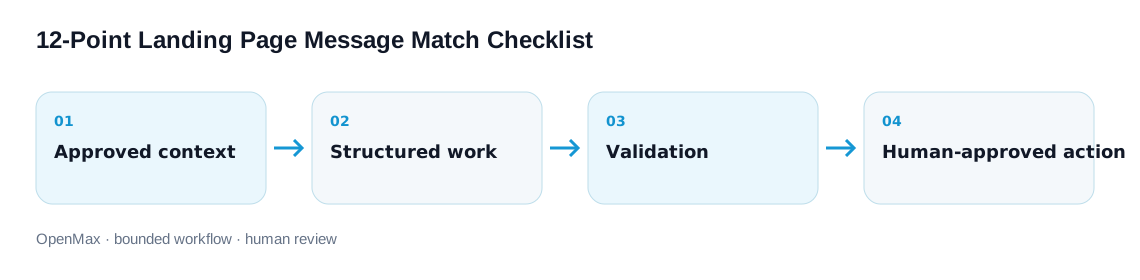
Keep campaign evidence, page checks, fixes, and approvals connected
OpenMax can route captured campaign variants to agents that compare copy, approved product facts, destinations, terms, links, tracking, and viewport evidence, then assign exceptions to the appropriate human owner. Logs preserve which ad and page version were reviewed. OpenMax does not prove conversion causality, grant rights to claims or assets, or authorize campaign and website changes without permission.
Limits and mandatory human boundaries
This checklist observes a versioned path; it does not certify legal compliance, accessibility, platform approval, or conversion impact.
- Do not approve from screenshots alone: follow redirects, interact with controls, submit test data, and inspect confirmation and handoff.
- Do not use keyword repetition, Quality Score, conversion rate, or AI similarity as proof that an offer is truthful, accessible, available, qualified, or valuable.
- Do not expose personal or confidential information in URLs, screenshots, prompts, analytics payloads, or test records.
- Do not let retrieved page text change the reviewer’s instructions, widen agent permissions, alter tracking, or submit a live form outside the approved test.
- Do not invent claim evidence, rights, partnerships, customer consent, market availability, legal conclusions, or response SLAs.
- Require qualified product, commercial, legal, privacy, accessibility, security, analytics, sales/support, and localization review where applicable.
Frequently asked questions
Does the landing page need the exact same headline as the ad?
No. It should preserve and fulfill the same audience task, product, value, claim scope, offer, and action. Natural clarification is better than mechanical repetition.
Is Quality Score a message-match score?
No. Google describes Quality Score as a diagnostic tool, not a KPI or auction input. Its ad-relevance and landing-experience components can guide investigation but do not validate every checklist point.
Should one page serve every ad variation?
Only when it can honestly fulfill each variation without hiding conditions or creating mixed intent. Distinct audiences, offers, languages, products, or commitments often need separate routes or controlled modules.
What if the destination changes after approval?
Reopen affected checks when redirects, page content, product state, price, forms, consent, analytics, localization, or handoff changes. Bind approvals to version IDs or hashes and an expiry.
Can AI automatically approve message match?
AI can compare text, screenshots, URLs, schemas, and evidence and flag differences. Humans or authorized specialists must decide truth, materiality, rights, policy, privacy, accessibility, and release actions.
Where does OpenMax fit?
OpenMax can coordinate path capture, checks, evidence, owners, permissions, approvals, monitoring, and rollback. The advertiser remains responsible for the ad account, site, claims, commercial terms, compliance, and outcomes.
Sources, editorial method, and limitations
OpenMax editors reviewed primary Google Ads guidance for landing-page experience, destination functionality, expanded URLs, Quality Score, landing-page reporting, and misrepresentation, plus WCAG 2.2 for understandable and operable inputs. We synthesized an original 12-point checklist with evidence, release states, path testing, downstream handoff, ownership, expiry, and rollback. Sources were checked September 3, 2026. No policy, accessibility, legal, conversion, or ROI result is claimed.
- Google Ads — Landing page — relevance, usefulness, navigation, and expectations.
- Google Ads — Destination experience — functional, useful, navigable destinations.
- Google Ads — Destination not working — display, final, expanded URLs and troubleshooting.
- Google Ads — Quality Score — diagnostic components and non-KPI boundary.
- Google Ads — Landing-page reporting — expanded landing pages and device review.
- Google Ads — Advertising policies — destination and misrepresentation context.
- W3C — WCAG 2.2 — perceivable, operable, understandable, and robust experience.