

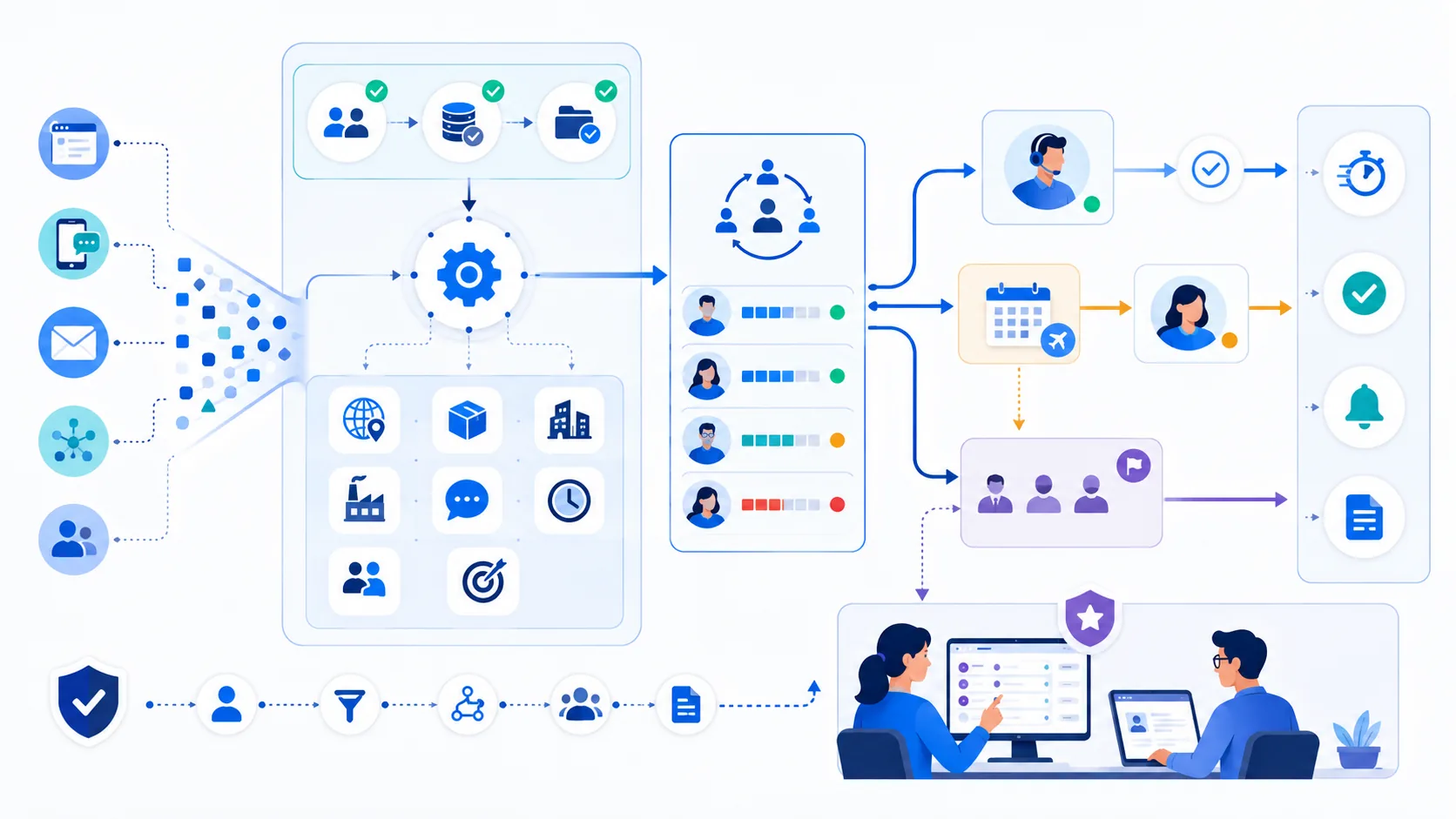
Quick answer

Start with the business decision, restrict the agent to approved territory table, account ownership, product interest, language, time zone, consent, seller capacity, and SLA, require a routing rule with priority, owner, fallback, SLA, reason code, and exception path, and name the person who approves consequential actions.

This guide is for: revenue, operations, marketing, support, and enablement teams that need repeatable work with visible ownership.

Lead routing is an ownership state machine, not a list of if-statements

A routing workflow begins when an eligible record becomes ready for sales and ends only when a valid owner accepts it—or the record enters a visible exception queue with a deadline. Assignment alone is not acknowledgement, and a notification alone is not ownership.

Separate eligibility, assignment, and response

First decide whether the record may enter sales routing: validate identity, minimum fields, consent and suppression state, duplicate risk, and lifecycle stage. Then choose a destination. Finally, track delivery, owner acceptance, first meaningful action, SLA status, requeue, and closure as separate timestamps.

Make precedence deterministic

Rules can conflict: an existing account may sit in one territory while asking about a product owned by another team. Publish a priority order and stop condition. Record every evaluated rule, not only the winner, so operations can explain why a lead moved and diagnose silent gaps.

A six-gate routing contract

Evaluate gates in order and define an explicit failure state
GateDecisionSafe failure
EligibilityIs the record valid, contactable for the intended purpose, and ready for sales?Quarantine, suppress, or request data correction
IdentityDoes it match an account, contact, open opportunity, or duplicate?Hold for match/merge review; never create parallel ownership
CoverageWhich named, territory, product, segment, industry, and language team qualifies?Route to a governed general pool with a reason
AvailabilityWhich qualified seller is scheduled, active, and below capacity?Use backup coverage or keep visibly unassigned
PriorityWhat verified source/intent tier and SLA apply?Default priority; never invent urgency from missing data
AcceptanceDid the owner acknowledge and perform a meaningful next step?Escalate, requeue idempotently, and preserve the trace
First-match transparencyVersion the ordered rule set and log all evaluated outcomes.
Capacity before fairnessRound robin is fair only among people who can actually take work.
No silent terminal stateUnmatched, duplicate, unavailable, and failed records stay visible.
15

15 lead routing rules with acceptance tests

Implement these as ordered, versioned contracts. Adapt the fields and precedence to your CRM; preserve the failure state and evidence.

01

Existing account owner

Preserve relationship context when the incoming person or domain resolves to one active account owner.

WHEN an eligible lead matches exactly one active account using approved identifiers [account ID, verified domain, normalized company, or confirmed contact relationship], THEN route to the current account owner if that owner is authorized, available within the account SLA, and not over the hard capacity limit. PRECEDENCE Run identity and duplicate checks first. This rule normally outranks geography, source, and round robin, but not an open-opportunity rule explicitly approved by Revenue Operations. Do not match consumer/free email domains to a company automatically. OUTPUT + TEST Write matched_account_id, match_method, match_confidence/state, previous owner, selected owner, rule version, and timestamp. Test exact, ambiguous, parent/subsidiary, inactive owner, and no-match cases. Ambiguous matches go to review; never steal or duplicate account ownership.
02

Open opportunity owner

Keep a new inquiry with the person already accountable for an active deal when the relationship is verified.

WHEN the matched account or contact has one qualifying open opportunity in [approved stages] and the inquiry is relevant to that opportunity, THEN assign to its active owner and attach the new context to the existing buying motion. CONFLICTS Define what happens with multiple opportunities, co-sell teams, stale stages, different business units, or restricted opportunity visibility. Never expose opportunity details to an unauthorized requester. A new product inquiry may require a specialist collaborator without changing the commercial owner. OUTPUT + TEST Record opportunity_id, stage, last verified activity, relationship evidence, selected owner, collaborator, and why other rules were skipped. Test one, many, stale, closed, inaccessible, and mismatched-product opportunities. If ownership is unresolved, hold for operations rather than guessing.
03

Named account rule

Honor an approved strategic-account map without embedding names in fragile workflow branches.

WHEN a normalized account identifier appears in the versioned named-account registry and its effective dates include the routing timestamp, THEN route to the designated owner/team and apply the documented named-account SLA. CONTROL The registry needs an owner, effective_from/to, territory, account hierarchy, backup, conflict resolver, and change history. Use stable account IDs where possible; a spreadsheet company name alone is not sufficient. Existing verified opportunity ownership may outrank the registry according to the published precedence table. OUTPUT + TEST Log registry version, matching key, effective date, designated owner, backup, and override reason. Test renamed companies, subsidiaries, acquired accounts, expired assignments, two registry entries, missing backup, and owner deactivation. Conflicts enter a named-account exception queue.
04

Geographic territory

Route by an authoritative business territory, not an unverified IP address or free-text country.

WHEN the eligible account has an approved routing geography [billing country, contracted service location, or verified headquarters] mapped to an active territory, THEN shortlist the territory team. Normalize country/region codes and make the governing field explicit. BOUNDARIES IP geolocation, browser locale, and phone country code are supporting clues, not identity. Define rules for remote employees, multinational accounts, parent-child ownership, disputed regions, and cross-border data restrictions. Existing ownership and named accounts usually take precedence. OUTPUT + TEST Return source geography, normalized value, source timestamp, territory table version, eligible team, and ambiguity reason. Test missing, conflicting, unsupported, newly created, and changed territories. Unknown geography goes to a time-bound global queue, not a random seller.
05

Product specialization

Match verified product interest to qualified coverage while keeping one accountable commercial owner.

WHEN the lead selects or demonstrates a specific product need using an approved event/field and that need maps to a current specialist roster, THEN add the qualified specialist team or choose the specialist as owner according to the account model. CONTROL Version the product taxonomy, distinguish explicit request from inferred interest, and define bundles, discontinued products, multiple products, and cross-sell. Do not let a single page view overwrite existing account or opportunity ownership. If a specialist is a collaborator, keep the primary owner visible. OUTPUT + TEST Record product code, evidence event, event time, taxonomy version, owner, collaborator, and SLA. Test one/many/unknown products, stale events, renamed SKUs, no specialist, and existing-account conflicts. Unsupported products enter the exception queue with customer-safe follow-up.
06

Company size segment

Use a documented segment definition and a confidence state rather than treating missing headcount as small business.

WHEN verified firmographic fields satisfy the current segment policy [employee band, revenue band, contract potential, or approved composite], THEN shortlist the corresponding coverage team. Store the exact policy version and which fields drove the result. DATA QUALITY Define source precedence, freshness, currency conversion, subsidiaries, conflicting providers, public-sector/nonprofit exceptions, and unknown values. Never fabricate a band. Missing or stale data should produce UNKNOWN or a general pool, not an automatic low-value classification. OUTPUT + TEST Return input values and dates, chosen band, confidence/state, eligible team, and unresolved conflicts. Test boundary values, conflicting sources, rapid growth, parent/child sizes, noncommercial organizations, and missing data. Audit segment changes for systematic service differences.
07

Industry specialization

Use a controlled industry taxonomy and route only when evidence is specific enough for specialist value.

WHEN the matched account has a current, approved industry code or a human-verified sector mapping, THEN shortlist sellers certified for that industry. Preserve both raw source and normalized taxonomy value. BOUNDARIES Define mixed businesses, parent/subsidiary differences, prohibited or regulated sectors, unknown categories, and taxonomy version changes. Website text classification can propose a category but should not silently determine regulated handling. Existing account/opportunity owners may retain ownership with a specialist added. OUTPUT + TEST Log source, source date, normalized code, confidence/state, specialist eligibility, owner/collaborator, and review requirement. Test multi-industry, low-confidence, newly added, regulated, excluded, and no-specialist records.
08

Language match

Match service language to a seller who can support it, using explicit preference over inferred locale.

WHEN the person explicitly selects a preferred business language or an existing verified profile contains one, THEN shortlist sellers/teams with a current approved language attribute at the required proficiency. CONTROL Define the source hierarchy, fallback languages, translation support, bilingual territories, and what happens when no qualified seller is available. Browser locale, name, nationality, and IP are not reliable substitutes for preference. Do not infer sensitive identity from language. OUTPUT + TEST Record requested language, evidence source/time, required proficiency, eligible sellers, chosen owner, translation fallback, and confirmation plan. Test unsupported, multiple, conflicting, missing, and changed preferences. Ask the customer when practical instead of guessing.
09

Time-zone coverage

Route to qualified coverage that can acknowledge within SLA, based on service location and published schedules.

WHEN the lead has a verified service time zone and a follow-up SLA, THEN shortlist qualified sellers who are working now or within the allowed window. Compute with IANA time-zone identifiers and the timestamp in UTC; account for daylight-saving transitions. CONTROL A seller being “next” in round robin does not mean available. Combine schedule, holidays, leave, presence policy, and capacity. Define after-hours regional pools and the maximum wait before fallback. Do not promise immediate contact when no staffed coverage exists. OUTPUT + TEST Log event UTC, service zone, local time, schedule version, next availability, chosen owner/queue, due_at, and fallback. Test weekends, holidays, DST gaps/folds, missing zone, overnight windows, and outages.
10

Lead source priority

Assign an SLA tier from a verified acquisition event without letting source bypass ownership, consent, or qualification.

WHEN source and campaign data are present in approved immutable fields, map them to a versioned service tier [for example, requested demo versus general content]. Keep original source separate from latest touch and from a model score. BOUNDARIES Source priority changes response timing, not truth or permission. Reject spoofed, malformed, self-reported, or overwritten attribution. Paid traffic is not automatically higher quality, and missing UTM data is not direct proof of a channel. Ownership, duplicate, suppression, and qualification checks remain earlier gates. OUTPUT + TEST Record original/latest source, evidence event, campaign identifiers, mapping version, SLA tier, and uncertainty. Test conflicting sources, redirects, offline imports, partner referrals, missing parameters, and bot/test submissions.
11

High-intent fast lane

Accelerate only from a verified action whose meaning and recency are defined.

WHEN an eligible person completes a high-intent event [approved demo request, pricing consultation, or product-qualified milestone] within its validity window, THEN apply the fast-lane SLA and alert qualified available coverage. CONTROL Document event identity, deduplication, bot/fraud checks, consent/purpose, recency, account context, and which events do not qualify. A page view, email open, or AI-inferred sentiment should not silently trigger high-touch outreach. Repeated submissions update one work item idempotently rather than creating races. OUTPUT + TEST Write event_id, type, occurred_at, verification state, validity window, priority, due_at, owner, and acknowledgement. Test replay, double-click, bot, stale, retracted, suppressed, existing-opportunity, and no-capacity cases.
12

Capacity-aware round robin

Distribute fairly only among qualified, available sellers with remaining capacity.

WHEN no continuity or specialist rule selects a single owner, build the eligible pool after role, territory, skill, schedule, leave, permission, and hard-capacity checks. Choose by [load balancing or least-recent assignment] with a documented tie-breaker. CONTROL Define capacity units, which active records consume them, reservation timing, concurrent assignments, manual assignments, and release conditions. Use an atomic reservation/idempotency key so simultaneous leads cannot overfill one seller. Round robin and load balancing answer different fairness questions; name the method. OUTPUT + TEST Log candidate set, exclusions, capacity before/after, last-assigned state, tie-break, selected owner, and transaction ID. Test concurrency, zero/negative capacity, equal ties, manual assignment, owner deactivation, and stale capacity.
13

Out-of-office fallback

Move work from an unavailable owner without losing relationship context or creating competing owners.

WHEN the selected owner is inactive, on approved leave, outside the SLA availability window, or fails acknowledgement by due_at, THEN invoke the owner-specific backup, team pool, or escalation manager in the documented order. CONTROL Define whether fallback transfers ownership or grants temporary coverage, who sees the full account context, when the original owner returns, and how active conversations avoid duplicate outreach. Calendar status alone may be stale; combine it with the approved availability source. Reassignment must be idempotent. OUTPUT + TEST Record original owner, unavailability reason/source, deadline, fallback chain, new owner/covering role, notifications, and restoration rule. Test planned leave, sudden deactivation, schedule mismatch, expired fallback, no backup, and repeated escalation jobs.
14

Duplicate and merge queue

Resolve identity before parallel sellers contact the same person or create conflicting CRM states.

WHEN approved matching rules flag a possible lead/contact/account duplicate, pause normal assignment and place the record in a restricted match/merge queue unless an exact safe match can attach the activity automatically. CONTROL Separate matching from merging. Define exact/fuzzy keys, confidence bands, cross-object matches, survivorship by field, consent/suppression precedence, owner conflict, activity reparenting, undo path, and who may merge. Never merge only on a shared company name or household email. OUTPUT + TEST Log candidate IDs, match features, confidence/state, current owners, sensitive conflicts, proposed survivor, field-level diff, reviewer, and decision. Test typos, aliases, recycled emails, parent/subsidiary, shared phones, conflicting consent, and false positives.
15

Unmatched lead exception

Guarantee that every eligible record without a deterministic destination remains visible and owned by a queue.

WHEN no routing rule yields exactly one valid owner—or the workflow errors, times out, lacks data, or produces multiple winners—create one exception item with reason code and due_at. Assign the exception queue itself to a named operations owner. CONTROL Reason codes should distinguish NO_MATCH, MULTIPLE_MATCH, MISSING_FIELD, NO_CAPACITY, NO_AVAILABILITY, OWNER_INACTIVE, DUPLICATE_REVIEW, SYSTEM_ERROR, and POLICY_BLOCK. Retry only transient failures with bounded backoff and the same idempotency key. Never default silently to an arbitrary user. OUTPUT + TEST Preserve the input snapshot, ruleset version, evaluation trace, candidates, failure, retries, queue, SLA, resolver, resolution, and rule change if needed. Alert on age and volume by reason. Test every reason code plus notification and queue outages.

Worked trace: a Friday demo request with competing rules

This hypothetical trace demonstrates precedence and recovery. It is not a customer incident or a claim about a specific CRM.

17:55 UTC — intakeA verified demo form arrives with consent for the requested follow-up, a corporate email, product code P2, and an account name. The event receives one immutable intake ID.
17:55 — identityExact domain plus account ID match an existing account and one open opportunity. A second newly created lead is flagged as a duplicate and held from assignment.
17:56 — continuityThe open-opportunity owner wins under the published precedence table. Product P2 requires a specialist collaborator, not a competing owner.
17:56 — availabilityThe owner is on approved leave and cannot meet the two-hour acknowledgement SLA. The account backup is active, authorized, and has capacity, so temporary coverage is assigned.
17:57 — deliveryThe backup receives the account context, inquiry, due time, and explicit covering-role status. A notification event alone does not close the SLA clock.
18:08 — acceptanceThe backup acknowledges the work. The trace stores rule-set version, evaluated rules, duplicate hold, owner/backup, product collaborator, capacity reservation, due_at, and acknowledgement.

Acceptance test

Only one accountable work item exists; the duplicate cannot trigger a second contact; the relationship owner remains visible; the qualified specialist is attached; the unavailable owner does not receive a doomed assignment; acknowledgement stops escalation; and an auditor can replay the decision from frozen inputs and the rule-set version.

Test the routing system before production

Build a decision table

List ordered rules, required fields, winners, stop conditions, fallbacks, and exception codes. Review every overlap pair.

Replay historical records in shadow mode

Compare proposed destinations with ownership context and inspect disagreements; do not rewrite live owners.

Exercise concurrency and failure

Submit duplicates simultaneously, remove capacity, expire schedules, delay notifications, retry jobs, and force CRM errors.

Measure the whole SLA

Track eligible_at, assigned_at, delivered_at, acknowledged_at, first_meaningful_action_at, requeue, and exception resolution.

How OpenMax supports this workflow
OpenMax workflow diagram for lead routing rules

From prompt to governed OpenMax workflow

OpenMax can turn a reviewed instruction into an AI employee workflow with shared context, tool connections, task ownership, logs, and human review. The template defines the job; permissions and approval gates control what can happen next.

Explore OpenMax →

Limits and human-review boundaries

Routing automates work ownership; it does not prove consent, intent, identity, entitlement, or sales quality.

  • Do not route from sensitive or unapproved proxy traits, or infer nationality and identity from language, name, or location clues.
  • Do not let priority, enrichment, or AI classification override verified account ownership, suppression, legal holds, or access controls.
  • Do not treat assignment or notification as a completed follow-up; measure acknowledgement and a defined meaningful action.
  • Do not silently discard unmatched, duplicate, over-capacity, unavailable, or failed records. Give every exception a queue, owner, reason, and deadline.
  • Test changes in a sandbox/shadow mode, version the rule order, use idempotent writes, preserve rollback, and review workload/service differences across relevant groups.

Frequently asked questions

What makes a good lead routing rules workflow?

A clear outcome, approved sources, explicit boundaries, a structured output, and a named review or escalation point.

Can the AI take action automatically?

Only if the action is explicitly permitted, technically constrained, logged, reversible where possible, and appropriate for the workflow risk.

How should teams test these entries?

Use a small labeled set containing normal, missing, conflicting, stale, and adversarial inputs. Record failures and revise the workflow, not just the wording.

Where does OpenMax fit?

OpenMax coordinates AI employees, shared context, connected tools, workflow ownership, and human review for repeated business work.

Are the examples guaranteed to improve results?

No. They are structured starting points. Results depend on models, source quality, tools, policy, evaluation, and reviewer judgment.

Sources, editorial method, and limitations

OpenMax editors reviewed current first-party CRM documentation for ordered assignment criteria, users and queues, owner rotation, overwrite behavior, duplicate matching, round robin, load balancing, schedules, and capacity. We converted those mechanisms into 15 vendor-neutral operational contracts and added eligibility, acknowledgement, idempotency, audit, and exception controls. Sources were reviewed September 3, 2026. No response-time improvement or customer result is claimed.

Scope note Each platform differs by edition, object, entitlement, queue semantics, order of execution, and release. Treat the rules as system requirements, not copy-paste vendor configuration. Verify the current product documentation and test exact behavior with your fields, permissions, concurrency, notifications, and failure modes.