


Quick answer
Start with the business decision, restrict the agent to approved objective, role boundaries, shared facts, task dependencies, tool permissions, and acceptance tests, require a coordination plan with role owners, handoff schema, completion evidence, unresolved questions, and human checkpoints, and name the person who approves consequential actions.
This guide is for: revenue, operations, marketing, support, and enablement teams that need repeatable work with visible ownership.
Use multiple agents only when the boundary is real
A multi-agent design earns its complexity when specialists need different instructions, tools, data access, evaluation criteria, or ownership. If one agent with clear tools can do the work safely, extra handoffs add latency, cost, context loss, and failure paths.
Manager and handoff patterns are different
In a manager pattern, one agent retains workflow and user-facing control while calling specialists as tools. In a handoff pattern, the active agent transfers control to another specialist. Choose based on ownership—not on how many agent names appear in a diagram.
A prompt does not enforce the graph
Applications must enforce enabled destinations, tool permissions, schema validation, authorization checks, context filtering, maximum turns, idempotency, logging, approval, and recovery outside natural-language instructions.
Eight fields in a reliable agent handoff
| Field | Purpose | Reject when |
|---|---|---|
| Task and decision | One bounded job and the decision it supports | Outcome or audience is ambiguous |
| Sender and receiver | Named current owner and enabled destination | Recipient is selected by untrusted content |
| Context | Minimum facts, evidence, state, and permissions | Secrets, unrelated history, or missing provenance appear |
| Input schema | Required fields, types, IDs, versions, timestamps | Payload is incomplete or invalid |
| Authority | Allowed tools/actions and explicit prohibitions | Transfer silently expands privilege |
| Output/acceptance | Artifact schema, evidence, tests, and quality threshold | “Done” cannot be independently checked |
| Stop/escalate | Conflict, risk, missing data, limits, human queue | No safe next owner or exit exists |
| Trace/recovery | Run/task/span IDs, status, retries, side effects, rollback | State cannot be reconciled or audited |
10 multi-agent prompts entries
Use each entry as a starting point. Replace bracketed context, attach approved evidence, and assign a reviewer before execution.
Planner to researcher handoff
Convert an approved plan into a bounded research contract with no hidden expansion.
Researcher to writer handoff
Transfer a source ledger and uncertainty—not just a confident summary.
Writer to reviewer handoff
Package a draft so review can reproduce every material decision.
Lead researcher and parallel scouts
Run parallel evidence gathering without duplicating work or combining incompatible conclusions.
Sales research to outreach
Keep account evidence, contact permission, and message approval separate across agents.
Support triage to specialist
Transfer a customer issue without losing identity, impact, attempted steps, or commitments.
Analyst to decision owner
Separate reproducible analysis from the accountable business decision.
Content localization handoff
Pass meaning, evidence, rights, and policy—not merely source text—to the locale team.
Exception escalation handoff
Stop normal automation and create a minimal, actionable exception packet.
Final quality gate
Validate the complete multi-agent trace before accepting or releasing the result.
Worked example: a refund handoff that cannot authorize itself
This hypothetical illustrates orchestration controls; it is not a customer result.
Acceptance test
The run passes only if the correct specialist receives a valid minimal payload, no privilege expands, missing fields cause rejection, duplicate retries do not duplicate action, and the human decision remains auditable.
How to implement and test it
Choose one business outcome
Do not combine research, judgment, writing, approval, and execution in one vague request. Name the decision this output supports.
Connect only approved context
Provide the minimum records needed, preserve source links and dates, and exclude data the workflow is not authorized to use.
Test with ordinary and edge cases
Check correct inputs, missing data, conflicts, prompt injection, stale records, and requests that should trigger escalation.
Review before expanding autonomy
Start read-only. Compare quality and exceptions, then grant narrowly scoped actions only when controls are proven.
How OpenMax supports this workflow
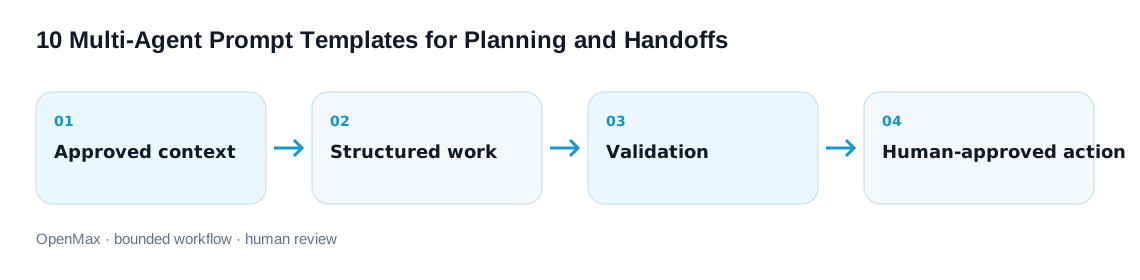
From prompt to governed OpenMax workflow
OpenMax can turn a reviewed instruction into an AI employee workflow with shared context, tool connections, task ownership, logs, and human review. The template defines the job; permissions and approval gates control what can happen next.
Limits and human-review boundaries
These examples are editorial templates, not independent performance tests or legal, privacy, employment, or security advice.
- Do not use the workflow for letting agents silently expand scope, overwrite shared state, delegate irreversible actions, or conceal uncertainty without an authorized reviewer and enforceable controls.
- Verify facts against the cited source system; model confidence is not evidence.
- Minimize personal and confidential data, retain source dates, and follow applicable consent and retention rules.
- Measure exception rate, correction rate, completion quality, and harmful side effects before scaling.
Frequently asked questions
What makes a good multi-agent prompts workflow?
A clear outcome, approved sources, explicit boundaries, a structured output, and a named review or escalation point.
Can the AI take action automatically?
Only if the action is explicitly permitted, technically constrained, logged, reversible where possible, and appropriate for the workflow risk.
How should teams test these entries?
Use a small labeled set containing normal, missing, conflicting, stale, and adversarial inputs. Record failures and revise the workflow, not just the wording.
Where does OpenMax fit?
OpenMax coordinates AI employees, shared context, connected tools, workflow ownership, and human review for repeated business work.
Are the examples guaranteed to improve results?
No. They are structured starting points. Results depend on models, source quality, tools, policy, evaluation, and reviewer judgment.
Sources, method, and limitations
OpenMax editors reviewed current first-party OpenAI guidance for agent architecture, manager/handoff orchestration, structured handoff inputs, tracing, sensitive trace data, and deterministic testing, then rewrote all 10 entries as distinct operational contracts. Sources were reviewed September 3, 2026. No benchmark, reliability percentage, cost saving, or customer outcome is claimed.
- OpenAI — A practical guide to building agents — manager and decentralized patterns, orchestration complexity, guardrails, and exit conditions.
- OpenAI Agents SDK — Agent orchestration — agents-as-tools, handoffs, and parallel execution patterns.
- OpenAI Agents SDK — Handoffs — destinations, descriptions, input schemas, filters, metadata, and authorization caveats.
- OpenAI Agents SDK — Tracing — traces/spans for agents, generations, tools, guardrails, and handoffs, including sensitive-data controls.
- OpenAI Agents SDK — Testing — deterministic testing of tools, handoffs, guardrails, retries, sessions, and orchestration.