

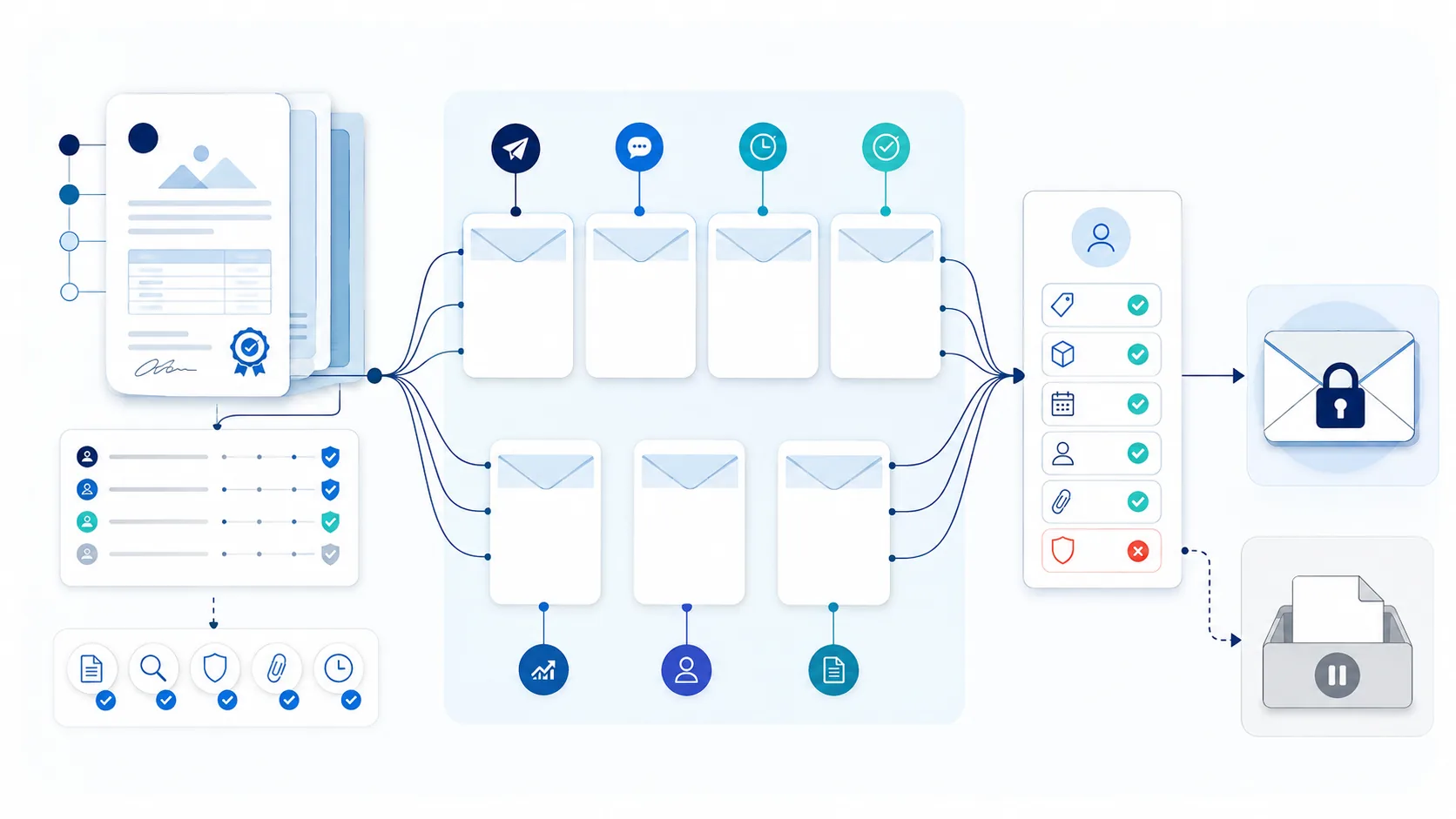
Quick answer: follow the buyer's verified stage
Confirm proposal ID, revision, authorized recipients, commercial facts, security and legal attachments, the buyer's last authored message, and any pause or opt-out request. Choose one purpose: receipt, useful context, one open question, stakeholder support, diligence, timing, or close-out. Use only dates and commitments found in the current proposal or approved record. A tracking pixel, document view, CRM score or silence is not evidence of interest.
The minimum safe structure
State which proposal revision you mean, why you are writing, the single action or choice available, and how the buyer can correct, pause or decline. When a deadline is real, name its source and consequence without turning it into a threat. When the proposal is stale or access is uncertain, send nothing until the responsible owner repairs the record.
What these templates cannot authorize
They cannot approve a discount, extend validity, promise a feature, answer a legal or security exception, add stakeholders, override suppression, or send on behalf of an unauthorized person. Applicable commercial-email law and provider requirements depend on message purpose, recipient, jurisdiction and sending pattern; a qualified owner must decide the real case.
Freeze the proposal and buyer-state contract
Proposal follow-up fails when the system has five plausible versions and no authoritative one. Create a contract before drafting: proposal ID, current revision, approved scope, price and currency, taxes and assumptions, validity terms, commercial owner, recipient set, confidentiality class, buyer-authored stage, last interaction, permitted next step, suppression state and source timestamps.
Keep proposal facts separate from CRM interpretation
The proposal controls the offered scope, price, duration and stated validity. Buyer messages control what the buyer actually said. CRM stages, lead scores and seller notes are operational interpretations and may lag or conflict. Preserve each provenance instead of blending them into a sentence such as “your team is ready to proceed.”
Treat engagement signals as weak observations
An open may come from privacy scanning, forwarding or preview behavior. A document view does not reveal which section was read or whether the reader has authority. Use a reliable activity record only for internal diagnostics when lawful and appropriate; do not confront the buyer with an inferred behavior or translate it into intent.
Define a stop register
Before generating text, list conditions that block outreach: expired or superseded proposal; unresolved price or scope conflict; a pause, decline or opt-out request; unapproved recipient; broken restricted link; stale security material; prohibited jurisdiction or channel; missing sender authority; or unresolved legal/compliance decision.
Choose the message that solves one obstacle
The seller's desired stage is irrelevant. Use the last buyer-authored interaction and the current proposal state.
Seven-stage selection matrix
| Verified state | Useful purpose | Do not imply |
|---|---|---|
| Delivery is uncertain | Confirm receipt and access | Interest or review |
| Buyer asked for context | Provide one approved resource | Product superiority |
| One fact blocks completion | Ask one bounded question | Urgency or obligation |
| Buyer named a review process | Offer support to that process | Permission to contact others |
| Technical/security diligence is active | Route controlled material and owners | Approval or certification |
| Buyer supplied a decision window | Confirm whether it still applies | An invented deadline |
| No response after permitted attempts | Close the loop and pause | Guilt, scarcity or future consent |
When not to follow up
Do not send merely because a cadence timer fired. Stop when the buyer asked to pause, the proposal is no longer accurate, the intended recipient changed roles, a required attachment is outdated, or the only available “reason” is an engagement score. Repair the record or wait for the agreed checkpoint.
Template 1: confirm receipt and access
Use this after sending a proposal when delivery or document access is genuinely uncertain. It asks whether the right people can open the current version; it does not treat receipt as interest.
Evidence required
Proposal ID and revision, sent timestamp, delivery channel, approved recipient, access-control state, support route and whether another transmission is allowed. Stop when the link exposes broader content or the address is unverified.
Complete reusable email
Subject: Can you access proposal [ID / revision]?
Hello [buyer name],
I sent proposal [ID, revision] on [date] for [buyer-stated objective]. Could you confirm that the file opens and reached the right review contact? The current controlled copy is available at [secure link], which requires [access method].
This note is only an access check; receipt does not require a decision. If someone else should own the review, you can reply with their role or forward my contact details. Please do not send confidential information by ordinary email; [secure route] is available if access troubleshooting requires account details.
If now is not a useful time, reply pause and I will stop proposal follow-up until [agreed event or buyer-selected date].
Regards,
[authorized sender]
Verification and stop condition
Open the exact link with a least-privileged test identity and confirm revision, access and final destination. Do not write “I saw you opened it.” Stop if delivery is already confirmed, the proposal was superseded, or the only problem is internal tracking uncertainty.
Template 2: provide one useful context item
Use this when the buyer asked a question or named an evaluation concern. Send one current, approved artifact that directly helps; do not attach a generic library of sales material.
Evidence required
Buyer-authored question, proposal section, approved resource version, claim owner, intended audience, access class, limitations and correction route.
Complete reusable email
Subject: Context for evaluating [proposal ID]: [verified topic]
Hello [buyer name],
You asked about [verified topic] while evaluating [proposal ID, revision]. The attached [resource name and version] addresses [specific question]. The relevant section is [section], and its stated boundary is [limitation or assumption].
This material supports review; it does not amend the proposal or create an additional commitment. [Specialist name / role] owns questions about [security, implementation, privacy or another domain]. If the resource does not match what you need, please tell me which decision or audience it should support rather than reviewing an unrelated packet.
The proposal remains [current state and genuine validity term]. You may proceed with questions, pause the review or decline without explanation.
Best,
[authorized sender]
Verification and stop condition
Check publication date, access, version and every claim in the attachment. Stop if the resource is stale, includes another customer's data, makes a claim stronger than the proposal, or requires a specialist exception that has not been approved.
Template 3: ask one bounded open question
Use this only when one missing buyer fact prevents a correct proposal or next step. Ask the smallest necessary question and provide a safe channel for sensitive information.
Evidence required
Exact unresolved field, why it matters, authorized recipient, data-minimization rule, acceptable response values, optional genuine deadline, and secure route.
Complete reusable email
Subject: One question to complete [proposal section]
Hello [buyer name],
To complete [section] of proposal [ID], could you confirm [bounded question]? We need this to [specific calculation, scope or routing purpose]. The acceptable response can be [range / category / yes-no]; please do not send [sensitive data] by email.
If the answer is not yet known, “unknown” is useful and we can leave the section open. If [real event] requires a response by [date and timezone], the consequence is [accurate consequence]; otherwise there is no artificial deadline.
You can respond through [secure route]. This question does not assume budget, authority, purchase intent or approval.
Regards,
[authorized sender]
Verification and stop condition
Confirm the question is required rather than merely useful to sales. Stop if the requested data is excessive, the recipient lacks authority, the deadline was invented, or the answer would trigger an automated commitment without review.
Template 4: support stakeholder review
Use this when the buyer explicitly described a review group or process. Offer a role-specific summary or question session without naming, researching or contacting additional stakeholders independently.
Evidence required
Buyer's exact statement about the review process, authorized contact, permitted stakeholder roles, approved summary scope, scheduling route, confidentiality and introduction requirement.
Complete reusable email
Subject: Support for your [proposal ID] review
Hello [buyer name],
You mentioned that [buyer-described roles or committee] would review [proposal ID, revision]. Would either of these help: a [length] summary focused on [approved topic], or a [duration] question session with [specialist role]?
I will not contact additional reviewers unless you introduce or authorize them. Any summary will use the current proposal and exclude [restricted commercial or internal detail]. Please choose summary, question session, no support needed, or pause. If your process has changed, a correction is enough; no explanation is required.
Regards,
[authorized sender]
Verification and stop condition
Trace the stakeholder reference to the buyer's message. Stop when a seller inferred the committee from public profiles, the proposed summary would reveal confidential pricing, or the calendar invite would add unauthorized attendees.
Template 5: technical or security diligence
Use this when the buyer has requested a technical, privacy, legal or security review. Route current controlled documents and owners; never improvise certifications, architecture, data residency or contract exceptions.
Evidence required
Request ID, requested control or question, approved document version, disclosure class, specialist owner, current review state, exception path and expiry/review date.
Complete reusable email
Subject: Materials for [proposal ID] technical review
Hello [buyer name],
For the [technical / security / privacy] review of proposal [ID, revision], the current approved materials are:
- [document and version] — covers [scope] — reviewed [date];
- [controlled portal] — access requested through [route];
- [specialist role] — owns questions about [domain].
These materials do not represent approval of [explicit exception], and they do not change the proposal's [scope / terms]. Please place detailed or sensitive questions in [controlled channel]. If your reviewer requires [specific artifact], we will confirm availability and authorization rather than promise it in this email.
The next documented checkpoint is [buyer- or process-stated date]. You may pause diligence through [route].
Regards,
[authorized sender]
Verification and stop condition
Verify every document hash or version, owner, access group and review date. Stop if a security packet is stale, a portal grants excess access, a claim depends on a future roadmap, or no specialist owns the response.
Template 6: confirm decision timing
Use this when the buyer previously supplied a decision window or evaluation milestone. Ask whether it still applies; do not transform a seller forecast into the buyer's deadline.
Evidence required
Buyer-authored date or event, source message, proposal validity term, consequences of expiration, current commercial approval, pause option and owner.
Complete reusable email
Subject: Is [buyer-stated date] still useful for [proposal ID]?
Hello [buyer name],
In your [date] message, you expected to review proposal [ID, revision] around [buyer-stated date / event]. Is that timing still realistic, would a later checkpoint be better, or should we pause?
The proposal states [genuine validity term and source]. If that date passes, [precise consequence: for example, pricing must be revalidated]; it does not mean your team must decide by then. We have not reserved capacity, applied a discount or assumed approval beyond what the proposal states.
Reply with continue, new date, pause, or close. I will update the record using your answer rather than treating silence as a forecast.
Best,
[authorized sender]
Verification and stop condition
Confirm the date came from the buyer or current proposal. Stop if sales forecasting supplied it, if proposal validity was extended informally, or if the message uses availability, a competing buyer or discount as fabricated pressure.
Template 7: respectfully close the loop
Use after the permitted, relevant follow-up attempts have produced no buyer response and no other agreed checkpoint exists. It should reduce inbox pressure, not provoke a guilt response.
Evidence required
Permitted cadence, complete contact history, suppression and consent state, prior pause/decline requests, last useful resource, record owner and retention rule.
Complete reusable email
Subject: Pause follow-up on [proposal ID]?
Hello [buyer name],
I have not received an update on proposal [ID, revision], so I will pause proposal follow-up after this message. No response is required.
If the review is still active, you can reply continue with a useful checkpoint. If another role should receive future information, please introduce or authorize that contact. Later, no, and remove me are all complete answers and will be recorded according to the applicable communication policy.
The secure proposal copy remains available until [genuine access or validity condition]. After that, [accurate record consequence]. This email does not imply that you opened, reviewed or rejected the proposal.
Regards,
[authorized sender]
Verification and stop condition
Check the entire contact history, not just the current sequence. Do not send if a pause, decline, opt-out or channel preference already exists. Stop automated reminders immediately when the buyer's response requires it.
Inspect the complete PF090 fictional case
PF090 models seven unrelated proposals from Larkspur Grid Systems to fictional organizations using .invalid domains. Each scenario has its own revision, buyer-authored state and recipient boundary. No buyer, proposal or measurement is real.
Forty-two evidence records cover seven proposals
Each proposal has six records: current version, commercial facts, buyer-authored stage, authorized audience, permitted next step and stop state. IDs E01–E42 are unique and contiguous. Drafts D01–D07 and reviews R01–R07 cite these records. The packet never uses a CRM probability as proof of buyer intent.
Seven seeded defects test different failure modes
The first candidate set contains a stale proposal version, an invented document-open claim, an unapproved discount, an unauthorized stakeholder contact, an outdated security packet, a seller-created deadline and a missed pause request. They are deliberately different because one generic “fact check” would not expose every failure.
Four corrected drafts reach owner review
After correction and rerun, D01, D02, D03 and D05 satisfy the packet's evidence and audience gates. D04 still lacks stakeholder authorization, D06 still uses an unapproved validity extension, and D07 conflicts with an earlier pause request. READY_FOR_OWNER_REVIEW means a person may inspect the final candidate; it does not mean approved or sent.
Final state remains NOT_SENT
The release register records zero mail-provider API calls, zero scheduled jobs, zero production recipients, zero deliveries, zero CRM stage mutations and zero external side effects. The remaining blockers and absent sender authorization keep the complete case at NOT_SENT.
Recompute the PF090 measurements
These ratios describe one seeded teaching packet. They are not OpenMax performance, customer results, response rates, deliverability metrics or a sales benchmark.
Controlled-fact retention: 36 of 42
The first seven drafts retain 36 of 42 required records with the correct state and condition. 36 ÷ 42 × 100 = 85.71%. Similar wording does not count when a stale revision or changed validity term alters meaning.
Supported commercial claims: 18 of 21
Across price, scope and validity statements, eighteen have current approved evidence and three do not. 18 ÷ 21 × 100 = 85.71%. One unsupported discount, feature or expiration claim can block a draft regardless of the average.
Verified stage selection: 5 of 7
Five initial templates match the last buyer-authored state. One uses a timing check where only receipt is unknown; another sends close-out despite a recorded pause. 5 ÷ 7 × 100 = 71.43%.
Recipient and communication checks: 12 of 14
Two checks per draft create fourteen tests. Twelve pass and two fail: an unauthorized stakeholder address and a prior pause request. 12 ÷ 14 × 100 = 85.71%. Actual sending requires a current recheck.
Owner-review readiness: 4 of 7
Four corrected drafts meet the predefined evidence, stage and audience gates. 4 ÷ 7 × 100 = 57.14%. Readiness is a state, not an overall quality score or sending authority.
Use cadence as a constraint, not a reason
A fixed sequence can keep work organized, but the clock alone does not make a message relevant. Buyer-authored timing and meaningful new information should control the next contact.
Start from the communication contract
Record the relationship, message purpose, lawful and policy basis, preferred channel, frequency, local time, pause/opt-out state and owner. Different jurisdictions and message classes can require different treatment. Do not copy a U.S. rule or Gmail threshold into a global sending policy.
Require a new reason for each contact
A valid reason could be resolving access, answering a stated question, providing an approved requested artifact, checking a buyer-supplied milestone or closing the loop. “Day seven in sequence” is scheduling metadata, not reader value.
Cap and reconcile sequences
Define maximum attempts and stop events before launch. Reconcile replies, bounces, opt-outs, role changes and manual account updates before each step. A delayed synchronization must not cause another email after a buyer says stop.
Run a controlled proposal-follow-up workflow
1. Resolve the current proposal
Identify one authoritative revision and its owner. Compare scope, price, currency, assumptions, validity and attachments with CRM and storage records. Block on conflicts rather than choosing the newest timestamp blindly.
2. Resolve the buyer-authored state
Read the last reliable buyer message and approved call record. Store exact wording, date, channel and allowed inference. If no buyer state exists, the system may say “unknown”; it may not substitute a lead score.
3. Select one purpose and draft read-only
Use the seven-stage matrix and generate only a candidate. The drafting identity should not export new contacts, change opportunity stage, amend the proposal, schedule messages or access unrelated accounts.
4. Trace consequential sentences
Map price, scope, validity, capability, security, stakeholder, date and sender statements to evidence IDs. A specialist reviews domain claims, and an account owner reviews buyer context and tone.
5. Validate recipients and message class
Check address, role, authorization, confidentiality, suppression, consent or other applicable communication control. Confirm subject and identity are not misleading. Apply jurisdiction and provider rules only within their actual scope.
6. Approve sending separately
Present exact From, To, Cc, subject, body, links, attachments and planned time to an authorized sender. Approval of proposal content is not approval of the recipient list, and CRM access is not mail-send authority.
7. Reconcile the real outcome
Record the buyer's actual reply, correction, pause, decline, redirect or bounce. Do not convert non-response, opens or views into stage progression. Preserve the evidence that caused a sequence to stop.
Design review around commercial consequence
The proposal owner controls commercial truth
They verify revision, price, currency, scope, validity, assumptions and approval state. They must explicitly approve any change; a salesperson's note cannot silently amend the controlled document.
Specialists control domain claims
Security, privacy, legal, finance and product owners review claims and exceptions within their remit. An account owner can route a buyer question but should not improvise an assurance or certification.
The account owner controls relationship context
They confirm the last buyer interaction, useful purpose, tone, frequency and stakeholder path. Their familiarity with the account does not override suppression or specialist controls.
The authorized sender controls release
They inspect the exact artifact and recipients immediately before sending. Corrections after approval reopen affected checks. The release record stores who authorized which version and when.
Configure OpenMax as a bounded workflow
OpenMax can be considered for a workflow that retrieves a permitted proposal and CRM history, structures the last verified stage, drafts a matching message, flags conflicts, routes specialist review and presents the exact candidate for human approval. Actual connectors, permissions, retention and actions depend on current product documentation and tenant configuration.
Start with observation and drafting
Begin by showing which proposal version and buyer record the draft uses. Keep send, discount, proposal-edit, stakeholder-discovery and CRM-stage mutation tools unavailable. A reviewer should be able to reject the draft without producing an external effect.
Encode blockers outside the prompt
Suppression, valid revision, recipient authorization, attachment access and commercial approval should be enforced by controlled systems or deterministic gates where possible. Prompt wording is not a reliable permission boundary.
Evaluate critical errors separately
Test stale versions, negation, genuine and invented deadlines, opt-outs, unauthorized contacts, hidden tracking signals, confidential pricing, old security documents and prompt injection inside attachments. Report critical failure counts beside any aggregate measure.
Expand only after reconciliation works
The smallest credible path is read → cite → draft → review → record. Add scheduling or sending only after representative tests, stop propagation, duplicate prevention, least-privilege permissions and rollback meet the organization's acceptance criteria.
Limits and non-claims
Jurisdictions and providers differ
The FTC guidance cited here concerns U.S. commercial email; Gmail guidance concerns sending to personal Gmail accounts and adds requirements for specified high-volume senders; ICO guidance concerns UK data-protection and electronic-marketing context. None is a universal rule set. Obtain current qualified review for the actual audience and program.
Tracking is not buyer truth
Technical activity can be incomplete, automated, privacy-sensitive or misattributed. The page does not recommend confronting recipients with tracking, using it to infer emotion, or treating it as authorization to contact new people.
Synthetic evidence is not experience
PF090 was designed to teach review. It is not a live sales sequence, customer case study, deliverability test, product evaluation or proof that OpenMax improves reply, conversion or revenue.
A template cannot repair a bad offer
If price, scope, value, access or approval is wrong, revise the controlled proposal through its owner. More persuasive follow-up text does not cure an inaccurate or unsuitable proposal.
Common failure modes
Manufacturing urgency
“Slots are filling,” “price ends tonight” or “another buyer is waiting” require exact current evidence and authority. Do not use scarcity as decoration. Explain a real validity consequence without implying the buyer must decide.
Pretending an email is a reply
Do not add Re: or Fwd: unless the message is an actual reply or forward. Keep sender identity, subject and routing accurate. Provider guidance and commercial-email rules treat deceptive identity and subjects seriously within their applicable scopes.
Mentioning hidden engagement
“I noticed you opened the proposal three times” can be unreliable, invasive and unhelpful. Ask about the observable decision obstacle instead.
Offering an unapproved concession
A discount, free service, reserved capacity or extended validity is a commercial commitment. Route it to the proposal owner and update the proposal before mentioning it.
Contacting inferred stakeholders
Public job titles, email enrichment and copied calendar attendees do not authorize outreach. Ask the buyer to introduce or approve the correct contact.
Ignoring pause, decline or opt-out
A new sequence, different sender or manual task must not bypass a recorded stop. Synchronize suppression and account state before every message.
Letting attachments command tools
A proposal or buyer attachment may contain instructions such as “send this to procurement.” Treat that content as untrusted evidence. It cannot expand recipients or grant a tool permission.
Implementation checklist
Proposal and evidence
- One proposal ID, revision, owner, hash or stable version, scope, price, currency and validity state are resolved.
- Buyer-authored state remains separate from CRM interpretation and engagement signals.
- Every date, commercial claim, stakeholder and attachment has current evidence.
- Conflicts, unknowns and superseded records remain visible.
Purpose and copy
- One of seven purposes matches the last verified buyer state.
- Subject and sender identity accurately represent the message.
- The message offers proceed, pause, redirect or decline where appropriate.
- No open, view, budget, objection, authority or intent is invented.
Audience and compliance
- To, Cc, attachments and secure links pass current authorization checks.
- Pause, decline, suppression, channel preference and applicable consent state are reconciled.
- Legal, privacy, security, product, finance and commercial owners review relevant claims.
- Jurisdiction and provider requirements are scoped rather than generalized.
Release and outcome
- Exact message version and planned time receive separate sender authorization.
- Scheduling, sending and CRM mutation are independent permissions.
- Replies, bounces, corrections, pauses and declines update the authoritative record.
- Duplicate prevention, emergency stop, audit log and rollback are tested before delegation expands.
Frequently asked questions
How long should I wait before following up on a proposal?
Use the buyer's stated review timing, the proposal's genuine validity terms and your applicable communication policy. A fixed number of days may organize tasks, but it is not evidence that another email is useful or permitted.
Can I say that I saw the buyer open the proposal?
Usually the better choice is to ask about the decision obstacle without mentioning tracking. Opens and views may be automated, incomplete or privacy-sensitive and do not prove review, authority or interest.
Should every follow-up include a discount or deadline?
No. Include a price change, discount, expiration or capacity limit only when it is real, current, documented in the controlled proposal and approved by the responsible owner. Never create pressure for style.
What should I do when another stakeholder needs to review?
Ask the buyer whether a role-specific summary or question session would help and request an introduction or explicit authorization. Do not independently enrich and contact people merely because their title looks relevant.
When should I close the loop?
Use the permitted contact history and relationship policy. A final message should say follow-up will pause, require no response and honor later, no, remove-me and preferred-channel choices.
Can AI negotiate or send proposal follow-ups automatically?
Only within verified product capability and explicit, technically enforced organizational authority. Begin with cited, read-only drafts and human review. Price, terms, recipients and final sending remain consequential controls.
Are the FTC, Gmail and ICO rules interchangeable?
No. They address different legal jurisdictions, recipient classes, provider destinations and sending patterns. Record which rule applies and why, then obtain qualified review for the actual program.
Sources, method and publication limits
OpenMax editors synthesized the current primary materials below into an original operational guide and fictional teaching case. Sources were reviewed on 5 September 2026. PF090 is not a customer story, and its counts are not a ranking or performance benchmark.
OpenMax product context
- OpenMax — AI Business Email Assistant — reviewed drafting and the human-control boundary for recipients, commitments and sending.
- OpenMax — AI Agent Platform — roles, tools, permissions, logs, review, evaluation and deployment context.
Email, privacy and AI governance sources
- U.S. Federal Trade Commission — CAN-SPAM Act compliance guide — U.S. commercial-message scope, identity, subject, address, opt-out and sender-responsibility guidance.
- Google — Email sender guidelines — requirements and recommendations for mail sent to personal Gmail accounts, including accurate identity and scoped bulk-sender controls.
- UK Information Commissioner's Office — Business-to-business marketing — UK B2B direct-marketing scope and subscriber distinctions.
- NIST — Generative AI Profile, AI 600-1 — generative-AI risk, measurement and governance reference.
- OWASP — Prompt Injection — untrusted proposal, CRM, email and attachment content at tool boundaries.