


Quick answer
A prospect-specific sales battle card is a short, source-linked decision aid for one active buying motion. Fill 12 fields: account scope, business problem, desired outcome, buying stage, buying group, decision criteria, current approach, real alternatives, approved proof, gaps and risks, evidence-safe objection responses, and the next action with owner and date.
Label every entry VERIFIED, REPORTED, HYPOTHESIS, UNKNOWN, or PROHIBITED. Link the source and observation date, record who may approve the claim, and expire stale facts. A battle card should help a seller ask better questions—not invent urgency, attack a competitor, expose confidential information, or send a message without review.
A battle card is a decision aid, not a competitor dossier
Generic cards usually collapse product marketing, anecdotes, old pricing, and a few objection scripts into one page. A prospect-specific card starts with the buyer’s actual decision and only includes alternatives that the buyer has named or that a qualified owner has deliberately introduced. Its job is to expose what is known, what remains unknown, and which claim can be used safely in this conversation.
Keep facts, interpretations, and recommendations separate
“The prospect requires EU data residency” can be a verified requirement linked to an approved security questionnaire. “The incumbent cannot meet it” is a separate competitor claim that needs current, comparable evidence. “Lead with our residency controls” is a recommendation that still needs product and account-owner approval. Mixing these sentences hides the weakest link.
Research only what the team is allowed to use
Prefer the prospect’s own statements, signed or approved records, official company publications, regulator filings, current product documentation, approved internal proof, and attributable public sources. Do not use leaked decks, private conversations outside their purpose, scraped personal data, unsupported reviews, invented usage, or confidential information carried from a former employer or another customer.
Five evidence states for every field
| State | Meaning | May a seller state it? | Required handling |
|---|---|---|---|
| VERIFIED | Supported by a current, attributable source suitable for this purpose. | Yes, within the exact scope and qualifications of the source. | Link source, observation date, excerpt or field, owner, and expiry. |
| REPORTED | Stated by the prospect or an authorized participant but not independently confirmed. | Attribute it: “You told us…”; do not convert it into an objective fact. | Record speaker, channel, date, scope, consent/permission, and confirmation need. |
| HYPOTHESIS | A reasoned possibility that can guide discovery. | Only as a question, never as a diagnosis or assertion. | Show reasoning, contrary evidence, sensitivity, and the question that would test it. |
| UNKNOWN | Relevant information is absent, conflicting, stale, or inaccessible. | No. | Name the missing evidence and owner; do not fill the gap with model inference. |
| PROHIBITED | Information or a claim is not permitted, reliable, relevant, or safe to use. | No. | Suppress from prompts and outputs; record policy reason and escalation route. |
12 fields for one prospect-specific sales battle card
Complete each field against the same opportunity cutoff. Copyable blocks include the field definition, evidence test, and acceptance condition so the output can be reviewed instead of merely read.
Prospect identity, opportunity, and scope
Name the legal account or business unit, opportunity ID, region, product/workload in scope, seller, stage, currency, preparation cutoff, and intended meeting or decision. Distinguish a parent company from the actual buyer and a new purchase from renewal or expansion.
Current business problem and use case
Describe the operational problem in the prospect’s language: affected team, current workflow, trigger, frequency, consequence, constraints, and why it matters now. Avoid generic industry pain pasted from a persona.
Desired outcome and success measure
Record the change the prospect wants, the metric or observable condition, baseline if known, target or range, measurement owner, time horizon, and what would count as failure. Do not invent an ROI percentage to make the case look complete.
Buying stage and next decision milestone
State the current buyer-verified stage, completed exit evidence, next decision milestone, expected date, dependencies, and stop/no-decision conditions. CRM stage alone may reflect seller process rather than buyer progress.
Buying group, roles, and authority
Map confirmed users, evaluators, champion, economic decision maker, procurement, legal, security, implementation owner, blocker, and absent roles relevant to this stage. Role and influence are not reliably inferred from a job title.
Decision criteria, priority, and proof needed
List each criterion in buyer language, priority or weight if actually supplied, minimum threshold, evidence expected, responsible evaluator, decision date, and unknowns. Include functional, security, legal, commercial, service, implementation, and governance needs where relevant.
Current approach and cost of staying with it
Describe the incumbent product, manual workflow, internal build, outsourced service, or no-decision path; include ownership, dependencies, switching constraints, observed friction, and any approved cost model. “Do nothing” is often the real alternative.
Named alternatives and competitive status
Record only alternatives the buyer named or a qualified owner intentionally included: product, internal build, service provider, incumbent, delay, or no decision. Add evaluation status and why it is in scope without claiming hidden buyer preference.
OpenMax fit and approved proof
Map only the OpenMax capabilities relevant to verified criteria. For each, attach the exact approved product document, security response, demo evidence, contractual language, reference policy, or authorized case proof—and note prerequisites and limitations.
Gaps, risks, and where OpenMax may not fit
List unmet, untested, conditional, or out-of-scope requirements; integration and migration dependencies; policy or data limits; adoption burden; commercial uncertainty; and implementation capacity. A credible card includes reasons not to proceed.
Likely objections and evidence-safe responses
Write the objection in the prospect’s words, identify whether it is confirmed or anticipated, explain the underlying criterion, provide a short approved response, and add one diagnostic question. Include what the seller must not claim.
Next action, owner, date, and refresh trigger
Specify one smallest useful action, responsible human, counterparty or internal dependency, expected result, due date/time zone, approval requirement, and deduplication key. Add a review date and events that invalidate the card.
Worked example: turn a competitor rumor into a safe question
This hypothetical example demonstrates evidence handling. It is not a statement about any real competitor, prospect, customer, or product.
What the audit record should prove
Store the opportunity cutoff, source URLs or record IDs, captured excerpts, evidence states, freshness, alternative versions, prompt/output version, policy checks, approver, approved wording, rejected claims, next action, and later corrections. Minimize personal or confidential content.
How to use the template without creating sales noise
Start from one meeting or decision
Declare the opportunity, audience, objective, cutoff, permitted sources, and action boundary. Do not create one giant account dossier that silently merges unrelated subsidiaries and old deals.
Retrieve evidence, then draft
Fetch bounded source packets for each field, classify evidence state, surface conflicts, and leave missing fields UNKNOWN. Generate language only after claims and permissions are visible.
Review high-risk claims
Route security, legal, privacy, price, discount, roadmap, performance, ROI, customer reference, and named competitor comparisons to their qualified owners before seller use.
Use, observe, and expire
Record whether the card helped discovery or a decision, capture corrections, and refresh after material changes. Track usefulness and correction burden—not only opens, copies, or generated cards.
How OpenMax supports this workflow
From prompt to governed OpenMax workflow
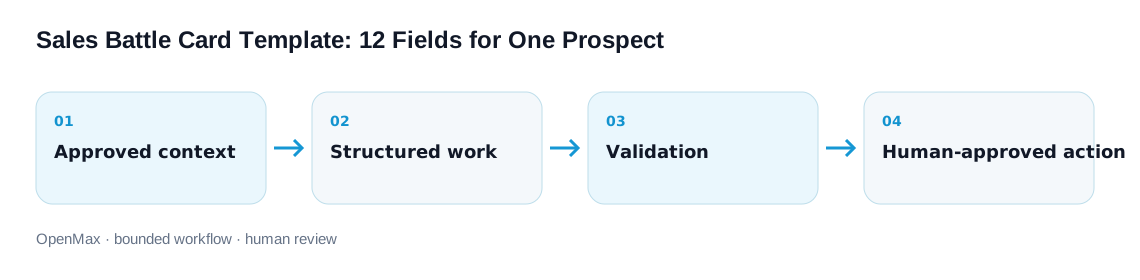
OpenMax can turn a reviewed instruction into an AI employee workflow with shared context, tool connections, task ownership, logs, and human review. The template defines the job; permissions and approval gates control what can happen next.
Limits and human-review boundaries
A battle card organizes evidence; it does not make a product, legal, security, pricing, or commercial decision.
- Never invent prospect pain, budget, authority, urgency, competitor usage, intent, win probability, or a customer result.
- Do not use confidential competitor material, scraped personal data, irrelevant sensitive attributes, restricted communications, or information without a lawful and permitted sales purpose.
- Comparative statements must use a clear comparison basis, current equivalent scope, accurate qualifications, and substantiation for both express and implied claims.
- Do not promise roadmap items, exceptions, discounts, contractual terms, security outcomes, implementation dates, ROI, or performance without the accountable owner’s approval.
- The AI may summarize, detect gaps, and propose questions. A human owns external wording, outreach, record changes, escalation, and any decision to proceed or withdraw.
Frequently asked questions
Should every opportunity have all 12 fields completed?
No. UNKNOWN is an honest and useful state. Complete fields relevant to the next decision and risk; do not conduct excessive research or invent content just to fill a template.
Can the card name a competitor?
Yes, when the alternative is genuinely in scope and comparisons are truthful, current, clearly based, and substantiated. Use official documentation where possible and show edition, region, configuration, capture date, and limitations.
Can AI infer what the prospect cares about?
It may produce a labeled hypothesis for discovery when policy allows, but it cannot turn industry stereotypes, job titles, browsing signals, or missing data into facts. Ask and verify.
How often should the card be refreshed?
Set a review date and event triggers: a new stakeholder, changed criterion, stage move, revised quote, security answer, product release, competitor update, source expiry, or correction. High-change fields may need shorter lifetimes.
How should quality be measured?
Track verified-field coverage, unknowns resolved, citation validity, stale or rejected claims, reviewer correction burden, time to a useful question, meeting usefulness, policy incidents, and downstream decision quality. Do not equate card volume with sales impact.
Sources, editorial method, and limitations
OpenMax editors reviewed primary guidance on comparative-claim clarity and substantiation, public-company research, opportunity record structure, sales playbooks, and AI risk documentation. We converted those principles into an original 12-field prospect card with evidence labels, field-level acceptance tests, explicit no-fit reporting, claim approval, expiry, and correction routes. Sources were reviewed September 3, 2026. Product and competitor information changes; always verify the precise current scope. No customer win rate, revenue, conversion, or productivity result is claimed.
- U.S. Federal Trade Commission — Statement of Policy Regarding Comparative Advertising — comparisons should identify the basis clearly and remain truthful and non-deceptive.
- U.S. Federal Trade Commission — Advertising Substantiation Policy Statement — objective express and implied claims need an appropriate reasonable basis before dissemination.
- U.S. Securities and Exchange Commission — Search Filings — free public access to issuer filings and full-text EDGAR research for attributable company context.
- Salesforce Help — Opportunities — opportunity records and the sales information used to manage a live buying motion.
- HubSpot Knowledge Base — Use playbooks — guided content, questions, notes, and record updates within seller workflows.
- NIST AI Resource Center — AI RMF resources for documentation, testing, evaluation, verification, and validation.