

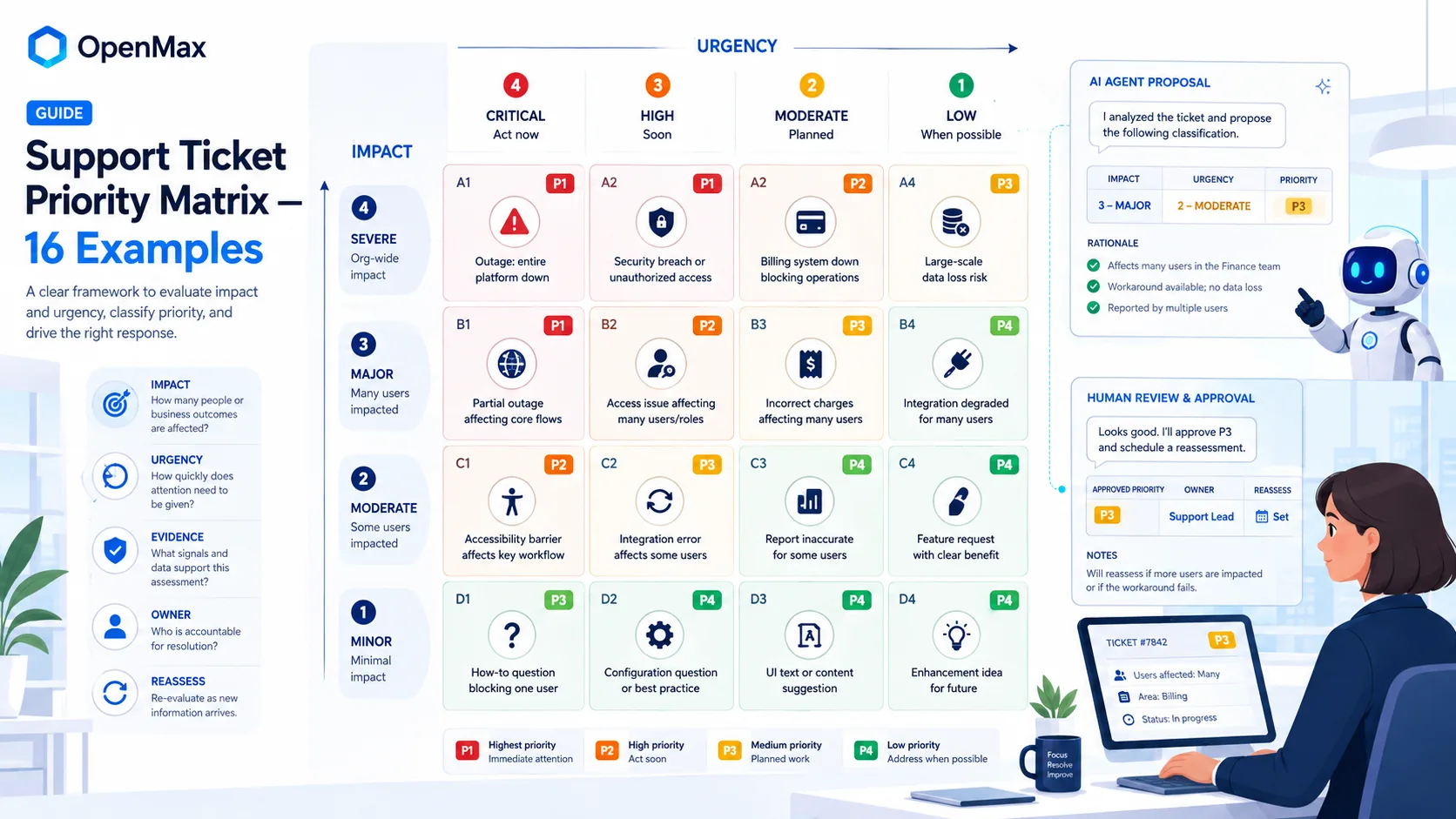
Quick answer

Score impact from 1 (minimal) to 4 (severe) using affected people, workflows, data, scope, reversibility, and business consequences. Score urgency from 1 (when possible) to 4 (act now) using the time until impact worsens, deadline, workaround endurance, containment, and recovery opportunity. Use the 4×4 matrix for an initial P1–P4, then apply documented safety, security, privacy, fraud, data-loss, legal/regulatory, accessibility, and contractual overrides. Assign an owner and reassessment time; update priority whenever evidence changes.

These labels are examples, not universal SLA promises. Organizations must define response objectives, incident criteria, authority, and escalation for their own risk, services, contracts, and capacity.

Priority, severity, impact, and urgency are different

Severity describes the condition or consequence. Impact estimates scope and harm. Urgency estimates how quickly response must change the outcome. Priority is the organization’s queued response decision after capacity, dependencies, and overrides. SLA is a separate service commitment, if one exists.

Impact must include more than user count

Consider criticality of the blocked workflow, data integrity/confidentiality/availability, safety, accessibility, financial or contractual consequence, affected markets/accounts, reversibility, workaround cost, and potential spread. One person can have high urgency; many users can have low urgency when no current defect exists.

Urgency is time-to-harm, not message tone

Use verified deadline, rate of deterioration, containment window, workaround endurance, recovery lead time, and whether delay makes evidence or restoration harder. All-caps language, executive status, customer tier, ticket age, and repeated contact are signals to inspect—not automatic urgency.

Overrides and incident declaration sit above the matrix

Active safety/security/fraud, suspected privacy breach, destructive data loss, regulatory reporting, accessibility exclusion, credible threat, or contractual trigger can require a specialist path regardless of the numeric cell. The receiving owner validates scope and can elevate, contain, or reclassify.

The 4×4 priority matrix

Initial priority from evidenced impact × urgency
Impact ↓ / Urgency →4 Act now3 Soon2 Planned1 When possible
4 SevereP1P1P2P3
3 MajorP1P2P3P4
2 ModerateP2P3P4P4
1 MinimalP3P4P4P4

A cell is provisional. Record confidence and missing facts, apply override rules, assign an accountable owner, and schedule reassessment. P1 can activate incident command when organizational criteria are met; P4 still needs ownership and closure.

16

16 worked ticket-priority examples

Each card represents one matrix cell. Replace scenario facts with verified local evidence; never copy its priority without recalculation.

01 · I4/U4/P1

Core service unavailable across organizations

Verified reports show the primary service unavailable across organizations and regions, with no safe workaround and impact increasing now.

IMPACT 4/4 — Verified reports show the primary service unavailable across organizations and regions, with no safe workaround and impact increasing now. URGENCY 4/4 — time-to-harm and workaround endurance are evidenced for this scenario INITIAL PRIORITY P1; provisional until override and owner review. EVIDENCE Ticket/source IDs; affected people/accounts/regions; exact task/error; start/last-good time; reproduction or telemetry; deadline; data/safety/security/accessibility flags; workaround and cost; recent changes; confidence; missing facts. ACTION Assign the service owner; apply specialist overrides; acknowledge and update under the organization’s P1 objective without inventing a resolution time. REASSESS Recalculate on new scope, deadline, workaround, telemetry, customer evidence, containment, or recovery state.
02 · I4/U3/P1

Organization-wide login failure with a fragile workaround

A tenant cannot authenticate; a temporary administrator-assisted path exists but capacity and security make it unsustainable within hours.

IMPACT 4/4 — A tenant cannot authenticate; a temporary administrator-assisted path exists but capacity and security make it unsustainable within hours. URGENCY 3/4 — time-to-harm and workaround endurance are evidenced for this scenario INITIAL PRIORITY P1; provisional until override and owner review. EVIDENCE Ticket/source IDs; affected people/accounts/regions; exact task/error; start/last-good time; reproduction or telemetry; deadline; data/safety/security/accessibility flags; workaround and cost; recent changes; confidence; missing facts. ACTION Assign the service owner; apply specialist overrides; acknowledge and update under the organization’s P1 objective without inventing a resolution time. REASSESS Recalculate on new scope, deadline, workaround, telemetry, customer evidence, containment, or recovery state.
03 · I4/U2/P2

Critical integration change blocked before next week

A broadly used integration cannot complete a required change; production still runs, evidence shows a fixed deadline next week, and a tested rollback exists.

IMPACT 4/4 — A broadly used integration cannot complete a required change; production still runs, evidence shows a fixed deadline next week, and a tested rollback exists. URGENCY 2/4 — time-to-harm and workaround endurance are evidenced for this scenario INITIAL PRIORITY P2; provisional until override and owner review. EVIDENCE Ticket/source IDs; affected people/accounts/regions; exact task/error; start/last-good time; reproduction or telemetry; deadline; data/safety/security/accessibility flags; workaround and cost; recent changes; confidence; missing facts. ACTION Assign the service owner; apply specialist overrides; acknowledge and update under the organization’s P2 objective without inventing a resolution time. REASSESS Recalculate on new scope, deadline, workaround, telemetry, customer evidence, containment, or recovery state.
04 · I4/U1/P3

Large migration validation needed next month

A future migration may affect most users, but no current defect exists; decision evidence is due next month and a reversible test environment is available.

IMPACT 4/4 — A future migration may affect most users, but no current defect exists; decision evidence is due next month and a reversible test environment is available. URGENCY 1/4 — time-to-harm and workaround endurance are evidenced for this scenario INITIAL PRIORITY P3; provisional until override and owner review. EVIDENCE Ticket/source IDs; affected people/accounts/regions; exact task/error; start/last-good time; reproduction or telemetry; deadline; data/safety/security/accessibility flags; workaround and cost; recent changes; confidence; missing facts. ACTION Assign the service owner; apply specialist overrides; acknowledge and update under the organization’s P3 objective without inventing a resolution time. REASSESS Recalculate on new scope, deadline, workaround, telemetry, customer evidence, containment, or recovery state.
05 · I3/U4/P1

Many users blocked at today’s financial cutoff

Multiple verified users cannot complete a required billing workflow before a same-day cutoff; no approved alternative is available.

IMPACT 3/4 — Multiple verified users cannot complete a required billing workflow before a same-day cutoff; no approved alternative is available. URGENCY 4/4 — time-to-harm and workaround endurance are evidenced for this scenario INITIAL PRIORITY P1; provisional until override and owner review. EVIDENCE Ticket/source IDs; affected people/accounts/regions; exact task/error; start/last-good time; reproduction or telemetry; deadline; data/safety/security/accessibility flags; workaround and cost; recent changes; confidence; missing facts. ACTION Assign the service owner; apply specialist overrides; acknowledge and update under the organization’s P1 objective without inventing a resolution time. REASSESS Recalculate on new scope, deadline, workaround, telemetry, customer evidence, containment, or recovery state.
06 · I3/U3/P2

Regional core workflow degraded and worsening

A region has rising errors in a core workflow; some transactions succeed, a costly workaround exists, and telemetry shows deterioration over hours.

IMPACT 3/4 — A region has rising errors in a core workflow; some transactions succeed, a costly workaround exists, and telemetry shows deterioration over hours. URGENCY 3/4 — time-to-harm and workaround endurance are evidenced for this scenario INITIAL PRIORITY P2; provisional until override and owner review. EVIDENCE Ticket/source IDs; affected people/accounts/regions; exact task/error; start/last-good time; reproduction or telemetry; deadline; data/safety/security/accessibility flags; workaround and cost; recent changes; confidence; missing facts. ACTION Assign the service owner; apply specialist overrides; acknowledge and update under the organization’s P2 objective without inventing a resolution time. REASSESS Recalculate on new scope, deadline, workaround, telemetry, customer evidence, containment, or recovery state.
07 · I3/U2/P3

Several teams receive an inaccurate report due tomorrow

A non-financial operational report is wrong for several teams; source data is intact, manual verification is available, and the decision is due tomorrow.

IMPACT 3/4 — A non-financial operational report is wrong for several teams; source data is intact, manual verification is available, and the decision is due tomorrow. URGENCY 2/4 — time-to-harm and workaround endurance are evidenced for this scenario INITIAL PRIORITY P3; provisional until override and owner review. EVIDENCE Ticket/source IDs; affected people/accounts/regions; exact task/error; start/last-good time; reproduction or telemetry; deadline; data/safety/security/accessibility flags; workaround and cost; recent changes; confidence; missing facts. ACTION Assign the service owner; apply specialist overrides; acknowledge and update under the organization’s P3 objective without inventing a resolution time. REASSESS Recalculate on new scope, deadline, workaround, telemetry, customer evidence, containment, or recovery state.
08 · I3/U1/P4

Integration degraded with a stable workaround

Several teams see delayed synchronization, but records are recoverable, a documented safe workaround meets current needs, and no near deadline exists.

IMPACT 3/4 — Several teams see delayed synchronization, but records are recoverable, a documented safe workaround meets current needs, and no near deadline exists. URGENCY 1/4 — time-to-harm and workaround endurance are evidenced for this scenario INITIAL PRIORITY P4; provisional until override and owner review. EVIDENCE Ticket/source IDs; affected people/accounts/regions; exact task/error; start/last-good time; reproduction or telemetry; deadline; data/safety/security/accessibility flags; workaround and cost; recent changes; confidence; missing facts. ACTION Assign the service owner; apply specialist overrides; acknowledge and update under the organization’s P4 objective without inventing a resolution time. REASSESS Recalculate on new scope, deadline, workaround, telemetry, customer evidence, containment, or recovery state.
09 · I2/U4/P2

Accessibility barrier blocks a time-critical key task

A small set of users cannot complete a key task with required assistive technology before a verified deadline, and no equivalent accessible route exists.

IMPACT 2/4 — A small set of users cannot complete a key task with required assistive technology before a verified deadline, and no equivalent accessible route exists. URGENCY 4/4 — time-to-harm and workaround endurance are evidenced for this scenario INITIAL PRIORITY P2; provisional until override and owner review. EVIDENCE Ticket/source IDs; affected people/accounts/regions; exact task/error; start/last-good time; reproduction or telemetry; deadline; data/safety/security/accessibility flags; workaround and cost; recent changes; confidence; missing facts. ACTION Assign the service owner; apply specialist overrides; acknowledge and update under the organization’s P2 objective without inventing a resolution time. REASSESS Recalculate on new scope, deadline, workaround, telemetry, customer evidence, containment, or recovery state.
10 · I2/U3/P3

Role access failure with a near-term deadline

One team’s approved role cannot reach a required workspace; identity and permissions are verified, a deadline is approaching, and manual processing is possible but costly.

IMPACT 2/4 — One team’s approved role cannot reach a required workspace; identity and permissions are verified, a deadline is approaching, and manual processing is possible but costly. URGENCY 3/4 — time-to-harm and workaround endurance are evidenced for this scenario INITIAL PRIORITY P3; provisional until override and owner review. EVIDENCE Ticket/source IDs; affected people/accounts/regions; exact task/error; start/last-good time; reproduction or telemetry; deadline; data/safety/security/accessibility flags; workaround and cost; recent changes; confidence; missing facts. ACTION Assign the service owner; apply specialist overrides; acknowledge and update under the organization’s P3 objective without inventing a resolution time. REASSESS Recalculate on new scope, deadline, workaround, telemetry, customer evidence, containment, or recovery state.
11 · I2/U2/P4

Intermittent small-team error with a safe workaround

A small team can reproduce an intermittent non-destructive error; a safe workaround exists, evidence is stable, and the next operational need is days away.

IMPACT 2/4 — A small team can reproduce an intermittent non-destructive error; a safe workaround exists, evidence is stable, and the next operational need is days away. URGENCY 2/4 — time-to-harm and workaround endurance are evidenced for this scenario INITIAL PRIORITY P4; provisional until override and owner review. EVIDENCE Ticket/source IDs; affected people/accounts/regions; exact task/error; start/last-good time; reproduction or telemetry; deadline; data/safety/security/accessibility flags; workaround and cost; recent changes; confidence; missing facts. ACTION Assign the service owner; apply specialist overrides; acknowledge and update under the organization’s P4 objective without inventing a resolution time. REASSESS Recalculate on new scope, deadline, workaround, telemetry, customer evidence, containment, or recovery state.
12 · I2/U1/P4

Feature gap affects a recurring secondary workflow

Several users request a capability for a secondary workflow; a current process exists, no committed deadline is present, and product discovery is appropriate.

IMPACT 2/4 — Several users request a capability for a secondary workflow; a current process exists, no committed deadline is present, and product discovery is appropriate. URGENCY 1/4 — time-to-harm and workaround endurance are evidenced for this scenario INITIAL PRIORITY P4; provisional until override and owner review. EVIDENCE Ticket/source IDs; affected people/accounts/regions; exact task/error; start/last-good time; reproduction or telemetry; deadline; data/safety/security/accessibility flags; workaround and cost; recent changes; confidence; missing facts. ACTION Assign the service owner; apply specialist overrides; acknowledge and update under the organization’s P4 objective without inventing a resolution time. REASSESS Recalculate on new scope, deadline, workaround, telemetry, customer evidence, containment, or recovery state.
13 · I1/U4/P3

One user blocked from a verified time-critical submission

A single user cannot complete an expiring submission, identity and deadline are verified, no equivalent route exists, and failure has a concrete consequence.

IMPACT 1/4 — A single user cannot complete an expiring submission, identity and deadline are verified, no equivalent route exists, and failure has a concrete consequence. URGENCY 4/4 — time-to-harm and workaround endurance are evidenced for this scenario INITIAL PRIORITY P3; provisional until override and owner review. EVIDENCE Ticket/source IDs; affected people/accounts/regions; exact task/error; start/last-good time; reproduction or telemetry; deadline; data/safety/security/accessibility flags; workaround and cost; recent changes; confidence; missing facts. ACTION Assign the service owner; apply specialist overrides; acknowledge and update under the organization’s P3 objective without inventing a resolution time. REASSESS Recalculate on new scope, deadline, workaround, telemetry, customer evidence, containment, or recovery state.
14 · I1/U3/P4

Single-user configuration issue before a scheduled task

One user has a reproducible configuration problem; a scheduled task is approaching, documentation is unclear, and an administrator can safely assist.

IMPACT 1/4 — One user has a reproducible configuration problem; a scheduled task is approaching, documentation is unclear, and an administrator can safely assist. URGENCY 3/4 — time-to-harm and workaround endurance are evidenced for this scenario INITIAL PRIORITY P4; provisional until override and owner review. EVIDENCE Ticket/source IDs; affected people/accounts/regions; exact task/error; start/last-good time; reproduction or telemetry; deadline; data/safety/security/accessibility flags; workaround and cost; recent changes; confidence; missing facts. ACTION Assign the service owner; apply specialist overrides; acknowledge and update under the organization’s P4 objective without inventing a resolution time. REASSESS Recalculate on new scope, deadline, workaround, telemetry, customer evidence, containment, or recovery state.
15 · I1/U2/P4

Cosmetic label error with no task impact

A UI label is inaccurate in one locale, but controls and outcomes remain clear, no data or accessibility failure is observed, and correction can enter planned work.

IMPACT 1/4 — A UI label is inaccurate in one locale, but controls and outcomes remain clear, no data or accessibility failure is observed, and correction can enter planned work. URGENCY 2/4 — time-to-harm and workaround endurance are evidenced for this scenario INITIAL PRIORITY P4; provisional until override and owner review. EVIDENCE Ticket/source IDs; affected people/accounts/regions; exact task/error; start/last-good time; reproduction or telemetry; deadline; data/safety/security/accessibility flags; workaround and cost; recent changes; confidence; missing facts. ACTION Assign the service owner; apply specialist overrides; acknowledge and update under the organization’s P4 objective without inventing a resolution time. REASSESS Recalculate on new scope, deadline, workaround, telemetry, customer evidence, containment, or recovery state.
16 · I1/U1/P4

How-to question or future enhancement idea

The customer asks for documented steps or proposes an improvement; no defect, deadline, blocked task, data risk, or current service impact is evidenced.

IMPACT 1/4 — The customer asks for documented steps or proposes an improvement; no defect, deadline, blocked task, data risk, or current service impact is evidenced. URGENCY 1/4 — time-to-harm and workaround endurance are evidenced for this scenario INITIAL PRIORITY P4; provisional until override and owner review. EVIDENCE Ticket/source IDs; affected people/accounts/regions; exact task/error; start/last-good time; reproduction or telemetry; deadline; data/safety/security/accessibility flags; workaround and cost; recent changes; confidence; missing facts. ACTION Assign the service owner; apply specialist overrides; acknowledge and update under the organization’s P4 objective without inventing a resolution time. REASSESS Recalculate on new scope, deadline, workaround, telemetry, customer evidence, containment, or recovery state.

Worked example: the loudest ticket is not automatically P1

An executive writes “URGENT—system broken” after one export fails. Initial automation assigns P1 using sender title and capitals. Evidence shows one user, a malformed filter, intact source data, a safe export workaround, and a meeting in two days: I1/U2 → P4. During review, the user reveals the workaround is inaccessible with their screen reader and a statutory submission expires today. The evidence becomes I2/U4 → P2 plus an accessibility specialist override.

Why both decisions can be correct at different times

Priority follows current evidence, not prestige or permanence. The audit trail stores the original facts, missing accessibility/deadline questions, changed evidence, prior/new scores, reviewer, owner, response strategy, and next reassessment. A change is not a model failure when new material facts arrive; failing to reassess is.

Decision Remove title and emotional tone from scoring features; add accessible-workaround and external-deadline questions; preserve human override and reassessment.

How to operate the matrix

Triage with minimum facts

Capture exact task, scope, time, evidence, deadline, workaround, risk flags, contact route, and uncertainty.

Apply matrix and overrides separately

Store raw impact/urgency rationale before specialist or contractual elevation.

Assign response roles

Name ticket owner, resolver, incident commander/communications lead when declared, customer owner, and decision authority.

Communicate verified state

Share known impact, action, workaround limits, next update, and correction—not unverified cause or resolution time.

Reassess and close with evidence

Change priority as scope or urgency changes; verify recovery, residual risk, user outcome, linked problem, and follow-up.

Minimum priority decision record

Store ticket/correlation IDs, source and exact report, requester/contact, affected people/accounts/regions, product/version/environment, task, start/last-good, evidence/telemetry, current/potential impact, deadline/time-to-harm, workaround and endurance, reversibility, data/safety/security/privacy/accessibility/legal/contract flags, impact/urgency scores and rationale, override, priority, confidence, missing facts, owner/roles, response/update objective, next reassessment, status changes, recovery evidence, corrections, and closure.

Audit fairness, drift, and outcomes

Measure reprioritization after new evidence, false P1/P4, missed overrides, time unowned, duplicate incidents, inaccessible workarounds, breach of internal objectives, update corrections, reopen rate, residual harm, and differences by product/market/channel—without using protected traits to deprioritize.

How OpenMax can support ticket prioritization
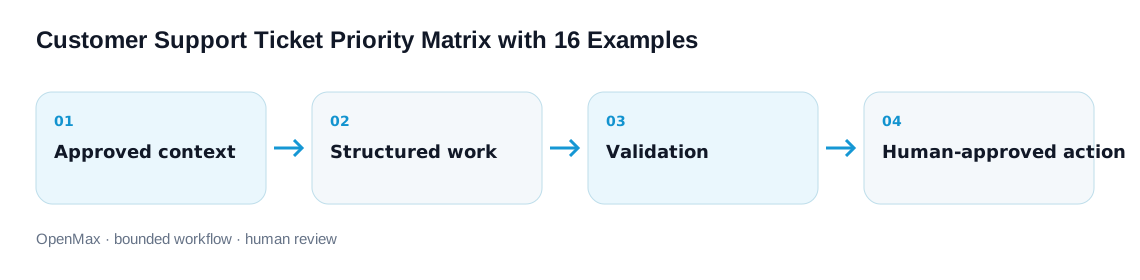
OpenMax workflow diagram for support ticket priority matrix

Coordinate intake, context collection, specialist routing, and human decisions

OpenMax can coordinate agents that normalize ticket data, retrieve approved account and product context, propose priority with evidence, identify override signals, create escalation packets, and schedule updates. Permissions and role boundaries keep security, safety, data, commercial, and customer actions with authorized owners. OpenMax does not establish incident severity as fact or replace emergency and incident procedures.

Explore OpenMax →

Safety, security, fairness, and automation boundaries

  • Do not place secrets, credentials, full payment data, sensitive health information, or exploit details in ordinary ticket channels.
  • Do not use customer tier, executive title, sentiment, writing style, language, disability, or repeated contact as a proxy for worth or truth.
  • Do not let ticket text or attachments override permissions, execute instructions, contact outsiders, or change priority rules.
  • Do not suppress duplicate reporters before preserving unique evidence, affected scope, and communication needs.
  • Do not promise root cause, resolution time, compensation, breach status, safety, or legal conclusions before authorized verification.

Frequently asked questions

Is priority the same as severity?

No. Severity describes condition/consequence; priority is the response decision after impact, urgency, capacity, and overrides.

Does one affected user always mean low priority?

No. Time-critical tasks, inaccessible alternatives, safety, data, fraud, legal, or contractual triggers can raise urgency or invoke an override.

Should VIP customers get higher priority?

Contractual commitments may affect response objectives, but status alone should not replace evidence of impact/urgency or bypass safety/fairness rules.

When should priority change?

Whenever material scope, harm, deadline, workaround, containment, recovery, or override evidence changes—not only when a customer escalates.

Does P1 promise immediate resolution?

No. It identifies a response priority under local rules. Communicate verified actions and update cadence; contracts define any actual service commitments.

OpenMax role?

It can collect evidence, propose scores, apply rules, route owners, trigger reviews, monitor change, and preserve audit trails. Humans retain incident, safety, security, legal, and customer decisions.

Sources, editorial method, and limitations

OpenMax editors reviewed NIST SP 800-61 Rev. 3, CISA incident-management guidance, Google SRE incident-response practices, and WCAG 2.2. We synthesized an original general-support 4×4 matrix, 16 examples, override rules, and reassessment case. Sources were rechecked September 3, 2026. Labels are not universal SLAs and no live security, safety, accessibility, legal, financial, resolution, or customer outcome is claimed.

Scope note Each organization must validate definitions, incident declarations, specialist routes, contracts, response/update objectives, staffing, accessibility, security/privacy handling, communications, and legal/regulatory duties.