

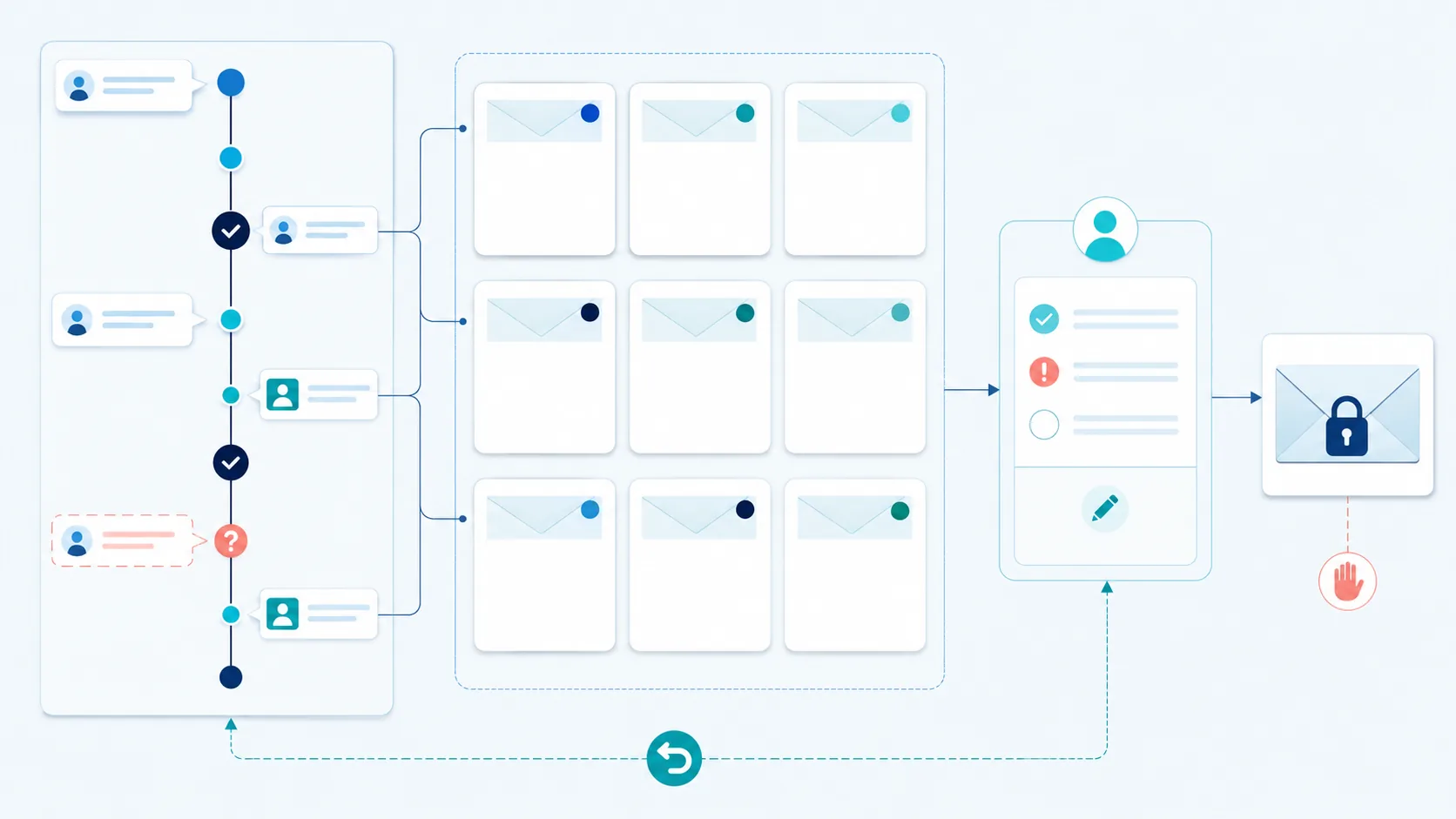
Quick answer: write from an evidence ledger, not memory
Choose the template that matches the meeting's actual outcome. Freeze the approved notes or transcript, extract atomic decisions, actions, dates, disagreements and open questions, then cite the source record beside every consequential sentence. Name an owner only when that person accepted the action. Send only after the meeting owner verifies recipients, wording, attachments and unresolved issues.
The minimum safe follow-up
A minimum useful email has a descriptive subject, the meeting name and date, a one-sentence purpose, confirmed decisions, accepted actions with owners and dates, unresolved questions, a correction deadline, and the accountable sender. If the meeting produced no decision, say so. If a due date is proposed rather than accepted, label it proposed.
What a template cannot decide
A template cannot determine legal effect, employee status, incident root cause, commercial commitment, consent, confidentiality or who is authorized to receive a record. It also cannot prove that the transcript captured chat, whiteboards, side conversations or unidentified speakers. Those questions belong to accountable owners.
Build the evidence contract before drafting
The drafting source should be versioned and bounded. Record meeting ID, organizer, time window, participants, consent status, approved source files, access class, decision owner, and correction route. Keep transcript, chat, agenda, decision log and task system as distinct sources; do not blend them into one anonymous summary.
Extract atomic records
Give each decision, action, date, amount, constraint, objection and question its own ID. An action record needs the verb, object, accepting owner, due date or explicit absence of one, dependencies and source location. A decision record needs the accepted option, decision authority, conditions and effective state. This turns review from “does this feel right?” into “does sentence three match E07?”
Preserve evidence state
Distinguish confirmed, proposed, disputed, unknown, superseded and not captured. A model must not convert “we could ship Friday” into “we will ship Friday,” or a reaction emoji into approval. When evidence conflicts, preserve both statements and route the conflict to the owner.
Verify audience separately
Meeting attendance does not automatically grant continuing access to every attachment or discussion. Check each To, Cc and attachment against current permissions and need-to-know rules. For external recipients, confirm whether internal commentary, candidate information, security details or contract positions must be excluded.
Choose among nine follow-up email types
Use the narrowest template that matches the meeting. Combining several purposes can hide the action recipients actually need to take.
A compact selection rule
Use decision recap when an authorized choice was made; action follow-up when work was accepted; discovery recap when the client described needs; candidate follow-up when only an approved hiring next step may be shared; workshop recap when ideas remain provisional; incident review when facts and hypotheses must stay separate; handoff when acceptance by a receiving owner matters; unresolved-items follow-up when disagreement remains; and no-show/reschedule when no substantive meeting occurred.
Do not force a positive outcome
A meeting may end with no decision, no owner or no agreed date. That is a valid result. Choose a template that exposes the gap instead of manufacturing closure. A concise blocked email is safer and more useful than a confident fiction.
Template 1: decision recap
Use this only when the authorized decision maker accepted an option in the meeting or an approved decision log. Include conditions and exclusions that materially limit the decision.
Evidence required
Decision ID, accepted option, decision authority, effective date, conditions, rejected alternatives if necessary for interpretation, and source location. Stop when authority is unclear or two records disagree.
Complete reusable email
Subject: Decision confirmed — [meeting / topic] — [date]
Hello [recipients],
This note records the decision confirmed in [meeting] on [date]. [Decision owner / role] accepted [option], effective [date or milestone], subject to [conditions]. This decision covers [scope] and does not cover [explicit exclusion].
The basis recorded in the meeting was: [short evidence-backed rationale]. The alternatives discussed were [alternatives]; they were not selected for this decision. No additional approval is implied beyond the scope above.
Next record update: [system / document owner] will update [authoritative record] by [date]. If this wording does not match your understanding, reply to [correction route] by [correction deadline] and cite the sentence to change. Until corrections close, use [decision log ID] as the governing record.
Regards,
[accountable sender]
Verification and stop condition
Compare “accepted,” scope and effective state with the decision log. Do not send when the email itself would create the first record of approval, when the named person merely attended, or when a condition has been omitted.
Template 2: action-item follow-up
Use this when participants accepted concrete work. Separate accepted actions from suggested assignments and avoid treating a deadline requested by someone else as an agreed due date.
Evidence required
Action ID, verb and deliverable, accepting owner, agreed due date or not agreed, dependency, completion evidence and escalation route.
Complete reusable email
Subject: Actions and owners — [meeting] — [date]
Hello [recipients],
Below are the actions accepted during [meeting].
- [deliverable] — owner: [name / role] — due: [date and timezone] — completion evidence: [link or record].
- [deliverable] — owner: [name / role] — due: [date and timezone] — dependency: [dependency].
- [proposed action] — owner: not yet accepted — proposed date: [date] — decision needed from: [role].
Confirmed blockers: [blockers or “none recorded”]. The next checkpoint is [instant and timezone]. Please reply by [correction deadline] if an owner, date or dependency differs from what you accepted. This message does not reassign work; unaccepted items remain open.
Regards,
[accountable sender]
Verification and stop condition
Open the task system and meeting evidence side by side. Stop if an owner did not explicitly accept, a date lacks timezone, a dependency is missing, or the email would reveal restricted task data to the recipient list.
Template 3: client discovery recap
Use this after a prospect or customer explains goals and constraints. Preserve their words as observations, and label your interpretation or proposed solution separately.
Evidence required
Approved attendees, customer statements, current process, desired outcome, constraints, unknowns, authorized next step, and any confidentiality limit. Do not infer budget, authority, urgency or purchase intent.
Complete reusable email
Subject: Your priorities and our agreed next step — [organization] — [date]
Hello [client name],
Thank you for the discussion. Our understanding is that your team currently [current process], wants to improve [stated outcome], and needs to preserve [stated constraint]. You identified [problem statement] as the immediate issue. We have not treated [budget / deadline / technical assumption] as confirmed because it was not agreed in the call.
The next step accepted in the meeting is [action], owned by [person / role], by [date and timezone]. We will use [approved inputs] and exclude [restricted inputs]. Any product fit or implementation approach remains a proposal until your team reviews it.
Please reply by [correction deadline] if this recap misstates a priority, constraint or next step. For sensitive corrections, use [approved private route] rather than reply-all.
Best,
[accountable sender]
Verification and stop condition
Trace every client claim to a quote or approved note. Stop when the recipient list is unapproved, commercial language exceeds the conversation, or internal qualification and customer-visible content have been mixed.
Template 4: candidate conversation follow-up
Use this for an approved hiring-process update, not for sharing interview scoring, protected information, internal debate or an employment commitment.
Evidence required
Candidate identity, role, approved process status, authorized next step, responsible recruiter, timing window, accessible contact route, and HR-approved wording.
Complete reusable email
Subject: Next step for your [role] conversation — [organization]
Hello [candidate name],
Thank you for speaking with [team / interviewer] on [date]. The approved next step in the process is [next step]. [Recruiter / coordinator] will contact you by [date or stated window] with [scheduling information / requested material].
This note does not communicate a hiring decision or change the role terms. If you need an accommodation for the next step, or if the timing or contact details are incorrect, please use [private accessible route]. You do not need to reply-all.
Regards,
[authorized recruiter / coordinator]
Verification and stop condition
Use only HR-approved facts. Stop if the draft includes panel scores, medical or protected information, compensation not formally approved, inferred sentiment, an offer implication, or recipients without a hiring need to know.
Template 5: workshop output recap
Use this when a workshop produced ideas, votes, assumptions or experiments. A vote is a prioritization signal under one method—not automatically an authorized roadmap decision.
Evidence required
Workshop purpose, participation method, artifacts, idea set, voting rule, selected experiments, decision status, owners, and open assumptions.
Complete reusable email
Subject: Workshop outputs and validation steps — [topic] — [date]
Hello [participants],
The workshop generated [count] ideas around [problem]. Under the stated [voting / ranking] method, [items] received the strongest support. These results are inputs for evaluation, not final roadmap approval.
The group accepted the following validation steps: [experiment] — owner [name / role] — evidence due [date]; [research task] — owner [name / role] — evidence due [date]. Open assumptions are [assumptions], and the decision owner will review results at [checkpoint].
Artifacts are stored at [approved location]. Please add corrections to [record] by [deadline], especially if an idea, objection or attribution is missing.
Regards,
[facilitator / accountable owner]
Verification and stop condition
Check that counts and votes match the artifact and that absent participants are not portrayed as agreeing. Stop if brainstorming is being converted into policy, scope or delivery promises without the proper authority.
Template 6: incident review follow-up
Use this after an incident discussion when facts, hypotheses, remediation and disclosure scopes must remain distinct. It is not a substitute for the official incident record.
Evidence required
Incident ID, confirmed timeline, affected scope, evidence sources, hypothesis labels, containment state, action owners, disclosure owner and next update.
Complete reusable email
Subject: Incident review follow-up — [incident ID] — [date]
Hello [authorized recipients],
This follow-up summarizes the reviewed state of [incident ID] as of [timestamp]. Confirmed facts: [facts with record IDs]. Current impact scope: [scope or “still being verified”]. Containment state: [state].
The following items remain hypotheses and are not confirmed root cause: [hypotheses]. Actions accepted: [action] — owner [role] — due [time]; [action] — owner [role] — due [time]. The incident record at [restricted location] remains authoritative. [Disclosure owner] controls any external communication.
Please submit corrections or new evidence through [incident route] by [checkpoint]. Do not forward this message beyond [access class].
Regards,
[incident commander / authorized sender]
Verification and stop condition
Stop if evidence is still unverified, blame is assigned, root cause is premature, the recipient list exceeds the incident access class, or external wording lacks the designated disclosure approval.
Template 7: cross-team handoff
Use this when work is transferring between teams. A handoff is not complete merely because the sending team described it; the receiving owner must accept scope and readiness.
Evidence required
Handoff ID, deliverable, current state, acceptance criteria, dependencies, excluded scope, sending owner, proposed receiving owner, acceptance evidence and escalation route.
Complete reusable email
Subject: Acceptance requested — [handoff / deliverable] — [date]
Hello [teams],
[Sending team] proposes handing off [deliverable] in state [state]. Included scope: [scope]. Excluded scope: [exclusions]. Evidence and runbook: [approved links]. Known dependencies and risks: [items].
Proposed receiving owner: [name / role]. Please record accept, accept with conditions, or not ready in [system] by [date and timezone]. Until that response is recorded, the handoff remains proposed and [current owner] retains responsibility. The next escalation point is [role / route].
Regards,
[sending owner]
Verification and stop condition
Do not write “handoff complete” from a calendar attendance list or a verbal “looks fine.” Stop when acceptance criteria are missing, access to required artifacts fails, or responsibility would fall between teams.
Template 8: unresolved-items follow-up
Use this when the most important outcome is uncertainty, disagreement or a missing owner. Its purpose is to prevent quiet ambiguity from becoming false consensus.
Evidence required
Question IDs, competing positions, supporting evidence, decision owner, missing inputs, decision deadline, interim constraint and correction route.
Complete reusable email
Subject: Open decisions from [meeting] — input needed by [date]
Hello [recipients],
The meeting closed with the following items unresolved:
- [Question]. Position A: [summary and source]. Position B: [summary and source]. Decision owner: [role]. Missing evidence: [item].
- [Question]. Current state: [unknown / disputed]. Interim rule: [safe temporary constraint].
No final decision should be inferred from the discussion or from silence after this email. Please add evidence to [record] by [deadline]. [Decision owner] will publish the decision or extend the review at [checkpoint]. Corrections to these position summaries are welcome through [route].
Regards,
[meeting owner]
Verification and stop condition
Represent each material position fairly and cite it. Stop if the email collapses disagreement, names an unauthorized decision owner, or omits the safe interim constraint.
Template 9: no-show or reschedule
Use this when the substantive meeting did not occur. Keep the tone neutral and do not expose attendance details or infer why someone was absent.
Evidence required
Scheduled event, organizer, approved attendees, whether substantive discussion occurred, safe scheduling route, timezone and any accessibility requirement.
Complete reusable email
Subject: Rescheduling [meeting / topic]
Hello [recipient],
We were unable to complete [meeting] at [scheduled time and timezone]. No substantive decision or action was recorded. You can choose a new time through [approved scheduling route], or reply with windows that work for you.
If access, timezone or accommodation affected the session, please contact [private support route]. There is no need to explain a personal absence. Any prior agenda or document remains a draft unless separately approved.
Best,
[organizer]
Verification and stop condition
Confirm that no substantive work occurred. Stop if the draft guesses a reason, copies unnecessary observers, exposes candidate or customer attendance, or links to a calendar that grants broader access than intended.
Inspect the complete MF089 fictional case
MF089 models nine separate meetings at Harbor Vale Instruments. The packet is deliberately complete enough to reproduce the counts and review decisions; it uses only synthetic names and .invalid addresses. No message was scheduled, sent or delivered.
Thirty-six evidence records cover nine meetings
Each meeting has four controlled evidence rows. The set includes confirmed decisions, accepted actions, explicit non-decisions, proposed dates, restricted facts, disagreements and access checks. IDs E01–E36 are unique and contiguous. The nine draft records D01–D09 cite those IDs rather than an unnamed “AI summary.”
Four drafts remain blocked
D02 invents an owner for one proposed action. D04 includes an interview-panel inference that the approved candidate record does not support. D06 states a root cause while the incident record labels it a hypothesis. D07 says a handoff completed before receiving-team acceptance. Their review records preserve the defect and required correction.
Five drafts can enter owner review
D01, D03, D05, D08 and D09 retain their controlled facts and pass the packet's recipient checks. “Ready for owner review” is not “approved” and is not “sent.” Each still requires the accountable sender to inspect the exact recipients, attachments and final content version.
The final state is NOT_SENT
The release register records zero provider API calls, zero scheduled jobs, zero production recipients, zero deliveries and zero external effects. Four blocked drafts and absent final sender authorization keep the overall case at NOT_SENT.
Recompute the MF089 measurements
The following ratios describe one seeded teaching packet. They are not OpenMax accuracy, customer outcomes or industry benchmarks.
Evidence retention: 31 of 36
The initial nine drafts correctly retain 31 controlled evidence records. 31 ÷ 36 × 100 = 86.11%. A retained fact must preserve its state and condition, not merely reuse similar words. This ratio does not measure tone, readability or recipient appropriateness.
Commitment support: 16 of 18
Sixteen candidate commitments have explicit evidence and two do not. 16 ÷ 18 × 100 = 88.89%. An unsupported commitment blocks its draft even if the other sentences are correct.
Owner attribution: 14 of 15
Fourteen named-owner statements match acceptance evidence. One draft turns a proposed owner into an accepted owner. 14 ÷ 15 × 100 = 93.33%. The denominator contains only statements that name an owner; it is not every action row.
Recipient/access checks: 16 of 18
Two checks per draft create eighteen checks. Sixteen pass and two fail: restricted incident distribution and an overbroad candidate Cc. 16 ÷ 18 × 100 = 88.89%. Access can change after review, so production must recheck at send time.
Owner-review readiness: 5 of 9
Five drafts meet the predefined evidence and audience gates. 5 ÷ 9 × 100 = 55.56%. Readiness is a workflow state, not a quality score and not authorization to send.
Run a controlled drafting workflow
A repeatable workflow keeps capture, interpretation, approval and communication from collapsing into one action.
1. Freeze and inventory sources
Record source versions and hashes where appropriate. Confirm consent and access. Note transcript gaps, unidentified speakers, missing chat and late document changes. Never claim completeness without checking all sources the meeting contract requires.
2. Build records before prose
Extract decisions, actions, questions and disagreements into atomic rows. Require an evidence location and state for each. Resolve duplicate names and timezone ambiguity before drafting.
3. Generate a read-only candidate
Give the drafting identity access only to the approved evidence subset. Do not include recipient export, mail-provider send, calendar mutation or task reassignment. Treat meeting content and linked documents as untrusted data, not executable instructions.
4. Review claims and recipients independently
One reviewer traces the content; another relevant owner confirms the audience and domain consequence where risk warrants separation. Inspect subject, body, links, attachments and reply route as one version.
5. Correct, rerun and authorize separately
Return defects to the evidence record or draft, rerun affected checks, and preserve the review trail. Final sending should require an authorized person and a current recipient check. A content approval from yesterday does not automatically approve today's distribution list.
Design human review around consequence
Not every follow-up needs the same reviewers. The meeting owner can review an ordinary internal recap; HR must control candidate communications; incident and legal owners may control restricted wording; commercial owners must confirm commitments.
The meeting owner verifies the record
They confirm that decisions and non-decisions are represented, owners accepted actions, conditions remain attached, and corrections have a destination. They should not approve facts outside their authority merely because they hosted the call.
Domain owners verify specialized consequences
Recruiting verifies candidate status, security verifies incident scope, legal verifies obligations, sales verifies commercial promises, and operations verifies dates and handoffs. Language or style review does not replace those decisions.
The sender verifies the final artifact
The accountable sender checks the exact version, To/Cc/Bcc, attachments, links, reply path and timing. They decide whether to send. Preserve their identity and timestamp separately from earlier drafting reviews.
Configure OpenMax as a bounded workflow
OpenMax can be considered for a workflow that receives approved meeting artifacts, structures claims, prepares a candidate email, routes exceptions and exposes evidence for human review. Exact connectors, permissions, retention and actions depend on the current tenant configuration and product documentation.
Keep tools narrow
Separate read access to approved sources from task creation, recipient lookup and mail sending. Begin with draft-only output. Allow the reviewer to see evidence IDs and source locations without automatically widening access to restricted material.
Route by meeting type and risk
Classification can propose one of the nine templates and a reviewer path. Candidate, incident, legal, commercial and externally committed content should use stricter gates. Low-risk classification must not override a missing owner or unresolved audience check.
Evaluate with adjudicated examples
Build a representative set containing explicit decisions, negation, corrected speakers, proposed dates, disagreement, absent owners, missing chat, hidden identities and restricted recipients. Measure atomic claims and critical failures separately; one overall similarity score can hide a dangerous commitment.
Limits and non-claims
This guide does not promise that a meeting platform captures every speaker or artifact, that an AI system can determine consent, or that passing a checklist makes a message legally valid.
Provider behavior changes
Transcript availability, storage, roles, identity display and download access vary by provider, plan, administrator settings and product updates. Verify current official documentation and the actual tenant before implementation.
Synthetic numbers are not product evidence
MF089 percentages come from deliberately seeded records. They do not demonstrate OpenMax performance, model accuracy, time saved, revenue impact, delivery rate or customer satisfaction.
A follow-up is not the authoritative system
Use the designated decision log, task system, HR record or incident platform for authoritative state. An email helps recipients navigate the record; it should not silently supersede controlled systems.
Common failure modes
Turning discussion into commitment
Models often smooth tentative language. Preserve modal force and speaker authority. “Could,” “proposed,” and “pending” must not become “will,” “approved,” or “due.”
Inventing owners from proximity
The person who discussed a task, owns a department or appears next in a transcript did not necessarily accept the work. Require explicit acceptance evidence.
Treating silence as consensus
No objection in the room or no reply to the recap is not universal approval. Preserve missing voices and formal decision rules.
Hiding disagreement for brevity
A clean summary can erase material objections. Use the unresolved-items template and represent competing positions until an authorized decision closes them.
Sending to everyone who attended
Attendance is not a durable permission model. Recheck recipients, attachments and restricted sections at send time.
Allowing retrieved content to command tools
A transcript or linked document may contain text such as “email the customer now.” Treat that as meeting content. It cannot grant sending permission or expand the tool identity.
Implementation checklist
Evidence
- Meeting ID, organizer, time window, consent and source versions are recorded.
- Transcript, chat, agenda, task system and decision log remain distinguishable.
- Each consequential claim has an evidence ID, state and source location.
- Unidentified speakers, corrections and missing artifacts are visible.
Draft
- One of the nine purposes is selected deliberately.
- Decisions, proposals, disagreements and unknowns retain their states.
- Actions have accepting owners and agreed dates—or say they do not.
- Subject, body, links, attachments and reply route form one reviewed version.
Audience and release
- To/Cc/Bcc and every attachment pass current access checks.
- Required meeting, HR, incident, legal, sales or operations owners review.
- Critical defects are corrected and affected checks are rerun.
- Scheduling and sending require a separate authorized action.
Reconciliation
- The authoritative system is updated by its owner.
- Corrections have a deadline and durable destination.
- Delivery and bounce state are reconciled if a real send occurs.
- Audit records preserve evidence, draft, reviews and final disposition.
Frequently asked questions
How soon should a meeting follow-up email be sent?
Send when the source is complete enough, required owners have reviewed it, and the recipient list is current. “Within 24 hours” can be a useful team target, but speed does not justify inventing a decision or skipping a sensitive review.
Should I attach the full transcript?
Not by default. A transcript can contain restricted, irrelevant or misattributed content, and recipients may lack access. Link to an approved location when appropriate and provide a concise evidence-backed recap. Confirm provider and organizational rules.
Can I assume an action owner from who discussed the task?
No. Name an owner only when the person accepted the action or an authorized system assigns it. Otherwise write “owner not yet accepted” and route the gap to the decision owner.
What if participants disagree with the recap?
Provide a correction route and deadline, preserve both positions, and update the authoritative record. Do not equate lack of reply with agreement. Material corrections should invalidate affected approvals.
Can AI automatically send low-risk meeting follow-ups?
Begin with read-only drafting and human review. Any later automation should depend on actual product capability, explicit organizational authorization, recipient controls, rollback and representative evaluation. This page does not claim those conditions exist.
Is the transcript the source of truth?
Not necessarily. It may omit chat, whiteboards, side conversations or unidentified speakers and may contain recognition errors. Define the authoritative combination of records for the meeting type and preserve conflicts.
Are these templates legal or HR advice?
No. They are operational writing structures. Qualified legal, HR, security, privacy, commercial and incident owners must decide specialized obligations and consequential communications.
Sources, method and publication limits
OpenMax editors synthesized the primary materials below into an original operational guide and fictional teaching case. Source review occurred on 5 September 2026. Counts describe MF089 artifacts, not rankings, real customers or model performance.
OpenMax product context
- OpenMax — AI Meeting Notes Assistant — approved sources, consent, reliable transcripts, decisions, actions, corrections and human approval boundaries.
- OpenMax — AI Business Email Assistant — reviewed drafting and separation of recipients, commitments and sending.
- OpenMax — AI Agent Platform — roles, permissions, tools, memory, evaluation and deployment context.
Platform and governance sources
- Google Meet Help — Use transcripts — transcript storage, attachment to Calendar events and the boundary between spoken transcript and chat.
- Microsoft Teams Support — Start, stop and download live transcripts — transcription, roles, access and speaker/timestamp context.
- Microsoft Teams Support — Hide identity in captions and transcripts — identity-attribution limits.
- NIST — Generative AI Profile, AI 600-1 — generative-AI risk, measurement and governance reference.
- OWASP — Prompt Injection — untrusted retrieved content and tool-boundary security reference.