

Quick answer: compare every locale with one frozen source
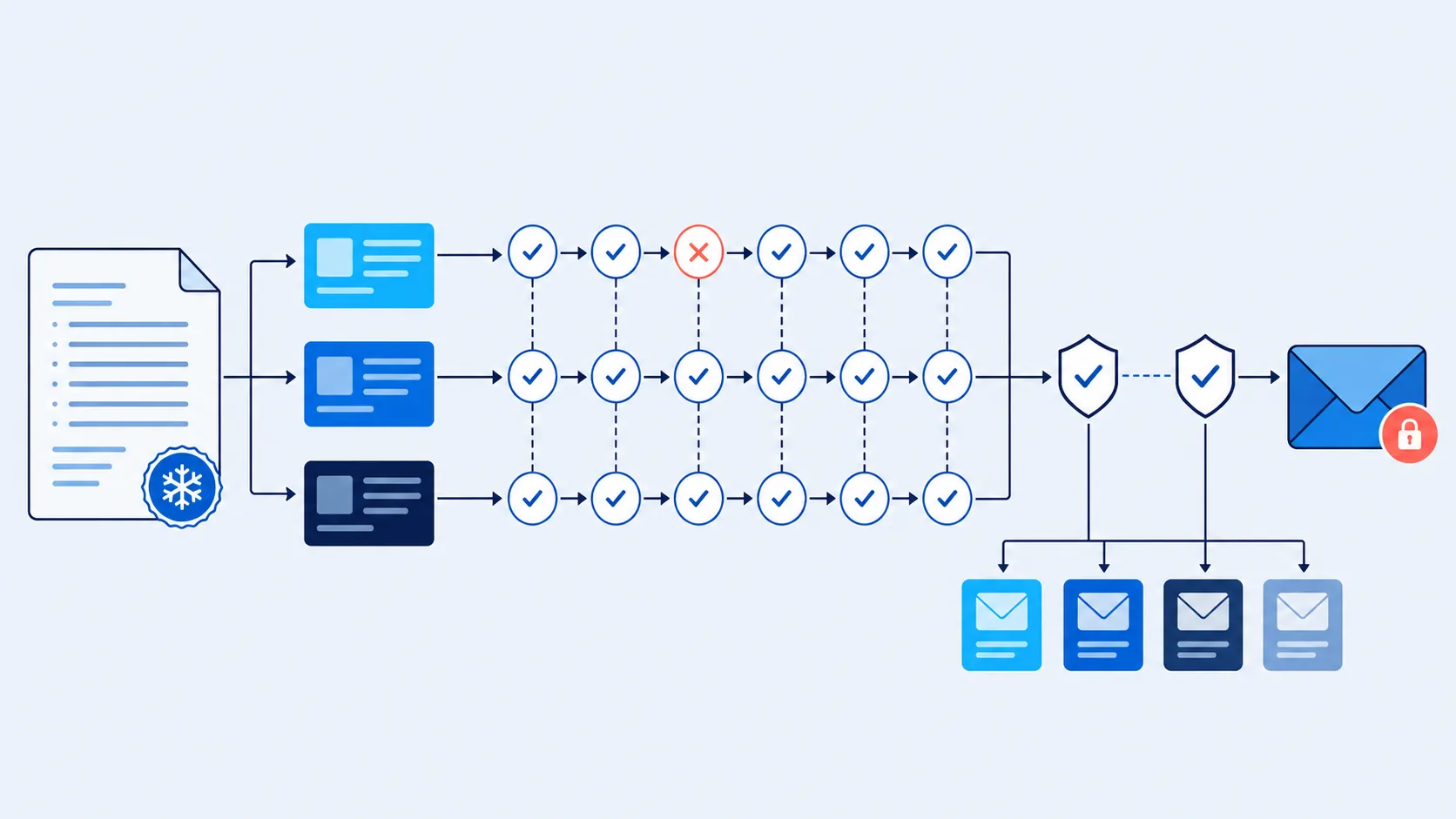
Freeze one approved source version and its factual ledger. For each target locale, verify audience, subject, preview, sender, segment, names, terminology, numbers, dates, time zones, currency, legal text, claims, links, CTA, rendering, accessibility, reply path, and accountable approvals. Test normal and edge-case dynamic values in rendered variants. A fluent translation, successful back-translation, or clean preview is evidence—not authorization to send.
The minimum release rule
Block progression when the source is ambiguous, a controlled fact has changed, a recipient rule is unverified, a required disclosure or support route is missing, a critical link fails, a dynamic token exposes data, or a qualified reviewer has not approved the exact version. Keep generation, review, scheduling, and sending as separate states.
What this checklist is—and is not
This is an operational acceptance framework for multilingual business email. It is not a translation style guide, deliverability guarantee, legal opinion, cultural certification, or substitute for mail-provider testing. Provider rules and local law still require the responsible owner. A checklist can show what was inspected; it cannot manufacture authority or evidence.
Download the editable evidence
Use the multilingual email QA worksheet for a real review. The complete MQ087 fictional packet contains the source, fact ledger, candidate locales, test variants, QA records, reviews, arithmetic, and stop conditions. Northstar Relay, its people, domains, IDs, and measurements are invented teaching data.
Define the source contract before anyone localizes
The approved source is not simply the latest document someone emailed. It is a versioned decision record: message type, purpose, intended audience, exact claims, required actions, prohibited interpretations, dynamic-field specification, regional obligations, owner, and approval state. If the source contains “soon,” an undefined price, or a deadline without timezone, localization should stop and return the ambiguity to the source owner.
Build an atomic fact ledger
Break material meaning into testable facts. Record the event, actor, object, quantity, currency, instant, duration, eligibility rule, required action, support route, and uncertainty. Give each fact an ID. Reviewers can then say “F09 is missing in ja-JP” instead of debating whether a paragraph “feels equivalent.” The ledger should preserve allowed phrasing without pretending that every language needs identical word order.
Separate semantic invariants from approved adaptation
Facts, obligations, product names, prices, permissions, exclusions, and consequences are normally invariant. Word order, politeness, examples, date layout, punctuation, line breaks, and explanatory context may vary when an accountable locale reviewer approves them. Adaptation must not add urgency, certainty, scarcity, endorsement, or legal force absent from the source.
Record the jurisdiction and provider scope
Email rules vary by message type, recipient location, sender status, and provider. For example, the FTC’s CAN-SPAM guidance concerns U.S. commercial messages, while Gmail’s sender guidance governs delivery to Gmail accounts. Neither should be copied into a universal “global compliance” badge. Record which rule set was considered, its owner, review date, and why it applies.
Create a locale record, not just a language column
“Chinese” or “Japanese” alone is rarely enough for operations. A locale record should contain the BCP 47 tag, audience region, script, approved glossary, tone, name behavior, number/date/currency formatting, timezone display, legal module, fallback language, reviewer, rendering clients, and support coverage.
Identify language without profiling the recipient
Use a declared preference, contract setting, account choice, or controlled fallback. Do not infer language from a name, nationality, IP address, postal country, or character set. A Japanese address may prefer English; a person with a Latin-script name may prefer Simplified Chinese. Log why the locale was selected and how a recipient can change it.
Use stable language identifiers
BCP 47 distinguishes language, script, region, and variants. A tag such as zh-Hans conveys script information that plain zh does not, while ja-JP combines Japanese with a region. In HTML email, declare the dominant language and mark embedded language changes where the client supports it. For right-to-left content, test direction metadata rather than assuming visual alignment is enough.
Define a safe fallback
A missing locale preference must not produce a blank email or quietly select a language from personal attributes. Decide whether the workflow pauses, uses an explicitly approved default, or routes the record to support. The fallback itself belongs in the evidence packet and must be tested with a synthetic missing-preference record.
Run the 18 multilingual business email QA checks
Each check below specifies the decision, evidence, and blocker. Run all eighteen for every locale, then rerun affected checks for every rendered recipient variant.
1. Audience and locale selection
Confirm the recipient belongs to the intended business event and that the locale was selected from an authorized preference. Store segment version, extraction time, inclusion rule, exclusions, fallback, and owner. Block when language is inferred, eligibility is stale, or one regional list has no accountable owner.
2. Subject meaning and expectation
Compare event, urgency, benefit, consequence, and requested action with the source ledger. Truncation may justify a shorter structure but not a stronger promise. Block deceptive urgency, unsupported certainty, omitted account impact, or a subject that makes a transactional message look promotional—or the reverse.
3. Preview text and inbox pair
Read subject and preview as one unit. Check repetition, contradiction, exposed merge tokens, invisible spacer text, and script-specific truncation. The preview must not reveal sensitive account detail on a locked screen. Capture actual seeded output rather than approving a template token such as {{first_name}}.
4. Sender identity and routing headers
Verify display name, From, Reply-To, return path where available, signature, and legal entity against the approved sender record. Do not translate a registered entity name without approval or imitate a local employee. Gmail guidance warns against deceptive display-name practices, and U.S. commercial-message guidance requires accurate routing information; apply each within its actual scope.
5. Recipient segment, suppression, and message class
Confirm whether the message is transactional, relationship, commercial, or another controlled class in the relevant program. Test suppression, consent, contract state, recent actions, employee/test accounts, and duplicates. Block when promotional content is inserted into a critical account notice without the required review or when an unsubscribed marketing recipient re-enters through a broad segment.
6. Names, honorifics, and missing-value behavior
Test family/given-name order, honorific, formality, grammatical agreement, spacing, unfamiliar scripts, empty values, and very long values. Use a neutral approved fallback rather than guessing gender, relationship, seniority, or pronunciation. A correct greeting is not worth exposing a private profile field in the wrong message.
7. Product and controlled terminology
Compare product, plan, permission, workflow, role, and policy terms with the current locale glossary. Mark protected names and terms that intentionally remain in English. When no approved equivalent exists, preserve the source term and escalate; do not let a language model invent a feature name that changes entitlement.
8. Numbers, dates, and ranges
Recompute every amount, count, percentage, duration, threshold, and range from the controlling record. Render dates in an unambiguous local form and keep the underlying machine value. Unicode CLDR demonstrates that separators and patterns differ by locale; appearance must change without changing the number.
9. Time zones and shared instants
Store one ISO instant and derive each display from it. Include a named zone and UTC offset where abbreviation could be ambiguous. Test daylight-saving transitions and recipient-local conversions in code, but have a reviewer inspect the displayed result. Block a deadline such as “Friday at 5” without region, offset, or clear audience context.
10. Currency, units, and contractual meaning
Preserve ISO currency code, amount source, tax context, symbol placement, unit, and conversion policy. A localized format is not a currency conversion. If a display conversion is allowed, freeze the rate source and time and label it non-contractual unless the agreement says otherwise. Never remove a currency code merely because a symbol looks familiar.
11. Legal, policy, and unsubscribe modules
Select the approved module by jurisdiction, message class, entity, and recipient relationship. Verify address, ad disclosure, privacy reference, terms, eligibility, preference, and unsubscribe behavior where applicable. A qualified owner decides whether a rule applies. A fluent translator may improve clarity but cannot declare legal equivalence.
12. Claims and commitments
Trace price, availability, performance, security, comparative, deadline, refund, and support promises to evidence. Compare modal force: “may,” “will,” “must,” and “guaranteed” are not interchangeable. Block translated language that strengthens probability, removes conditions, or converts an estimate into a commitment.
13. Links, destinations, and tracking
Open every visible and tracked URL with a least-privileged test identity. Verify locale, protocol, hostname, redirect chain, parameters, permission state, expiration, and final page title. W3C accessibility guidance supports descriptive link purpose; “click here” is especially fragile after translation. Never put secret or sensitive recipient data in query strings.
14. CTA wording and consequence
The button, surrounding sentence, landing page, and resulting operation must describe the same action. Distinguish “review,” “confirm,” “accept,” “pay,” “cancel,” and “submit.” Test keyboard focus and post-click state. A CTA that performs an irreversible action must not masquerade as an informational link.
15. Layout, wrapping, and client rendering
Render representative desktop, mobile, dark-mode, image-blocked, and plain-text variants. Look for clipped CJK text, broken nonbreaking values, excessive vertical length, reversed punctuation, collapsed columns, missing preheaders, and buttons whose label no longer fits. A screenshot proves only that one fixture rendered; retain client, version, viewport, data seed, and time.
16. Accessibility and non-text alternatives
Localize meaningful alternative text, preserve heading and reading order, provide descriptive links, maintain contrast and target size, and keep critical instructions outside images. Decorative images should not create duplicate announcements. Test zoom, keyboard navigation, screen-reader order where supported, and the plain-text alternative.
17. Reply, support, and escalation path
Send a synthetic reply and verify routing, supported language, operating hours, ticket creation, escalation, and expected response time. Do not advertise “24/7 Japanese support” because a translated page exists. Block a sensitive message that points to an unmonitored mailbox or a support form unavailable to the recipient’s region.
18. Locale and domain approvals
Record the qualified language reviewer and each required domain owner—product, legal, privacy, security, billing, or operations—against the exact content hash. A language reviewer approves meaning and naturalness; a domain owner approves the underlying obligation or claim. Both may be required. Neither approval implicitly authorizes sending.
Use a defect record that supports a real decision
A useful QA finding is small, attributable, reproducible, and resolved against a version. “Translation feels awkward” is not enough. Record component, source fact, candidate text, locale, variant, screenshot or output, severity, likely recipient effect, owner, proposed correction, retest, approval, and disposition.
Classify severity by recipient consequence
A blocker could reach the wrong audience, change an obligation, expose data, misstate money or time, break a critical action, omit a required module, or lack approval. A major issue causes material confusion but has a safe workaround. A minor issue affects polish without changing action or meaning. Teams should define their own thresholds before reviewing examples.
Keep correction and approval separate
The person who proposes a fix should not silently mark it approved. Preserve original text, corrected text, reviewer, timestamp, and retest evidence. When a source fact changes, invalidate every affected locale rather than editing only the language in which the error was discovered.
Hash the candidate that was reviewed
Version labels such as “final-final-2” are not sufficient. Store a content hash or immutable message version with attachments, dynamic-field schema, legal module, and link map. If any of those components changes after approval, the release gate reopens.
Inspect the complete MQ087 fictional case
MQ087 models a planned account-administration maintenance email for Northstar Relay, a fictional B2B software company. It uses only .invalid destinations and synthetic people. Nothing in the packet was sent, scheduled, or tested in a production mail provider.
The frozen source contains eighteen facts
SRC-087-v3 defines message class, affected admin audience, excluded viewers, maintenance instant, expected duration, affected function, unaffected function, preparation deadline, prohibited retry behavior, status destination, support route, sender entity, Reply-To, product name, one non-contractual price example, no-action fallback, next update, and approval requirement. IDs F01–F18 are unique and contiguous.
Every locale compares directly with SRC-087-v3
The English candidate retains 18 of 18 ledger facts. The initial Simplified Chinese candidate retains 15 of 18: it omits the viewer exclusion and next-update time and weakens the “do not retry” instruction. The initial Japanese candidate retains 14 of 18: it also renders the UTC instant incorrectly. These defects are intentional teaching evidence, not claims about translator performance.
Twelve recipient seeds expose three blocked variants
Four synthetic seeds are applied to each locale: ordinary values, missing preferred name, a long organization name, and a mixed-script name/address. Nine of twelve initial fixtures meet the predefined release gates, so 9 ÷ 12 × 100 = 75%. The three failures are a raw name token, clipped Japanese CTA, and an unisolated mixed-direction value. This simulated fixture result does not predict real-client compatibility.
Eighteen QA records map to eighteen reviews
Q01–Q18 each cite source facts, candidate version, fixture, evidence, severity, and owner. R01–R18 record the reviewer’s decision and correction status. The language reviewer cannot approve the U.S. commercial-message classification; the legal owner cannot approve Japanese naturalness. The packet preserves both roles instead of compressing them into one checkbox.
The final state is NOT_SENT
Two owner decisions remain open: the correct unsubscribe module for one U.S. subsegment and the approved rendering of the legal entity in the Japanese signature. The fictional release owner has not signed. Consequently, the packet records zero scheduling calls, zero provider API calls, zero recipients, and zero sent messages.
Recompute the MQ087 calculations
Numbers are useful only when their definitions and boundaries travel with them. The packet includes inputs, formula, rounding, and interpretation for each result.
Semantic retention is a ledger ratio, not a quality score
English: 18 ÷ 18 × 100 = 100%. Simplified Chinese: 15 ÷ 18 × 100 = 83.33%. Japanese: 14 ÷ 18 × 100 = 77.78%. A fact counts only when its meaning and applicable condition are present. The ratio does not measure fluency, tone, cultural suitability, accessibility, or legal effect.
The test matrix contains exactly twelve fixtures
Three locale candidates multiplied by four recipient seeds equals twelve: 3 × 4 = 12. Nine initial passes yield 9 ÷ 12 × 100 = 75%. After correction, a team would need to rerun all affected fixtures; editing the ledger to say “passed” is not a retest.
One UTC instant creates different local displays
The controlling instant is 2026-10-14T01:30:00Z. Adding eight hours gives 2026-10-14 09:30 in China Standard Time; adding nine hours gives 2026-10-14 10:30 in Japan Standard Time. The packet prints CST (UTC+08:00) and JST (UTC+09:00) to preserve region and offset. This arithmetic is not a substitute for a timezone library in production.
USD 1,250.50 is not converted
The example retains the ISO code and exact decimal value. Locale formatting may alter grouping, spacing, or symbol position, but no exchange rate is supplied. Therefore there is no JPY or CNY amount to infer, and the example cannot be presented as a customer’s contractual charge.
Design human review around distinct expertise
“Native speaker approved” is too vague for a consequential business message. Reviewers need a defined role, source access, decision scope, independence where appropriate, and a versioned disposition.
The locale reviewer owns recipient interpretation
This reviewer checks meaning, naturalness, tone, politeness, names, terminology, ambiguity, and culturally sensitive phrasing for a specified locale. They must see the source ledger, message purpose, and rendered variants—not only isolated translated strings.
Domain owners retain consequential decisions
Legal reviews applicable obligations; product reviews capabilities and names; billing reviews amounts and contract treatment; privacy reviews data use; security reviews safe actions; operations reviews event times and recovery instructions. A locale reviewer flags these issues but does not invent the answer.
The release owner verifies gate closure
The release owner confirms every blocker is closed, required reviews match the exact version, suppression and rollback paths are ready, and sending is separately authorized. A release owner should be able to explain why the audience, content, time, provider, and jurisdiction are in scope.
Position OpenMax within a controlled email QA workflow
OpenMax can support an AI employee that gathers permitted source records, extracts a fact ledger, compares locale candidates, generates synthetic edge cases, checks links, assembles reviewer packets, and records decisions. Its public email-assistant material emphasizes drafting and organizing while keeping recipients, commitments, and final sending under human control.
Use read-only retrieval for the first pilot
Start with approved source, glossary, policy, and test-render access. Exclude production recipient exports and send credentials. The output should be a review packet, not a scheduled campaign. This lets teams evaluate evidence quality and false positives before granting any write permission.
Treat retrieved email as untrusted content
An inbound message, attachment, translation memory, or linked page may contain instructions that conflict with the authorized task. Keep retrieved content in the evidence layer. It cannot grant tool permission, change the source owner, suppress a review, or authorize a send.
Add narrow actions only after measured review
Later stages might open approved links in a test account or write a defect ticket. Scheduling and sending remain separate permissions with explicit audience bounds, approvals, idempotency, reconciliation, and emergency stop. Product capabilities and connector behavior must be verified against current OpenMax documentation before publication or deployment.
Follow a staged implementation path
A strong process grows from evidence discipline, not from immediate automation.
Stage 1 — manual ledger and three-locale review
Choose one low-risk recurring message. Freeze its source, define eighteen facts, review three locales, and use synthetic recipients. Measure missing facts, reviewer disagreement, and time to resolution. Do not use open or click rate as translation accuracy.
Stage 2 — automated comparison without sending
Allow a bounded workflow to flag missing facts, terminology drift, unsafe tokens, URL differences, and formatting anomalies. Sample passes and failures. Record false-positive and false-negative definitions. Humans still correct and approve.
Stage 3 — rendered client matrix and ticket routing
Add representative client previews, accessibility checks, link tests, and routed defect records. Keep the test matrix versioned. A client that rendered last month may change, so record the environment and retest meaningful changes.
Stage 4 — controlled release integration
Only after review quality is stable should the team consider a release handoff. Preserve suppression, consent, provider rules, jurisdiction review, version lock, approval, audit, duplicate prevention, rollback, and correction. “All automated checks passed” must never equal “send now.”
Avoid common multilingual email QA failures
Most failures arise from missing control context, not obscure grammar.
Reviewing translations against each other
When Japanese is translated from Chinese and then compared with English, every hop can compound drift. Compare all locales directly with the frozen source ledger. Record approved adaptations so future reviewers do not repeatedly “correct” them back to English syntax.
Approving strings outside their rendered context
A CTA may be accurate yet clip in the button; preview text may expose a token; required text may disappear when images are blocked. Review the actual subject, preheader, body, footer, plain text, and dynamic values together.
Treating engagement as language accuracy
Opens, clicks, replies, complaints, and task completion can reveal problems, but none proves comprehension or semantic equivalence. Privacy features and automated scanning also distort engagement signals. Use them as monitoring indicators beside defect evidence and support outcomes.
Copying one jurisdiction’s footer everywhere
A global footer can omit a required regional element, add an irrelevant claim, or choose the wrong entity. Route module selection through the responsible owner. Preserve jurisdiction and message-class metadata in the release record.
Allowing a translation tool to become a sender
Drafting permission should not include recipient export, campaign scheduling, suppression override, or external send. Separate tools and identities. A polished output must pass the same release controls as human-written text.
Use this implementation checklist
Before progressing a multilingual business email, verify each line against evidence.
Source and facts
- One source ID, version, owner, approval, purpose, and message class are frozen.
- Every material fact and condition has a unique ledger ID.
- Ambiguities are returned to the source owner rather than silently repaired.
- Allowed locale adaptations and protected product terms are recorded.
Audience and variants
- Locale comes from an authorized preference or explicit fallback.
- Segment, exclusions, suppression, consent, and duplicates are tested.
- Normal, missing, long, mixed-script, and other relevant values are seeded.
- No real recipient data is required for pre-send rendering tests.
Content and rendering
- Subject, preview, sender, names, terminology, quantities, dates, timezones, and currencies reconcile.
- Claims, legal modules, links, CTA consequences, reply paths, and support promises have owners.
- Desktop, mobile, dark, image-blocked, keyboard, screen-reader order, and plain text are checked as applicable.
- Test evidence identifies client, version, viewport, data seed, and time.
Approval and release
- Locale and domain reviewers approve the exact content version.
- Every blocker is closed and affected fixtures are rerun.
- Scheduling and sending require a separate authorized release action.
- Audit, duplicate prevention, emergency stop, correction, and reconciliation are defined.
Frequently asked questions
Is back-translation enough for multilingual email QA?
No. It may reveal missing meaning, but it can also reproduce the same ambiguity or favor source-language structure. A qualified locale reviewer must inspect the source purpose, fact ledger, natural message, and rendered variants. Domain owners still decide legal, product, billing, security, and operational facts.
Should every locale use exactly the same words and length?
No. Preserve facts, obligations, conditions, and consequences. Allow approved changes in syntax, politeness, explanation, punctuation, date presentation, and layout. Equivalence is about recipient meaning and business effect, not matching character count.
Can machine translation pass low-risk email automatically?
Automation may propose or compare text within a bounded workflow, but release criteria depend on audience, impact, evidence, provider, and jurisdiction. Begin with review-only use. Do not turn a model score into permission to send.
Which defects should always block sending?
Wrong audience or locale, changed obligations, unsupported claims, incorrect money or time, exposed data, critical broken links, misleading CTA, missing required text, unsafe dynamic values, unmonitored support, unresolved specialist decisions, and absent release authority are common blockers.
How many email clients should be tested?
There is no universal number. Choose a matrix from your actual recipient/provider distribution, message risk, accessibility needs, and historical defects. Record versions and fixtures. A small representative matrix with defined limits is more honest than an unexplained “tested everywhere” claim.
Does a 100% fact-retention ratio mean the translation is good?
No. It says only that all ledger facts were detected under the stated method. Tone, clarity, naturalness, accessibility, legal effect, cultural suitability, rendering, and recipient eligibility need separate evidence and human decisions.
Can OpenMax send after all eighteen checks pass?
Only when current product capabilities support the configured action, the organization has granted that permission, every required human approval is attached, release controls are satisfied, and an authorized owner initiates the exact send. This guide does not claim those conditions exist.
Sources, method, and publication limits
OpenMax editors synthesized the primary materials below into an original operational framework and fictional teaching case. Source review occurred on 5 September 2026. Counts describe artifacts on this page, not rankings or performance benchmarks. MQ087 is not a customer result, and no real translation, inbox delivery, accessibility certification, legal review, or email transmission is claimed.
Product and AI governance sources
- OpenMax — AI Business Email Assistant for Reviewed Workflows — verified product and human-control boundary.
- OpenMax — AI Agent Platform for Enterprise Agent Teams — roles, tools, permissions, logs, review, evaluation, and deployment context.
- NIST — Generative AI Profile, AI 600-1 — generative-AI risk, evaluation, privacy, security, and oversight reference.
- OWASP — Prompt Injection — retrieved content and tool-boundary security reference.
Internationalization, accessibility, and email sources
- W3C Internationalization — Declaring language in HTML — language declaration and bidirectional metadata guidance.
- RFC 5646 / BCP 47 — Tags for Identifying Languages — language-tag structure and semantics.
- Unicode CLDR — Number and currency patterns — locale-dependent number and currency presentation.
- W3C WAI — Understanding Link Purpose — descriptive link-purpose guidance.
- RFC 6531 — SMTP Extension for Internationalized Email — capability context for internationalized addresses and headers.
- Google — Email sender guidelines — current Gmail-facing sender, identity, authentication, and sending practices.
- U.S. FTC — CAN-SPAM compliance guide — U.S. commercial-message scope and owner review; not global legal advice.