

Quick answer
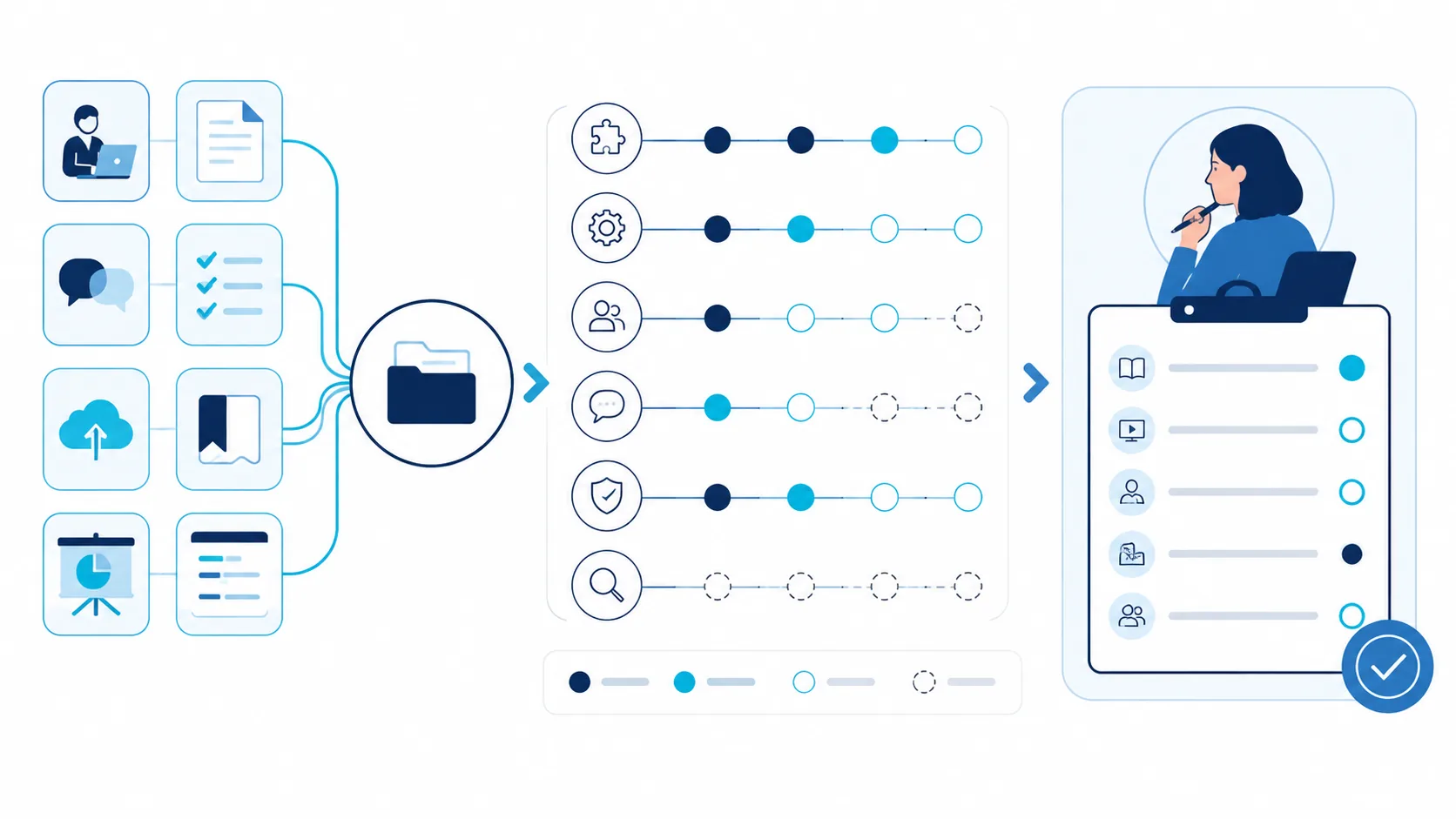
Use one row per role–skill pair. Record the required behavior, demonstrated behavior, evidence, and action separately across nine dimensions. Compare target and current proficiency only on the same behavior-anchored scale; keep not assessed separate from the lowest level. Prioritize a documented work need, then assign practice, support, an owner, and a reassessment date. Do not add the nine dimensions into a single “talent score.”
If the real problem is missing system access, insufficient staffing, or an unclear process, another training course will not close it. Your first decision is whether the observed shortfall is actually a skill gap.
Start with a usable worksheet
Download the editable skills gap worksheet. It is a plain-text Markdown file you can open, copy into your internal document, or adapt to a spreadsheet. It contains no employee data, automatic ranking, or hidden scoring formula.
Create a record for a specific role and task, not a broad label such as “communication.” For example: “Customer support specialist: document an incident handoff so the next owner can identify the customer impact, actions already attempted, unresolved issue, and escalation condition.” That sentence makes it possible to select evidence and design practice.
Before assessment, approve the role, task, planning horizon, purpose, reviewer, data access, and behavior anchors. Ask the employee which relevant work is missing from the evidence and whether access or opportunity limited demonstration. This prevents a manager’s incomplete view from becoming an apparently objective gap.
The U.S. Office of Personnel Management describes job analysis as examining work tasks, required competencies, and their connection. Use that connection to define your local worksheet; the source does not validate the nine-dimension template below. Source: OPM job analysis.
Nine dimensions to assess without creating a talent score
The dimensions answer different questions and therefore use different scales. Proficiency is an ordered behavior level; evidence quality is a confidence judgment; consequence is a planning category. Adding them would conceal those differences. Record the label and explanation together, and leave a value unknown when the evidence cannot support it.
1. Link to an actual work task
Name the task, expected output, recipient, and skill that enables it. Use three labels: unconfirmed, supporting, or essential to the approved task. A subject-matter owner should explain the linkage and identify the work artifact that would demonstrate it.
For incident handoffs, concise written documentation supports continuity between owners. “Executive presence” is too vague to assess until translated into relevant observable behavior. Do not replace the task analysis with a prestigious qualification or a generic competency list. O*NET distinguishes skills, knowledge, work activities, and work context; these are useful starting categories, not a ready-made judgment about an individual. Source: O*NET Content Model.
2. Approved future demand
Record why this skill will be needed and by when. Classify demand as current, approved upcoming, or exploratory. Attach the service change, operating plan, task requirement, or other approved basis; name the person who owns the assumption.
A confirmed product launch may create a new support task next quarter. An interesting technology trend is not equivalent to an approved staffing requirement. Keep exploratory needs in a separate planning queue so people are not judged against work that has never been assigned. Revisit the record if the launch date or process changes.
3. Target proficiency
State the required observable behavior, acceptable quality, task complexity, available support, and permitted independence. Choose an anchored level from the scale below, then explain why the role requires that level. “Everyone must be expert” is not a defensible development plan.
The same skill can require different levels in different jobs. A new specialist may need to complete standard handoffs with review; a senior incident lead may need to handle ambiguous cases and coach others. OPM’s reference materials describe proficiency illustrations through work behaviors. The four-level scale in this article is an illustrative local design, not OPM’s official scale. Source: OPM assessment reference materials.
4. Current demonstrated proficiency
Assign the level supported by recent work, a relevant work sample, or another approved assessment. Record what the person did, the support received, and the conditions. A course-completion badge shows participation; it does not by itself establish independent performance on the task.
Keep self-assessment, manager observations, and work artifacts identifiable rather than averaging them blindly. If reviewers disagree, retain both reasons and resolve the evidence question. If no suitable task was available, use not assessed, not level 1. The missing opportunity belongs in the plan.
5. Evidence quality and coverage
Use insufficient, limited, or adequate for this decision, with a written rationale. Check relevance to the task, date, authenticity, range of situations, assistance, contrary examples, and consistency with the current process. A large quantity of unrelated evidence is still weak evidence.
Choose the observation window according to how quickly the task changes; do not impose an arbitrary universal expiry. Keep links to authorized source records rather than copying sensitive material into a broad-access skills matrix. If a tool or policy changed, explain which older artifacts remain comparable and which require reassessment.
6. Size and confidence of the gap
Compare target and demonstrated behaviors on the same scale. A target at level 3 and demonstrated level 2 represents a one-level step to verify, not “33% unskilled.” Ordered levels need not be equal numerical distances. Describe the missing behavior explicitly.
Keep two separate fields: the observed difference and confidence in that difference. If current proficiency is not assessed or the target changed, leave the gap unresolved. Do not substitute zero, infer ability from a résumé keyword, or claim that a model’s confidence is evidence of occupational competence.
7. Consequence of leaving the gap unresolved
Classify the task consequence as routine, material, or critical, using the organization’s approved criteria. Describe the possible impact and the temporary control. A critical task may need supervision or reassignment while capability is assessed; it does not justify rushing someone into unsupported work.
Distinguish task risk from a judgment about the employee. Document whether the consequence concerns service continuity, customer harm, financial exposure, safety, or another relevant outcome. A qualified owner must determine any mandatory competency, licensing, or authorization requirement; this worksheet cannot replace it.
8. Learning feasibility and work barriers
Record the proposed practice, coach, time, environment, access, and accommodations through the appropriate process. Use blocked, feasible with prerequisites, or ready to practice. Identify what must change before the person can demonstrate the target behavior.
If a handoff record is incomplete because the system hides required fields, fix the system before prescribing writing training. If practice is feasible but the team has no protected time, assign a workload decision to the manager. Distinguish learning needs from organizational constraints and do not make the employee responsible for unavailable resources.
9. Action priority and readiness
Choose investigate, enable, develop, maintain, or replan. Record why that route follows from the preceding dimensions. Add one accountable owner, a checkpoint, the proof of success, and a rule for reopening the decision.
Prioritize critical work with credible evidence and an achievable control; investigate uncertain evidence before allocating a long course. Do not let the largest numerical gap automatically win. A smaller, well-supported gap in a frequent task may justify earlier action than a speculative advanced skill. Human owners retain the final resource and personnel decisions.
Use behavior anchors and preserve unknowns
This illustrative scale supports development discussions. Adapt and approve it for the actual task before use. It is not a certified assessment instrument, a psychometric claim, or a universal proficiency standard.
| State or level | Observable meaning | Handoff example |
|---|---|---|
| Not assessed | Suitable evidence or opportunity is absent | No authorized handoff sample is available |
| 1 — Guided | Performs parts of a standard task with detailed guidance | Completes required fields with step-by-step help |
| 2 — Supported | Completes standard work with occasional correction | Produces a standard handoff; reviewer corrects a missing escalation condition |
| 3 — Independent | Reliably completes standard work and routes exceptions | Produces a usable handoff and flags an ambiguous ownership boundary |
| 4 — Adaptive | Handles approved complex situations and helps improve practice | Resolves a complex handoff design issue and explains the approach to peers |
Level 4 is not inherently better for every job. Match the target to assigned work, not status. A person who has only been given routine cases cannot fairly be treated as having failed an advanced case. Keep access restrictions, lack of opportunity, and genuine evidence of difficulty distinct.
Worked example: a missing certificate is not the gap
Hypothetical development example—not a real employee assessment. A manager initially flags a support specialist as “weak in incident management” because no training certificate is on file. The approved task is incident handoff documentation, with target level 3. Three recent, authorized examples demonstrate level 2: the customer impact and prior actions are clear, but the escalation condition required reviewer correction.
The certificate record is not the assessment result. The observed development need is narrower: identify and document when the receiving owner should escalate. Evidence coverage is limited to standard incidents, so complex-incident proficiency remains not assessed.
| Dimension | Example record |
|---|---|
| Task linkage | Essential to the approved incident handoff task |
| Future demand | Current; regular shift handoffs |
| Target proficiency | Level 3 for standard cases |
| Demonstrated proficiency | Level 2 in the three reviewed examples |
| Evidence quality | Limited; recent standard cases only |
| Gap and confidence | One anchored level; adequate evidence for targeted practice, not a broad capability judgment |
| Consequence | Material; supervisor review remains in place |
| Feasibility | Ready after access to the approved escalation guide is confirmed |
| Action | Develop; practice two scenarios, then independently review a new authorized sample |
For an illustrative two-week plan, the coach confirms the escalation rule and access on day 1, reviews two practice scenarios during week 1, and assesses a fresh standard case during week 2. Those quantities are planning examples, not proven training effectiveness. If no suitable case occurs, extend the observation window instead of recording failure. Close the gap only when the target behavior is demonstrated and reviewed—not when attendance is recorded.
Turn the worksheet into a repeatable review
- Agree the scope. Choose one role, a small set of important tasks, the planning horizon, and development-only use. Confirm what data can be accessed.
- Calibrate the anchors. Have two reviewers discuss the same de-identified example and explain their ratings. Resolve vague criteria before assessing people.
- Collect representative evidence. Invite relevant employee input, record assistance and missing opportunities, and keep contrary examples.
- Choose the response. Training addresses a demonstrated learning need; access repair addresses a blocked tool; reassessment addresses missing evidence; replanning addresses an obsolete target.
- Check transfer to work. Review a new, comparable task after practice. Track the demonstrated behavior, support required, and any unintended harm—not just courses completed.
- Maintain the record. Reopen it when tasks, systems, standards, or role expectations materially change. Preserve the earlier version and explain the change.
For a small team, a manually maintained, access-controlled document or spreadsheet may be sufficient. An LMS is useful for course assignments and completions, but completion and demonstrated capability should remain separate. Consider workflow automation when repeated evidence requests, reviewer handoffs, and follow-up reminders become difficult to coordinate. Automate coordination before delegating assessment judgment.
Where OpenMax fits—and what must be verified
OpenMax describes its product as a workspace for human–agent collaboration. That positioning makes coordinating a development review a reasonable workflow to discuss with the team; it is not evidence that a validated skills-assessment module or a particular HRIS connector is available. Source: OpenMax’s official product page.
An illustrative implementation would accept an approved task definition, request authorized evidence, draft a source-linked development record, route it to a reviewer, and track the agreed checkpoint. Before using real employee data, verify the actual integrations, permissions, retention, review controls, audit records, and failure handling in your deployment. Do not let the agent decide proficiency, promotion, compensation, or discipline without the separately authorized assessment process.
Start with one de-identified task example and ask the OpenMax team to demonstrate the complete review handoff. A shared worksheet remains the better option when the process is infrequent or product controls have not been verified. Discuss a workflow with OpenMax.
Connect the resulting plan to a 30–60–90-day onboarding plan for new employees. For periodic documentation, use the evidence-preserving performance review guide without turning development notes into unsupported ratings.
Employment and privacy boundaries
This article is an editorial development template, not legal, psychological, statistical, or employment advice. The U.S. EEOC explains that employment tests and selection procedures can raise discrimination issues, including when used for promotion. A development worksheet reused for selection needs a separate review of its actual purpose, job relationship, administration, accessibility, and impact. Source: EEOC employment tests and selection procedures.
Qualified local HR and legal owners should approve any consequential use, including applicable accommodations and review rights. Collect only necessary work evidence; restrict access and retention; do not infer health, disability, personality, or protected characteristics from activity traces. Provide a way to challenge incorrect evidence. Neither citations nor a manager’s approval make this template a validated or universally lawful assessment.
Frequently asked questions (FAQ)
What is the difference between a skills matrix and a gap analysis?
A skills matrix inventories roles or people against skills. A gap analysis adds an approved target, evidence of current capability, the uncertainty in their comparison, and an action. A matrix full of self-ratings is an input, not a completed analysis.
Can I calculate target minus current proficiency?
You can record the difference in anchored levels when both values use the same task-specific scale and adequate evidence exists. Do not treat that ordinal difference as a percentage deficit or combine it with unrelated risk and readiness values. Unknown inputs must remain unknown.
Is training always the right response?
No. The issue may be missing access, unclear responsibility, workload, an unsuitable process, or an unapproved expectation. Identify the missing behavior and its cause before choosing training. An enabling action may be more appropriate.
How often should the analysis be updated?
Set a cadence matched to the role and planning horizon, then reassess after material changes in tasks, technology, or standards. A planned checkpoint should follow enough supported practice to observe the behavior; there is no universal quarterly rule.
Can AI assess the gap from a résumé or course history?
Those records can suggest areas to verify. They do not demonstrate performance on the current task. Use AI to organize approved evidence or draft questions, and retain an accountable reviewer, a correction route, and the task-specific assessment method.
Sources and editorial method
Prepared for OpenMax by the content team; revised September 4, 2026. The article combines the official sources linked at the relevant claims with an original worksheet and explicitly hypothetical handoff example. The sources inform job analysis, terminology, proficiency design, product positioning, and risk boundaries; none endorses this template or supplies outcome data for it.
No named occupational-assessment specialist or local employment-law reviewer has approved this draft. Such review remains necessary before consequential operational use. The useful next step is to complete one role–skill record, test whether a second reviewer can follow the evidence, and revise the criteria before expanding the process.